
Feature-heavy pitching doesn't just fall flat with informed buyers. It signals that the rep hasn't bothered to understand their world. Value selling flips this: instead of leading with what your product does, you lead with what it means for the buyer's business.
This post covers everything B2B sales teams need to practice value selling effectively — the definition, a practical three-step framework, five core techniques, and the measurable benefits backed by research.
Key Takeaways
- Value selling focuses on measurable business outcomes — cost savings, time savings, competitive advantage — not product features
- Winning requires deep buyer research, collaborative ROI development, and proof points tailored to each prospect
- Top techniques: consultative questioning, ROI quantification, stakeholder-specific messaging, and proof-backed pitching
- Organizations using value-based selling achieve 52% average win rates vs. 45% for those that don't, per RAIN Group
- Interactive demos make value tangible before the close — letting buyers experience outcomes firsthand
What Is Value Selling?
Value selling is a B2B sales methodology where reps shift their focus from product features and specs to the tangible business outcomes a solution delivers. That means leading with cost savings, time recovered, and risk reduction — not "our platform has 200 integrations."
The rep's role changes too. Rather than acting like a vendor pitching a product, they position themselves as a consultant who understands the prospect's world: their KPIs, their pressures, and what "success" actually looks like for them.
The Four Value Categories That Drive Purchase Decisions
Every purchase decision ultimately comes down to one of four things a buyer believes your solution will do for them:
- Make them more money — revenue growth, new market access, faster sales cycles
- Give them a competitive edge — capabilities their competitors lack
- Save them money — reduced headcount, lower operational costs, fewer errors
- Stabilize and de-risk operations — compliance, reliability, security, continuity
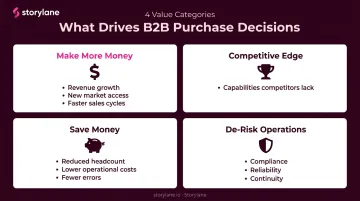
Effective value sellers identify which of these resonates most for each specific prospect — and build every conversation around it.
Value Selling in Practice: A B2B SaaS Example
Here's the difference in action. A sales rep selling reporting software could say: "Our platform automates report generation with 50+ templates." That's a feature pitch.
A value seller says: "Your team is spending roughly 10 hours per week on manual reporting. At your billing rates, that's approximately $4,000 in recovered capacity per month — and your data accuracy problem disappears with it."
Same product, completely different conversation — and the second rep wins more deals.
That shift in framing has measurable impact. Campminder saw this play out directly. By using Storylane interactive demos as pre-call material, their sales team let prospects self-educate before ever speaking to a rep. The outcome: deals that previously took up to six weeks closed in as little as two weeks — a two-thirds reduction in sales cycle time. The demos shifted the first conversation from basic discovery to high-intent discussion about business fit.
Value Selling vs. Consultative Selling
These two are often conflated. Consultative selling focuses on asking good questions and diagnosing needs — it's the discovery phase. Value selling goes further by attaching hard financial or operational proof to every recommendation.
In practice: consultative selling surfaces the problem, while value selling quantifies why solving it is worth the investment.
Why Value Selling Matters in B2B SaaS Today
Gartner's data shows that a majority of B2B buyers now prefer to minimize rep involvement in their buying journey. When they do engage with a rep, they expect the conversation to justify the time. That expectation has raised the floor for what "good" looks like in sales — and feature pitches no longer clear it.
The High-Growth Adoption Gap
Research from ValueSelling Associates and Training Industry found that 87% of high-growth companies use a value-based approach to sales, compared to just 45% of negative-growth companies. The 42-point gap makes a clear case: how you sell is directly tied to whether you grow.
Value selling is no longer a differentiator. It's becoming the baseline expectation among high-performing sales organizations. Teams still leading with feature lists are giving ground to competitors who can show measurable business impact from the first conversation.
Why Deals Stall Without a Value Case
That alignment problem shows up directly in the data. A Forrester survey of more than 18,000 business buyers found 89% had experienced a purchase stall — most often because internal stakeholders couldn't agree on whether the investment was justified.
This is where value selling provides a structural advantage. When a rep builds the ROI case collaboratively with the buyer throughout the sales cycle, the buyer can already articulate the business justification internally. The deal doesn't stall at procurement because the financial argument has already been made — by the buyer themselves.
Value Selling vs. Solution Selling
These two approaches get conflated often — but they operate on fundamentally different logic.
| Dimension | Solution Selling | Value Selling |
|---|---|---|
| Focus | Features that solve pain points | Business outcomes the solution enables |
| Buyer relationship | Vendor-client | Advisor-stakeholder |
| Pitch structure | Product-led | Outcome-led |
| Negotiation dynamic | Feature comparisons, discount pressure | ROI already established, less price sensitivity |
| Deal quality | Transactional, higher churn risk | Strategic, stronger retention |
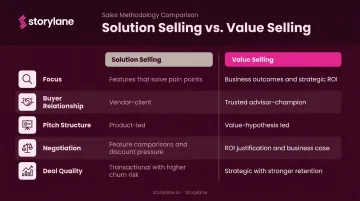
Solution selling works by identifying a pain point and showing which product features address it. The problem, as HBR noted, is that modern buyers now define their own solutions — which turns sales conversations into feature-comparison exercises and pushes suppliers toward price-driven bake-offs.
Value selling avoids that trap. By the time negotiations start, the ROI case has been built collaboratively with the buyer. When they've helped calculate the return, there's little incentive to push for discounts.
How to Build a Value Selling Framework
Value selling is a repeatable process, not a personality trait. This three-step framework gives reps a structure they can apply deal by deal.
Step 1: Research and Understand Buyer Needs
Thorough preparation before any pitch is non-negotiable. Before the first call, reps should review:
- The prospect's LinkedIn profile and recent activity
- Company website, recent press releases, and earnings reports (if public)
- Competitor landscape and known industry pressures
- CRM history for any prior interactions
The goal isn't just industry knowledge. It's understanding the specific role's KPIs, what success looks like for that person, and where the most acute pressure points are.
Discovery calls in value selling are structured differently than standard demos. The priority is helping the prospect quantify their own problem — not pitching. Open-ended questions like "What does this problem cost you in time or revenue each month?" surface the pain in the buyer's own language. Follow-ups help them paint a picture of the cost of inaction before a single feature is mentioned.
Step 2: Map Pain Points to Value Drivers
Once the pain is surfaced, break it down into specific problems and map each one to a value driver:
- Manual data updates → Time saved + accuracy improved
- High error rates in reporting → Cost reduced + risk mitigated
- Slow competitive response time → Competitive edge gained
Then build the ROI case. The key is doing this with the buyer, not presenting it to them. Use data from existing customer outcomes as benchmarks, but let the prospect validate the numbers against their own context. Gartner research found buyers are 1.8x more likely to complete a high-quality deal when they use supplier-provided digital tools in partnership with a sales rep — collaborative value development, not one-sided persuasion.
Forrester backs this from the buyer side: 97% of B2B enterprise buyers build a business case before making a purchase, and 41% specifically want ROI and business-impact data from vendors. The business case isn't optional — it's expected.
Step 3: Deliver a Tailored, Proof-Backed Pitch
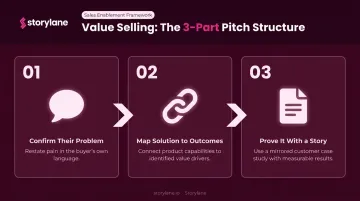
That ROI case becomes the backbone of your pitch. Structure it in three parts:
- Confirm their problem — restate the pain in their language, showing you listened
- Map the solution to outcomes — connect specific product capabilities to the value drivers you identified
- Prove it with a relevant story — use a customer case study that mirrors the prospect's situation
Story selling matters here. Abstract claims about "efficiency gains" don't resonate. A specific story about a similar company solving a similar problem — with a measurable result attached — does.
Interactive demos extend this further. Rather than describing the value, let the prospect feel it. Storylane's buyer hubs let reps consolidate demos, case studies, ROI resources, and collateral into a single personalized link for each account.
Reps can segment content by stakeholder role — a CFO view focused on ROI, an end-user view showing workflow impact — and track which sections each stakeholder engages with most. When a champion needs to sell internally, they have everything they need in one place.
Demo tokens allow reps to personalize demos with the prospect's company name, industry-specific data, and relevant use cases in seconds — no manual rebuilding per account. Respond.io used this approach and saw a 162% increase in trial clicks and a 2x increase in engagement by structuring their demos around specific value propositions.
Key Value Selling Techniques and Best Practices
Technique 1: Be a Consultant, Not a Salesperson
The mindset shift is from "how do I sell this?" to "how do I help this person solve their problem?" Prospects respond to being understood, not pressured. Avoid rushing to the pitch — use early interactions to gather information and build credibility.
Rushing the pitch signals that the rep cares more about quota than outcomes. That destroys trust before value has a chance to land.
Technique 2: Bring Fresh Insights to Every Interaction
Top-performing sales reps are 33% more likely to inspire buyers with new ideas and perspectives than average performers, according to RAIN Group research across 700+ B2B purchases.
In practice, this means arriving at every touchpoint with something new: a relevant data point, a customer story, an insight specific to their industry. Tools like Storylane's account reveal show exactly which features a prospect spent the most time exploring, so reps can lead the next conversation with those specific capabilities rather than recycling a generic pitch.
Technique 3: Quantify Value in the Buyer's Language
Abstract claims don't close deals. Specific numbers do.
Train reps to translate every benefit into financial or operational impact:
- "Saves time" → "Saves your team 8 hours per week, which at your billing rate is approximately $X per month"
- "Reduces errors" → "Eliminates the rework cost you estimated at $Y per quarter"
- "Speeds up reporting" → "Gets your team from first draft to final report in 2 hours instead of 2 days"
Use existing customer metrics as benchmarks. Demo analytics — tracking time spent on specific features, return visits, and completion rates — give reps concrete benchmarks to show prospects where others in similar roles focus their attention.
Technique 4: Tailor Your Message to Each Stakeholder
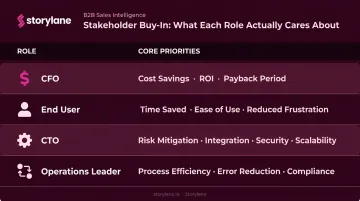
Value means different things to different people in a buying committee. Effective value sellers adapt their message to the role, not just the company — a pitch that resonates with an operations leader will bore a CFO.
| Stakeholder | What They Actually Care About |
|---|---|
| CFO | Cost savings, ROI, payback period |
| End user | Time saved, ease of use, reduced frustration |
| CTO | Risk mitigation, integration, security, scalability |
| Operations leader | Process efficiency, error reduction, compliance |
Storylane's buyer hubs support this by organizing content paths by persona — each stakeholder sees the version of the value story most relevant to their priorities.
Technique 5: Pace the Conversation to the Buyer's Readiness
Don't jump to ROI before the buyer has fully articulated their problem. If a prospect is still in early research mode, pushing a financial case creates misalignment. Provide resources that help them define their needs first : audits, checklists, use case demos.
Once a prospect moves into active evaluation, timing matters. Storylane's intent scoring classifies demo engagement as low, medium, or high based on time spent, completion rate, features explored, and return visits. Reps get Slack alerts when high-intent accounts engage, so outreach hits at moments of genuine buyer interest rather than cold guessing.
Benefits of Value Selling for B2B Sales Teams
Higher Win Rates and Growth Correlation
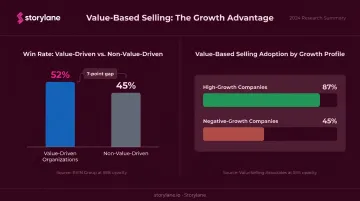
The performance gap is measurable. RAIN Group data shows value-driving sales organizations achieve a 52% average win rate, compared to 45% for non-value-driven organizations. That seven-point gap compounds across a full pipeline.
At the organizational level, 87% of high-growth companies use value-based selling vs. 45% of negative-growth companies. The methodology doesn't guarantee growth, but high-growth teams have adopted it at a far higher rate.
Better Deal Quality and Margin Protection
When the ROI case is built collaboratively before negotiation, buyers have less reason to push for price concessions — they've already done the math on the return. The negotiation shifts from "can we lower the price?" to "when can we get started?"
Storylane's internal data supports this: prospects who engage with interactive demos before sales conversations convert at 3.2x the rate of those who don't (10.1% vs. 3.1%). A buyer who has experienced the product before the close negotiates from understanding, not skepticism.
Stronger Long-Term Customer Relationships
Value selling doesn't end at the signed contract. Reps who follow up post-sale to confirm that promised outcomes were actually delivered create the conditions for renewals, expansions, and referrals.
Dreamdata used Storylane interactive demos for expansion conversations, with 17% of upsell revenue influenced by the platform. Their approach — letting champions share demos with executives who don't have time to explore the product themselves — made the expansion value case easy to communicate internally without requiring another live demo.
When buyers have internalized the value at every stage — not just at close — renewals and expansions become a natural next step rather than another sales conversation.
Frequently Asked Questions
What is the meaning of value selling?
Value selling is a sales methodology where reps focus on demonstrating measurable business outcomes — cost savings, time savings, competitive advantage — rather than product features. The rep acts as a consultant who connects their solution to the specific results the prospect is trying to achieve.
What is an example of value-based selling?
Instead of saying "our platform has automated reporting," a value seller says: "Our platform eliminates 5 hours of manual reporting per week — for your team size, that's roughly $2,000 in recovered productivity per month. The error rate drops to near zero, too. Same product, entirely different conversation.
What is the difference between value selling and solution selling?
Solution selling matches product features to pain points. Value selling connects the solution to measurable business impact. Value selling typically produces less price sensitivity at negotiation because the ROI case is built collaboratively with the buyer before the deal closes.
How do you quantify value for a prospect?
Work with the buyer to calculate ROI using their own numbers — time spent, headcount, current costs — combined with benchmarks from existing customers. The more the buyer helps build the estimate, the more they trust it.
How long does a value selling sales cycle typically take?
Value selling cycles tend to run longer than transactional approaches because each interaction is built around delivering insight and building a shared ROI case. The trade-off is deal quality: higher close rates, less discounting, and lower post-sale churn.