Introduction
Most B2B interactive demos do one thing well: they show the product. What they rarely do is make the buyer feel anything.
That gap between informative and immersive costs SaaS teams pipeline. When a prospect clicks through a generic walkthrough that could belong to any of five competing tools, they don't leave with intent — they leave with a tab to close.
The bar has moved. According to 6sense's 2024 B2B Buyer Experience Report, 81% of buyers had already selected a preferred vendor before speaking to a sales rep. By the time someone lands on your demo, they're not browsing — they're validating. A forgettable experience at that moment doesn't just fail to convert; it actively hands the deal to a competitor.
This guide covers:
- What separates a truly immersive demo from a feature walkthrough
- Five concrete strategies to close that gap
- How to personalize at scale without rebuilding every demo from scratch
- Which metrics actually tell you if it's working
Key Takeaways
- Generic demos fail because they inform without creating "this is built for me" resonance
- Immersion comes from narrative structure, brand fidelity, contextual guidance, and multi-format layering working together
- Five strategies: buyer-centric storytelling, deep brand identity, AI-powered guidance, demo hubs, and embedded social proof
- Personalization at scale uses dynamic variable tokens and persona branching to deliver many tailored experiences from one demo framework
- Measure what matters: step completion rates, time-per-step, and drop-off patterns beat total views every time
Why "Good Enough" Demos Fall Short of Immersive
The Difference Between Informing and Immersing
Informing a buyer and immersing one are not the same thing. A click-through walkthrough delivers facts about your product. An immersive demo makes the buyer think: this is solving my specific problem — and that mental shift is what moves someone from "interesting tool" to "I need to see pricing."
Immersive demos preview the buyer's future workflow — with their data, their team's pain points, and their industry's language. That specificity drives purchase intent in a way feature lists never will.
The self-serve research shift makes this more urgent. Demand Gen Report found that 51% of buyers said content was too generic and irrelevant to their needs in 2024 — up from 38% in 2023. When every SaaS demo looks the same, buyers recognize it within seconds — and disengage just as fast.
Three Common Demo Failure Modes
That generic feeling isn't accidental. It's the predictable result of a few structural mistakes that show up across underperforming demos:
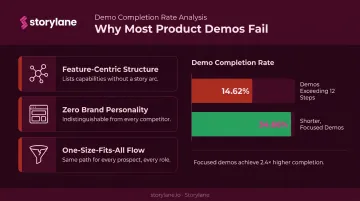
- Feature-centric structure with no narrative — organized around product modules rather than buyer problems, so the prospect spends the whole demo asking "so what?"
- Zero brand personality — generic SaaS typography, neutral copy, and a logo slapped on a default template that looks identical to every other tool in the category
- One-size-fits-all flows — a VP of Sales and an IT Admin forced through the same linear path, neither of whom sees their actual use case reflected
Storylane's own benchmark data reinforces this. Demos exceeding 12 steps drop to a 14.62% completion rate, versus 34.66% for shorter, focused demos. When you build around features rather than a buyer story, you build long — and buyers leave.
The Building Blocks of an Immersive Interactive Demo
"Immersive" in demo context doesn't mean AR or VR. It means the demo environment, narrative, pacing, and visual identity all align to make the prospect feel like they're already a successful user of your product. Four building blocks create that effect.
Narrative Structure
Start with the buyer's pain, not your feature list. A demo structured around a before/after arc (here's the friction you're living with; here's what your world looks like after) creates emotional resonance that a product manual never will.
Gartner's B2B buying jobs framework maps this well: buyers move through problem identification, solution exploration, and validation in a non-linear loop. A demo that mirrors that journey (problem → friction point → resolution) meets buyers where their heads already are.
Brand Fidelity
Visual consistency between your demo and your actual product signals quality. If your demo looks polished and on-brand, the implicit message is that your product is polished and on-brand. If it looks generic, buyers carry that impression into their evaluation.
Forrester identifies consistency as one of the top three trust levers for global business buyers, alongside competence and dependability. In a demo, consistency means covering all four touchpoints:
- Your exact color palette and typography
- Your copy voice and terminology
- Your domain (not a generic subdomain)
- Matched UI patterns between demo and live product
Storylane supports custom brand themes across all paid tiers, with white-label demo URLs on Premium and Enterprise plans for full domain control.
Contextual Guidance and Multi-Format Layering
Brand consistency sets the stage. What happens inside the demo determines whether buyers stay. The goal of in-demo guidance is to feel like a knowledgeable colleague walking someone through, not a scripted tour. Tooltips, hotspots, and modals handle low-complexity steps. AI voiceovers and video avatars belong at high-stakes moments: value demonstration, objection-prone features, or anything that requires genuine explanation rather than just labeling.
Immersive demos don't rely on a single medium. Combining screenshot walkthroughs for quick orientation, short video clips for context-heavy features, and guided flows for interactive sections keeps buyers engaged longer and reduces the cognitive load of any one modality.
Five Strategies to Create Immersive Brand Experiences in Your Demos
Strategy 1: Use Buyer-Centric Storytelling as the Demo Framework
Stop organizing demos by product module. Instead, structure them around a specific problem scenario or "day in the life" — the kind of friction your buyer experiences before your product exists in their workflow.
This shift changes how buyers engage. Instead of evaluating a tool, they're imagining themselves as a successful user of it. That's the mental state that creates purchase intent.
How to map demo flows to buyer personas:
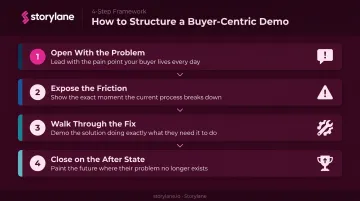
- Open with the problem — use a scenario pulled directly from their world, not a generic pain point
- Expose the friction — show the manual, error-prone state they're still dealing with today
- Walk through the fix — demonstrate the solution step by step, tied to that specific scenario
- Close on the "after" state — leave them with the outcome, not a recap of features
TrustRadius found that 94% of buyers said demos tailored to their specific use case were important during product evaluation. That's not a stretch goal. It's what buyers now expect before they'll take a next step.
Storylane's Product Flows feature supports this by letting teams add multiple flows inside a single demo, each mapped to a distinct persona or use case, without rebuilding the entire asset.
Strategy 2: Build In Brand Identity Beyond a Logo
A logo on a generic demo template isn't brand identity — it's decoration. Real brand fidelity in a demo means:
- Color schemes that match your design system exactly
- Copy tone that sounds like your brand, not generic SaaS-speak ("Track your pipeline in real time" beats "Gain pipeline visibility with one click")
- Custom domain URLs that replace the platform's default with your own domain, reinforcing credibility at every touchpoint
- Branded intros and chapter headers that keep your brand present throughout without interrupting the flow
Each micro-touchpoint — the CTA frame wording, the chapter transition copy, the tooltip language — either reinforces or undermines the perception that your product is high quality and purpose-built.
Storylane's white-label URL feature (available on Premium and Enterprise) directly addresses this. A demo hosted on your own domain reads as a seamless extension of your website; one hosted on a third-party URL creates a subtle but real break in trust.
Strategy 3: Use AI-Powered Features to Add a Human Touch
Silent, click-through demos leave buyers doing all the interpretive work. AI-powered guidance replaces that silence with something that feels closer to a live conversation.
Matching format to moment:
| Demo Moment | Recommended Format |
|---|---|
| Feature orientation, simple UI steps | Text tooltips or hotspots |
| Context-heavy concepts or product logic | AI voiceover narration |
| High-stakes value demonstration | AI video avatar |
| Objection-prone features | Video avatar or recorded presenter |
Storylane's AI Suite includes AI video avatars (pick from dozens of life-like options), AI voiceovers in 25+ languages, auto-generated contextual annotations, and AI content editing. The avatar and voiceover features eliminate the inconsistency of recorded human walkthroughs — no re-recording needed when the product changes, and no awkward pauses.
Add AI avatars or voiceovers starting from step 2, once the buyer is already oriented to the demo environment. This improves engagement without front-loading production effort.
Strategy 4: Create Self-Guided Discovery With Demo Hubs
A single linear demo forces every buyer — regardless of role, industry, or pain point — through the same path. Demo hubs flip that model: they're curated galleries that let different buyer personas navigate to the content most relevant to them.
Think of it as a product experience center rather than a single demo. A VP of Sales and an IT Admin can arrive at the same hub URL and each find a path built for their specific context.
Storylane Demo Hubs support two layouts:
- Gallery layout — an SEO-friendly grid organized by use case or persona, ideal for marketing and multi-persona situations
- Playlist layout — a sequential, curated flow that works well for sales and customer success scenarios with a defined narrative order
Best practices: limit each hub to three sections and under nine demos total. This creates a navigable experience without overwhelming prospects. SentinelOne uses this approach to validate multiple complex security capabilities across bite-sized demos, rather than forcing prospects through a single exhaustive walkthrough.
Navattic's 2024 benchmark data shows demo libraries grew 2.7x year-over-year, with "Additional Tours" CTAs inside demos generating the highest internal click-through rates at 35.18%. Buyers want to keep exploring — hubs give them the structure to do that.
Strategy 5: Trigger Emotion With Social Proof and Real-World Context
Skepticism has natural peaks in any demo — typically right after you show a complex feature or make a strong performance claim. That's where social proof earns its place.
Embedding customer logos, industry-specific use case copy, and relevant metrics directly within the demo flow doesn't just validate your claims. It creates the "companies like mine use this" recognition that accelerates trust.
Where to place social proof strategically:
- After complex features: a proof point from a recognizable brand in their industry ("How [Customer] reduced onboarding time by X weeks") reframes complexity as capability
- At decision-stage moments: metrics tied to outcomes (cost savings, time reduction, error rates) placed just before a CTA create momentum toward the next step
- In persona-specific flows: industry-specific logos and language signal that the demo was built for someone like them, not adapted from a generic template
Storylane supports embedding customer logos, co-branding elements, and dynamic metrics directly within demo flows — and token-based personalization means you can swap in industry-relevant proof points automatically based on the prospect's segment.
Personalization at Scale: Making Every Prospect Feel Like It Was Built for Them
The Gap Between Expectation and Execution
Buyers expect tailored experiences. 82% of global B2B marketing decision-makers agree that buyers expect personalized sales and marketing experiences, according to a Forrester study reprinted by Contentful. But manually rebuilding a demo for every prospect, company, or persona is unsustainable — it becomes a multiplication problem that quickly buries the team.
Dynamic personalization solves this by turning one master demo into many.
Token-Based Personalization
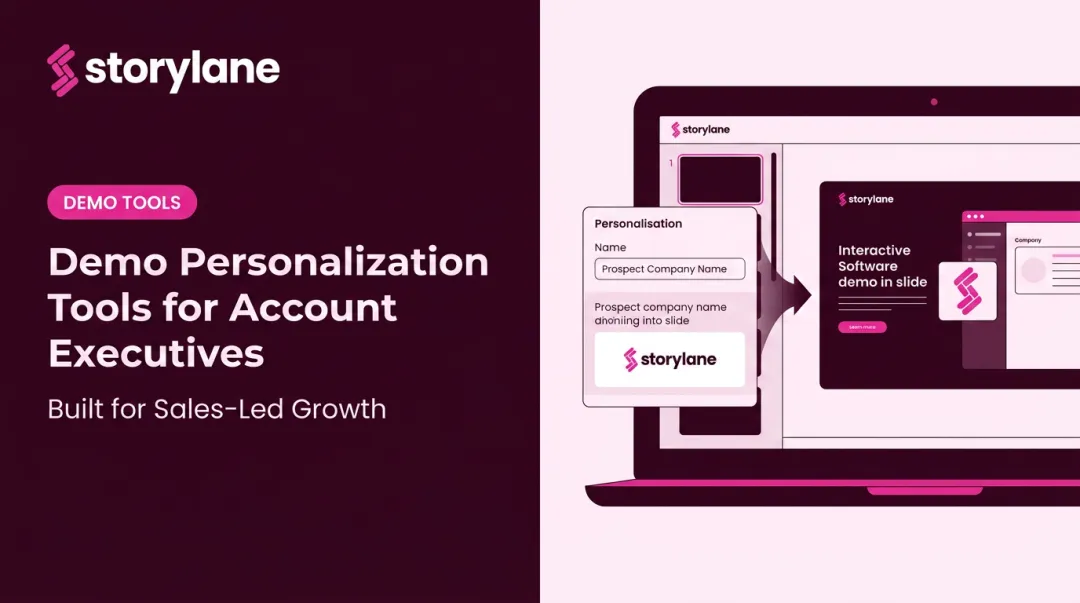
Dynamic variable tokens let you inject prospect-specific information into a single master demo: company name, logo, role, currency, industry-specific language. One demo framework generates dozens of relevant variants without rebuilding anything.
Storylane's personalization tokens support:
- Text tokens — name, company, role, industry-specific language
- Image tokens — logo and screenshot replacement
- Date/time tokens — real-time contextual data
- Currency tokens — localized financial displays
These tokens connect directly to form submissions and CRM data. When a prospect fills out a form, the demo adapts automatically — personalization happens at the moment of engagement without manual intervention.
Persona-Based Demo Branching
Token personalization handles the surface layer — name, logo, language. Conditional branching goes deeper, routing different buyer types through entirely different content paths within the same demo. A cybersecurity buyer and an HR tech buyer can start from the same URL and arrive at completely different use cases and proof points.
Storylane's "choose your own adventure" flow structure supports this through multiple demo chapters — each chapter designed for a distinct role or scenario. Buyers self-select their path, spending more time on content that matters to them.
Multi-flow demos achieve 48% higher completion rates than single-flow demos, according to Navattic's analysis of 40,000+ interactive demos. That's the measurable impact of giving buyers a relevant path rather than a generic one.
Measuring What Matters in Your Immersive Demo Strategy
The Metrics That Actually Signal Immersion
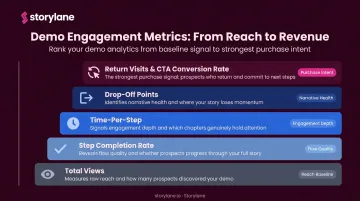
Total views tell you about reach. These metrics tell you about quality:
- Step completion rate — tracks what percentage of buyers finish each flow; low rates on specific steps reveal exactly where the demo loses people
- Time-per-step — abnormally short time suggests a step isn't registering; abnormally long may signal confusion
- Drop-off points — the exact steps where engagement breaks reveal narrative, complexity, or relevance problems
- Return visits — a buyer who comes back is actively championing internally; this is a strong buying signal
- CTA conversion rate — the clearest indicator that the demo created enough intent to act
Storylane's analytics benchmark: across 535,000+ demo sessions, the average engagement rate is 14.7%, with a 15% lead conversion rate from engaged users and an average session length of 1 minute 29 seconds. Use those as a baseline — anything significantly below warrants investigation.
From Vanity Metrics to Sales Intelligence
Knowing a step is underperforming is useful. Knowing who disengaged — and from which company — is what turns demo data into pipeline action. Storylane's Account Reveal feature transforms anonymous demo traffic into actionable prospect data: you get the company name and firmographic details, enabling timely follow-up before the prospect moves on.
Account Reveal is available starting from the Starter plan (250 visitors/month), scaling to 10,000 visitors/month on Premium and custom volumes on Enterprise.
The Continuous Improvement Loop
Treat your demo as a living asset, not a one-time production. Respond.io runs this cycle on a two-week cadence: review completion rates and drop-off points, identify the step where engagement breaks, hypothesize why (too complex? wrong audience? weak CTA?), make a targeted edit, and re-measure.
Respond.io doubled their engagement rate — from 3% to 6% — after one targeted change: adding presenter videos with faces and voices. A single edit, measured and validated. That's the entire point of running this cycle.
Frequently Asked Questions
What are the main types of immersive brand experiences?
For B2B SaaS, the most scalable immersive experience is a well-crafted, branded interactive demo — it meets buyers during self-serve research, requires no event logistics, and generates behavioral data. Broader options include digital formats (AI-personalized content, virtual product tours) and physical activations (experiential events, AR/VR).
How do you make an interactive demo more immersive?
Three levers matter most. First, structure the demo around a buyer story, not a feature list. Second, apply brand identity consistently across visuals and copy so the experience feels purpose-built. Third, add AI-guided narration or video avatars to create human presence instead of a silent click-through.
What is the difference between an interactive demo and an immersive brand experience?
An interactive demo is the format — click-through, self-guided, product walkthrough. An immersive brand experience is the outcome: achieved when the demo's narrative, design, and personalization combine to make the prospect feel genuinely engaged with the brand, not just shown a product. The format is the vehicle; building that outcome takes deliberate strategy.
How do you personalize interactive demos at scale without rebuilding each one?
Dynamic variable tokens — company name, logo, role-specific language, currency — let you generate dozens of tailored variants from one master demo. Layer in persona-based branching flows, and different buyer types follow different content paths without any additional builds.
What metrics should you track to know if your interactive demo is truly immersive?
Focus on behavioral engagement: step completion rates, time spent per section, and drop-off patterns show where the demo holds attention and where it loses it. Return visits and CTA conversions are the strongest signals of genuine immersion — they indicate the buyer came back and acted, which total views never tell you.