According to Gartner, 61% of B2B buyers now prefer a rep-free buying experience — and 73% actively avoid suppliers who send irrelevant outreach. The implication is clear: volume-focused lead generation isn't just inefficient, it actively damages your brand with the prospects you most want to reach.
The real challenge isn't filling a pipeline. It's building one that actually converts.
This guide covers everything you need to close that gap: what separates a high-quality B2B lead from a database contact, which inbound and outbound strategies consistently deliver qualified prospects, how to score and prioritize leads systematically, and which metrics tell you whether your efforts are working.
Key Takeaways
- Quality beats volume: a smaller, well-matched prospect list outperforms a large generic one every time
- Inbound and outbound work best together — most high-performing B2B teams run both in parallel
- Lead scoring on firmographic fit and behavioral signals (demo engagement, page visits) sharpens prioritization
- Interactive demos are an underused inbound lead capture tool with click-through rates far above standard B2B channels
- Tracking Cost per Lead, MQL-to-SQL ratio, and Pipeline Velocity shows which channels actually drive revenue
What Makes a High-Quality B2B Sales Lead
A B2B sales lead isn't just anyone in a database. It's a contact or company that fits your ideal customer profile (ICP) and has shown some level of interest or intent. Chasing low-fit contacts wastes sales capacity and inflates pipeline numbers without moving revenue forward.
MQLs vs. SQLs
Two lead types drive most B2B go-to-market strategies:
- Marketing Qualified Leads (MQLs) have engaged with content or campaigns (downloaded a guide, attended a webinar, visited key pages) but aren't ready for a sales conversation yet — they still need nurturing.
- Sales Qualified Leads (SQLs) have demonstrated direct purchase intent and cleared a qualification threshold — they're in active evaluation, not just browsing.
The B2B SaaS MQL-to-SQL conversion rate benchmarks around 13%, which means most MQLs require ongoing nurturing before they're worth handing to sales. That gap is where lead scoring and behavioral triggers earn their keep — routing the right leads at the right time.
Attributes of a Strong B2B Lead
| Attribute | What to Look For |
|---|---|
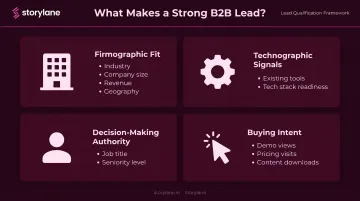
| Firmographic fit | Industry, company size, revenue range, geography aligned with ICP |
| Technographic signals | Existing tools that complement or indicate readiness for your product |
| Decision-making authority | Job title and seniority sufficient to influence or approve a purchase |
| Buying intent | Behavioral signals: demo views, pricing page visits, content downloads |
Proven Inbound Strategies to Generate B2B Sales Leads
78% of B2B content marketers use content marketing for lead generation — and for good reason. Inbound strategies attract prospects who are already looking for solutions, making them inherently higher quality than cold outreach targets.
SEO-Driven Content Marketing
Long-form content targeting high-intent keywords — comparison guides, solution-aware blog posts, detailed how-to articles — pulls qualified traffic from prospects actively researching options. Ranking for pain-point queries ("best CRM for enterprise sales teams") delivers far more pipeline value than broad awareness content.
The goal is to be visible when your ICP is actively searching, not just when they happen to scroll past an ad.
Gated Content and Landing Page Optimization
A well-designed landing page with a compelling offer — a benchmark study, a practical checklist, a research report — converts anonymous visitors into known leads. Keep forms short: three fields consistently outperform six. Every additional field is an exit ramp for prospects who are only mildly interested.
ContactMonkey saw their demo form conversion rate jump from 11% to 15% simply by reducing their form from six fields to three — contributing to $1.3M in directly attributed pipeline.
Interactive Product Demos
Static PDFs and screenshot carousels don't tell prospects much. Interactive demos let buyers experience your product before any sales call, and the engagement data tells you exactly who's serious.
Interactive demos generate click-through rates of 8–32%, compared to 0.7–3.7% for typical B2B marketing channels. That's a 10x+ difference — enough to change how you weight your channel mix.
Storylane lets teams embed interactive demos directly on landing pages and capture leads inside the demo through custom forms that flow into Salesforce, HubSpot, and other CRMs.
Teams like BigTeams use demo engagement metrics — completion rate, time on feature, CTA clicks — as direct inputs to their lead scoring model, converting MQLs into SQLs more systematically.
Storylane also supports three gating configurations:
| Gating Type | Conversion Rate | How It Works |
|---|---|---|
| Fully gated | 42.9% | Form required before demo starts |
| Partially gated | ~5% | Form appears mid-demo |
| Ungated | ~0.3% | Form shown after completion |
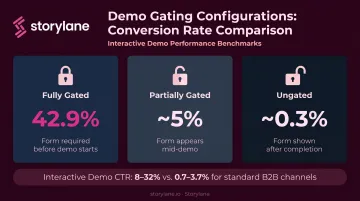
If lead generation is the primary objective, fully gated demos deliver the highest volume by a wide margin.
Webinars and Virtual Events
Webinars capture registrant data, establish credibility, and create a warm follow-up opportunity with people who have already demonstrated topical interest. The average B2B webinar viewing time is 55 minutes — a substantial attention window compared to almost any other channel.
Third-Party Review Platforms
G2, Capterra, and GetApp function as discovery channels for buyers already in active evaluation mode. Prospects consulting these platforms are further along in the buying process than typical inbound visitors. Actively soliciting reviews from satisfied customers — particularly after strong NPS scores — strengthens your presence and keeps you visible when it matters most.
Live Chat and Conversational Marketing
Tools like Intercom or Drift engage visitors in real time, answering questions that would otherwise cause drop-off and capturing contact information for follow-up. For high-intent pages (pricing, comparison pages), live chat improves conversion without requiring a visitor to fill out a form.
Proven Outbound Strategies to Generate B2B Sales Leads
Outbound's reputation problem is execution, not the channel itself. Done right — with the right list, the right message, and the right timing — it's one of the most predictable lead sources in B2B.
Building a Targeted Prospect List
Effective outbound begins with the right list. Using ICP-aligned filters — industry, company size, revenue range, job title, technology stack — in tools like Apollo, ZoomInfo, or LinkedIn Sales Navigator narrows your universe to contacts who actually match your buyer profile.
A 500-contact list of well-matched prospects will consistently outperform a 5,000-contact spray-and-pray approach. The math works out better, and your sender reputation stays intact.
Personalized Cold Email Outreach
Personalization means more than inserting a first name. Referencing a prospect's recent company announcement, a role-specific pain point, or something from their LinkedIn profile transforms a generic pitch into a relevant conversation starter.
Average B2B cold email reply rates run around 5.8% (down from 6.8% the prior year, per Belkins' analysis of 16.5 million emails). That number climbs when outreach is relevant. Keep the CTA singular — asking for one specific next step, not three options.
LinkedIn Social Selling
LinkedIn Sales Navigator lets reps identify second-degree connections, monitor job change signals, and engage with prospect content before reaching out directly. Warm InMails — sent after commenting on a post or connecting over shared content — convert at higher rates than cold contact requests.
RAIN Group research finds that 82% of buyers are willing to accept meetings with sellers who reach out proactively. LinkedIn provides the context to make that outreach feel earned rather than intrusive.
Warm Calling
The most effective phone outreach combines pre-call research — recent company news, shared connections, trigger events — with a concise, value-focused script.
Prospects who have already engaged with content (viewed a demo, downloaded a guide, attended a webinar) convert significantly better than true cold contacts. They already have a reference point for the conversation, which changes the dynamic from interruption to follow-through.
Paid Advertising
LinkedIn Ads allow targeting by job title, company size, and industry — precise enough to reach specific buyer personas rather than broad audiences. Each channel serves a different stage of the funnel:
- LinkedIn Ads — reach specific buyer personas by title, company size, and industry
- Google Search Ads — capture high-intent queries from prospects actively researching solutions
- Retargeting campaigns — re-engage site visitors who haven't converted yet
Paid ads perform best when driving to a specific, optimized landing page. Precise targeting only matters if the destination is built to convert.
How to Qualify and Prioritize B2B Sales Leads
Generating leads is one problem. Knowing which ones deserve immediate attention is another.
The BANT Framework
BANT remains a practical starting point for qualification:
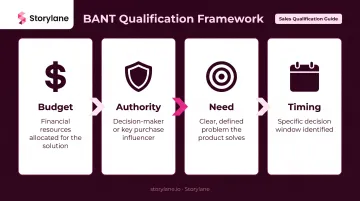
- Budget: Does the prospect have financial resources allocated for this type of solution?
- Authority: Is this person a decision-maker or a key influencer on the purchase?
- Need: Is there a clear, defined problem your product solves?
- Timing: Is there a specific window for making a decision?
These dimensions can surface through discovery calls, form fields on gated content, or conversational qualification. Storylane's RepX feature handles this autonomously — engaging prospects around the clock, qualifying responses, and routing them into the CRM without a human rep in the loop.
Lead Scoring
Lead scoring assigns points based on two data types:
- Explicit data: job title, company size, industry, geography — how well the contact fits your ICP
- Implicit/behavioral data: pages visited, content downloaded, demo viewed, pricing page visited, return visits
A high score signals readiness to engage. A low score indicates the lead needs more nurturing before a sales conversation is appropriate.
Behavioral signals from demos are particularly strong intent indicators. Storylane's Demo Signals feature automatically classifies demo visitors into Low, Medium, or High intent based on engagement depth — time spent, completion rate, feature exploration, return visits — and syncs that classification directly to Salesforce or HubSpot. Teams like BigTeams use these signals alongside email and website data in Pardot to prioritize which MQLs are ready to become SQLs.
The MQL-to-SQL Handoff
Misalignment between sales and marketing on what constitutes a "sales-ready" lead is one of the most common sources of pipeline inefficiency. Both teams need an agreed, explicit definition before any lead gets passed over — not a vague understanding, but a documented threshold.
A practical threshold typically includes criteria like:
- Minimum lead score reached (for example, 50+ points)
- Job title matches a defined ICP role
- At least one high-intent behavior recorded (pricing page, demo view, return visit)
- Company size and industry fall within target parameters
Without a written definition, leads get passed too early, reps waste time, and marketing loses visibility into what actually converts.
Demo Engagement as an Intent Signal
When a prospect spends significant time on a specific demo section, shares a demo link with colleagues, or returns to revisit the experience, those behaviors signal active evaluation — not casual interest.
Storylane's Account Reveal feature de-anonymizes demo visitors by surfacing company and firmographic data on anonymous visitors. Real-time Slack alerts then notify sales reps the moment high-intent engagement occurs. The result: sales conversations that start while the prospect is actively evaluating, not three days after the fact.
Account-Based Marketing (ABM)
ABM inverts the typical funnel. Instead of generating broad lead volume and qualifying after the fact, it starts with a defined list of high-value target accounts and focuses all outbound and content efforts on those specific companies.
Top B2B marketers report 81% higher ROI with ABM compared to broader approaches. ABM makes the most sense for enterprise deals or high-ACV products where the effort of deep account penetration is justified by deal size.
Measuring the Success of Your B2B Lead Generation
Tracking the right metrics tells you whether your lead generation engine is actually working — or just producing noise. Focus on these five:
| Metric | What It Measures | Healthy Direction |
|---|---|---|
| Cost per Lead (CPL) | Spend required to generate one lead | Decreasing over time |
| Lead-to-Opportunity Rate | % of leads that become sales opportunities | B2B SaaS benchmark: ~6.2% |
| MQL-to-SQL Ratio | % of marketing leads that qualify for sales | B2B SaaS benchmark: ~13% |
| Sales Cycle Length | Time from first contact to closed deal | Shortening with better qualification |
| Pipeline Velocity | Speed at which revenue moves through the pipeline | Increasing |
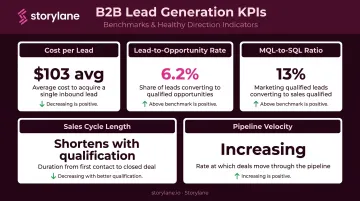
On cost benchmarks: average CPL for B2B SaaS runs around $103, with a broad range of $30–$200 depending on channel, industry, and sales cycle length. Content marketing and organic SEO typically yield lower CPL than paid channels, though they take longer to build. Paid search and LinkedIn Ads generate faster volume but at higher cost per lead.
The more important question isn't whether your CPL is above or below a benchmark — it's whether the leads you're generating at that cost are actually closing. A $200 lead that closes at 20% is far more valuable than a $40 lead that closes at 2%.
Continuous optimization comes down to three habits:
- A/B test email subject lines and CTAs regularly to improve conversion rates
- Review which channels produce the highest-quality leads, not just the highest volume
- Update your ICP as closed-won and closed-lost data accumulates
Frequently Asked Questions
What is a B2B sales lead?
A B2B sales lead is a contact or company that has shown interest in your products or services and fits your ideal customer profile. They represent a potential opportunity to move through the sales pipeline, distinguished from a raw database contact by some combination of fit and demonstrated intent.
What is the average cost per lead for B2B?
B2B CPL varies widely by industry and channel. The average for B2B SaaS sits around $103, with a broad range of $30–$200 across industries. Content marketing and organic SEO typically yield lower CPL than paid channels, though they require more time to generate volume.
What is the difference between inbound and outbound B2B lead generation?
Inbound attracts prospects who come to you through SEO, content, interactive demos, and webinars. Outbound involves proactively reaching out to targeted prospects via cold email, LinkedIn, and paid ads. Most high-performing B2B teams use both, with inbound handling awareness and outbound accelerating pipeline at specific accounts.
What is the difference between an MQL and an SQL?
An MQL has engaged with marketing content and shown interest but isn't yet ready to buy. An SQL has demonstrated direct purchase intent and is vetted as ready for a sales conversation. Distinguishing the two requires clear, agreed-upon qualification criteria between sales and marketing.
How do you qualify a B2B sales lead?
Start with the BANT framework (Budget, Authority, Need, Timing) to assess fit and readiness. Layer in behavioral signals: demo engagement, pricing page visits, content downloads, and return visits. Prospects who score high on both fit and behavior are your highest-priority opportunities.
What tools are commonly used for B2B lead generation?
Most teams build a stack across several categories:
- Prospecting & contact data: Apollo, ZoomInfo, LinkedIn Sales Navigator
- Outreach & email: sequencing platforms for cold and warm campaigns
- SEO & content: tools for organic lead capture and content distribution
- Interactive demos: platforms like Storylane for in-demo lead capture and engagement signals
- CRM & nurturing: Salesforce, HubSpot for tracking and follow-up
- Intent data: providers that surface in-market accounts
Few teams rely on a single tool — the most effective stacks integrate several of these layers.