Introduction
Most B2B reps are either reaching out too early, too late, or to the wrong person entirely. According to 6sense's 2025 Buyer Experience Report, buyers are already 61% through their purchase journey before they ever speak to a seller — and in 2024, 81% had already selected a preferred vendor before that first conversation happened.
That means by the time a prospect responds to your cold outreach, they may have already decided. Reps who consistently outperform their peers spot genuine purchase intent early and move before the window closes — not because they pitch better, but because they show up at the right moment.
This guide breaks down the three types of buying signals, how to rank them by strength, how to identify them at each funnel stage, and how to build a response playbook that turns high-intent behavior into closed deals.
Key Takeaways
- Buying signals fall into three categories: verbal, non-verbal, and digital/behavioral — and each one calls for a different response from your team
- Not all signals carry equal weight — treating low-intent signals as high-intent ones drains pipeline capacity fast
- High-intent signals demand an immediate response; conversion rates drop sharply within minutes of first engagement
- Demo engagement analytics reveal which prospects are actively evaluating — insight most reps don't act on fast enough
- Multi-stakeholder engagement from a single account is one of the strongest signals a rep can receive
What Are Buying Signals and Why Do They Matter?
Buying signals are real-time actions, behaviors, or indicators that suggest a prospect is actively considering a purchase. They range from a prospect asking about pricing mid-demo to a funding announcement on LinkedIn to a competitor complaint on G2. The challenge is that signals vary enormously in what they actually mean — and most reps treat them all the same.
That's costly. McKinsey research found that companies using data-driven B2B sales approaches report EBITDA increases of 15% to 25% above market peers. The difference isn't product quality — it's how intelligently they identify and act on buyer intent.
The Modern Signal Problem
The complexity has compounded fast. According to Gartner, the typical buying group for a complex B2B solution now involves six to ten decision-makers, each independently gathering information. Meanwhile, Gartner projects that 80% of B2B sales interactions will occur through digital channels — meaning no single conversation captures all the signals you need.
Reps must now track intent across:
- Multiple stakeholders at the same account
- Multiple platforms (your website, review sites, social media, email)
- Multiple signal types with very different urgency levels
When signals are scattered across all three dimensions at once, it's easy to misread their strength or respond too late. Either way, the outcome is the same: deals you were positioned to win slip to a competitor who moved faster.
The 3 Types of Buying Signals
Verbal Buying Signals
Verbal signals are direct, spoken cues prospects share during calls, demos, or meetings. They're the clearest form of intent because the prospect is explicitly articulating interest, curiosity, or concern — no interpretation needed.
Key verbal signals to listen for:
- Asking about pricing, tiers, or contract terms
- Volunteering frustration with their current vendor unprompted
- Asking about integrations or customization options
- Requesting a follow-up meeting or next step during the current call
- Bringing up their budget, procurement process, or internal approval chain
The last two are particularly telling. When a prospect starts mapping your solution to their internal buying process, they're not just curious. They're actively planning.
Non-Verbal Buying Signals
Non-verbal signals are physical and behavioral cues observed during in-person or video meetings. Sustained eye contact, leaning forward, and taking notes mid-demo all indicate active engagement. So does asking questions in real time rather than saving them all for the end.
On video calls, these cues are harder to read, but they're still there. A prospect who turns their camera on, stays off mute, and volunteers reactions is engaged. One who's multitasking, keeps the camera off, or gives one-word answers is not.
Negative signals to watch for:
- Checking the clock or phone frequently
- Minimal engagement, no follow-up questions
- Reluctance to schedule next steps when asked directly
- Deflecting when you ask about their decision timeline or budget
A prospect showing these signs isn't necessarily disqualified, but they're signaling friction you need to address before moving forward.
Digital and Behavioral Buying Signals
Digital signals are trackable online behaviors that indicate research and evaluation activity. These are the signals most reps miss entirely — and they often predict purchase intent before the prospect says a single word.
First-party signals (from your owned channels):
- Repeated visits to pricing or demo request pages
- Email opens and click-throughs
- Content downloads (especially product-specific assets)
- Interactive demo engagement — which features they explored, where they dropped off
Third-party signals (activity outside your channels):
- Competitor comparisons on G2 or TrustRadius
- Funding announcements or leadership changes at target accounts
- Job postings suggesting a new initiative (e.g., hiring a VP of Security signals security software evaluation)
- Intent data from third-party providers
Neither signal type tells the full story alone. A prospect who reads your case study and has been researching alternatives on G2 for two weeks is a different opportunity entirely than one who did only one of those things. Platforms like Storylane's Account Reveal combine first-party demo engagement data with enriched firmographic context — giving reps a clear view of who is engaging and how deeply, without waiting for the prospect to raise their hand.
Buying Signals Ranked by Strength
Not all signals warrant the same response. Treating a newsletter sign-up like a demo request wastes SDR time and burns good leads with premature outreach. Here's how to tier them.
High-Strength Signals — Act Immediately
These signals indicate the prospect has shortlisted you and is actively evaluating. Delay is expensive.
| Signal | What It Means |
|---|---|
| Demo or free trial request | Highest-intent action a prospect can take |
| Direct pricing inquiry | They're scoping budget and comparing options |
| RFP submission | Formal evaluation has begun |
| Security, compliance, or contract questions | Legal/procurement are involved — late stage |
| Buying committee expansion | Multiple stakeholders engaging — signals internal consensus is forming |
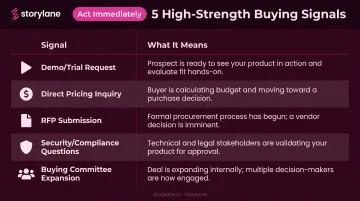
The last item deserves special attention. When a champion suddenly adds their VP, a technical evaluator, and a procurement lead to a Zoom call, internal alignment is forming. That's a signal to map the full buying committee immediately and tailor messaging to each role.
Mapping that committee requires knowing who's actually engaging with your content. Storylane's demo engagement analytics show exactly which features each prospect explored and for how long — and Account Reveal identifies company-level visitors before they ever fill out a form.
Medium-Strength Signals — Nurture and Engage
These prospects are actively researching but haven't committed to an evaluation. The right response is to draw them deeper into your content, not close hard.
- Repeated visits to pricing, integrations, or case study pages
- Attending a product-specific webinar
- Positive response to cold outreach or agreement to a discovery call
- Competitor dissatisfaction comments in conversations or on review sites
- Leadership change or funding announcement at a target account
For medium-intent signals, share a relevant case study tied to what they engaged with, offer a comparison resource if they're evaluating competitors, and move them toward a high-intent action — a demo request or pricing conversation.
Low-Strength Signals — Monitor and Warm Up
These signals indicate brand awareness, not purchase readiness. Immediate SDR outreach here typically backfires.
- Newsletter sign-ups
- Social media follows
- Downloaded broad guides with no follow-on product page visits
- Email opens without clicks
The productive use of low-intent signals is pattern recognition, not pipeline triggering. Put them to work by:
- Tracking progression over time (whitepaper → integrations page → pricing = climbing the intent ladder)
- Building ICP-fit lists from recurring visitors
- Feeding nurture sequences rather than triggering immediate sales outreach
How to Identify Buying Signals at Each Funnel Stage
Buying signals mean different things depending on where a prospect is in their journey. Misreading the stage leads to one of two failures: pushing for a demo with someone who's barely problem-aware, or slow-playing a buyer who's ready to sign. Here's how signals — and the right response — differ across all three stages.
Top-of-Funnel Signals — Awareness and Research
Top-of-funnel prospects are problem-aware but haven't started evaluating vendors yet. They want education, not a pitch.
Signals to watch:
- First website visit from a target account
- Newsletter subscription
- Downloading a broad, non-product-specific resource
- Attending an educational webinar (not product-specific)
- Social media follow
Add these prospects to nurture workflows, share educational content, and track for escalation. Don't push for a demo — you'll lose them.
Mid-Funnel Signals — Consideration and Evaluation
These prospects know solutions like yours exist and are actively comparing options.
Signals to watch:
- Repeated visits to product or pricing pages
- Asking about integrations or customization in a discovery call
- Requesting case studies or ROI data
- Comparing you against competitors on review sites
- Engaging directly in product-focused conversations
What to do next: personalized outreach with relevant proof points. Share a case study from their industry, offer a competitive comparison, and propose a demo tailored to their specific use case.
Bottom-of-Funnel Signals — Decision and Purchase
These prospects are in active evaluation mode. Response speed matters most here.
Signals to watch:
- Demo or trial request
- Pricing inquiry with specific questions about tiers or terms
- Questions about implementation, onboarding, or security/compliance
- Senior stakeholder joining calls or engaging with content
- Fast response times to your sales communications
Respond within minutes — not hours. Loop in an AE immediately. Reference exactly what they engaged with — which demo steps they explored, which pricing tier they viewed — to show you were paying attention.
How to Act on Buying Signals: A Response Playbook
Speed and relevance are the two variables that determine whether a buying signal turns into a conversation or goes cold.
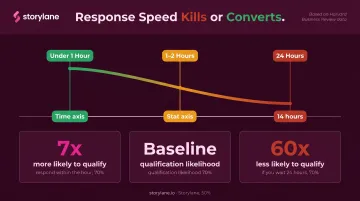
Research published in Harvard Business Review found that companies responding to online queries within one hour were nearly seven times more likely to qualify the lead than those who waited even an hour longer. Wait 24 hours, and you're 60 times less likely to qualify. The window doesn't shrink gradually — it slams shut.
Response Framework by Signal Tier
High-intent signals → Respond within minutes
- Send personalized outreach referencing what they specifically engaged with
- Loop in the AE immediately — don't let this sit in an SDR queue
- Customize the follow-up: which demo features did they explore? Which pricing tier did they view?
- Propose a concrete next step: a call, a custom demo, or a proposal
Medium-intent signals → Respond within 24 hours
- Lead with a relevant proof point tied to their observed interest (case study from their industry, integration they asked about)
- Avoid pushing for a close — push for a higher-intent action instead (demo request, pricing conversation)
- Keep it specific: generic follow-up on medium-intent signals is worse than no follow-up
Low-intent signals → Automated nurture
- Enroll in appropriate email sequences
- Monitor for signal escalation (a pricing page visit after two whitepaper downloads is a tier upgrade)
- No immediate SDR action unless the signal escalates
The Tooling Reality
Executing this framework at scale requires infrastructure. Sales teams need a combination of CRM data, engagement analytics, and real-time alerting to surface intent the moment it happens — not hours later when a rep manually reviews a report.
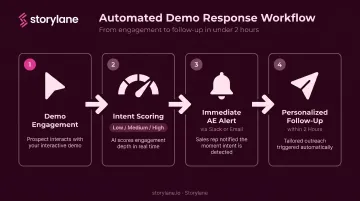
Storylane's platform automates that loop. When a prospect engages with an interactive demo, it scores their intent as Low, Medium, or High based on engagement depth, then triggers a Slack or email alert to the assigned AE with full context on which features the prospect explored.
The Account Reveal feature takes it a step further — de-anonymizing demo visitors with enriched company and firmographic data, so reps know about high-intent accounts before those accounts ever fill out a form.
The recommended workflow: demo engagement → intent scoring → immediate AE alert → personalized follow-up within two hours. No manual monitoring, no guesswork about who's in-market.
Frequently Asked Questions
How do you identify buying signals?
Monitor a combination of verbal cues (prospect questions, unprompted pain-point sharing), non-verbal behavior (engagement during demos, attentiveness), and digital signals (page visits, content engagement, demo interaction data, intent tools). At scale, tracking tools are essential — you can't manually watch every touchpoint across a 6–10 person buying committee.
What does it mean to receive a buying signal?
It means a prospect has taken an action or exhibited behavior indicating interest in purchasing. The signal's strength — high, medium, or low — determines how urgently you should respond and what that response should look like.
What is a buying signal example?
A demo request is a high-strength signal requiring immediate outreach. A prospect asking about integrations mid-call is medium-strength — nurture toward a pricing conversation. Repeatedly visiting the pricing page without requesting a demo is medium-low — monitor and escalate with relevant content.
What are the 5 main buying roles?
Forrester identifies five roles: Champion, Decision-Maker (Economic Buyer), Influencer (Technical Evaluator), User (End User), and Ratifier (Legal/Procurement). Each generates distinct signals — champions drive internal advocacy, technical evaluators probe security and integrations, ratifiers surface contract questions. Track activity across all roles, not just your primary contact.
What is the difference between explicit and implicit buying signals?
Explicit signals are deliberate expressions of intent (demo requests, pricing questions, RFP submissions); implicit signals are behavioral patterns suggesting interest without direct acknowledgment (repeated page visits, content downloads, review site activity). Explicit signals warrant immediate engagement while implicit ones call for nurturing until intent escalates.
How do you respond to a buying signal?
Match your response to the signal's strength. High-intent signals need immediate, personalized outreach — within minutes, referencing exactly what the prospect engaged with. Medium-intent signals call for relevant, insight-led follow-up within 24 hours. Low-intent signals should trigger automated nurture sequences monitored for escalation.