These moments don't have to derail a deal. How a rep responds in the next 30 seconds often determines whether the conversation moves forward or quietly dies.
This guide is for B2B sales reps, sales managers, and enablement leaders who want a structured, repeatable process for handling objections — not improvising under pressure. You'll find the most common objection types, a six-step handling framework, and the mistakes that cause reps to lose winnable deals.
Key Takeaways
- Sales objections signal unresolved questions, not rejection — treat them as opportunities to build trust
- The five core objection types: price/budget, no perceived need, poor timing, lack of trust, and lack of authority
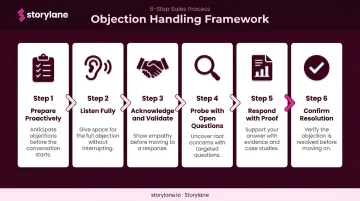
- Effective objection handling follows six steps: prepare, listen, validate, probe, respond with proof, and confirm resolution
- The first objection a prospect raises is rarely the real one — skilled reps always probe for the underlying concern
- Pre-call preparation and interactive product demos reduce objections before they come up
What Is Sales Objection Handling?
Objection handling is the structured process by which a sales rep identifies, addresses, and resolves a prospect's concerns to move a deal forward — without dismissing or debating the buyer's perspective.
The key distinction: an objection is not a rejection. A rejection is a closed door. An objection signals engagement — it means the prospect is still considering you but has unresolved questions. Handling objections is about turning those questions into a pathway to close.
In B2B sales, the stakes are higher. Longer sales cycles, multiple stakeholders, and high deal values mean unresolved hesitations compound quickly. Forrester's 2026 State of Business Buying report found that B2B purchases now involve an average of 13 internal stakeholders and 9 external influencers. One unaddressed concern doesn't just stall one person — it can derail an entire buying committee.
That's the practical difference between knowing objections exist and having a repeatable process for handling them:
- Acknowledged but unresolved: The deal stalls at the next stakeholder touchpoint
- Acknowledged and addressed: Momentum builds across the committee
- Proactively surfaced: The rep controls the narrative before hesitation spreads
The Most Common Types of Sales Objections
Objections vary by deal, but they consistently cluster into five categories. Knowing them in advance means reps prepare responses rather than react.
Budget and Price Objections
"It's too expensive" or "we don't have budget" is the most frequently heard pushback. In most cases, it's a value-perception problem — the prospect hasn't yet been convinced the return justifies the cost.
The right response connects price to the prospect's specific pain points and quantifies the cost of inaction. Defaulting to discounting signals weakness and trains buyers to push harder.
No Perceived Need or Product Fit
"We already have a solution" or "this doesn't apply to us" usually means the rep hasn't surfaced a pain the prospect recognizes as real and urgent. The fix isn't defending the product — it's reframing the problem.
Timing and Urgency
"Now isn't a great time" is often a soft deflection rather than a hard no. Reps need to probe: is there a genuine competing priority, or simply no urgency? If it's the latter, anchor the conversation to the cost of delay.
Lack of Trust or Credibility
Skepticism about whether a product will actually deliver hits newer and less-known brands hardest. Social proof is the primary lever here: case studies, customer references, and live demos that let prospects evaluate value firsthand rather than rely on your word.
Lack of Authority or Stakeholder Alignment
"I need to check with my team" can signal genuine multi-stakeholder dynamics or a polite brush-off. Either way, the play is the same: map the decision process, identify who actually owns the decision, and give your contact what they need to champion the solution internally.
That last part is where most reps lose deals — the champion is willing, but leaves the conversation empty-handed. Storylane's Buyer Hubs solve this by letting reps bundle demos, case studies, pricing context, and role-specific content into a single shareable link. Champions distribute it to decision-makers, and tracking shows exactly when key stakeholders engage.
Effective Steps for Handling Sales Objections
This six-step process applies regardless of objection type. Following a consistent framework prevents reps from reacting emotionally or skipping critical steps under pressure.
Step 1: Prepare Proactively Before Objections Arise
The best objection handling happens before the call starts. Strong pre-call discovery — uncovering pain, decision-making dynamics, and budget constraints — gives reps the context to address concerns before they fully surface.
Practical preparation steps:
- Research the account — current stack, recent initiatives, and likely objections based on company size and industry
- Check engagement signals — Storylane's Account Reveal shows which prospects already viewed a demo and which features they revisited, so reps know where concerns are likely to land
- Send a pre-call demo — an interactive walkthrough before the meeting lets prospects self-qualify, arrive familiar with core functionality, and surface fewer basic fit or trust objections on the call
One sales manager at Campminder described the shift after implementing pre-call demos through Storylane: "Prospects see the product. We skip over the discovery, and jump straight into a high-intent demo."
Step 2: Listen to the Objection Fully Without Interrupting
When an objection lands, the instinct is to jump in with a counterargument. Don't.
Let the prospect finish. Pause before responding. Gong's conversation intelligence analysis found that successful reps pause longer after objections than at any other point during a call — and their overall talk-to-listen ratio is 43% talking to 57% listening.
That pause signals respect and creates space for the prospect to keep talking. What they say next frequently reveals more than the original objection did.
Step 3: Acknowledge and Validate the Concern
Before responding, acknowledge the objection. Something like "I hear this often, and I understand why you'd feel that way" isn't agreement — it's empathy. It lowers defensiveness and signals that you're a problem-solver, not a pusher.
Skipping this step and going straight to your rebuttal makes prospects feel unheard. That's when conversations become adversarial.
Step 4: Ask Open-Ended Questions to Uncover the Root Cause
The stated objection is frequently not the real one. Probing with open-ended questions — starting with "what," "why," or "how" — pushes the prospect to articulate the underlying concern in their own words.
Useful probing questions:
- "When you say budget is a concern, what specifically would need to change for this to be feasible?"
- "What would an ideal timeline look like from your side?"
- "Is there a specific capability gap that's driving the concern about fit?"
Before moving to a response, check for hidden objections: "Aside from timing, is there anything else giving you pause?" Skipping this is how reps invest heavily in overcoming one concern, only to face three more.
Step 5: Respond with a Tailored Solution, Reframe, or Redirect
With the real concern now on the table, the response strategy depends on what you're actually dealing with:
| Mode | When to Use | How It Works |
|---|---|---|
| Address | The concern is factually incorrect or outdated | Directly disprove the claim with evidence |
| Reframe | The prospect is focused on the wrong comparison | Redirect from competitor features toward the outcomes they actually need |
| Redirect | The shortcoming is legitimate | Acknowledge honestly, then demonstrate superior value in areas that matter most to this prospect |
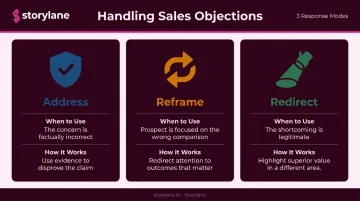
Whichever mode you use, responses need proof behind them — not assertions. UserEvidence's 2025 survey of 619 B2B buyers found 67% name a compelling ROI business case as the most important software-evaluation factor, with 51% trusting statistical evidence most and 49% trusting case studies.
This is where tools matter. Storylane's sandbox demos and Presenter Mode let reps run live, controlled product walkthroughs mid-call — no unexpected glitches, no data exposure, no lost momentum — to demonstrate specific capabilities in direct response to an objection in real time.
Step 6: Confirm Resolution and Check for Additional Objections
After responding, explicitly verify the concern is resolved: "Does that answer your question about X?" Don't assume it has.
Then ask whether anything else is holding them back before attempting to advance the deal. Checking for additional objections is one of the most skipped steps in the process. It's also one of the most common reasons deals stall after an objection appears resolved.
Key Factors That Determine Objection Handling Success
Knowing the steps isn't enough. Three conditions separate reps who consistently close from those who stall:
- Discovery quality: Most late-stage price objections are preventable. Sandler's research shows surfacing investment concerns earlier in the process can eliminate them before closing becomes a battle.
- Product knowledge depth: Reps who map specific capabilities to specific pain points handle objections with evidence. Reps who can't do this default to assurances — and assurances rarely close deals.
- Proof materials on hand: Case studies, ROI data, and customer references should be ready before the call — not hunted down mid-conversation. Dreamdata, for example, attributed 40.9% of their closed-won deals to use case pages featuring Storylane interactive demos — that's the kind of documented outcome that neutralizes trust and value objections on the spot.
A fourth variable cuts across all three: deal stage. The same "it's too expensive" objection on a cold call requires a completely different response than at contract stage. A one-size-fits-all script applied regardless of context creates more resistance, not less.
Modern tools also extend coverage beyond business hours. Storylane's RepX functions as an always-on AI sales rep — engaging prospects, answering objections, running demos, and routing qualified leads to CRM around the clock — eliminating the coverage gaps that let warm prospects go cold overnight.
Common Mistakes in Objection Handling
Treating the First Objection as the Only One
Reps who spend all their energy overcoming the stated concern — without probing for what's underneath — get blindsided later. The "peel the onion" approach in Step 4 exists specifically to prevent this cycle.
Trying to Win the Argument
Reps who debate, dismiss, or over-explain create more resistance, not less. In the Sandler framework, the traditional defensive response becomes a "punch-counter punch" dynamic that steadily erodes trust. The goal is to understand and resolve the concern — not outsmart the buyer.

Pushing Past a Genuine Deal-Breaker
Not all objections are solvable. A fixed budget ceiling, a missing must-have feature, or a timing freeze tied to a board decision aren't objections to overcome — they're signals to qualify out. Reps who push past them waste time and burn goodwill that could have preserved a future opportunity.
Disengaging cleanly — acknowledging the constraint, leaving the door open — is what keeps you in the running when circumstances change.
Conclusion
Effective objection handling comes down to a consistent, trust-first process — one where every step, from pre-call prep to confirming resolution, is designed to build confidence rather than overcome resistance.
The reps who handle objections most effectively treat every concern as a signal worth investigating — not a barrier to push past. Pair that mindset with solid pre-call research, relevant proof materials, and tools like interactive demos that let buyers explore on their own terms — and objections stop feeling like dead ends. They become the clearest signal of where a deal actually stands.
Frequently Asked Questions
What are the 5 steps for objection handling?
Listen to the objection fully without interrupting, acknowledge and validate the concern, ask open-ended questions to uncover the root cause, respond with a tailored solution backed by concrete proof, and confirm the objection is resolved before moving forward.
What are the 5 most common objections to a sale?
Price or budget constraints, no perceived need or product fit, poor timing or lack of urgency, lack of trust or credibility, and lack of authority or stakeholder buy-in.
What is the difference between a sales objection and a sales rejection?
An objection signals unresolved concern and an opening to keep the conversation going. A rejection is a definitive no. Skilled reps learn to tell the difference rather than treating every pushback as a closed door.
How should you respond to the objection "your price is too high"?
This usually means the prospect doesn't yet see sufficient value, not that they genuinely can't afford it. Focus on connecting the price to their specific pain points, quantify the cost of inaction, and present ROI evidence from similar customers — rather than immediately offering a discount.
How can you prevent sales objections before they arise?
Thorough pre-call discovery, sharing relevant case studies early, and giving prospects access to interactive product demos before the sales conversation resolve common concerns about fit, value, and trust before they become formal objections on the call.