Introduction
Most sales organizations have training programs. Many have onboarding curricula, sales playbooks, and a library of enablement content. Yet reps still walk into calls underprepared—fumbling objections, missing product nuances, or pitching features that don't connect to what the buyer actually cares about.
The numbers back this up. According to Ebsta and Pavilion's 2024 B2B Sales Benchmarks, 69% of B2B reps are falling short of quota, based on analysis of 4.2 million opportunities across 530 companies. That's not a talent problem—it's a readiness problem.
A sales readiness checklist fixes this by turning preparation into a repeatable system—one that covers strategic alignment, onboarding, tooling, and ongoing measurement. Each section below gives you a specific area to audit, with the actions that actually move the needle.
Key Takeaways
- Sales readiness is ongoing—not a training event with a completion date
- The checklist spans six areas: alignment, onboarding, coaching, tools, process, and measurement
- Without reinforcement, knowledge decays — microlearning and coaching cadences keep skills sharp
- Demo readiness is a distinct, measurable competency that belongs in every rep's certification path
- Leading indicators — certifications, coaching frequency, demo engagement — surface pipeline risk before it hits revenue
What Is Sales Readiness—and Why Does It Matter?
Sales readiness is the ongoing state of being prepared to handle every buyer interaction effectively. It's not the same as sales training (a point-in-time knowledge transfer) or sales enablement (which focuses on resources and content access). Readiness is about whether a rep can apply knowledge and tools in a live conversation.
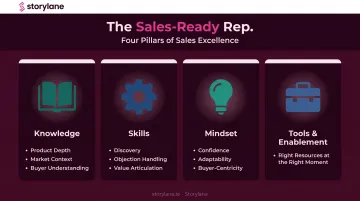
The Four Pillars
A truly sales-ready team operates across four dimensions:
- Knowledge — product depth, market context, buyer understanding
- Skills — discovery, objection handling, value articulation
- Mindset — confidence, adaptability, buyer-centricity
- Tools & Enablement — access to the right resources at the moment of need
Why One-Time Training Fails
The core problem is knowledge decay. According to the Association for Talent Development, learners forget roughly 50% of new information within one hour and up to 80% within 30 days without reinforcement.
Onboarding boot camps produce reps who test well on Friday and struggle on calls the following Tuesday. Readiness requires a continuous reinforcement model with no end date—not a one-time curriculum you check off and move on from.
The Sales Readiness Checklist
Strategic Alignment & Goal-Setting
Before anything else, readiness requires clarity about what reps are preparing for.
Check these three things:
- Write down quotas, target segments, and ICP definitions — goals tied to revenue targets should be shared explicitly, not assumed
- Define success metrics upfront — win rate, time-to-productivity, deal velocity, and quota attainment give readiness investments a measurable yardstick
- Align sales leadership, marketing, and enablement on messaging before reps engage prospects — inconsistency here creates a fragmented buyer experience
Teams that skip this step often find themselves investing in training and coaching that points reps in slightly different directions.
Onboarding & Foundational Knowledge
Structured onboarding produces reps who ramp faster. Research from Korn Ferry's 2024 Sales Maturity Survey found that effective onboarding accelerates ramp-up to full productivity by 10 percentage points. CSO Insights benchmarked full productivity at 9.2 months on average—meaning small improvements to onboarding structure compound into meaningful revenue impact.
Onboarding checklist:
- Structured curriculum with defined milestones and a measurable time-to-productivity target (not an all-at-once boot camp)
- Buyer personas, competitive battlecards, and product messaging surfaced in the tools reps actually use—not buried in a shared drive
- Certification on core product knowledge and discovery skills before the first live prospect call, using scenario-based assessments rather than passive completion tracking
The certification piece is non-negotiable. A rep who has "completed" onboarding but can't handle a basic objection in a role-play is not ready for a live call.
Microlearning Over Annual Refreshers
Annual training refreshers are close to useless as a standalone approach. Short, role-specific modules tied to real selling scenarios—delivered continuously—produce far better retention. A peer-reviewed systematic review found that microlearning significantly improved knowledge retention, practical skills, and overall performance compared to traditional formats.
Replace the quarterly training day with weekly 5-10 minute modules tied to the deals reps are actually working.
Coaching Frequency and Quality
Coaching is where readiness compounds. According to Korn Ferry's research on sales effectiveness, high coaching maturity correlates with 14% higher quota attainment, 15% higher win rates, and 18% lower voluntary turnover.
The key word is maturity—not just frequency. Effective coaching focuses on:
- Active deals, not generic feedback
- Specific skill gaps surfaced by call reviews or assessment data
- Role-play scenarios for objection handling, competitor differentiation, and late-stage negotiation
A weekly 30-minute deal review that surfaces a real skill gap outperforms a monthly hour-long session that stays surface level.
Tools, Content & Demo Readiness
Content Library
Reps should never be searching for a case study or ROI calculator during an active opportunity. A centralized library—organized by buying stage and kept current—prevents this. The test: can a rep find the right asset in under 60 seconds without leaving their CRM?
Demo Readiness
Demo delivery is one of the most visible readiness gaps on any sales team. A rep who knows the product deeply but stumbles through a disorganized demo loses deals.
Storylane's interactive demo platform addresses this directly. Reps can build personalized, self-guided demo experiences and share them with prospects before the live call—so buyers arrive already familiar with the product rather than starting from zero.
Specifically, Storylane supports:
- Personalization tokens — dynamic variables that inject company names, logos, and account-specific data into demos without rebuilding them from scratch. Whispli's team, for example, built master templates that reps duplicate, customize with the prospect's logo, and send in minutes
- Offline demos — downloadable demos that run without WiFi, useful for conferences, field sales, and on-site presentations where connectivity is unreliable
- Multi-chapter demos — branching paths for different buyer personas (technical evaluators vs. business decision-makers), so each stakeholder sees the most relevant flow
- Analytics — step-level engagement data showing where prospects spent time, what they explored, and where they dropped off. Reps can review this before a call and tailor their conversation accordingly
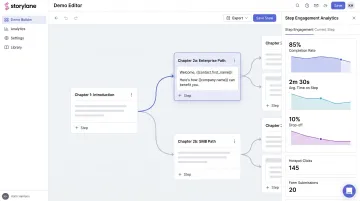
This pre-call intelligence transforms what would be a generic pitch into a targeted conversation.
CRM and Tool Integration
When demo engagement, content usage, and deal progression are visible in one place, managers can coach on actual behaviors rather than rep self-reporting. Storylane integrates natively with Salesforce, HubSpot, and Marketo—pushing demo interaction data directly into CRM records so reps walk into calls with a full behavioral profile of their prospect already logged.
Process Standardization & Sales Methodology
Tools and training only go so far. Without process alignment, individual readiness still produces inconsistent buyer experiences. A rep may know the product cold but run a discovery call that doesn't surface the right information to advance the deal.
Checklist:
- Documented sales methodology (MEDDIC, Challenger, SPIN, or equivalent) with clear stage definitions and entry/exit criteria
- Playbooks covering each stage—discovery call structure, multi-stakeholder demo facilitation, negotiation tactics—accessible to all reps, not siloed in the heads of senior sellers
The data on methodology adoption is compelling: organizations with more than 75% adoption of a formal sales methodology achieve 21% higher quota attainment and 15% higher win rates, according to Korn Ferry.
Certification & Accountability
Role-Based Certifications
Certifications formalize readiness. They create a clear standard against which rep capability can be assessed—and they create accountability for maintaining that standard over time.
Effective certifications:
- Cover key competencies: product knowledge, discovery, objection handling
- Use scenario-based assessments, not multiple-choice quizzes
- Include recertification cadences (quarterly or biannually) to prevent skill drift
Ownership Structure
Certification programs stagnate when no one owns them. Define clearly:
- Who owns content freshness
- Who owns coaching cadence and quality
- Who owns certification standards and pass/fail criteria
Without explicit ownership, readiness becomes everyone's vague responsibility and no one's actual job.
Common Mistakes That Break Sales Readiness Programs
Most sales readiness programs don't fail from lack of effort—they fail from the same three recurring mistakes:
Treating readiness as a one-time event. Without reinforcement, reps forget the majority of training content within days. Build microlearning, coaching, and certification into the normal rhythm of work—not a separate initiative that competes for time.
Measuring activity instead of outcomes. Tracking module completions tells you nothing about whether reps can actually apply the skills. Shift from consumption metrics to assessment-based ones: call quality scores, certification pass rates, demo engagement analytics.
Skipping process alignment. When the underlying sales methodology is inconsistent, readiness efforts fragment. Individual reps may be knowledgeable, but the team collectively produces an unreliable buyer experience. Standardize the process before layering on readiness initiatives.
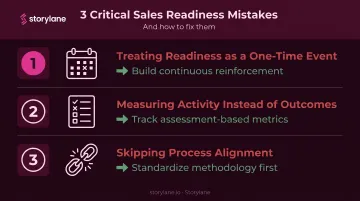
Avoiding these pitfalls is what separates programs that move metrics from ones that just move through modules.
How to Know If Your Team Is Actually Ready
Leading Indicators to Track
Revenue metrics lag by weeks or months. These signals surface readiness gaps earlier:
- Certification completion rates by role and cohort
- Coaching session frequency and quality scores
- Demo engagement data: time spent per feature, drop-off points, feature exploration depth
- Content usage at each deal stage (are reps using the right assets at the right moments?)
Ebsta and Pavilion's data offers a concrete example of how process signals predict outcomes: if a deal's SPICED qualification is completed by the Solution Presented stage, it's 307% more likely to close won. These process signals sit inside your pipeline data right now — most teams just aren't tracking them.
Manager Call Reviews and Deal Debriefs
Formal assessments catch some gaps. Call reviews catch the rest. Regular deal debriefs surface messaging misalignment, skill gaps, and process breakdowns that certifications alone miss—and they generate coaching opportunities in the moment rather than weeks later.
Readiness Dashboards
Call reviews and debriefs generate the raw signal. Dashboards make it actionable at scale. The CSO Insights 2019 Sales Enablement Report found that organizations with sales enablement achieved a 49% win rate—15.3 percentage points higher than those without it. Dashboards connecting rep behavior signals (coaching completion, certification rates, demo engagement) to pipeline health give sales leadership a clear view of where gaps exist and enough time to close them before the quarter slips.
Frequently Asked Questions
What is sales readiness?
Sales readiness is the ongoing process of equipping reps with the knowledge, skills, tools, and mindset to handle buyer conversations effectively at every stage of the sales cycle. It's distinct from one-time training events—readiness requires continuous reinforcement, coaching, and measurement.
What are the 4 pillars of sales readiness?
The four pillars are:
- Knowledge — product and market understanding
- Skills — practical techniques like discovery and objection handling
- Mindset — confidence and adaptability under pressure
- Tools & Enablement — the right content and technology when reps need it
What is the difference between sales readiness and sales enablement?
Sales enablement focuses on the resources and content reps have access to. Sales readiness focuses on whether reps can actually apply that knowledge and those resources effectively in live buyer conversations. Enablement feeds readiness, but the two are not the same.
What should a sales readiness checklist include?
Six core areas to cover:
- Strategic goal alignment
- Structured onboarding with defined milestones
- Ongoing training and coaching
- Tools and demo readiness
- Standardized sales process with documented methodology
- Role-based certification with clear accountability
How do you measure sales readiness?
Measure readiness through leading indicators (certification completion, coaching frequency, demo engagement) and lagging outcomes (win rates, time-to-productivity, quota attainment). Leading indicators are more actionable—they surface gaps before those gaps hit revenue.
How long does it take to build a sales-ready team?
Basic foundational readiness can be achieved within a structured 30–90 day onboarding program. But true continuous readiness has no fixed end date—it requires regular reinforcement, coaching cadences, and recertification built into the ongoing rhythm of work.