Introduction
Solutions Engineers are stretched thin. According to Consensus' 2026 Sales Engineering Compensation & Workload Report, nearly 37% of demos are delivered to unqualified or under-qualified leads, and 73% of teams report only minimal or informal discovery before demos. Many experienced SEs are working 55–60+ hour weeks just to keep up.
Demo volume isn't the root issue. Without structured enablement, presales teams end up reacting to every inbound request instead of focusing on deals that actually warrant technical depth. Buyers get inconsistent experiences, sales cycles drag out, and SEs burn their highest-skill hours on work that shouldn't require them at all.
This article covers the core pillars, practical strategies, and tools that turn presales from a reactive bottleneck into a scalable revenue function.
Key Takeaways
- Nearly 37% of demos are unqualified — structured enablement fixes this by defining clear SE engagement criteria
- Strong presales enablement rests on five pillars: demo infrastructure, content library, knowledge management, training, and team alignment
- SE ramp time runs 1–2 years vs. 4 months for AEs — onboarding investment pays off faster than most teams expect
- Buyer self-serve through interactive demos and demo hubs reduces SE bottlenecks and raises lead quality before live calls
- Track technical win rate, demo-to-close conversion, and SE utilization ratio — these three metrics reveal where enablement is working
What Is Presales Enablement and Why It Matters
Presales enablement is the systematic approach of equipping Solutions Engineers, technical account managers, and presales specialists with the tools, content, training, and workflows to operate effectively at every stage of the sales cycle. Unlike a one-time training event, it's a continuous practice that keeps pace with product changes, competitive shifts, and evolving buyer expectations.
Why This Stage Decides Deals
In complex B2B sales, presales is where buyers make their real evaluation. They're not just assessing fit — they're validating whether a solution works in their technical environment, justifies the budget, and solves the right problems. Consensus reports that 70% of sales deals require presales support, which means the quality of that engagement directly shapes win rates.
Without structured enablement, that critical moment is inconsistent. One SE delivers a polished, persona-specific demo while another shows the wrong features to the wrong stakeholder. The product is identical — but the buyer's experience isn't.
Presales vs. Sales Enablement: Not the Same Thing
These two disciplines are often conflated, but they serve different stages:
| Sales Enablement | Presales Enablement | |
|---|---|---|
| Audience | Account Executives | Solutions Engineers, Technical SAs |
| Focus | Messaging, pipeline, closing | Demos, POCs, RFPs, technical validation |
| Goal | Commercial momentum | Technical confidence and buyer conviction |
Sales enablement helps AEs move deals forward commercially. Presales enablement supports everything that happens once conversations shift to product depth. They're complementary — but building one doesn't substitute for the other.
Key Pillars of a Presales Enablement Program
Strong presales enablement isn't a single initiative. It's built on interconnected pillars, and gaps in any one of them create friction across the entire sales cycle.
Demo Infrastructure
Demo infrastructure is the operational backbone of presales. It includes stable demo environments, sandbox access, and the ability to create tailored, reusable experiences across multiple formats — live walkthroughs, self-guided tours, and async video demos.
Gartner's 2024 Market Guide for Interactive Demonstration Applications validates this category specifically because these tools simplify and accelerate demo creation while decreasing workloads and shortening sales cycles.
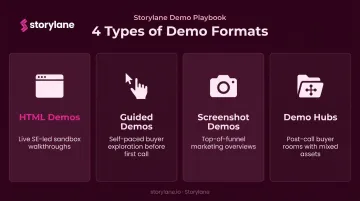
Buyers increasingly want to explore products before talking to an SE. Platforms like Storylane support this through multiple demo formats:
- HTML Demos: Pixel-perfect sandbox environments for live SE-led walkthroughs, eliminating live environment risks
- Guided Demos: Self-paced interactive walkthroughs buyers can explore before the first call
- Screenshot Demos: Quick-to-build overviews suited to top-of-funnel and marketing use cases
- Demo Hubs: Centralized buyer rooms combining demos, PDFs, and videos for post-call self-evaluation
Dynamic personalization tokens let SEs swap company names, logos, currencies, and use-case-specific content in seconds — customizing a demo for a new prospect without rebuilding it from scratch.
Presales Content Library
A centralized content library prevents SEs from reinventing assets for every deal. It should include:
- Technical decks segmented by buyer persona and deal stage
- Competitive battlecards with current objection responses
- RFP and security questionnaire templates
- Case studies organized by industry and use case
- A curated demo library with clear guidance on when to use each asset
The demo library component is especially useful. When SEs can pull a pre-built, nearly ready demo and personalize it with tokens rather than building from scratch, deal prep time drops sharply.
Knowledge Management
A content library organizes external-facing assets — but what about internal knowledge? As presales teams grow, institutional knowledge — successful discovery flows, past configurations, resolved technical objections — becomes impossible to access if it lives only in email threads or the heads of top performers.
A dedicated knowledge management system captures and surfaces this intelligence so every SE can perform at the level of your best SE. That gap matters most during onboarding: a new hire without access to proven playbooks means lost deals and extended ramp time.
Training and Continuous Coaching
PreSales Collective data shows SE ramp time runs 1–2 years, compared to roughly 4 months for AEs. For experienced presales professionals in complex enterprise software, time-to-value can stretch to 9–12+ months.
That gap has real costs. Effective training programs address it through:
- Structured onboarding tied to specific demo-readiness milestones
- Scenario-based practice using actual deal recordings
- Product certification programs that stay current with releases
- Ongoing coaching tied to deal outcomes, not generic calendars
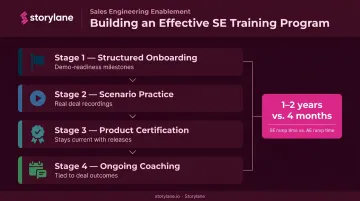
PSC recommends 2–3 hours of development time per week with bi-weekly coaching cadences as a baseline.
Cross-Functional Alignment
Presales enablement doesn't operate in isolation. Without shared KPIs and defined handoff criteria, SEs get pulled into deals that aren't ready for technical depth, and messaging drifts between what AEs promise and what SEs can deliver.
Clear rules of engagement fix this. Joint pipeline reviews, shared qualification thresholds, and coordinated feedback loops between sales, presales, and marketing prevent capacity drain — and ensure the buyer experience stays consistent from first outreach through close.
Common Presales Enablement Gaps
Tribal Knowledge That Never Gets Systematized
The most common failure mode: your best SEs carry everything in their heads. Discovery frameworks, winning objection responses, demo sequences that close — none of it gets documented. New hires ramp slowly, consistency suffers, and the team can't scale without adding headcount.
The SE-as-Generalist Trap
Without clear qualification criteria, SEs get pulled into every deal regardless of stage or fit. Consensus' data is direct: **SEs deliver 37% of demos to unqualified leads**. That's more than one in three demos where SE time is spent on opportunities that aren't ready.
Shifting an AE:SE ratio from 4:1 to 5.75:1 adds 45% more demand per SE — equivalent to 22 additional work hours per week. Without engagement rules, ratio drift silently burns out your team.
Sales-Presales Misalignment
When AEs and SEs don't share qualification frameworks or performance metrics, they deliver different value stories to the same buyer. The result is visible to buyers at the worst possible moment:
- Technical claims conflict with commercial promises
- Handoff expectations between AE and SE don't align
- Buyer confidence erodes precisely when it should be building
Strategies to Optimize Your Presales Enablement
Standardize Demo Workflows Before Scaling
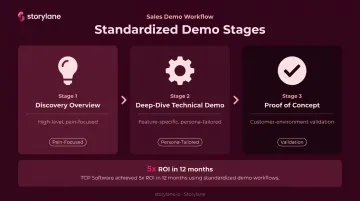
Define standard demo formats by deal stage:
- Discovery-level overview — high-level, product-agnostic, focused on pain
- Deep-dive technical demo — feature-specific, persona-tailored
- Proof of concept — customer-environment-specific validation
Automate environment setup wherever possible. Build a library of ready-to-deploy demos that SEs personalize quickly rather than rebuilding from scratch. TCP Software, with 11 SCs/SEs supporting 105 reps, used Storylane to create "helicopter demos" for qualification and discovery calls — enabling their SE team to close smaller deals with zero SC involvement and achieve 5x ROI in 12 months.
Operationalize Lead Qualification for SE Involvement
Work with sales leadership to establish clear thresholds for when an SE gets involved. Without defined criteria, SE capacity gets consumed by deals that don't need technical depth.
Common qualification thresholds include:
- Deal size exceeds a minimum ACV target
- Buyer has reached a specific pipeline stage
- Technical complexity requires environment-specific discussion
- Multiple stakeholders or champions are engaged
Document the criteria. Enforce the handoff. Review it quarterly.
Create Feedback Loops Between Presales, Product, and Marketing
Presales sits closest to the buyer's technical reality. Recurring objections, feature gaps surfaced in POCs, and RFP patterns all carry intelligence that product and marketing teams need.
Build a systematic channel that routes field intelligence upstream:
- A shared Slack thread for real-time objection logging
- A monthly sync between SE leads, product, and marketing
- A structured template for capturing POC findings and RFP gaps
This turns deal-level interactions into product roadmap input and competitive positioning updates.
Invest in Buyer Self-Serve to Reduce SE Bottlenecks
Gartner research found that 67% of B2B buyers prefer a rep-free buying experience. Buyers who arrive at a live demo having already explored the product self-serve ask sharper questions, skip foundational explanations, and engage more meaningfully.
Storylane's Demo Hub enables this directly. Prospects can browse feature-specific and persona-segmented demos at their own pace, evaluate use cases independently, and arrive at the SE call already anchored in the product. Campminder used this approach to cut deal cycles from 6 weeks to 2 weeks.
Run Structured Retrospectives After Wins and Losses
After every significant deal outcome, document what happened across each stage:
- How discovery was handled and what gaps emerged
- What the demo revealed about buyer priorities
- How objections were managed and whether they recurred
- Where the deal shifted — positively or negatively
Feed those learnings back into your content library and coaching programs. Over six months, this turns one-off deal outcomes into reusable playbooks — so the next team member facing the same objection has a tested response, not a guess.
Essential Tools for Presales Enablement Teams
Interactive Demo Platforms
These are the operational core of modern presales. Platforms like Storylane allow presales teams to build, personalize, and distribute product demos across multiple formats without engineering involvement.
Key capabilities to evaluate:
- Supports multiple formats (guided, HTML sandbox, screenshot, hub) to cover both live SE-led and self-serve buyer scenarios
- Personalizes at scale using dynamic tokens for company name, persona, and use case — no rebuild required
- De-anonymizes demo visitors: Storylane's Premium plan includes 10,000 Account Reveals per month with enriched firmographic data
- Cuts demo build time with AI tools including voiceovers, video avatars, and one-click annotations
- Shows engagement analytics — where buyers spend time, where they drop off, and which features drive interest
Storylane's Deal Intelligence syncs demo engagement data bidirectionally with Salesforce, HubSpot, and Marketo — so demo interaction signals flow into the systems AEs and RevOps teams already use.
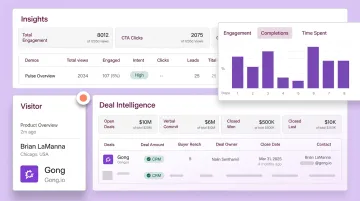
That CRM connectivity matters beyond just reporting — it's what makes presales activity visible to the rest of the revenue team. The same logic applies to the next layer of the stack.
Knowledge Management and RFP Response Tools
Platforms that centralize technical documentation, past RFP answers, and security questionnaire libraries cut the time SEs spend searching for information. The goal is getting your fastest SE's response time to your average SE.
Common capabilities in this category:
- Searchable libraries of past RFP and security questionnaire responses
- Auto-suggested answers based on question similarity
- Version-controlled technical documentation accessible across the team
Presales Management Platforms
These give presales leaders visibility into team workload, demo pipeline, SE utilization, and deal influence — enabling smarter resource allocation before any individual SE hits a capacity ceiling.
The Lean Stack Principle
More tools don't fix a broken process. Map where SE time is actually being lost:
- Manual demo setup
- Content searching
- Unqualified demos
- Repetitive RFP responses
Then prioritize tools that directly address those specific drains. A focused stack of three tools solving real problems beats a sprawling suite that adds its own administrative overhead.
How to Measure Presales Enablement Effectiveness
Leading Indicators
These reveal whether your enablement infrastructure is improving team output before it shows in revenue:
- Demo-to-technical-win rate — percentage of demos that result in a positive technical evaluation
- Time-to-first-demo — how quickly a new SE reaches demo readiness after joining
- SE utilization rate — ratio of strategic deal work to administrative and reactive tasks
Lagging Indicators
These confirm whether presales investment translates to deal outcomes:
- SE-influenced win rate — deals where an SE was involved vs. not
- Sales cycle length for SE-supported deals
- Average deal size for SE-touched opportunities
Alexander Group data provides useful staffing context: sales forces with a 1:5 SE-to-rep ratio average $2M revenue per rep, compared to $3.2M at a 1:1 ratio. That's not an argument for 1:1 coverage across the board — but it frames the capacity conversation clearly.
The Feedback Measurement Cycle
Metrics shouldn't just be reported — they should feed back into the system. In practice, that means:
- Demo engagement data (drop-off points, time-on-step, feature interest) informs demo redesign
- Win/loss patterns update battlecards and objection playbooks
- Coaching conversations reference actual deal recordings, not hypothetical scenarios
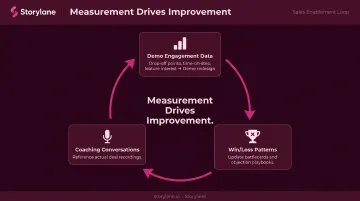
The teams that improve fastest use measurement to drive program changes — not just to report on them.
Frequently Asked Questions
What is presales enablement?
Presales enablement is the systematic approach of equipping Solutions Engineers and technical sales professionals with the tools, content, training, and workflows to support complex deals. Coverage spans discovery and demos through technical validation and RFP responses. Unlike a one-time training initiative, it's a continuously maintained system that evolves with your product and sales motion.
What are the key pillars of presales enablement?
The five core pillars are: demo infrastructure, a centralized content library, knowledge management, continuous training and coaching, and cross-functional alignment between presales, sales, and marketing. Gaps in any one pillar create friction across the entire sales cycle.
What does a presales enablement role do?
A presales enablement function designs and maintains the systems that allow SEs to operate effectively at scale. Responsibilities include building demo libraries, standardizing workflows, managing knowledge bases, running coaching programs, and tracking performance metrics that connect presales activity to deal outcomes.
What is the difference between presales and sales enablement?
Sales enablement focuses on helping AEs with messaging, pipeline management, and closing techniques. Presales enablement is specifically designed for the technical depth of the buying process — demos, product validation, POCs, and security questionnaires. Both functions work together, but the tooling, content, and workflows each requires are distinct enough to justify separate investment.
How do you measure presales enablement effectiveness?
Key metrics include technical win rate, demo-to-close conversion, SE-influenced ARR, time-to-first-demo for new hires, and the ratio of strategic deal work to administrative tasks in an SE's weekly calendar. Leading indicators reveal process quality; lagging indicators confirm revenue impact.