Introduction
Most sales reps enter discovery calls with good intentions and leave with bad data. They ask questions like "What are your goals this year?" and get polished, noncommittal answers — then spend the next three weeks chasing a deal that was never real.
Gong's analysis of 326,000 sales calls found that losing reps asked more questions per call — averaging around 20 — while winning reps averaged 15 to 16. Volume isn't the issue. Asking the right questions in the right order is.
This post gives you 15 discovery questions organized into five qualification categories: pain, goals, urgency, stakeholder mapping, and budget. For each question, you'll get the reasoning behind it and what the answer (or non-answer) tells you about whether this lead is worth pursuing.
Key Takeaways
- Discovery questions filter out prospects who'll stall — surfacing only those with real pain and genuine buying intent
- Effective discovery is a structured conversation where listening consistently outweighs asking
- Organize questions by category (pain, goals, urgency, decision-making, budget) to qualify systematically
- A personalized follow-up demo post-discovery keeps qualified prospects engaged and reveals who's still actively interested
What Sales Discovery Questions Are (and Why Most Reps Get Them Wrong)
Sales discovery questions are open-ended questions reps ask early in the sales process to expose whether a prospect has real pain, budget, authority, and urgency — and to disqualify those who don't before wasting weeks chasing a dead deal.
The most common mistake: treating discovery as a formality before the pitch. Reps ask generic questions, get polite surface-level answers, and interpret the absence of objections as interest — then move straight to demo. Three weeks later, the deal goes cold.
Only 26% of buyers say sellers excel at uncovering their needs, and only 25% say sellers listen well. That's not a question-quality problem — it's a mindset problem. Reps treat discovery as a checklist to clear, not a conversation to have. The fix starts with understanding what discovery is actually for, and how it differs from basic qualification.
Qualification vs. Discovery: Not the Same Thing
These two are often conflated, but they serve different purposes:
| Type | Purpose | Example |
|---|---|---|
| Qualification questions | Confirm basic fit criteria | "What's your company size?" or "Do you use Salesforce?" |
| Discovery questions | Expose depth of pain, urgency, and buying dynamics | "What happens if this problem isn't solved by Q3?" |
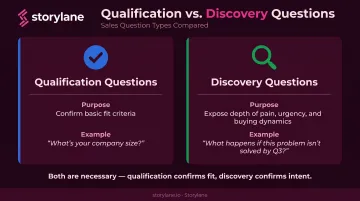
Both are necessary. Qualification confirms you're in the right zip code. Discovery tells you whether there's a real house to buy.
The 15 Essential Sales Discovery Questions
These questions are grouped into five categories. On any given call, use 8–12 based on what you already know about the prospect and where the conversation leads. Not every category needs the same depth of exploration for every deal.
Questions to Uncover Pain and Problems (Q1–Q3)
Q1: "What's the biggest challenge your team is facing right now in [relevant area]?"
This open-ended opener lets the prospect define the problem in their own words. You learn both the pain and how acutely they feel it. If they struggle to name a clear challenge — or pivot immediately to features they want — treat that as a signal. Prospects without a crisp problem statement rarely drive internal urgency to buy.
Q2: "What have you tried so far to solve this, and what happened?"
Listen for investment level here. A prospect actively working through past attempts is far more likely to close than one who's just browsing. Failed solutions also tend to resurface as objections — if they've tried three approaches and abandoned each one, you need to understand why before you position yours as different.
Q3: "What does this problem cost you in terms of time, revenue, or missed opportunities?"
Vague pain rarely closes deals. This question converts a qualitative complaint into a quantifiable business impact. If the prospect can't — or won't — put any number on it, urgency is probably too low to justify a deal moving forward.
Questions to Clarify Goals and Priorities (Q4–Q6)
Q4: "What are your top two or three business priorities for this quarter?"
Asking about quarterly priorities (not annual goals) gets more honest, targeted answers. More to the point, it reveals whether solving that pain is tied to what leadership cares about right now. A problem that isn't connected to a current priority is a problem that won't get budget.
Q5: "What does success look like for you six to twelve months from now?"
Shifting from features to outcomes gives you a benchmark to position ROI against. It also tells you whether the prospect is thinking strategically or tactically.
A prospect who describes vague aspirations ("we want to be more efficient") is harder to close than one who says "we need to reduce demo-to-close time by 30%."
Q6: "What would change for you personally if this problem were solved?"
Individual motivation drives deals in ways that business logic alone rarely does. Challenger research found that high buyer indecision can drop win rates from 41% to just 6% — and prospects who have personal skin in the game (a promotion on the line, a recurring frustration, a quota they're missing) are far more likely to champion a deal internally.
Questions to Gauge Urgency and Timeline (Q7–Q9)
Q7: "What's prompting you to look for a solution right now?"
Every real buying cycle has a triggering event — a contract renewal, a leadership mandate, a competitive threat, a growth milestone. The more specific and recent the trigger, the higher the urgency. A vague answer like "we've been thinking about it for a while" is a signal that this is exploration, not active buying.
Q8: "What happens if nothing changes by the end of this quarter?"
A status quo challenge. If the prospect can't describe meaningful consequences of inaction, there's no urgency — and the deal will stall. RAIN Group found that 28.2% of organizations cite losing deals to "no decision" as a major challenge, which is almost always a symptom of insufficient urgency created during discovery.
Q9: "What does your decision-making timeline look like?"
Use this to confirm alignment between the prospect's timeline and your pipeline goals, and to set the stage for mapping next steps. Listen carefully for vague answers like "sometime this year" — those require a follow-up that creates urgency rather than accommodating it.
Questions to Map Stakeholders and the Buying Process (Q10–Q12)
Q10: "Who else is involved in evaluating or approving this type of solution?"
Gartner's 2025 research found that B2B buying groups now include 5 to 16 people across multiple functions, and 74% of those groups show unhealthy conflict during the decision process.
Building a relationship with only one stakeholder — who may have limited authority — is one of the most common reasons deals die late in the cycle.
Ask this early. Then work toward getting access to the other stakeholders who matter.
Q11: "Can you walk me through how you've made similar purchasing decisions in the past?"
The answer reveals the prospect's actual buying process, not the idealized version they might present. You'll learn who really holds influence, how long decisions typically take, and what factors determined the outcome. That information lets you sequence your approach around how they actually buy — not how you'd like them to.
Q12: "What criteria matter most to you and your team when selecting a vendor?"
Get must-haves on the table before you've pitched anything. If a critical capability is on their list and you don't have it, better to know now than after three demos. If your strengths align with their top criteria, you can orient the entire rest of the conversation around those signals.
Questions to Qualify Budget and Deal Viability (Q13–Q15)
Q13: "Do you have a budget allocated for this initiative, or is this exploratory?"
Direct, but not aggressive. "No budget" doesn't automatically mean disqualify — it may mean the prospect needs help building a business case. What it does tell you is whether you're in an active buying cycle or an education phase, which changes how you invest your time.
Q14: "What other solutions are you currently evaluating?"
Competitive context tells you how far along the prospect actually is. Gong data shows that discussing competition early in the sales cycle improves closing chances by 49% — so don't avoid the question. If they're deep into another vendor's trial, you need to understand what it would take to earn a real evaluation.
Q15: "Is there anything that could prevent you from moving forward in the next 30 to 60 days?"
Your preemptive risk question. It pulls blockers into the open — procurement freezes, pending reorgs, board approvals, seasonal budget holds — before they derail the deal. Prospects who answer this honestly give you time to address those blockers or plan around them. Prospects who say "nothing I can think of" and then go dark were signaling early.
How to Run a Discovery Call That Actually Qualifies
The questions above only work inside a well-run call. Here's what that looks like:
Before the call:
- Research the company, role, and industry — don't ask what you could have Googled
- Identify which qualification categories are most likely to reveal gaps for this persona
- Set a clear internal objective: what do you need to confirm or disqualify by the end?
During the call:
- Open with a brief agenda and invite the prospect to add topics
- Ask one strong question, then stay quiet — resist the urge to fill silence
- Aim for 8–12 questions; depth beats breadth every time
- Skip slides — Gong found that slide use in discovery correlates with 15% more rep talk time and 21% fewer questions asked
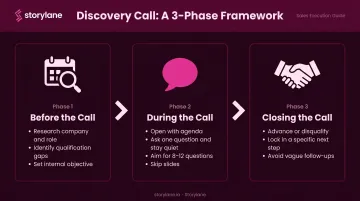
How you close the call determines whether discovery actually did its job.
Closing the call:
- Discovery ends when you can confidently advance or disqualify — anything short of that is an incomplete call
- If advancing, lock in a specific next step before you hang up: a stakeholder intro, a demo, or a proposal
- "I'll send you some information" is not a next step — get a commitment or reschedule
Turning Discovery Answers into Pipeline Action
Getting strong discovery answers is only useful if you act on them. Here's the post-call workflow:
Immediately after the call:
- Log your qualification status in CRM using a framework like BANT or MEDDIC — note what was confirmed, what was missing, and your recommended next action
- Score the lead against your ICP criteria before the call fades from memory
For qualified leads — send something personalized:
A generic follow-up email wastes the intelligence you just collected. Reference the prospect's specific pain, their stated goals, and the timeline they mentioned.
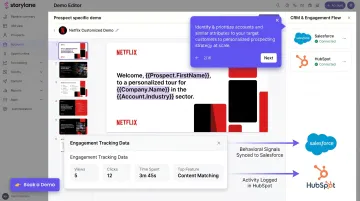
One effective tactic: send a tailored interactive demo that lets the prospect explore the features most relevant to their stated use case before your next meeting. With Storylane, reps can duplicate a base demo template, swap in the prospect's company name, logo, and relevant data using dynamic variable tokens, and send a personalized link in minutes.
When the prospect opens and navigates the demo, Storylane tracks which chapters and features they engage with most and pushes that behavioral data to Salesforce or HubSpot. Reps get real-time signals of continued interest, giving them a clear angle for how to open the next conversation.
For leads that didn't qualify:
- Document the disqualification reason clearly (budget timing, wrong stakeholder, no urgency)
- Set a future follow-up tied to when circumstances might change — contract renewals, budget resets, org changes
- A lead that's not ready today is often a strong opportunity in 90 days with the right nurture sequence
Frequently Asked Questions
What are the 5 C's of sales?
The 5 C's refer to a situation-analysis framework: Company, Customers, Competitors, Collaborators, and Context. It maps a business environment and is primarily used in marketing and GTM strategy. During live sales calls, discovery questions are how reps surface the "Customers" and "Context" components in real time.
What is an example of a discovery question?
A strong example: "What's the biggest challenge your team is facing right now in [relevant area]?" It works because it's open-ended, invites the prospect to define the problem in their own words, and reveals both the pain and how acutely they feel it — all in one question.
What is the difference between a discovery call and a sales call?
A discovery call is focused on understanding the prospect's situation, pain, and fit — the rep primarily listens and asks questions. A sales call is focused on presenting a solution and moving toward a close. Discovery comes first and directly shapes how the sales conversation is framed.
How many discovery questions should you ask on a single call?
Gong's 2025 analysis found winning reps averaged 15–16 questions per call, while losing reps averaged around 20 — more questions aren't better. Depth of answer matters more than volume. Aim for 8–12 well-chosen questions focused on uncovering genuine pain and fit.
What is the BANT framework and how does it relate to discovery?
BANT stands for Budget, Authority, Need, and Timeline — a widely used qualification framework originally from IBM. Discovery questions are how reps validate each criterion in a live conversation, rather than relying on form data that's often incomplete by the time a rep picks up the phone.
How do you qualify or disqualify a lead based on discovery?
Qualification depends on whether the prospect meets the core criteria your team has defined: confirmed pain, budget alignment, decision-making authority, and a realistic timeline. Disqualifying early is a deliberate choice — it keeps your pipeline focused on leads that can actually close.