Finding sales leads sounds simple — identify people who might buy, reach out, repeat. But results vary dramatically depending on how clearly you've defined your ideal buyer, which channels you actually commit to, and how rigorously you qualify what comes in.
This guide walks through a repeatable process for finding sales leads, the channels that consistently perform, how to qualify what you capture, mistakes that quietly kill results, and the tools that make the whole system faster.
Key Takeaways
- A precise Ideal Customer Profile (ICP) is the foundation — every channel underperforms without it
- Top-performing teams combine inbound and outbound rather than betting on a single source
- BANT qualification separates real opportunities from pipeline clutter
- Interactive demos are high-intent lead capture tools that convert prospects before the first sales call
- Most conversions require multiple touchpoints; follow-up persistence matters as much as initial outreach
How to Find Sales Leads: A Step-by-Step Process
Finding sales leads is a repeatable system, not a single action. Teams that follow a defined process consistently outperform those relying on ad hoc outreach. Skipping any step reduces the quality of what flows into the pipeline.
Step 1: Define Your Ideal Customer Profile (ICP)
An ICP is a detailed description of the company and buyer most likely to get value from your product — and to pay for it. Without this definition, every subsequent step wastes effort on prospects who'll never convert.
Build your ICP using:
- CRM records from your best-fit closed-won deals
- Win/loss analysis to identify patterns in who converts and who churns
- Customer interviews to surface the pain points that drove the purchase decision
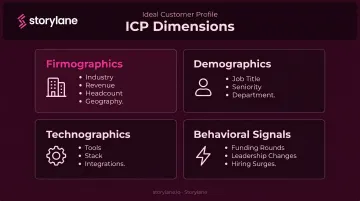
The ICP should define four dimensions:
| Dimension | Examples |
|---|---|
| Firmographics | Industry, revenue, headcount, geography |
| Demographics | Decision-maker title, seniority, department |
| Technographics | Existing tools, current stack, integration needs |
| Behavioral signals | Funding rounds, leadership changes, hiring surges |
Salesforce research shows 86% of B2B buyers are more likely to buy when a company demonstrates it understands their specific goals — which is impossible without a clear ICP.
Step 2: Identify Where Your Ideal Leads Are
Once the ICP is defined, map which platforms and channels your target buyers actually use. Most teams default to the channels that feel easiest, not the ones where their buyers actually spend time — and that gap quietly kills pipeline.
Common channel-to-ICP mapping:
- LinkedIn — B2B decision-makers, especially in mid-market and enterprise
- Industry forums and communities — Technical buyers, niche verticals
- Review sites (G2, Capterra) — Buyers already in active evaluation mode
- Trade events and conferences — High-intent, role-specific audiences
- Inbound via content/SEO — Prospects researching a problem your product solves
Pick two or three channels where your ICP is most concentrated, go deep on those, and expand only once you've proven traction.
Step 3: Execute Outreach and Capture Leads
Personalization is what separates responses from silence. Cold emails and LinkedIn messages that reference a prospect's specific industry pain points consistently outperform generic templates. Every message needs a clear next step:
- Book a discovery call
- Request a product demo
- Download a relevant resource
- Watch a self-serve interactive demo
On the capture side: 6sense reports that only 3–4% of website visitors fill out forms, meaning the vast majority of inbound interest goes unrecorded. Lead capture must be set up across every active touchpoint — landing pages, demo flows, event sign-ups, chatbots — so no expressed interest disappears.
Step 4: Qualify, Score, and Route Leads
Once leads are captured, qualification determines which ones deserve sales attention. Not every click or reply signals real intent — filtering out noise keeps the team focused on high-probability deals.
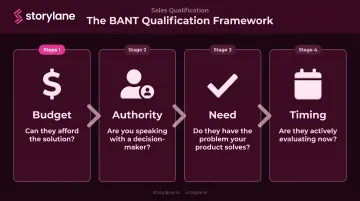
The BANT framework is a practical starting structure:
- Budget — Can they afford the solution?
- Authority — Are you speaking with a decision-maker?
- Need — Do they have the problem your product solves?
- Timing — Are they actively evaluating now?
Feed qualification from multiple inputs: discovery call questions, form submissions, and behavioral signals like pricing page visits or demo engagement time.
Proven Strategies to Find Sales Leads
No single channel delivers all the leads a team needs. The strongest pipelines draw from multiple sources simultaneously.
LinkedIn and Sales Prospecting Tools
89% of B2B marketers use LinkedIn for lead generation, and 62% say it produces leads effectively, according to HubSpot's marketing statistics. For B2B outreach, it's difficult to match LinkedIn's combination of role-level filtering, firmographic targeting, and intent signals.
LinkedIn Sales Navigator allows you to:
- Filter prospects by role, seniority, industry, company size, and geography
- Set lead alerts for trigger events: job changes, funding announcements, expansion signals
- Track prospect activity to time outreach when receptivity is highest
For the outreach itself, warm approaches consistently outperform cold pitches. Research the prospect's recent activity, identify any mutual connections, personalize the connection request with relevant context, and avoid pitching in the first message.
Cold Email Outreach
Cold email remains a top B2B lead generation channel when executed with precision. QuickMail's analysis of 65 million cold emails found a 44% average open rate, with top-quartile campaigns achieving 20%+ reply rates — but those results come from well-targeted, well-written sequences, not volume blasts.
A high-converting cold email includes:
- A specific subject line that reflects the prospect's situation
- A pain-point-led opener (not a product introduction)
- A brief value statement tied to a relevant outcome
- Social proof: a named customer or concrete result
- A low-friction CTA (a single question, not a calendar link)
A single send rarely converts. A multi-touch sequence spaced over 2–3 weeks, mixing email, a LinkedIn touchpoint, and a call attempt, increases response rates measurably.
Referrals and Referral Partnerships
Referral leads arrive with built-in trust, which compresses sales cycles. The right moment to ask is after a clear success milestone — a positive outcome the customer can describe specifically. Asking immediately after a contract closes, before value has been demonstrated, rarely yields strong referrals.
Beyond customer referrals, consider referral partnerships: companies selling to your same ICP but not competing can exchange qualified leads through revenue-sharing or co-marketing arrangements. If your product integrates with a complementary tool, a mutual referral agreement often benefits both parties without requiring significant investment from either.
Content Marketing and SEO
Inbound content attracts leads already researching the problem your product solves, making them higher-intent than cold outreach targets from the start. G2's 2024 Buyer Behavior Report found 69% of B2B software buyers engage sales only after they've already made a purchase decision, and 83% prefer self-service discovery.
This makes bottom-of-funnel content — comparison pages, category rankings, use-case-specific case studies — particularly valuable. These pages capture buyers mid-evaluation and can generate a steady lead stream without per-lead costs over time.
Interactive Demos and Product-Led Lead Capture
For B2B SaaS companies, a self-serve interactive demo is one of the most effective lead capture tools available. Prospects who engage with a product experience have already self-selected their interest before speaking to a rep.
Storylane enables teams to act on that engagement in several ways:
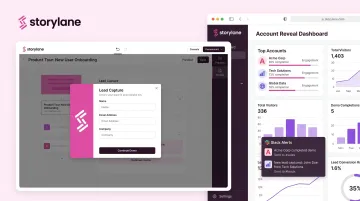
- Embedded lead capture: Forms placed inside the demo flow collect contact information when engagement is highest, not before or after
- Proven conversion lift: ContactMonkey achieved a 28% lead-to-opportunity conversion rate from a gated interactive demo, and improved further by reducing form fields from six to three
- Account Reveal: Prospects who explore a demo without submitting a form can be de-anonymized with company and firmographic data, triggering a real-time Slack alert with full engagement context for the sales rep
Networking and Events
55% of B2B marketers say in-person events produce the best results, per the Content Marketing Institute. Trade shows, conferences, and hosted webinars give reps access to pre-qualified audiences and allow relationship-building that accelerates trust faster than digital channels alone.
The follow-up window matters. Conversion rates run 8x higher when reps follow up within 5 minutes of a prospect showing interest. Post-event follow-up within 48 hours applies the same logic. This is often where event leads are won or lost.
Re-Engaging Past Leads and Lost Opportunities
Past leads who went cold, chose a competitor, or simply weren't ready represent a warm pipeline source most teams underuse. A systematic re-engagement cadence every 4–6 months, anchored to new product developments, a relevant case study, or a trigger event within the prospect's company, keeps these relationships alive without requiring new prospecting work.
The message framing matters:
- Weak: "Just checking in" — no reason to re-open the conversation
- Strong: Lead with a relevant customer win or a product update they missed
One gives the prospect nothing to respond to. The other gives them a reason.
How to Qualify and Score Your Sales Leads
A pipeline full of unqualified leads creates false confidence in forecasts and wastes the sales team's most limited resource: time. Lead scoring gives teams a consistent framework for prioritizing follow-up rather than working by gut feel.
Explicit vs. Implicit Scoring Data
Lead scoring works best when it combines two types of signals:
- Explicit data — firmographics and demographics: job title, company size, industry, geography
- Implicit data — behavioral signals: pricing page visits, demo engagement time, email opens, repeat website sessions
Neither type alone is sufficient. A prospect with perfect firmographics who never engages may be less ready than a smaller company that's viewed the pricing page three times and completed a demo.
The Lead Type Spectrum
Understanding where a lead sits determines the right follow-up action:
- IQL (Information Qualified Lead) — Downloaded content, early awareness stage; needs nurturing, not a sales call
- MQL (Marketing Qualified Lead) — Meets ICP criteria and has engaged with marketing content; ready for sales development outreach
- SQL (Sales Qualified Lead) — Has been qualified via BANT or discovery; actively in the sales process
- PQL (Product Qualified Lead) — Has engaged with a free trial or interactive demo; the warmest lead type
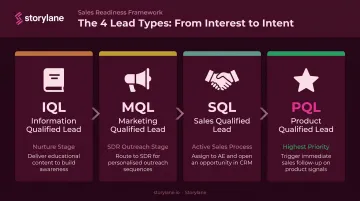
PQLs should be routed to sales first. Gainsight reports that free trials using PQLs convert 2.8x better than trials that don't use product qualification signals. Interactive demo platforms like Storylane make this practical — demo analytics and Account Reveal surface exactly which companies engaged, for how long, and where they dropped off, feeding directly into the implicit scoring signals that separate a warm PQL from a cold contact.
Common Mistakes That Kill Lead Generation Results
Skipping ICP Definition and Targeting Too Broadly
Skipping ICP definition is the root cause of most underperformance. Without one, personalization is impossible and outreach feels generic to every recipient. A wide net fills the pipeline with poor-fit prospects who consume sales time without converting.
Spreading Effort Across Too Many Channels
Running too many channels at once — cold email, LinkedIn, paid ads, content, referrals, events — without the resources to execute any of them well produces mediocre results everywhere. Pick the 2–3 channels where your ICP is most reachable:
- Cold email or LinkedIn outreach for direct prospecting
- Content and SEO for inbound demand generation
- Events or referrals for relationship-driven pipelines
Execute those well before expanding.
Giving Up Too Early on Follow-Up
McKinsey found that B2B buyers used an average of 10 distinct touchpoints in their purchase journey — up from 5 five years earlier. Most reps abandon outreach after one or two attempts with no response. Multi-touch sequencing across email, LinkedIn, and phone is how most conversions happen. One message rarely closes the loop.
Tools to Help You Find and Manage Sales Leads
The right tool stack reduces time spent on manual research and increases prospecting accuracy. Tools fall into three categories:
| Category | Tools |
|---|---|
| Prospecting & data | LinkedIn Sales Navigator, Apollo, ZoomInfo, Lusha |
| Engagement & sequencing | Outreach, Salesloft, Lemlist |
| CRM & lead tracking | Salesforce, HubSpot |
Interactive demo platforms like Storylane add a distinct layer to this stack, building lead capture and qualification directly into the product experience:
- Embedded lead forms route captured data to Salesforce or HubSpot automatically
- Account Reveal surfaces company-level data on anonymous website visitors
- RepX, Storylane's conversational AI agent, qualifies leads 24/7 through natural product conversations and routes sales-ready prospects directly to CRM
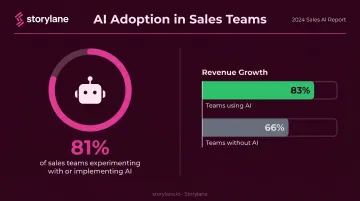
AI tools (including purpose-built prospecting platforms) assist with four core tasks: researching prospects, drafting personalized outreach, identifying trigger events, and summarizing company intelligence before calls. Salesforce data shows 81% of sales teams are now experimenting with or fully implementing AI, and 83% of AI-using teams saw revenue growth versus 66% of teams without it. That said, AI requires human judgment for qualification and relationship decisions — it accelerates the work but doesn't replace the judgment calls that close deals.
Conclusion
Quality lead generation works as a system. It starts with a defined ICP, flows through the right channel mix with personalization and consistency, and depends on disciplined qualification to keep the pipeline honest.
The gap between high-performing and average sales teams rarely comes down to channel selection. The real differentiators are:
- ICP clarity — knowing exactly who you're targeting before any outreach begins
- Follow-up persistence — consistent, multi-touch sequences rather than one-and-done messages
- Fast qualification and routing — getting leads to the right rep before interest cools
Tools that surface buyer intent early give sales teams a meaningful edge here. Storylane's Account Reveal and demo engagement signals, for example, show which prospects are actively exploring your product — so reps can prioritize outreach based on real behavior, not guesswork.
Frequently Asked Questions
What is the difference between a sales lead and a prospect?
A lead is anyone who could potentially buy your product — they've shown some level of interest or fit, but haven't been vetted yet. A prospect is a lead who has been qualified against criteria like budget, authority, need, and timing, and is actively being pursued through the sales funnel.
What are common sales outreach rules (3-3-3, 2-2-2, 10-3-1) for finding sales leads?
These are multi-touch cadence benchmarks for understanding expected conversion at each outreach stage. The 10-3-1 model, for example, means 10 initial contacts typically yield 3 conversations and 1 qualified opportunity. They're useful for calibrating sequence expectations.
Can ChatGPT find leads?
ChatGPT can assist with lead-related tasks like drafting personalized outreach and researching company pain points. It can't access proprietary databases or CRM systems — for systematic lead discovery, dedicated tools like LinkedIn Sales Navigator or Apollo are better suited.
What is the difference between inbound and outbound lead generation?
Inbound lead generation attracts prospects through content, SEO, and product experiences — they come to you. Outbound involves proactively reaching prospects via cold email, calls, or LinkedIn — you go to them. The strongest pipelines combine both approaches rather than relying on either exclusively.
How do you qualify a sales lead quickly?
Use BANT as a rapid filter: does the prospect have the budget, decision-making authority, a clear need, and an active evaluation timeline? Behavioral signals — demo engagement, pricing page visits, repeat sessions — can serve as fast, passive qualification indicators before any conversation takes place.
How many touches does it typically take to convert a sales lead?
McKinsey's B2B research found buyers average 10 touchpoints across their purchase journey, up from 5 five years prior. Persistence across email, LinkedIn, and phone — with varied messaging across a 2–3 week sequence — is where most responses actually occur.