
This article breaks down both models clearly: what each looks like day-to-day, where each performs best, how they differ on cost and deal size, and a practical framework for choosing the right fit for your business.
Key Takeaways
- Inside sales — remote selling via phone, email, and video; best for standardized products with shorter cycles
- Outside sales — in-person field selling; suited for complex, high-value deals requiring relationship depth
- Deal size and sales cycle length are the most reliable predictors of which model to use
- McKinsey research shows hybrid sales is now the dominant B2B strategy — most growing companies use both
- Interactive demos let prospects explore the product before a call, cutting time-to-close for inside sales teams
Inside Sales vs. Outside Sales: Quick Comparison
| Dimension | Inside Sales | Outside Sales |
|---|---|---|
| Work Environment | Office or remote setup, centralized | Field-based, travel-heavy |
| Typical Deal Size | Smaller to mid-market | Mid-market to enterprise |
| Sales Cycle Length | Weeks to a few months | Months to over a year |
| Daily Activity Volume | High (calls, emails, demos) | Low (a few in-person meetings) |
| Cost per Acquisition | Lower (primarily salary + software) | Higher (travel, lodging, entertainment) |
| Geographic Reach | National or global | Territory-bound |
The sections below cover each dimension in detail.
What Is Inside Sales?
Inside sales is the practice of selling remotely — through phone, email, video conferencing, and chat — without in-person meetings. It's the dominant model for SaaS and B2B tech companies because it scales efficiently and keeps acquisition costs manageable.
The Daily Workflow
A typical inside sales rep juggles high-volume outreach alongside structured qualification and follow-up. On any given day, that looks like:
- Running discovery calls and qualifying inbound leads
- Conducting product demos via screen share or interactive demo links
- Managing follow-up email sequences for prospects at different stages
- Logging activity and updating pipeline in a CRM
Salesloft's benchmark data shows SDRs send around 150 emails per week on average, with a 2.8% average reply rate — which means reps need to run lean, move fast, and make every touchpoint count.
The Inside Sales Tech Stack
Inside reps work from a shared infrastructure of digital tools:
- CRM software (Salesforce, HubSpot) for pipeline management
- Video conferencing (Zoom, Teams) for live discovery and demo calls
- Sales automation platforms for sequenced outreach
- Interactive demo tools for asynchronous, self-guided product experiences
Platforms like Storylane fit into this stack by letting reps send self-guided demos prospects can explore on their own time. When a prospect engages, the rep gets a real-time alert with data on which features they clicked through and how long they spent — giving the follow-up call a concrete starting point.
Advantages and Limitations
Where inside sales wins:
- Faster ramp time for new reps
- National and international reach without travel costs
- Easier performance tracking through digital analytics
- Quick scalability — adding headcount is an HR and software decision
That said, the model has real gaps. Where it struggles:
- Higher risk of prospects ghosting without face-to-face accountability
- Harder to build deep trust for high-complexity purchases
- Lower close rates on multi-stakeholder or six-figure deals
Use Cases for Inside Sales
Inside sales works best for SaaS companies, B2B tech vendors, and digital marketing agencies selling standardized products with predictable buying processes. As a benchmark, SaaS Capital reports the median ACV for private B2B SaaS companies is $26,265 — a deal size that closes comfortably through a 30-minute video demo and a few follow-up emails, with no field visit required.
What Is Outside Sales?
Outside sales (also called field sales) means selling through in-person meetings, site visits, trade shows, and executive presentations. Reps spend the majority of their time traveling to clients rather than working from a central office.
The Daily Workflow
The pace is different from inside sales. Where inside reps run volume, outside reps run depth. A field rep's day typically involves:
- Driving to client meetings and conducting on-site product demonstrations
- Attending industry events to network and generate pipeline
- Running multi-stakeholder presentations with procurement, IT, and executive leadership
- Managing long-term account relationships through repeat visits
Advantages and Limitations
Where outside sales wins:
- Higher close rates on large, complex deals with multiple stakeholders
- Trust built through in-person presence and relationship continuity
- Ability to read body language and adjust messaging in real time
- Stronger retention for high-value accounts over time
Where it struggles:
- Higher cost per acquisition — travel, lodging, and entertainment add up fast
- Longer ramp time for new reps learning a territory
- Limited daily contact volume compared to inside reps
- Harder to attribute what specifically moved a deal forward or caused it to stall
Use Cases for Outside Sales
Outside sales fits industries where relationship depth and in-person credibility are non-negotiable: enterprise software, manufacturing, construction, healthcare, insurance, and financial services.
Take a $200,000 enterprise software implementation. It typically requires multiple on-site discovery sessions and stakeholder presentations spanning several months. Video conferencing can supplement that process, but buying committees at that deal size expect in-person investment from a vendor. The relationship built across those touchpoints is part of what justifies the price tag.
Key Differences: Inside vs. Outside Sales
Deal Size and Sales Cycle
The clearest predictor of which model fits is deal complexity. SaaStr's benchmark data links ACV directly to cycle length:
| ACV Range | Typical Sales Cycle |
|---|---|
| Under $5K | 14–30 days |
| ~$25K | ~3 months |
| ~$100K | ~6 months |
| ~$250K | ~9 months |
| ~$1M | ~12 months |
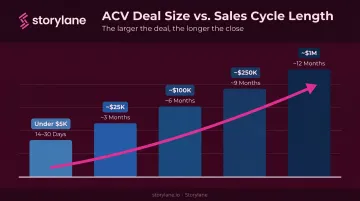
Cycle length is driven by stakeholder complexity, not rep effort. More decision-makers means more time, regardless of how skilled the rep is.
Cost Structure
Inside sales carries lower overhead. The core costs are salaries and software. Outside sales adds fixed expenses (travel, lodging, client entertainment) that only make financial sense when deal sizes are large enough to justify them.
Salesforce data confirms inside sales generally has lower cost-per-acquisition than field-based models — though the gap widens considerably at enterprise deal sizes.
Required Skill Sets
Inside sales reps need:
- CRM and sales tech proficiency
- High-volume written and verbal communication
- Time management across dozens of daily touchpoints
- Data-driven decision-making from digital analytics
- Resilience to handle rejection at scale
Outside sales reps need:
- Strong interpersonal and relationship-building skills
- Quick thinking under pressure in live, unscripted conversations
- Active listening across multi-hour executive engagements
- Organizational discipline to manage travel, territories, and long deal timelines
Scalability
Inside sales scales faster. Adding reps is primarily a recruiting and software cost, and new hires can become productive within weeks.
Outside sales expansion is slower for three reasons:
- Territories need to be defined and assigned before a rep can start
- Relationship-building ramp periods extend the time to first close
- Higher fixed investment per rep is required before returns materialize
Understanding these structural differences is what makes the inside vs. outside decision less about preference and more about deal economics.
How to Choose the Right Sales Model
The decision comes down to four factors. Work through them in order:
1. Product complexity and price point
- Simple, standardized product → inside sales
- Complex, custom implementation → outside sales
- Mid-range with variation → consider hybrid
2. Buyer expectations
- Tech and digital-native buyers generally prefer efficiency and self-serve options
- Traditional industries (manufacturing, financial services, healthcare) often expect in-person commitment as a trust signal
3. Geographic reach
- National or international scale → inside sales advantage
- Deep local penetration with relationship-intensive accounts → outside sales advantage
4. Budget
- Inside sales has lower upfront and ongoing costs
- Outside sales requires sustained investment that only works at proportionally higher deal sizes
The Hybrid Model
Once you've worked through those four factors, you may find the answer still isn't clear-cut. For most growing B2B companies, it shouldn't be either/or. McKinsey found that 85% of B2B sales leaders believe hybrid sales is as effective or more effective than traditional models — and 60% of companies increased hybrid sales teams as of 2021.
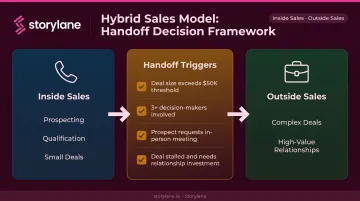
Hybrid works like this: inside sales handles prospecting, qualification, and smaller deals; outside sales takes over when complexity or deal size warrants it.
Clear handoff triggers worth defining:
- Deal size crosses a defined threshold (e.g., $50K+)
- Three or more decision-makers are involved
- A prospect requests an in-person meeting
- Deal has stalled and relationship investment is needed to move it forward
Tools like Storylane's Buyer Hub make these handoffs smoother in practice. Inside reps deploy interactive demo hubs for early-stage qualification, and engagement analytics (time spent, features explored, intent score) sync directly to Salesforce or HubSpot before the field rep takes over — so they arrive with context, not questions.
Quick Decision Guide
| Your ACV | Recommended Model | Key Signal |
|---|---|---|
| Under $25K | Inside sales | Short cycle, standardized product |
| $25K–$75K | Evaluate buyer type and complexity | Buyer industry and deal structure matter |
| Above $75K with 3+ stakeholders | Outside sales or hybrid | Relationship investment required |
Frequently Asked Questions
Is inside sales just cold calling?
Cold calling is one prospecting tactic inside sales reps use — but inside sales covers the full sales cycle: qualification, product demos, follow-up sequences, negotiation, and closing. It spans multiple digital channels, not just the phone.
What is an example of inside sales?
A SaaS rep identifies a warm lead from a free trial signup, conducts a 30-minute discovery call, follows up with a personalized interactive demo link, and closes the deal via email — all without meeting in person.
Which sales model is better for SaaS companies?
Inside sales is generally preferred for SaaS: software demonstrates well remotely, acquisition costs stay lower, and Gartner finds 61% of B2B buyers prefer a rep-free experience — a natural fit for self-serve and async demo workflows.
What is the salary difference between inside and outside sales?
PayScale reports inside sales reps earn an average base of $53,291, while Glassdoor puts outside sales rep total pay at approximately $134,000. The gap reflects deal size and complexity — outside reps carry larger, more complex quotas.
Can a company use both inside and outside sales?
Yes — most scaling B2B companies do. Inside sales handles lead generation and early qualification; outside sales focuses on closing high-value, multi-stakeholder deals. Defining clear handoff criteria is what makes the hybrid model work in practice.
What skills matter most for inside sales reps?
The core skills that separate effective inside reps:
- CRM and sales tool proficiency
- Strong written and verbal communication
- Active listening and discovery technique
- Time management across high call and email volumes
- Resilience to handle consistent rejection without losing momentum