
Introduction
69% of sales representatives missed quota in 2024, according to Ebsta's benchmark study covering 4.2 million opportunities across 530 companies. The problem rarely comes down to effort — the gap is structural. Most teams lack a coherent system that delivers the right content, skills, and knowledge at the right moment in a deal.
Sales enablement is that system — and the data backs it up. Organizations with a formal enablement program achieve 49% average win rates compared to 42.5% for those without one, per CSO Insights' research on B2B sales performance.
Here's what this guide covers:
- What sales enablement actually is (and what it isn't)
- The core components of a strategy that moves revenue
- Actionable best practices for alignment, content, and coaching
- How to measure whether any of it is working
Key Takeaways
- Sales enablement is a continuous operating system — built around rep behaviors, buyer journeys, and feedback loops
- Effective strategies tie specific rep behaviors to measurable revenue outcomes
- 65% of marketing-created content goes unused — content must map to deal moments, not org charts
- Leading and lagging metrics are both required to prove program impact
- Interactive demos are replacing static decks as the primary mid-funnel asset
What Is Sales Enablement?
Sales enablement is the ongoing process of equipping sales teams with the content, tools, training, and knowledge needed to engage buyers effectively at every stage and close more deals. Ongoing is the operative word. This isn't a one-week onboarding or a quarterly training event — it's a continuous system that evolves alongside your buyers and your product.
Gartner defines it as providing the sales organization with the information, content, and tools that help sellers sell more effectively. That breadth is intentional — a platform without training doesn't change rep behavior, and training without the right content falls apart the moment a live deal gets complicated.
Who Owns It?
Sales enablement sits at the intersection of three functions:
- Sales enablement manager — coordinates strategy, measures adoption, and owns program execution
- Marketing — creates and refreshes assets, maintains content accuracy and relevance
- Sales operations — manages tool integration, CRM architecture, and data infrastructure
Three Terms Worth Separating
These get conflated constantly:
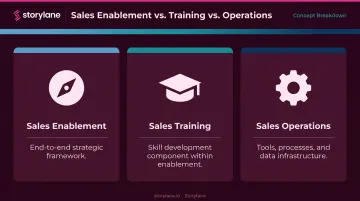
| Term | What It Actually Means |
|---|---|
| Sales enablement | The end-to-end strategic framework |
| Sales training | One component within it, focused on skill development |
| Sales operations | The team responsible for tools, processes, and data |
A training program without the right content and tools is incomplete. A well-stocked content library without coaching doesn't change how reps actually sell. Each function depends on the others to deliver results.
Key Components of an Effective Sales Enablement Strategy
A Clear Charter Tied to Revenue Outcomes
A sales enablement charter defines the specific, observable behaviors the strategy is designed to drive — and connects each directly to a revenue outcome.
"Improve discovery skills" is not a charter. "Reps uncover at least three confirmed pain points before introducing the product" is. Vague goals produce activity, not results. If a manager can't observe and score a behavior in a call review, it doesn't belong in the charter.
Each behavioral target should map to a metric: win rate, sales cycle length, quota attainment, or average deal size. That connection is what earns continued investment from leadership.
A Centralized Content Management System
Scattered assets kill rep productivity. When demos live in one folder, battle cards in another, and proposal templates in someone's inbox, reps either waste time searching or create their own materials. Either way, messaging consistency breaks down.
A centralized content library needs:
- Version control so outdated assets don't reach buyers
- Clear ownership for each high-use asset
- Strong searchability by deal stage, persona, and use case
The cost of disorganization is real. Seismic's 2023 research found reps without enablement technology spend 10 hours per week searching for or recreating content.
Structured Training and Coaching Infrastructure
Effective enablement needs two separate things that often get collapsed into one:
- Milestone-based onboarding — a structured 30/60/90-day ramp, not an information dump in week one
- Ongoing coaching loop — managers coaching on observed behaviors from live deals, not just pipeline reviews
Onboarding gets reps to baseline. Continuous coaching is what separates average performers from top performers over time.
Integrated Technology Stack
Tools only earn adoption when they live inside existing workflows. A new login that reps have to remember is a login that won't get used.
The core categories:
- CRM — system of record for pipeline and rep activity
- Sales enablement platform — content management, training delivery, and asset tracking
- Conversation intelligence — coaching at scale by analyzing actual call behavior
Where interactive demos fit in: Storylane connects directly with Salesforce, HubSpot, Marketo, Outreach, Gong, and 50+ other tools, pushing demo engagement signals into the rep's existing workflow rather than requiring a separate destination to check.
Cross-Functional Feedback Loops
Content goes stale without a closed loop. The cycle should work like this:
- Reps surface buyer objections and content gaps from live deals
- Marketing updates assets based on that signal
- Win/loss data feeds back into messaging strategy
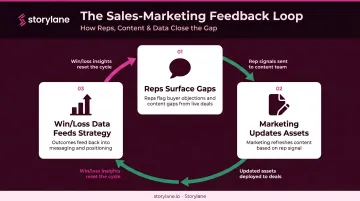
Without this loop, marketing produces content based on assumptions, reps ignore it, and the gap between what buyers ask and what assets exist keeps widening.
Sales Enablement Best Practices
Align Sales and Marketing Around Shared Goals
The most common misalignment pattern: marketing produces content based on internal assumptions, sales ignores it and creates ad-hoc materials, and messaging becomes inconsistent across the funnel. SiriusDecisions research puts the scale of the problem plainly: 65% of sales content created by marketing is never used by sales.
Practical alignment tactics that actually work:
- Agree on shared ICP and buyer persona definitions — not separate versions for each team
- Set joint KPIs tied to pipeline and revenue, not activity metrics
- Hold regular cross-team content reviews where reps flag what buyers are actually asking
- Establish a formal channel for reps to submit content gaps back to marketing
Personalize Buyer Engagements at Scale
B2B buyers arrive at sales conversations better informed than ever. Gartner found that 73% of B2B buyers actively avoid suppliers who send irrelevant outreach. Generic pitches don't just underperform; they actively damage relationships.
Personalization at scale requires two things: content that maps to specific buyer roles and use cases, and a mechanism for delivering it before the first conversation begins.
Interactive demos are one of the most effective pre-call enablement assets for this. Storylane's Buyer Hub lets prospects self-select and explore demos organized by use case, persona, and feature area. They arrive at the first meeting already familiar with the capabilities most relevant to them. Reps receive Slack alerts with engagement data (time spent, features explored, completion rate) before making contact, so discovery can start with genuine signal rather than generic questions.
SentinelOne uses this model at major industry events like RSA Conference — their demo hub serves C-suite, technical, and operations stakeholders from a single centralized location, enabling different audiences to self-navigate at their own level.
Build Structured Onboarding and Continuous Training
"Firehose" onboarding — overwhelming reps in week one — produces short retention and slow ramp. A milestone-based approach works better:
| Period | Focus |
|---|---|
| Days 1–30 | Product fundamentals, ICP, buyer personas, core messaging |
| Days 31–60 | Full-cycle practice, certification on key skills and talk tracks |
| Days 61–90 | Live deals with structured coaching support |
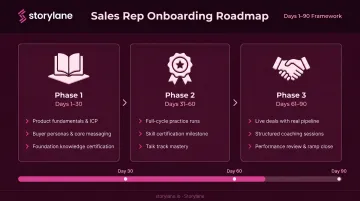
Training must continue well past onboarding. Buyer personas shift, products change, and competitive dynamics evolve. Gartner has noted that sellers begin forgetting training content immediately after a session ends, which is why periodic all-hands events don't hold.
More effective approaches:
- Spaced repetition: short reinforcement drills delivered at regular intervals, not large quarterly training blocks
- Micro-training in the flow of work: learning surfaced inside the tools reps already use, exactly when they need it
Leverage Data and Analytics to Refine Strategy
Most teams track lagging indicators — win rate, quota attainment, average deal size. These matter, but they're backward-looking. By the time they shift, months of activity have already happened.
Leading indicators give you earlier warning:
- Content usage rate (which assets reps actually deploy in deals)
- Training completion and certification rates
- Talk-track adoption observed in call reviews
- Coaching session frequency
The real value comes from connecting the two layers. When reps consistently set confirmed next steps on discovery calls, does deal closure rate improve? When a specific demo gets high engagement, does that correlate with faster progression to proposal? That correlation builds the internal case for continued investment.
Storylane's Demo Signals feature surfaces exactly this type of behavioral data: time spent, completion rates, feature exploration, and return visits tracked at the account level. It pushes that data directly into Salesforce and HubSpot records so it lives alongside deal data, not in a separate tool.
Measure Regularly and Avoid Common Failure Modes
Most enablement programs fail in predictable ways:
- Treating training attendance as success without tracking behavior change
- Building content in isolation from rep feedback
- Launching tools that live outside rep workflows
- Allowing the function to operate without clear ownership or a RACI
Review cadence that works:
- Monthly — adoption metrics, behavior indicators, content usage
- Quarterly — outcome metrics, strategic adjustments, asset retirement decisions
Give teams explicit permission to retire underperforming content and unused initiatives. Accumulating dead weight in a content library is not neutral — it makes the good assets harder to find.
Building a Sales Enablement Content Strategy
Content is where sales strategy meets buyer experience. Yet the same SiriusDecisions data cited earlier confirms that 65% of marketing-created content never gets used by sales — and less than 10% of B2B marketers map all content to audience and buyer journey stages.
Producing more content isn't the answer. The real work is organizing existing assets around the specific moments reps face in deals.
Buyer-Journey Content Mapping
| Stage | Content Types | Purpose |
|---|---|---|
| Awareness | Blogs, thought leadership | Introduce the problem |
| Interest | White papers, webinars | Build category understanding |
| Evaluation | Case studies, ROI calculators | Provide proof and business case |
| Decision | Battle cards, proposals | Handle objections, close |
| Post-sale | Onboarding guides | Drive adoption and expansion |
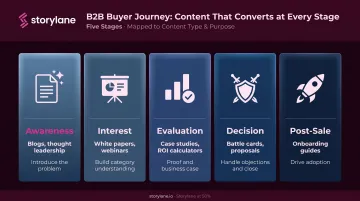
Each asset should answer one specific buyer question at one specific moment — not function as an all-purpose resource.
Key Content Types for Sales Enablement
The highest-impact asset types for B2B sales teams:
- Sales playbooks — deal navigation, objection handling, and qualification frameworks
- Battle cards — competitive positioning for live objection handling
- Case studies — proof for evaluation-stage buyers who need external validation
- Interactive demos — self-serve product exploration before and between calls
- One-pagers and email templates — quick-turn rep assets for outbound and follow-up
- Proposal templates — consistent structure with room for deal-specific customization
Interactive demos deserve particular attention. Static slide decks require a rep to explain what the product does. An interactive demo lets buyers experience it themselves — a meaningful difference in how evaluation-stage conversations begin.
Storylane supports multiple demo formats: guided tours, multi-chapter branching demos by persona, offline demos for conference use, and AI video avatar walkthroughs. Built-in engagement analytics track which features held attention and where prospects dropped off. Companies like PaySauce have reported that prospects who engage with Storylane demos arrive at live sales calls "already engaged and primed," compressing the discovery phase.
Content Governance and Maintenance
Content without governance becomes a liability. Outdated battle cards damage credibility in live deals; stale case studies reference products that no longer exist. When reps can't trust the library, they build rogue materials — and messaging consistency breaks down.
A workable governance model:
- Assign a named owner to every high-use asset
- Set a defined refresh cadence (quarterly for fast-moving content, annually for foundational pieces)
- Establish a retirement rule — if an asset goes unused for a defined period, remove it
A smaller, well-maintained library outperforms a sprawling one every time.
How to Measure Sales Enablement Effectiveness
Measurement requires two layers working together, not one or the other.
Leading indicators (proof enablement is being executed):
- Content usage rate and asset engagement
- Coaching session frequency and quality
- Onboarding milestone completion
- Talk-track adoption in call reviews
Lagging indicators (proof it's producing results):
- Win rate and quota attainment
- Average deal size
- Sales cycle length
- Time-to-productivity for new hires
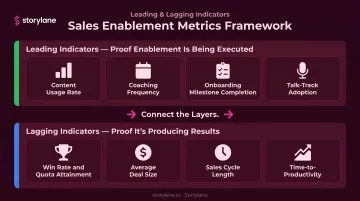
Connect the layers by tracking what happens downstream when a specific behavior improves. If reps trained on multi-threading start engaging three stakeholders per deal, does win rate shift? That correlation is how you build the internal case for investment — and identify which enablement activities actually deliver.
The measurement gap is real. The Sales Enablement Collective's 2025 report found only 43.8% of enablement professionals are aligned with their senior leadership on which success metrics matter most. That misalignment makes programs vulnerable to budget cuts when outcomes take time to appear.
Closing that gap starts with agreeing on a shared reporting cadence before a program launches. When presenting to leadership, frame each metric as a before/after story: pick one leading indicator and one lagging indicator from the same initiative, track them over 90-day cycles, and show the correlation explicitly. That structure makes it harder to dismiss enablement as overhead when results are still building.
Recommended reporting cadence:
- Monthly: leading indicators (content usage, coaching frequency, onboarding progress)
- Quarterly: lagging indicators (win rate, quota attainment, deal size, sales cycle length)
- Annually: time-to-productivity benchmarks for new hire cohorts vs. prior year
Frequently Asked Questions
What is the difference between sales enablement and sales training?
Sales training is one component within sales enablement focused on skill development. Sales enablement is the broader strategic system that encompasses training, content management, tools, coaching, and cross-functional feedback loops.
Who is responsible for sales enablement in a B2B organization?
Ownership is cross-functional: a sales enablement manager leads strategy, marketing owns asset creation, sales ops handles tool and data infrastructure, and frontline managers reinforce behaviors through coaching.
What are the most important KPIs to track for sales enablement?
Track both layers: leading metrics (content usage rate, coaching cadence, training completion) and lagging outcomes (win rate, quota attainment, ramp time, sales cycle length). Tracking only lagging indicators makes course-correction too slow to act on.
How do you align sales and marketing teams through sales enablement?
Start with shared ICP and buyer persona definitions, then set joint KPIs tied to pipeline. From there, create a structured process for reps to flag content gaps back to marketing and centralize all assets in a shared library both teams can access.
What role do interactive demos play in modern sales enablement?
Interactive demos enable buyers to self-explore product features before speaking with a rep — surfacing genuine intent, reducing time spent on basic discovery, and allowing live sales conversations to focus on specific use cases and objections rather than a generic product walkthrough.
How long does it take to see results from a sales enablement strategy?
Leading indicators like content usage and training adoption can improve within 30 to 60 days of launch. Meaningful business outcomes — improved win rates, higher quota attainment — typically take 3 to 6 months to reflect the investment; teams with shorter sales cycles tend to see results on the earlier end.