The stakes for understanding this path have never been higher. According to Gartner, 75% of B2B buyers now prefer a rep-free sales experience — meaning buyers are researching, evaluating, and building consensus long before they talk to a salesperson. Sales cycles are growing longer, buying groups are expanding, and teams that misread the journey lose deals they should have won.
This guide covers exactly what the B2B customer journey is, the five stages that define it, how it differs from B2C, and a practical step-by-step approach to mapping and optimizing it for your go-to-market team.
Key Takeaways
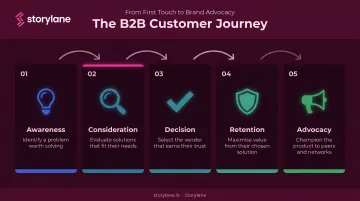
- The B2B customer journey spans five stages: Awareness, Consideration, Decision, Retention, and Advocacy — and buyers rarely move through them in order.
- Average B2B buying decisions involve 13 stakeholders across multiple departments, making a single-threaded sales approach insufficient.
- Mapping the journey requires real buyer data — not internal assumptions — built around personas, touchpoints, and drop-off signals.
- Today's buyers expect self-service experiences; interactive demos, ungated content, and digital-first touchpoints are no longer optional.
- A journey map is a living document — review it every 6–12 months or after any significant market or product change.
What Is the B2B Customer Journey?
The B2B customer journey covers every interaction a buying organization has with a vendor — from the first brand touchpoint through purchase, onboarding, renewal, and advocacy.
Two terms often get conflated here, and the distinction matters:
- Buyer journey: The pre-purchase decision path — from problem recognition to vendor selection
- Customer journey: The full relationship lifecycle, including everything after the contract is signed
If your team only tracks the buyer journey, you're missing the retention and advocacy stages where recurring revenue is actually built.
What Makes B2B Uniquely Complex
B2B purchases aren't made by one person with a credit card. Forrester's 2024 State of Business Buying report found that an average of 13 people are involved in a typical buying decision, and 89% of purchases involve two or more departments.
Each stakeholder enters at a different point with different priorities. A CFO scrutinizes ROI, an IT lead needs security documentation, a procurement manager wants contract flexibility, and end users want to know the product won't complicate their daily work. Cycles run from several months to well over a year, driven by business logic, risk reduction, and consensus.
The Journey vs. The Funnel
Many teams track the sales funnel — a linear, internal model showing leads moving from MQL to SQL to closed-won. The customer journey is different. It reflects how buyers actually behave: looping back between research and evaluation, stalling while waiting for stakeholder buy-in, and re-engaging months after going quiet.
Teams that only manage the funnel miss the friction points that kill deals beyond their visibility.
The 5 Stages of the B2B Customer Journey
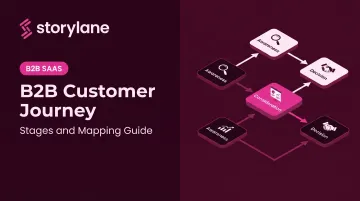
Think of these five stages as a framework, not a rigid sequence. Buyers loop back, stall, and revisit earlier stages. Different stakeholders in the same account can be at different stages simultaneously.
Awareness
A business identifies an operational gap or pain point and starts asking whether solutions exist. Buyers at this stage aren't looking for your product — they're still defining their problem.
What works here:
- SEO-optimized blog content that addresses pain points, not product features
- Thought leadership and industry reports
- LinkedIn content and podcasts where buyers are already spending time
- Ungated guides that answer the questions buyers are typing into Google
The key principle: you must be discoverable before buyers know to look for you specifically. If your content only talks about your solution, you're invisible during the stage when buyers form their shortlists.
Consideration
The buyer has identified potential solutions and is now comparing vendors, evaluating fit, and building a business case. This is the most content-intensive stage of the journey.
What performs best:
- Case studies and ROI-focused content
- Comparison guides and analyst-style buying criteria
- Webinars and live Q&A sessions
- Product demos — ideally self-serve
Buyers in this stage increasingly want to evaluate products on their own terms, without scheduling a call just to see what the software looks like. Storylane's interactive demos address this directly: prospects can explore the product independently, navigate to features most relevant to their role, and arrive at live sales conversations already informed.
Companies like Cin7 and Goformz deployed this approach because prospects were losing interest between demo requests and actual calls. A self-serve demo bridges that gap before it becomes a lost deal.
Decision
Once evaluation wraps up, the buying group narrows to one or two vendors and moves toward final approval. Sales involvement increases here, but the outcome is heavily influenced by the groundwork laid during Consideration.
What drives final selection:
- ROI calculators and business case documentation
- Security and compliance paperwork
- Proof-of-concept trials and sandbox demos
- Pricing negotiation and procurement workflows
- Reference calls and peer reviews (G2, Capterra)
Demo quality matters at this stage. Personalized, role-specific demo hubs that buying committees can revisit asynchronously — with private access controls for sensitive evaluations — give sellers a meaningful edge over vendors sending one-size-fits-all slide decks.
Retention
After purchase, the focus shifts entirely to onboarding speed, product adoption, and time-to-value. For subscription businesses, the economics are unforgiving.
According to Harvard Business Review, acquiring a new customer costs five to 25 times more than retaining an existing one. A 5% improvement in retention can increase profits by 25% to 95%. For SaaS businesses with subscription economics, churn is an existential threat.
What drives retention:
- Structured onboarding flows that reduce time-to-value
- Interactive product walkthroughs for self-serve adoption
- Customer success check-ins tied to usage data
- Proactive support before issues surface
Whispli's customer success team, for example, uses Storylane interactive demos for post-sale onboarding, giving new users guided walkthroughs and self-serve feature exploration without requiring live sessions for every question. The result: faster adoption with less CS team overhead.
Advocacy
Satisfied customers don't automatically become advocates. Advocacy must be built.
Advocacy creates top-of-funnel fuel — G2 reviews that surface in competitor searches, reference calls that close deals, and co-marketed case studies that establish credibility in new verticals. The tactics that cultivate it:
- Referral programs with real incentives
- Customer community building
- Case study partnerships that give customers visibility
- Moments that genuinely exceed expectations
Most B2B teams underinvest here. But the advocates you develop today are generating the peer reviews and social proof that your next buyers will encounter before they ever hear your name.
How the B2B Customer Journey Differs From B2C
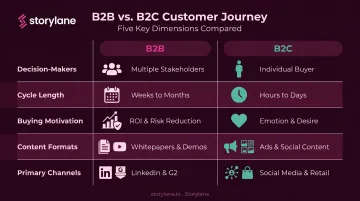
The structural differences go beyond deal size. Here's a direct comparison:
| Dimension | B2B | B2C |
|---|---|---|
| Decision-makers | 5–16 stakeholders across multiple functions | 1–2 people, often one |
| Cycle length | Months to over a year | Minutes to days |
| Buying motivation | ROI, risk reduction, cross-functional consensus | Convenience, emotion, price |
| Key content formats | Case studies, analyst reports, demos, whitepapers | Ads, influencer content, social proof |
| Primary channels | LinkedIn, email sequences, events, G2/Capterra | Social media, paid search, retail |
The Millennial and Gen Z Buyer Shift
The gap between B2B and B2C buying behavior is narrowing. Forrester's research found that Millennials and Gen Zers accounted for 71% of the B2B buyer population in its 2023 annual State of Business Buying survey. These digital-native buyers expect consumer-grade experiences even for complex enterprise software — easy product trials, transparent pricing, and on-demand content.
For B2B sellers, this means self-serve buying paths aren't optional — they're the baseline expectation for getting into serious consideration.
Channel and Touchpoint Differences
That shift in buyer expectations also reshapes where and how those buyers engage. B2B journeys now span touchpoints that most B2C teams never map:
- Digital: LinkedIn, G2/Capterra, email sequences, webinars, SEO content
- Offline: Industry events, analyst briefings, executive dinners, in-person demos
- Hybrid: Virtual conferences, peer community forums, on-demand analyst reports
McKinsey's 2024 research found that B2B customers use an average of 10 interaction channels, up from just 5 in 2016. That's a doubling in channel complexity in under a decade, with no sign of leveling off.
How to Build a B2B Customer Journey Map
A journey map is a visual, data-backed representation of how buyers actually move through each stage — not how your internal team assumes they do. The core principle: build it outside-in.
Step 1: Define Your ICP and Buyer Personas
Start with clarity on who you're mapping. Two distinct definitions matter here:
- Ideal Customer Profile (ICP): Firmographic fit — company size, industry, revenue, tech stack
- Buyer personas: The individual stakeholders within those accounts
In B2B, multiple personas must be mapped separately because they enter the journey at different points and evaluate the purchase differently:
- Champion: Drives the project internally, needs to build a business case
- Economic buyer: Controls budget, needs ROI justification
- End user: Cares about usability, not ROI
- Technical evaluator: Focused on security, integrations, and implementation complexity
For a platform like Storylane, these personas look quite different in practice: a sales leader cares about pipeline influence and demo-to-meeting conversion, while a product marketing manager cares about demo creation speed and content scalability.
Step 2: Gather Qualitative and Quantitative Data
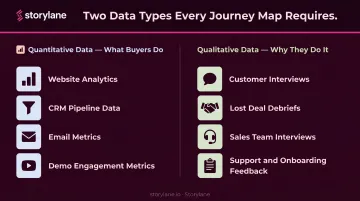
Accurate journey maps require two data types working together:
Quantitative (what buyers do):
- Website analytics and conversion rates
- CRM pipeline data and stage velocity
- Email open and click-through rates
- Demo engagement metrics
Qualitative (why they do it):
- Customer interviews — the single highest-value input
- Lost deal debrief conversations
- Sales team interviews
- Support tickets and onboarding feedback
The most common and costly mistake in journey mapping is building the map purely from internal assumptions. Teams end up mapping the journey they want buyers to take, not the one buyers actually take.
Step 3: Map Touchpoints to Each Stage
List every touchpoint from first impression to renewal — then assign each to a stage. This spans more interactions than most teams expect.
Forrester's 2021 B2B Buying Study found that B2B buying interactions rose from 17 in 2019 to 27 in 2021, covering both self-guided and personal interactions. A 27-interaction journey means buyers cycle repeatedly through education, comparison, validation, and sales conversations before deciding.
Touchpoints to map by category:
- Digital: Paid ads, organic search, website, email, social, product, G2 reviews
- Offline: Trade shows, events, in-person meetings, phone calls
- Hybrid: Webinars, virtual demos, analyst briefings
Storylane's Account Reveal feature contributes directly here — it identifies which companies are engaging with demo content before they self-identify, converting anonymous touchpoints into company-level data that sales can use for targeted outreach.
Step 4: Identify Emotions, Pain Points, and Drop-Off Moments
The map must capture not just what happens at each touchpoint, but how the buyer feels — frustrated, confident, confused, or ready to move forward.
Where to look for friction:
- High exit rates on product pages or pricing pages
- Pipeline stages where deals consistently stall
- Support ticket spikes in the first 30 days post-onboarding
- Low demo completion rates or attendance drop-off
Storylane's demo analytics surface this kind of intelligence specifically during product evaluation. The platform tracks step-level completion rates, time spent per feature, CTA clicks, and return visits — then automatically classifies prospects as Low, Medium, or High intent.
When a high-intent prospect re-engages, sales teams get real-time Slack alerts with full context on exactly what was explored. Instead of "just checking in," a rep can open with: "I noticed you spent time on the workflow automation section — want to walk through how that would work in your environment?" That context turns a generic follow-up into a conversation the buyer actually wants to have.
Step 5: Align Teams and Assign Ownership
The map only creates value if every revenue-facing team knows their role in it.
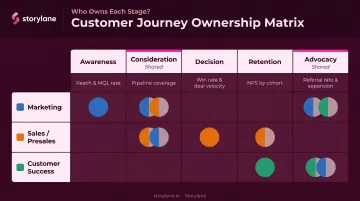
Assign ownership by stage:
- Awareness: Marketing (SEO, content, demand gen)
- Consideration: Marketing + Sales (demos, case studies, nurture sequences)
- Decision: Sales + Presales (custom demos, proposals, negotiation)
- Retention: Customer Success (onboarding, adoption, QBRs)
- Advocacy: Customer Success + Marketing (case studies, referral programs)
Each owner needs metrics tied to their stage — not just revenue. Pipeline coverage, demo engagement rates, onboarding completion scores, and NPS by cohort all tell part of the story.
Treat the map as a living document. Review it every 6–12 months — or sooner if you change your ICP, launch a new product tier, or shift your go-to-market motion. A map built on last year's buyer behavior will steer your teams toward friction points that no longer exist and blind spots that do.
Common Mistakes in B2B Customer Journey Mapping
Even well-intentioned mapping efforts fall apart in predictable ways. These three mistakes show up repeatedly — and each one quietly undermines the work that went into the map.
- Building around internal processes, not buyer behavior. Most teams map how they want buyers to move, not how buyers actually do. The result: misaligned content, missed touchpoints, and budget spent in channels your buyers aren't using.
- Assuming the journey is linear. B2B buyers loop, stall, re-engage, and introduce new stakeholders at unexpected moments. A neat Awareness → Decision sequence gives teams false confidence — and no explanation when deals go dark.
- Treating the map as a finished deliverable. Buyer behavior shifts. Competitive landscapes change. Products evolve. A map that isn't revisited becomes actively misleading, optimizing for an experience that no longer exists. Schedule regular reviews and treat it as a living document.
Frequently Asked Questions
What are the 4 types of B2B?
The four main B2B business models are product-based, service-based, software/SaaS, and distribution/reseller. Each has a different journey structure: SaaS typically pairs shorter initial cycles with longer retention-focused journeys, while product-based or distribution models tend toward more transactional, repeat-purchase dynamics.
What is an example of a B2B customer?
A marketing operations team at a mid-market SaaS company evaluating a new CRM platform is a classic example. The buying committee typically spans a marketing ops manager identifying the need, an IT lead on security, a CFO on budget, and end users on usability, all before a contract is signed.
How is the B2B customer journey different from the B2C customer journey?
B2B involves multiple decision-makers with different priorities, longer cycles measured in months, and purchases justified through business value and ROI. B2C typically involves a single buyer, decisions made in hours or days, and emotional or convenience-driven motivations.
How long is a typical B2B sales cycle?
It varies significantly by deal size and buying committee complexity. CSO Insights data reported via MarketingCharts indicates that 74.6% of B2B sales to new customers take at least four months to close, with 46.4% taking seven months or more. Salesforce's 2026 research adds that 57% of sales professionals say cycles are getting longer, not shorter.
What are the most important touchpoints in the B2B customer journey?
High-impact touchpoints include SEO content and thought leadership at Awareness, interactive product demos and case studies at Consideration and Decision, and structured onboarding flows with customer success check-ins at Retention. Peer review sites like G2 and Capterra also matter most at the Decision stage, where buyers seek independent validation.
How often should a B2B customer journey map be updated?
Review the map every 6–12 months under normal conditions. Update it immediately after any significant change — a new ICP, a new product line, a go-to-market pivot, or measurable shifts in how buyers are finding and evaluating you. A map that's 18 months old in a fast-moving SaaS market is likely misleading more than it's helping.