According to Demand Gen Report's 2024 research, 80% of B2B buyers initiate first vendor contact only after they're 70% through the buying journey — with 84% already having a preferred vendor and 83% having set their requirements before talking to anyone in sales.
That gap — between when a buyer starts deciding and when a seller finds out — is where deals are won or lost.
This article explains the five stages of the buyer decision process, what drives buyer behavior at each one, and what sales and marketing teams can do to influence each stage without pushing prospects away.
Key Takeaways
- The buyer decision process has five stages: problem recognition, information search, evaluation of alternatives, purchase decision, and post-purchase behavior.
- B2B buyers complete most of their research before contacting any vendor, so early visibility and self-serve content are non-negotiable.
- Shortlists form fast: 63% of B2B tech buyers consider only 2–3 products before purchasing.
- Stage-aligned messaging, not generic product pitches, is what shortens deal cycles.
- Post-purchase experience directly determines renewal rates, reviews, and referral volume.
What Is the Buyer Decision Process?
The buyer decision process is the mental and behavioral sequence a person or buying group moves through — from first recognizing a problem to evaluating a purchase after the fact. Philip Kotler and Kevin Lane Keller formalized this into the five-stage marketing model most practitioners use today.
Understanding this sequence matters because each stage calls for a different response from sales and marketing teams.
How It Differs From Related Concepts
The buyer decision process is often confused with two adjacent ideas:
- The buyer's journey — a marketing funnel construct (awareness, consideration, decision) that describes channel-level stages, not the buyer's internal psychology
- Consumer behavior — the broader academic field covering attitudes, motivation, and social influence across all purchase types
The buyer decision process is specifically the cognitive sequence: what happens inside a buyer's head, in what order, and why.
The Four Types of Buying Decisions
Not every purchase triggers all five stages equally. The depth of engagement depends on buying type:
| Buying Type | Involvement Level | B2B Example |
|---|---|---|
| Routine/habitual | Low — stages compressed or skipped | Renewing a SaaS subscription |
| Limited decision-making | Moderate — some comparison | Switching project management tools |
| Extensive decision-making | High — full five stages engaged | First-time enterprise software purchase |
| Impulse | Unplanned — emotionally triggered | Buying a tool after a conference demo |
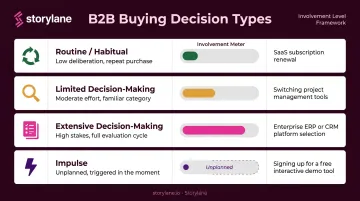
High-investment B2B SaaS purchases sit firmly in the extensive category. Each of the five stages in that category carries real stakes — and specific opportunities for sellers who understand what buyers need at each one.
The 5 Stages of the Buyer Decision Process
Each stage represents a distinct mindset. Buyers may spend days or months at any one of them. They don't always move forward linearly — looping back, stalling, and sometimes restarting from scratch.
Stage 1: Problem Recognition
The process begins when a buyer notices a gap between where they are and where they want to be. In B2B, that trigger is usually organizational: a process breaks down, a competitor pulls ahead, a new regulation creates compliance pressure, or a key team member leaves and exposes a workflow dependency.
Two types of triggers drive this stage:
- Internal: mounting inefficiency, failed processes, rising costs, team frustration
- External: peer recommendations, competitor announcements, analyst reports, new regulations
What this means for sellers: Buyers who haven't recognized the problem yet won't respond to product messaging. It simply doesn't land. Marketers need to validate and name the problem first — thought leadership, pain-point content, and awareness campaigns that describe the problem in the buyer's own language are what move buyers into stage two.
Stage 2: Information Search
Once a problem is recognized, buyers go looking for solutions on their own, without contacting vendors. They use past experience and brand memory, but most of the research happens through external sources: search engines, peer communities, review platforms, and increasingly, AI-generated search results.
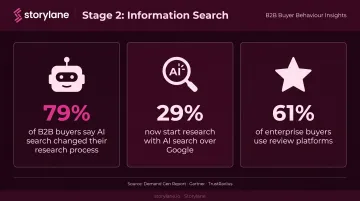
G2's 2025 Buyer Behavior Report found that 79% of B2B buyers say AI search has changed their research process, and 29% now start with AI search more often than Google. Review platforms are used by 61% of enterprise buyers. The research stage was the longest part of the buying process for 34% of buyers surveyed.
What this means for sellers: Visibility here depends on:
- SEO-optimized content that answers the buyer's problem, not just pitches the product
- Active presence on G2, Capterra, and TrustRadius with recent, credible reviews
- Content that surfaces in AI-generated answers and community discussions
- Peer-level social proof — case studies, customer quotes, and testimonials from companies the buyer recognizes
Companies that aren't findable or credible at this stage are frequently eliminated before a sales conversation begins. Storylane's Account Reveal feature helps sales teams identify which companies are exploring demos anonymously during this stage — surfacing firmographic data on visitors who haven't yet raised their hand.
Stage 3: Evaluation of Alternatives
Once a shortlist forms, buyers compare their options on specific criteria: features, pricing, integrations, ease of implementation, security, and perceived risk of switching. The shortlist narrows faster than most sellers expect — 63% of B2B technology buyer shortlists include only 2–3 products, and 78% of buyers choose a product they had heard of before research began, rising to 86% for enterprise buyers (TrustRadius, 2024).
This is where proof replaces positioning. Late-stage buyers prioritize:
- Product demos (77%)
- User reviews (63%)
- ROI calculators (61%)
Generic marketing content stops working here. Buyers want to experience the product, not hear about it.
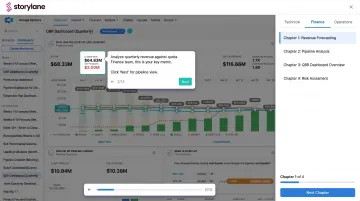
What this means for sellers: Interactive demos, competitive comparison pages, and case studies with measurable outcomes do the heaviest lifting at this stage. Storylane supports HTML, screenshot, video, guided, and mixed-media demo formats, letting prospects explore the product before a sales call. Multi-chapter demos allow different stakeholders — technical teams, finance, operations — to each navigate a path relevant to their evaluation criteria, addressing the whole buying committee at once.
Stage 4: Purchase Decision
Choosing a preferred vendor doesn't mean the deal closes. Even after a buyer has made their mental decision, two forces can unravel it:
- Negative peer feedback — a trusted contact shares a bad experience, reopening evaluation
- Unforeseen circumstances — budget freezes, leadership changes, competing priorities
Challenger's 2024 research puts the scale of this problem plainly: purchase attempts end in no decision 38% of the time, and 40–60% of deals with stated buyer intent are still lost to indecision. The barrier isn't product fit. It's friction, risk perception, and stakeholder misalignment.
The seller's job at this stage is removing obstacles, not adding information:
- Simplify procurement steps and provide clear pricing
- Provide executive sponsorship for large deals
- Surface testimonials from buyers in comparable situations
- Address remaining objections before they harden into blockers
Storylane's personalized demo experiences use dynamic tokens — prospect names, company logos, and relevant metrics — so buyers see a version of the product that already maps to their context. Combined with real-time Slack alerts when a prospect re-engages with a demo, sales teams can reach out at exactly the moment a buyer is reconsidering their commitment.
Stage 5: Post-Purchase Behavior
The purchase isn't the end of the process — it's the beginning of a new one. Buyers evaluate whether the product delivered on its promises. The outcome of that evaluation feeds directly back into stage two for future buyers: satisfied customers leave positive reviews and make referrals; dissatisfied ones churn, leave negative reviews, and actively derail future deals.
The prevalence of post-purchase regret is higher than most teams assume. Gartner's 2024 research found that more than 80% of HR technology buyers experienced some purchase regret after a software decision.
What this means for sellers: Onboarding, feature adoption tracking, and customer success check-ins aren't afterthoughts — they're revenue protection. ChurnZero's 2025 study found net revenue retention was 98% with dedicated CSMs versus 90% without. The gap between pre-sale expectations and post-sale reality drives churn. Closing that gap starts before the contract is signed, by not overpromising during the sales process.
Key Factors That Influence the Buyer Decision Process
Several variables determine how intensely a buyer engages with each stage and how long the overall process takes:
- Involvement Level — high-cost, high-risk, or first-time purchases trigger deeper engagement at every stage. Routine repurchases may skip stages entirely.
- Number of Decision-Makers — Challenger's 2024 data shows buying committees now average 11 people in complex deals. Each stakeholder has their own stage, their own information needs, and their own objections.
- Information Quality — gaps in available product information increase perceived risk and stall progress. Transparent pricing, detailed documentation, and accessible demos all reduce friction.
- Emotional vs. Rational Triggers — emotional factors initiate the journey in B2B just as they do in consumer buying. Google/CEB/Motista research found B2B purchasers are nearly 50% more likely to buy when they perceive personal value — confidence, career protection, reduced anxiety. ROI analysis and feature comparisons follow, but they confirm a direction the buyer was already leaning.
- Brand Familiarity — buyers who recognize a vendor from stage two are far more likely to shortlist them. TrustRadius found 71% of buyers ultimately purchase the product that was their first choice, and strong brand recall shortcuts the entire evaluation process.
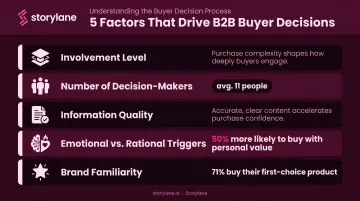
Understanding these factors tells you where deals slow down — and exactly where better information, earlier visibility, or a more memorable first impression changes the outcome.
How Sales and Marketing Teams Can Influence Each Stage
The foundational discipline here is stage alignment: meeting buyers where they are, not where you want them to be. Pushing purchase messaging at a buyer still in problem recognition wastes budget and creates distrust. Sending educational content to someone ready to sign slows the deal.
Problem Recognition and Information Search
At these early stages, visibility and credibility are everything:
- Publish SEO-optimized content that names buyer pain points in their language
- Build and maintain a presence on G2, TrustRadius, and Capterra with fresh reviews
- Create thought leadership that surfaces in AI-generated search results and community forums
- Make educational resources ungated and accessible — 51% of buyers say content that requires too many steps to access blocks their research (Demand Gen Report, 2024)
Evaluation of Alternatives
Here, the goal is differentiation backed by evidence:
- Deploy interactive demos buyers can explore without scheduling a call
- Build competitive comparison pages that address the criteria buyers actually use
- Develop case studies with specific, quantifiable outcomes — not generic success stories
- Provide reference customer access for enterprise deals
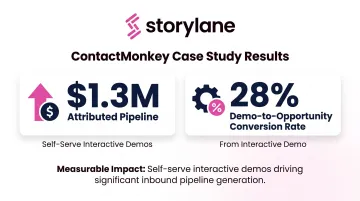
ContactMonkey, a Storylane customer, generated $1.3M in attributed pipeline from a single gated interactive demo, with 28% of demo leads converting to opportunities — roughly double their rate from other inbound sources. Prospects who self-qualified through the demo arrived at sales conversations already primed to buy.
That level of pre-qualification makes the final stage considerably easier to close.
Purchase Decision
At this stage, friction removal and reassurance drive conversion:
- Simplify procurement and provide clear, accessible pricing
- Surface testimonials from buyers in comparable industries and deal sizes
- Ensure sales teams receive real-time alerts when a prospect re-engages
- Use personalized demo experiences to address fit concerns before they become objections
Storylane's Buyer Hub also supports multi-stakeholder deals by giving champions a curated, shareable destination: one place to distribute relevant demos to IT, finance, and legal colleagues without losing control of the narrative.
Post-Purchase
Once the deal closes, value realization and advocacy become the focus:
- Design onboarding to deliver a fast, visible first win
- Track feature adoption to identify at-risk accounts early
- Request reviews at positive milestone moments — not arbitrarily
- Every satisfied customer feeds directly into the next buyer's information search — close the loop by asking for reviews and case study participation
Common Misconceptions About the Buyer Decision Process
The process is always linear
Buyers loop. They move from evaluation back to information search when a new competitor surfaces, or from purchase decision back to evaluation after a peer shares a negative experience. Sales teams that treat the pipeline as a one-way road misread buying signals and intervene at the wrong moment.
The process ends at purchase
Post-purchase behavior drives churn rates, renewal likelihood, referral volume, and the review pipeline that feeds future buyers. Companies that invest in post-purchase experience generate higher NPS scores and lower customer acquisition costs over time — the two metrics are directly connected.
B2B buyers decide rationally
B2B purchases involve extensive rational evaluation, but the initial trigger and often the final decision are emotionally driven. Fear of making the wrong call, peer pressure, and trust in the vendor all tip decisions that ROI calculators alone cannot close.
Challenger/JOLT research makes this explicit: deals stall not because the product lacks value, but because the buyer fears being wrong. Sellers who address only features miss the emotional dimension that initiates and closes deals.
Frequently Asked Questions
What are the stages of the buyer decision process?
The five stages are: problem recognition, information search, evaluation of alternatives, purchase decision, and post-purchase behavior. The depth and duration of each stage varies significantly based on purchase type — high-involvement B2B purchases engage all five stages fully, while routine repurchases may compress or skip several entirely.
What are the 4 types of buying decisions?
The four types are: routine/habitual (low involvement, repeated purchases), limited decision-making (moderate involvement, some comparison), extensive decision-making (high involvement, thorough research — typical of B2B SaaS), and impulse buying (unplanned, emotionally triggered). Most enterprise software purchases fall into the extensive category.
How does the buyer decision process differ in B2B vs. B2C?
B2B purchases involve multiple stakeholders rather than a single consumer, longer decision timelines, structured evaluation criteria, and procurement or legal review. The information search and evaluation stages are far more complex: buying committees now average 11 people in complex deals, each with their own information needs and approval authority.
Can buyers skip stages in the decision process?
Yes — particularly in low-involvement purchases or when strong brand loyalty exists. In high-involvement B2B purchases, however, skipping stages tends to increase perceived risk and can lead to longer deal cycles or post-purchase regret, as buyers arrive at commitments without sufficient confidence.
What is post-purchase dissonance and why does it matter for sellers?
Post-purchase dissonance is the psychological tension buyers feel after committing: did they choose correctly? For sellers, leaving that question unanswered leads to churn, negative reviews, and lost referrals. Proactive onboarding and early wins resolve the doubt within the first 30 days, when it's most acute.
How can sales teams identify which stage a buyer is in?
Behavioral signals are the most reliable indicators: content consumption patterns, demo engagement depth, the questions a prospect asks, and response times all map to specific stages. Platforms like Storylane track time spent, completion rates, CTA clicks, and return visits — automatically scoring intent and alerting sales teams when a prospect's behavior signals they've moved from evaluation into active purchase consideration.