Introduction
Most people picture inside sales as a room full of headset-wearing agents reading from scripts. That mental image belongs to a different era — and a different job category entirely.
Inside sales is now the default revenue motion for B2B software, cloud computing, and technology companies. Reps close five- and six-figure deals entirely over video calls, email sequences, and shared product demos — no travel required.
According to McKinsey's 2024 B2B Pulse, B2B buyers now use an average of 10 interaction channels, up from just 5 in 2016. Inside sales teams are built to meet buyers across all of them.
Despite how widespread the model is, confusion still surrounds it. People conflate it with telemarketing, assume it's lower-prestige than field sales, or think it only works for small deals. This guide addresses all three assumptions directly.
This guide covers what inside sales actually is, how the process runs stage by stage, how it compares to outside sales, and what skills and tools reps need to execute it effectively.
Key Takeaways
- Inside sales is remote, consultative B2B selling conducted via phone, email, video, and digital tools — not telemarketing.
- The process runs through five stages: prospecting, qualification, demo, objection handling, and close.
- It dominates in B2B SaaS, cybersecurity, cloud, and HR tech — anywhere a product can be demonstrated on a screen.
- Core tools include CRM platforms, video conferencing, sales engagement software, and interactive demo platforms like Storylane.
- It scales faster and at lower cost than field sales, making it the preferred model for high-growth companies.
What Is Inside Sales?
Inside sales is the practice of selling products or services remotely using digital communication channels — phone, email, video conferencing, chat, and social platforms — without traveling to meet prospects. You'll also hear it called "virtual sales" or "remote sales." The label doesn't matter much; the mechanics do.
Why This Model Exists
B2B buying behavior changed. Prospects now research vendors independently, shortlist options before contacting anyone, and prefer digital interactions for much of the process. Gartner found in 2025 that 61% of B2B buyers prefer a rep-free buying experience — meaning they want to self-educate before a rep ever enters the picture. Inside sales aligns with that reality.
What Inside Sales Is Not
The telemarketing comparison comes up constantly — dismiss it. Telemarketing involves agents cold-calling from lists, reading scripts, with minimal product knowledge and no intention of building a relationship.
Inside sales is consultative and strategic: reps learn a prospect's business context, tailor their approach to specific pain points, and guide decision-making over multiple conversations.
The Core Roles
Inside sales teams typically split across three role types:
- SDRs (Sales Development Representatives) — focus on prospecting and qualifying leads; their output is meetings booked for AEs
- AEs (Account Executives) — run discovery calls, deliver demos, handle objections, and close
- CSMs (Customer Success Managers) handle post-sale onboarding and retention, often expanding accounts over time
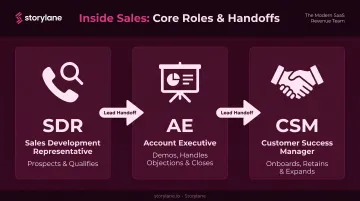
A well-qualified lead from an SDR makes an AE's job significantly easier — the chain only works when each handoff is clean.
Where Inside Sales Dominates
Inside sales is the standard in B2B SaaS, cloud computing, cybersecurity, HR tech, and financial technology. The common thread: the product can be demonstrated on a screen. When you can show a prospect exactly how software solves their problem without a physical visit, the case for field sales weakens considerably.
How Does Inside Sales Work?
Inside sales runs through a defined sequence — from first contact to signed contract. Each stage has a specific objective and a set of tools that support it.
Prospecting and Lead Generation
Everything starts with finding the right people. Inside sales reps work two channels simultaneously:
- Outbound prospecting — researching target accounts via LinkedIn, intent data platforms, and company databases; crafting personalized outreach to decision-makers
- Inbound lead handling — following up on form fills, content downloads, ad clicks, and demo requests from prospects already showing interest
Lead prioritization matters as much as lead generation. Which accounts have both the right profile and active buying signals? Spending time on the wrong prospects is where inside sales efficiency breaks down fastest.
RAIN Group research puts the average number of touchpoints needed to get an initial meeting at 8 — which means inside sales prospecting is a multi-touch discipline, not a one-email exercise.
Qualification and Discovery
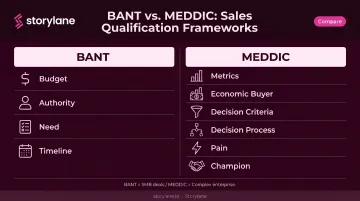
Once a prospect engages, the rep needs to determine whether there's a real opportunity before investing more time. Two qualification frameworks dominate:
- BANT — assesses Budget, Authority, Need, and Timeline
- MEDDIC — goes deeper, evaluating Metrics, Economic Buyer, Decision Criteria, Decision Process, Pain, and Champion
The right choice depends on deal complexity. BANT works well for faster-moving SMB deals; MEDDIC fits complex enterprise sales with multiple stakeholders.
The discovery call does double duty. It qualifies the opportunity and gathers the information the rep needs to build a relevant demo. Strong discovery isn't interrogation. It's structured conversation. Gong's analysis found that the most effective sales calls maintain a 43% seller / 57% buyer talk ratio. When reps dominate the conversation, performance drops.
Product Demo and Pitch
The demo is where inside sales execution becomes visible. A strong demo isn't a product tour. It maps directly to what the prospect said they care about during discovery.
Modern inside sales teams increasingly send self-guided interactive demos before or after the live call. This approach gives prospects a chance to explore the product at their own pace, arrive at meetings already informed, and engage with features relevant to their specific use case. TrustRadius found that 78% of B2B buyers selected products to evaluate before contacting vendors — which means buyers are often doing this exploration regardless. Sales teams that facilitate it win more of that attention.
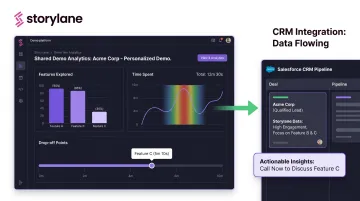
Tools like Storylane take this further by tracking exactly how prospects engage with a shared demo — which features they explored, where they dropped off, how long they spent. That session data turns a follow-up call from a generic check-in into a targeted conversation about what the prospect actually cared about.
Objection Handling and Follow-Up
Objections in inside sales are inevitable. The common ones cluster around pricing, timing, and competitive alternatives. Handling them well remotely is harder than in person : without body language, reps have to work harder on tone, pacing, and active listening to read what's really going on.
Effective objection handling requires:
- Prepared responses to the five or six objections that appear repeatedly
- Case studies and social proof matched to the prospect's industry or situation
- Patience — resistance often means "I need more information," not "no"
Follow-up sequences should be structured and multi-touch — email, phone, and LinkedIn — but they should also be relevant to where the conversation actually is. Sending a generic follow-up after a detailed demo signals you weren't paying attention.
Closing the Deal
In inside sales, the close happens without a handshake. The trust built through prior stages (discovery, demo, objection handling) does the work that a face-to-face final meeting would do in field sales.
The mechanics are straightforward: align on terms, issue the proposal or order form, collect an e-signature digitally, and log the closed deal in the CRM. What matters more is the judgment call on timing : pushing too early kills deals, waiting too long loses momentum.
Inside Sales vs. Outside Sales
The structural difference is simple: outside sales reps travel to meet clients in person. Inside sales reps don't. Everything else flows from that.
| Dimension | Inside Sales | Outside Sales |
|---|---|---|
| Cost per sale | Lower (no travel) | Higher (travel, entertainment) |
| Sales cycle | Typically faster | Often longer |
| Scalability | High — one rep covers more accounts | Limited by geography and travel time |
| Deal complexity | SMB to mid-market; enterprise with strong process | Large enterprise, complex negotiations |
| Relationship style | Digital-first, video-driven | In-person meetings, site visits |
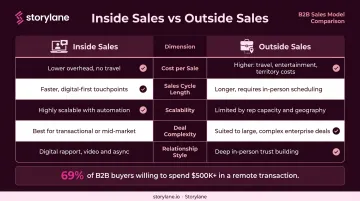
A common assumption is that inside sales can't handle large transactions. The data argues otherwise. McKinsey found that 69% of B2B buyers were willing to spend $500,000 or more in a single remote or digital transaction. The ceiling on deal size in inside sales is much higher than the model's reputation suggests.
The inside/outside distinction has also blurred considerably. In the same McKinsey research, 85% of companies expected hybrid sales to become the dominant model within three years. Most modern sales organizations use inside reps for the bulk of the process and bring in field reps only for final enterprise closes or on-site implementations.
Key Skills and Tools for Inside Sales Reps
Skills That Actually Matter
Communication and active listening — Without body language, everything rides on how a rep sounds and what they ask. Tone, pacing, and open-ended questions determine whether a prospect feels heard or processed.
Prospecting and research — Effective reps identify the right accounts, understand their business context before reaching out, and write outreach specific enough to get a response. Generic sequences produce generic results.
Objection handling — Reps field pricing objections, competitive comparisons, and timing concerns in real time. Composure under pressure is as important as the response itself.
Resilience — Inside sales involves rejection at scale. The reps who build strong pipelines aren't the ones who avoid rejection; they're the ones who don't let it slow them down.
The Core Toolstack
| Category | Examples | Primary Function |
|---|---|---|
| CRM | Salesforce, HubSpot | Pipeline management, contact tracking |
| Video Conferencing | Zoom, Microsoft Teams | Live calls, demos, discovery |
| Sales Engagement | Outreach, Salesloft | Multi-touch sequencing, email and call cadences |
| Interactive Demo | Storylane | Personalized async demos, engagement tracking |
Tool proficiency directly affects how many deals a rep can run simultaneously and how well they execute at each stage. Salesforce's State of Sales data shows 9 in 10 sales teams use AI agents or plan to within two years, meaning the toolstack is only getting more sophisticated.
Storylane gives inside sales reps a way to run personalized async demos without adding meetings to the calendar. Reps build demos from templates, share them via tracked links in outreach sequences, and get real-time Slack alerts when a prospect engages.
That engagement data — features explored, time spent, drop-off points — flows automatically into the CRM. Every follow-up starts from actual knowledge of what the buyer cared about, not a cold recap request.
For teams that can't respond to every inbound visitor in real time, Storylane's RepX acts as an autonomous AI sales rep: it qualifies leads, handles objections, runs interactive demos, and routes prospects to CRM without a human rep present. Teams running lean SDR operations use it to cover inbound volume that would otherwise go unworked.
Frequently Asked Questions
What is meant by inside sales?
Inside sales is the practice of selling products or services remotely — through phone, email, video calls, and digital tools — without traveling to meet clients in person. It's most common in B2B and SaaS businesses where products can be demonstrated and evaluated digitally.
What skills do you need for inside sales?
The core skills are verbal and written communication, active listening, prospecting and research, and objection handling. Proficiency with CRM and sales tools is equally important — as is the ability to build trust and rapport without in-person interaction.
What is the difference between inside sales and outside sales?
Outside sales requires reps to travel to meet clients in person; inside sales is conducted entirely remotely. Outside sales typically handles very large or complex deals, while inside sales is more scalable and cost-efficient — and can support high-value transactions via digital channels.
What tools do inside sales reps use?
Most inside sales reps rely on CRM software (Salesforce, HubSpot), video conferencing platforms (Zoom, Teams), sales engagement tools for multi-touch sequencing, and interactive demo platforms for sharing product walkthroughs prospects can explore on their own.
What industries use inside sales the most?
Inside sales dominates in B2B SaaS, cloud computing, cybersecurity, HR tech, and financial technology — any industry where the product can be shown on a screen and where buyers research and evaluate digitally before engaging a rep.
Is inside sales a good career path?
It offers strong earnings potential and a clear progression: SDR to AE to sales manager. Glassdoor puts the average U.S. inside sales rep salary at $110,676 per year, with significant upside as reps move into AE and leadership roles. The skills transfer broadly across industries.