
Solution selling flips that dynamic. Instead of pitching a product and hoping it sticks, reps first diagnose what the prospect actually needs — then position their offering as the answer to a specific, named problem.
This guide covers everything you need to know:
- What solution selling is and where it came from
- How it differs from product selling
- When to use it (and when not to)
- The six-step process, start to finish
- Honest pros, cons, and best practices
Key Takeaways
- Solution selling prioritizes diagnosing buyer pain before recommending any product
- It's best suited for complex, high-value deals with longer sales cycles
- The process follows six structured steps, from initial research through diagnosis to closing on outcomes
- Gong research recommends 11–14 discovery questions per call to diagnose without overwhelming buyers
- Tools like Storylane help reps personalize demos directly to pain points uncovered in discovery
What Is Solution Selling?
Solution selling is a sales methodology where reps identify and deeply understand a prospect's specific pain points before recommending anything. The "solution" comes after the diagnosis — never before it.
The approach is commonly attributed to Frank Watts, who developed the concept in the mid-1970s at Wang Laboratories. Mike Bosworth later spent a decade with Xerox Computer Services refining the methodology before founding his own firm in 1983 and publishing Solution Selling in 1994. Richardson now describes it as a comprehensive, end-to-end sales system — a structured execution methodology, not a loose philosophy.
The Core Philosophy
Solution selling treats every prospect as an individual with a specific problem, not a name on a target list. Reps operate more like consultants than vendors. Before any product is mentioned, three diagnostic questions frame the entire conversation:
- What are the prospect's goals?
- What's preventing them from reaching those goals?
- What outcome would solving those problems create?
Leading with these questions shifts the power dynamic. The prospect stops defending against a pitch and starts collaborating on a solution.
Solution Selling vs. Consultative Selling
The two terms get used interchangeably, but they operate at different levels. Consultative selling is a broad philosophy — the seller as trusted advisor. Solution selling is a specific, structured method built on a diagnostic questioning framework that moves from problem identification through impact quantification to solution visualization.
| Consultative Selling | Solution Selling | |
|---|---|---|
| What it is | A mindset and relationship approach | A defined process and framework |
| Focus | Building advisor trust | Diagnosing problems, then prescribing solutions |
| Structure | Flexible | Sequential — diagnosis before recommendation |
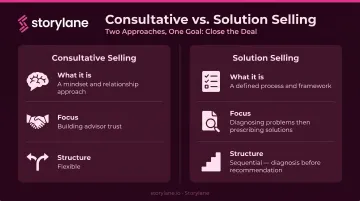
In practice, the two work together. Consultative selling shapes how you engage; solution selling dictates what you do next.
Solution Selling vs. Product Selling
Product selling — sometimes called "box pushing" — leads with features, specs, and pricing. The pitch is roughly the same for every prospect, regardless of what they actually need. The product is the star; the buyer is the audience.
Solution selling asks a different opening question: not "what can we sell today?" but "what problem does this prospect need to solve?"
A Side-by-Side Scenario
Consider an HR software rep with a new prospect:
Product selling: Open with a 45-minute platform demo covering every feature — attendance tracking, payroll integration, performance reviews, org charts. Comprehensive, but forgettable.
Solution selling: Spend the first conversation learning that the prospect's HR team manually reconciles attendance data in spreadsheets every Friday, a process that takes four hours and still produces errors. Then demo specifically the automated attendance tracking module, framing every click around eliminating that exact problem.
Same product. Completely different experience.
The Key Differentiator
The core difference between product selling and solution selling is simple: solution selling diagnoses customer pain before presenting anything. Product selling pitches regardless of fit. Solution selling starts with the buyer's problem — product selling starts with the catalog.
RAIN Group's research across 700 B2B purchases found that sales winners differentiated themselves by educating buyers, listening actively, and connecting buyer problems to seller solutions — not by having better features. Meanwhile, 73% of B2B buyers actively avoid suppliers that send irrelevant outreach, which is what generic product-led pitches look like from the buyer's side.
When Should You Use Solution Selling?
Solution selling works best when two conditions are present:
- The product or service requires significant configuration, onboarding, or customization
- The buying decision is high-stakes enough to justify a multi-touch, consultative process
It is not the right approach for commodity products with short buying cycles. Spending three discovery calls to sell a $50/month tool is a resource mismatch.
Ideal Industries and Use Cases
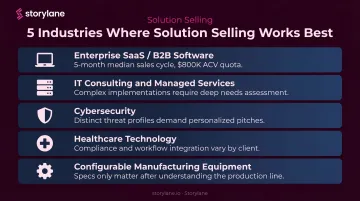
Both conditions show up consistently across a handful of industries where deal complexity is the norm:
- Enterprise SaaS and B2B software — The Bridge Group's 2024 SaaS AE report found a 5.0-month median sales cycle and $800K median annual ACV quota. At that deal size, personalization pays off.
- IT consulting and managed services — Complex implementations require deep needs assessment before any proposal makes sense
- Cybersecurity — Buyers like the ones at SentinelOne and CyberArk face distinct threat profiles; generic pitches don't survive procurement
- Healthcare technology — Compliance requirements and workflow integration mean no two deployments look alike
- Manufacturing with configurable equipment — Product specs only matter after understanding the production line
The Emerging Technology Angle
When buyers are evaluating categories they don't fully understand — AI platforms, advanced analytics, edge computing — they don't know what they need. They rely on the seller to frame the problem.
Gartner research found that human sellers are 32 percentage points more likely than AI-generated content to create buyer confidence in these contexts.
When the category is unfamiliar, buyers aren't shopping features — they're looking for someone to help them define the problem. That's exactly what solution selling is built for.
The Solution Selling Process: Step by Step
Step 1: Research and Understand Your Prospect
Before any outreach, build a picture of the prospect's world. Research their industry dynamics, company stage, recent milestones (funding, mergers, leadership changes, product launches), and known operational challenges. This pre-call intelligence shapes every diagnostic question you'll ask.
Tools like Storylane's Account Reveal surface real-time company insights when prospects engage with a demo, giving reps an immediate, data-backed starting point for discovery conversations.
Step 2: Qualify Your Leads
Solution selling is time-intensive. Spending it on poorly-fit prospects is expensive. Before investing in deep discovery, confirm:
- Budget — Is there funding available or accessible?
- Authority — Is a decision-maker involved, or just an evaluator?
- Need — Is there a real, urgent problem your product solves?
- Timeline — When does a decision need to happen?
G2's 2024 Buyer Behavior Report found that 79% of software buyers say the CFO has final decision-making power on purchases over $20K. If you're only talking to an individual contributor, you're not fully qualified yet.
Step 3: Diagnose Pain Points Through Purposeful Questions
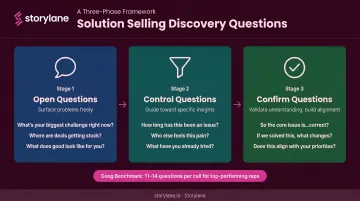
This is the heart of the methodology. Use three types of questions:
Open questions — Surface problems freely
- "Walk me through how your team handles [process] today."
- "What's the biggest friction point in your current workflow?"
- "Where are you spending time you wish you weren't?"
Control questions — Guide the conversation toward specific insights
- "When that happens, which team feels it most?"
- "How often does that issue come up — weekly, daily?"
- "What have you tried to solve it so far?"
Confirm questions — Validate understanding and build alignment
- "So if I'm hearing you right, the core problem is X — is that accurate?"
- "That sounds like it costs your team roughly Y hours per week. Does that match your estimate?"
- "If we could eliminate that bottleneck, what would change for your team?"
Move through three diagnostic phases: understand the pain, quantify its business impact, and help the prospect visualize life without it. Gong's research recommends 11–14 targeted discovery questions per call — fewer skips the diagnosis; more starts to feel like an interrogation.
Step 4: Show Prospects What They're Missing
Before jumping to a pitch, help the prospect connect the dots themselves. Use questions to surface the gap between their current state and where they want to be.
When a buyer articulates their own problem — and their own desired outcome — they've already sold themselves on the need. Your job at this stage is facilitation, not persuasion.
Step 5: Present the Solution (Not the Product)
When it's time to propose, every product capability should be framed around a specific pain point the prospect surfaced in discovery. That means leading with "here's what solves the attendance reconciliation problem you described," not "here's our feature set."
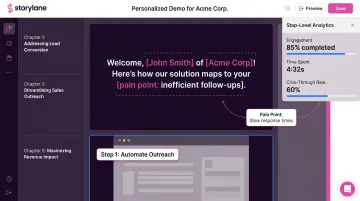
Personalized demos are where this framing becomes tangible. Storylane lets sales teams build prospect-specific demo experiences that map product capabilities directly to stated pain points, using smart variable tokens, multi-chapter paths for different buyer personas, and step-level analytics showing which features the prospect explored.
Rather than a generic product tour, the prospect sees a demo that mirrors their own environment. ContactMonkey's sales team using this approach achieved a 2x demo-to-opportunity conversion rate compared to other inbound sources.
Step 6: Handle Objections and Close
Objections in solution selling aren't roadblocks — they're diagnostic signals. Top performers respond to pushback with questions, not defenses.
Common objections and how to reframe them:
| Objection | Reframe |
|---|---|
| "It's too expensive." | "What would it cost to keep the current process running for another year?" |
| "We're not ready to make a decision." | "What would need to be true for this to become a priority?" |
| "We're already looking at another vendor." | "What problem are they solving for you that we haven't addressed yet?" |
Each reframe pulls the conversation back to the pain — where solution selling does its best work.
Pros and Cons of Solution Selling
Like any methodology, solution selling has real strengths — and real costs if applied without discipline.
Advantages of Solution Selling
- Builds genuine trust — Buyers who feel heard, not sold to, are more likely to become long-term customers and internal champions
- Improves deal quality — Customers who bought the right solution for their needs have fewer implementation problems and less buyer's remorse
- RAIN Group found top-performing sellers are 58% more likely to lead thorough needs discovery and 63% more likely to communicate strong ROI cases than average sellers — a gap generic pitches simply can't close
- Stickier relationships post-sale — When the sale is grounded in actual problems, customers are easier to retain and expand
Disadvantages of Solution Selling
- Time and resource intensive — Multi-touch discovery before any proposal means significant investment per prospect. With a 5.0-month median SaaS sales cycle, the cost of misallocated effort is real
- Salesforce research found 72% of sellers feel overwhelmed by the number of skills required — and overwhelmed reps are 45% less likely to hit quota. Consultative questioning, business acumen, and deep product knowledge take time to develop
- Misapplication extends cycles — Running a full solution selling motion for a prospect who just needs a standard setup wastes everyone's time. Apply it selectively
Solution Selling Best Practices
Talk With Prospects, Not at Them
Keep discovery exploratory. Gong's research confirms the 11–14 question benchmark, and top sellers maintain roughly a 46% talk / 54% listen ratio during discovery calls. Focus on understanding before presenting — the questions you ask reveal more than any pitch deck.
Arm Prospects With Relevant Content Between Touchpoints
Organizations with structured sales enablement see 49% win rates versus 42.5% without it. Between calls, send content that reinforces the business case you've built together — case studies, industry benchmarks, and use-case walkthroughs tied to their specific pain points.
Personalize the demo experience. Solution selling at scale requires tools that make personalization fast. Storylane's Buyer Hub lets sales teams organize multiple demos in one place so prospects can self-navigate to the content most relevant to their situation.
The platform's CRM integrations push demo engagement data directly into Salesforce and HubSpot — including:
- Which features a prospect explored
- How long they spent on each section
- Where they dropped off
Reps enter every follow-up conversation with full context, not guesswork.
Don't stop at the close. The consultative relationship continues after the deal closes. Post-sale onboarding, regular check-ins, and ongoing support protect retention and create natural opportunities for upsell and cross-sell — outcomes that transactional selling almost never produces.
Frequently Asked Questions
What is the difference between product selling and solution selling?
Product selling leads with features and specs the same way for every prospect. Solution selling starts with diagnosing the customer's specific pain points, then recommends a solution tailored to those needs. One is product-centric; the other is buyer-centric.
What are the key steps in the solution selling process?
Six steps: research the prospect, qualify the lead, diagnose pain points through structured questioning, help prospects recognize their gap, present the solution in terms of outcomes, then handle objections and close.
Is solution selling right for every business?
No. It's best suited for complex, high-value, or highly configurable products with longer sales cycles — enterprise SaaS, IT services, cybersecurity, healthcare tech. For commodity products with simple, short buying processes, it's more effort than the deal justifies.
What types of questions should you ask in solution selling?
Three types to use in sequence:
- Open questions — surface problems freely without leading the prospect
- Control questions — guide the conversation toward specific, relevant insights
- Confirm questions — validate your understanding and build alignment
The goal is to help prospects articulate their own pain — not to pitch at them.
How does solution selling relate to consultative selling?
The two terms are often used interchangeably, but solution selling is a more structured methodology with a defined diagnostic questioning framework. Consultative selling is a broader philosophy emphasizing the seller-as-advisor relationship — solution selling gives that philosophy specific tools and steps to execute on.
What are the biggest challenges of implementing solution selling?
Three main challenges: the significant time investment per prospect, the consultative skill and product knowledge reps must develop, and the difficulty of scaling a personalized approach across a large team. The last one — scale — is where most implementations stall without the right enablement and tooling in place.