Interactive demo platforms close this gap. Instead of asking prospects to commit to a sales call, you let them explore the product first. That shift in sequence changes conversion math at every funnel stage — from anonymous website visitors to late-stage deals awaiting internal buy-in.
This guide covers the five best B2B demo platforms for CRO in 2025: Storylane, Navattic, Walnut, Demostack, and Reprise — with honest positioning on what each does best and where each fits in your funnel.
Key Takeaways
- Interactive demos let prospects experience product value before committing to a sales call, raising lead quality and close rates
- 67% of B2B buyers now prefer a rep-free buying experience, making on-demand demos a necessity rather than a nice-to-have
- Platforms vary by demo format: screenshot capture, HTML cloning, sandbox environments, and AI-powered creation serve different use cases
- Choose based on format flexibility, personalization depth, buyer analytics, and CRM integration
- Storylane, Navattic, Walnut, Demostack, and Reprise are the top platforms covered here
What Are B2B Demo Platforms and Why Do They Matter for CRO
B2B demo platforms are tools that let revenue teams build self-guided, interactive product experiences — walkthroughs prospects can explore on their own schedule, without a live sales rep on the call.
That definition matters for CRO because the traditional demo funnel has a structural problem. Prospects land on your site, see feature bullets and screenshots, and get asked to book time with sales. Most don't. That gap between "I'm curious" and "I'll give you 30 minutes" is where most pipeline stalls.
Interactive demos remove that gap. A prospect who clicks through a guided product tour has already seen your core value proposition in action. When they do talk to sales, they arrive informed and pre-qualified — which shortens cycles and raises close rates.
The data backs this up. Walnut's analysis across thousands of B2B sales engagements found interactive demos drive 32% higher conversion rates than static content, with decision-stage demos delivering a 38–45% lift in opportunity-to-close rates.
Buyer behavior is shifting in the same direction. Gartner's 2025 survey found 61% of B2B buyers prefer a rep-free buying experience — a figure that rose to 67% by early 2026.
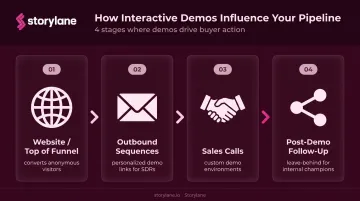
That lift shows up across the funnel, not just on the website. Demo platforms influence pipeline at every stage:
- Website / top of funnel — embedded demos replace static product pages and convert anonymous visitors
- Outbound sequences — personalized demo links give SDRs a differentiated cold outreach asset
- Sales calls — custom demo environments replace fragile staging setups
- Post-demo follow-up — leave-behind demos help champions sell internally without a rep present
Choosing the right platform depends on where your funnel stalls most — the sections below break down the top options by use case.
Best B2B Demo Platforms for Conversion Rate Optimization
These platforms were selected based on their ability to move prospects meaningfully closer to a buying decision — not just their ability to create visually polished product tours.
Storylane
Storylane covers more demo formats than any other platform on this list: Screenshot Demos, Video Demos, HTML Clones, Demo Hubs, and Sandbox environments. A single team can use it across the entire revenue funnel, from a marketing landing page to a post-deal champion enablement hub.
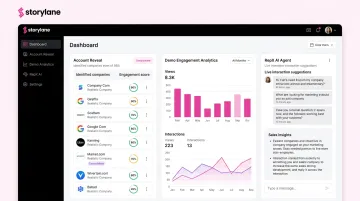
What separates Storylane for CRO is depth of buyer intelligence. The Account Reveal feature de-anonymizes demo visitors in real time, surfaces firmographic data, and pushes Slack alerts to sales reps. Anonymous website traffic becomes warm, context-rich outreach. Monthly reveal limits scale by plan: 250/month on Starter, 2,500/month on Growth, and 10,000/month on Premium.
RepX, Storylane's AI sales agent, runs demos, qualifies prospects, handles objections, and routes leads to CRM autonomously, 24/7. For teams with global audiences or lean SDR capacity, that's a meaningful pipeline lever.
The AI Suite handles the creation side:
- One-click contextual annotations and guided flows
- AI video avatars and voiceovers in 25+ languages
- HTML content editing via natural language prompts
For enterprise deployments, Deal Intelligence connects demo engagement directly to CRM pipeline data. Dreamdata found that 40.9% of all closed-won new business was influenced by Storylane demos.
Trusted customers include Gong, Rippling, Nasdaq, CyberArk, SentinelOne, Sprout Social, Cognism, and Clari.
| Category | Details |
|---|---|
| Key Features | Multi-format demos (Screenshot, Video, HTML, Hubs, Sandbox), AI Suite (video avatars, voiceovers, translations, HTML editing), Account Reveal, RepX AI sales agent, Deal Intelligence, CRM integrations with Salesforce, HubSpot, Marketo, Pardot, offline demo support |
| Best For | B2B SaaS teams that want one platform to run website demos, sales demos, outbound personalization, and buyer intelligence at scale |
| Pricing | Free plan (1 demo, 1 seat); Starter from $40/month; Growth from $500/month (5 seats); Premium from $1,200/month (10 seats); Enterprise custom. Annual billing saves 20%. |
Navattic
Navattic is the go-to choice for product marketing and demand gen teams that need to get demos onto websites and into email campaigns quickly without involving engineering.
Its no-code capture workflow lets teams build and publish interactive demos entirely through a browser extension, with no developer dependency. Embedded demos can be dropped into landing pages, nurture sequences, or outbound emails with minimal setup friction.
The platform's step-level analytics are a CRO asset: you can see exactly which demo steps prospects engage with, where they drop off, and which paths lead to form submissions. That data feeds directly into A/B testing and messaging optimization.
Navattic reports top-performing demos reaching 84.4% engagement rates and 54% click-through rates among its highest-performing cohort, with one customer generating $150K in pipeline within five months of deployment.
| Category | Details |
|---|---|
| Key Features | No-code capture and publish, embeddable demos, step-level engagement analytics, demo checklists, Salesforce and HubSpot integration |
| Best For | Teams prioritizing fast deployment of website-embedded demos to improve top-of-funnel conversion without developer dependency |
| Pricing | Starter: free (1 seat, 1 demo); Base and Growth plans available with unlimited HTML demos (exact dollar pricing not publicly listed); Enterprise: custom |
Walnut
Walnut is built for sales teams that need to personalize every demo before every call. Reps can swap logos, adjust data, and tailor demo flows per account without a staging environment or SE support. An AE can show a prospect a demo that looks like it was built specifically for their company, in minutes.
For mid-funnel CRO, this matters because generic demos lose deals. Walnut's own data shows teams that personalize at least 50% of demos see 40% higher conversions than those using generic templates.
Its section-level engagement analytics show which parts of a demo hold attention and which cause drop-off , giving reps data to tighten their narrative before the next call.
| Category | Details |
|---|---|
| Key Features | Account-level demo personalization, no sandbox required, interactive demo flows, section-level engagement analytics, team collaboration features |
| Best For | Mid-market and enterprise sales teams that want to personalize every demo interaction to accelerate mid-funnel conversion |
| Pricing | Ignite: $575/month (billed annually, 3 editor + 3 presenter seats); Accelerate: $1,550/month (billed annually, 6 editor + 6 presenter seats, sandbox demos, advanced analytics); Scale: custom |
Demostack
Demostack takes a different approach: it clones your product's actual front-end to create a stable, realistic demo environment that mirrors the real thing with no bugs, incomplete data, or infrastructure dependencies.
For complex SaaS products where a live demo could break mid-call, that stability is a meaningful CRO lever. Prospects who see a clean, realistic product experience are more likely to trust what they're buying. Demostack's data editor lets teams populate demos with prospect-specific content (names, use cases, metrics) without writing code.
It's primarily a presales tool rather than a marketing one , best suited for enterprise sales environments where live demo reliability directly affects close rates.
| Category | Details |
|---|---|
| Key Features | Live product front-end cloning, stable demo environments, no-code data editor for customization, deal room integration, enterprise security controls |
| Best For | Enterprise SaaS sales and presales teams that need a reliable, realistic demo environment for complex product demonstrations |
| Pricing | Custom pricing only — requires contacting sales |
Reprise
Reprise offers three distinct products under one platform: Reprise Replay (screenshot-based product tours), Reprise Replicate (HTML-cloned demo environments), and Reprise Reveal (live product overlays with no-code editing). Large GTM teams can assign the right format to the right use case : Replay for marketing, Replicate for sales engineers, Reveal for quick personalization before calls.
For enterprise organizations with large demo libraries, Reprise's governance and access control features are a genuine differentiator. Teams can standardize assets across marketing, SDRs, and AEs while maintaining brand consistency , which gets harder to manage as a sales org scales.
| Category | Details |
|---|---|
| Key Features | Three demo creation modes (Replay, Replicate, Reveal), enterprise-grade governance, team access controls, analytics, integrations with major CRMs and marketing automation platforms |
| Best For | Large enterprise GTM teams that need standardized, governed demo libraries across marketing campaigns and a large sales organization |
| Pricing | Single annual platform fee plus per-user licenses — specific dollar amounts not publicly disclosed |
How We Chose the Best B2B Demo Platforms
The most common selection mistake is choosing a demo platform based on visual polish or ease of capture without asking whether it actually supports your specific conversion goal.
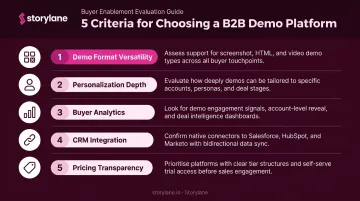
A team trying to improve website conversion needs embeddable demos with fast load times and top-of-funnel analytics. A team trying to accelerate mid-funnel velocity needs deep personalization and section-level engagement data. An enterprise presales team needs stability and governance. The platforms below were evaluated on five criteria:
- Demo format versatility — does it serve both marketing and sales use cases, or only one?
- Personalization depth — can reps customize per account without engineering support?
- Buyer analytics — does it surface engagement at the step or section level?
- CRM and sales stack integration — does it connect bidirectionally with Salesforce, HubSpot, or Marketo?
- Pricing transparency — is the cost model legible relative to team size and expected usage?
No single platform wins every category. Start by identifying where your pipeline stalls — whether that's top-of-funnel awareness, mid-funnel engagement, or late-stage presales — and let that constraint drive the decision.
Conclusion
The best demo platform is the one that removes friction at your specific conversion bottleneck — whether that's a cold website visitor who won't book a call, a sales-qualified prospect who needs a tailored experience before signing, or a champion who needs a shareable leave-behind to secure internal approval.
When evaluating options, look past feature lists. Prioritize platforms that offer step-level engagement analytics, buyer identification, and CRM pipeline influence tracking. These are the capabilities that connect demo activity to actual revenue outcomes — and most platforms on this list only cover one or two of them.
For teams that need to cover every stage of the funnel from a single platform, Storylane is built for that scope. It supports five demo formats — screenshot, video, HTML, hubs, and sandbox — and pairs that with buyer intelligence features most platforms don't offer:
- Account Reveal — de-anonymizes demo visitors with company and firmographic data
- RepX — a conversational AI agent that qualifies, answers objections, and routes leads 24/7
- Deal Intelligence — tracks pipeline and deal influence directly from demo engagement
Together, these make it possible to run a full-funnel demo strategy without stitching together multiple tools.
Start for free or explore an interactive demo to see how it works.
Frequently Asked Questions
What is an interactive product demo?
An interactive product demo is a self-guided, clickable product experience that prospects explore at their own pace, with no sales rep required. Prospects evaluate product fit on their own timeline, before or instead of booking a traditional demo call.
What is a good B2B website conversion rate?
First Page Sage reports B2B SaaS visitor-to-lead conversion rates of around 2.1% for organic search and 2.2% for LinkedIn traffic. Rates vary by traffic source, ICP quality, and whether high-intent pages like demo pages are properly optimized.
What is the most used testing method for improving conversions?
A/B testing is the most widely used CRO method: you show two page variants to different visitor segments to see which drives higher conversion. Heatmaps and session recordings are commonly paired with A/B tests to sharpen hypotheses before launching experiments.
How do interactive demos improve B2B conversion rates?
Interactive demos let prospects experience product value before committing to a sales call, which improves lead quality and shortens sales cycles. According to Walnut's platform data, interactive demos drive 32% higher conversion rates than static content, with decision-stage demos delivering a 38–45% lift in opportunity-to-close rates.
What is the rule of 7 in B2B?
The rule of 7 is a marketing principle suggesting a prospect needs to encounter a brand's message at least seven times before taking action. Interactive demos are effective here because they create repeated, high-engagement touchpoints. A prospect who revisits a demo multiple times builds product familiarity on their own terms, accelerating trust faster than passive content.