
Introduction
Your sales team invests real budget generating leads — paid ads, content, events, outbound sequences. Then a qualified prospect fills out a demo request form on a Tuesday afternoon, gets assigned to a rep who's buried in a late-stage deal, and doesn't hear back until Thursday morning.
That's not a sales problem. That's a process problem.
Research from Harvard Business Review found that companies reaching out to leads within one hour were nearly 7x more likely to have a meaningful conversation with a decision-maker than those who waited just one additional hour — and more than 60x more likely than companies waiting 24 hours or longer. Yet the same study found that 23% of companies never responded at all.
Lead distribution — matching incoming leads to the rep best positioned to close them, fast — is where most of that gap lives. Get it wrong and you're not just losing deals; you're burning the budget it took to generate the lead.
This guide breaks down how lead distribution works, which routing methods fit which teams, and what a well-built process actually looks like.
Key Takeaways
- Lead distribution is distinct from lead generation — it determines which rep receives a lead, not how the lead was acquired
- Speed-to-lead is the single most measurable factor in whether a routed lead converts
- Automation only works well when your routing logic is defined first — manual distribution breaks down before that point
- Routing criteria should include rep expertise, territory, availability, and lead score — not just workload balance
- Garbage data in means garbage routing out — data quality is the foundation of any distribution system
What Is Lead Distribution and Why Does It Matter
Lead distribution is the process of assigning inbound leads to specific sales reps based on defined criteria. It sits inside the broader lead management lifecycle but is distinct from both lead generation (acquiring leads) and lead nurturing (moving them through the funnel over time).
Lead generation fills the top of your funnel. Lead distribution determines who handles what comes out of it.
The Revenue Case for Getting This Right
Intent decays fast. The MIT/InsideSales Lead Response Management Study, based on over 15,000 leads and 100,000 call attempts, found that the odds of contacting a lead were roughly 100x higher when a rep called within five minutes versus 30 minutes — and the odds of qualifying that lead were 21x higher at the five-minute mark.
That's not a marginal difference. A 30-minute delay doesn't just slow your response — it often means the buyer has already moved on.
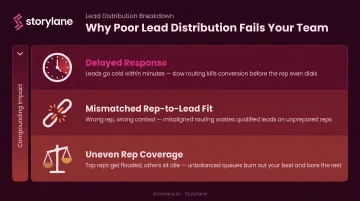
When speed matters that much, distribution quality directly drives revenue outcomes. Poor distribution creates three compounding problems:
- Delayed response — leads assigned to unavailable or overloaded reps sit idle while intent cools
- Mismatched rep-to-lead fit — the wrong rep handles a deal that needs different expertise, hurting close rates
- Uneven rep coverage — some reps get flooded while others go light, creating morale and pipeline variability
When distribution works well, the right rep reaches out fast, with the right context, and the buyer experience improves from the first touchpoint.
From Lead Generation to Distribution: How the Process Works
Lead distribution doesn't happen in isolation. Its quality depends entirely on what precedes it. The typical flow looks like this:
Lead Generation → Lead Capture → Lead Qualification → Lead Distribution
Each stage feeds the next, and gaps at any stage degrade the output.
The Four Stages
Lead Generation brings prospects into the funnel through paid channels, content, events, or outbound outreach.
Lead Capture converts anonymous interest into an identifiable record — through demo request forms, chatbots, gated content, or live chat. The cleaner and more complete the capture, the more routing logic has to work with.
Lead Qualification is the gatekeeping step. Without it, even perfectly designed routing rules send noise to reps. According to a 2016 Demand Gen Report survey, 86% of marketers were already using lead scoring as part of their demand generation strategy — and 74% cited prioritized leads as the top benefit.
Lead Distribution takes the qualified, enriched lead record and routes it to the right rep.
How Data Quality Shapes Routing Quality
Modern tools can enrich and pre-qualify leads before they ever reach a rep's queue. Storylane, for example, captures leads directly inside interactive demos through embedded custom forms — collecting name, email, job title, and company — and passes that data to connected CRM platforms in real time.
The Account Reveal feature takes this further by de-anonymizing demo visitors and attaching enriched firmographic data to their session, even without a form submission. A lead can arrive in your CRM already tagged with company identity, industry context, and an automatic intent classification (Low, Medium, or High) based on time spent, completion rate, feature interactions, and return visits.
That classification is only useful if the underlying data is complete. The CRM becomes the source of truth for routing logic — but only if what goes in is enriched enough to trigger the right rules.
Lead Distribution Methods: Manual vs. Automated
Manual Distribution
Manual lead distribution takes two common forms:
- Shared pool (cherry-pick) — Leads sit in a shared queue and reps claim them
- Manager-assigned — A team lead reviews incoming leads and manually assigns them
Both can work at low volume or on very small teams. The problems emerge quickly at scale:
- The fastest or most aggressive reps claim the best leads, not necessarily the best-fit ones
- Slower or newer reps get the leftovers, creating performance gaps that compound over time
- Response times depend entirely on rep availability and attention — there's no system enforcement
- Manager assignment creates a bottleneck and introduces subjective bias
Automated Distribution Methods
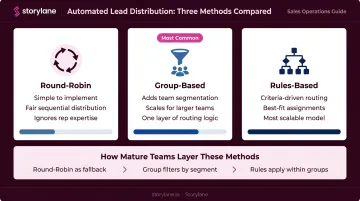
Automation removes the human bottleneck and enforces consistent coverage. Three main approaches:
Round-Robin
Rotates leads evenly across available reps in sequence. Simple to set up and fair on paper. The limitation: it ignores expertise, current workload, and lead characteristics entirely. An enterprise inbound from a Fortune 500 company goes to whoever is next in the queue — which may be a rep who handles SMB accounts.
Group-Based Distribution
Leads route to a defined group first (enterprise vs. SMB, East vs. West, specific product lines), then to individuals within that group. Useful for larger teams with distinct segments. It adds one layer of intelligence without requiring complex rule-building.
Rules-Based / Criteria-Driven Routing
The most scalable approach. Leads are matched to reps based on predefined conditions — territory, company size, industry vertical, lead score, account ownership. This method requires more upfront configuration but produces the best-fit assignments consistently.
Most mature sales teams layer these methods: rules-based routing handles primary logic, round-robin distributes leads within matched groups, and weighted distribution adjusts volume to account for rep capacity or performance.
Key Criteria for Smart Lead Routing Decisions
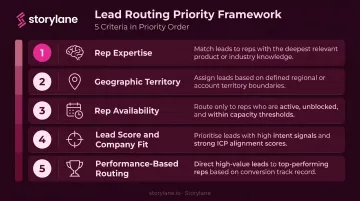
What conditions should actually drive your routing rules? Five criteria matter most:
- Rep Expertise — match by product line, industry, or deal complexity
- Geographic Territory — align time zones, account ownership, and compliance coverage
- Rep Availability — factor real-time capacity, not just specialization
- Lead Score and Company Fit — route high-intent leads to closers, low-score leads to nurture
- Performance-Based Routing — weight top reps for higher-quality inbound, with guardrails
Rep Expertise and Experience
An enterprise deal with a new logo in a specialized vertical should go to a senior rep with relevant domain knowledge — not whoever happens to be available. Matching by product line, industry, or deal complexity improves close rates and buyer experience simultaneously.
Geographic Territory
Territory alignment matters for field sales models with designated account ownership, time zone coverage for follow-up calls, and regional compliance knowledge. A prospect in EMEA routed to a rep working US Pacific hours will wait until they're 12 hours into their day before hearing back.
Rep Availability
Routing to the "best" rep doesn't help if that rep is out of office or already managing five active deals. Real-time availability should factor into routing logic — a slightly less specialized but immediately available rep will often outperform a perfect-fit rep who responds 48 hours later.
Lead Score and Company Fit
High-intent, high-fit leads should reach experienced closers. Early-stage or low-score leads may be better routed to SDRs or dropped into a nurture track. Firmographic signals — company size, industry, tech stack — combined with behavioral signals like demo engagement depth create a stronger score than either dimension alone.
Performance-Based (Weighted) Routing
Weighted distribution gives higher-performing reps a larger share of leads, or prioritizes them for higher-quality inbound. The risk: done carelessly, it creates a self-reinforcing advantage for top reps and widens the gap with the rest of the team. Apply it selectively — cap the lead share advantage at a defined threshold, and review distribution data quarterly to prevent the gap from compounding.
How to Build and Automate Your Lead Distribution Process
Step 1 — Automate from the point of capture
When a lead fills a form, books a demo, or engages with a product experience, their data should enter your CRM in real time with enough enrichment to trigger routing rules immediately.
Tools like Storylane capture leads inside interactive demos and pass engagement data (firmographic details, intent scores, demo completion rates, features explored) directly to Salesforce, HubSpot, and Marketo. Routing logic fires the moment a lead identifies themselves, with richer context than a standard form submission provides.
Step 2 — Define routing rules before touching any software
Write down your criteria first. Who handles enterprise versus SMB leads? What territories exist? Which reps own which verticals? If you can't explain your routing logic in two sentences, it's too complex to automate reliably. Start simple and add conditions as you encounter edge cases.
Step 3 — Match the method to your team size
| Team Size | Recommended Method |
|---|---|
| Under 10 reps | Round-robin with basic availability rules |
| 10–30 reps, specialized | Group-based + round-robin within groups |
| 30+ reps or segmented | Rules-based routing, weighted for top performers |
Step 4 — Build, test, and involve your reps
Run a 30–60 day pilot before full rollout. Track whether assigned leads are being accepted, contacted, and worked. Reps who see routing logic applied consistently, and understand the criteria, are far more likely to trust and work within it.
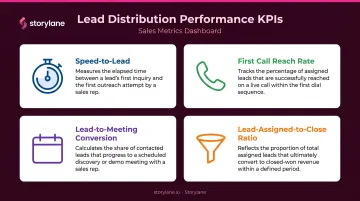
Step 5 — Measure the right metrics
- Speed-to-lead — How fast after assignment does the rep make first contact?
- First call reach rate — What percentage of assigned leads actually connect on a call?
- Lead-to-meeting conversion — What share of routed leads book a discovery or demo call?
- Lead-assigned-to-close ratio — By rep and by routing method
When a metric drops, ask whether it's a rep performance issue or a routing problem before drawing conclusions.
Lead Distribution Best Practices for Sales Leaders
Keep It Simple and Transparent
Document routing logic clearly enough that a new hire can understand it in their first week. Opacity breeds distrust — reps who don't understand why certain leads go to certain people assume the system is rigged. A well-documented process also makes troubleshooting faster when metrics shift.
Don't Automate Prematurely
Automation earns its place when manual assignment is consuming significant time and creating coverage errors. If you have five reps and 20 inbound leads per week, a spreadsheet might genuinely be the right tool. Don't automate until volume makes manual assignment genuinely error-prone.
Review Routing Rules on a Schedule
As the team grows, territories change, or new product lines launch, routing logic becomes outdated. Schedule a quarterly review of routing rules against pipeline and close rate data. Watch specifically for reps with strong close rates who are receiving fewer leads than lower performers — that gap usually points to a routing rule that's no longer aligned with reality.
Three quick checks to run each quarter:
- Compare close rates by rep against lead volume they're receiving
- Audit whether territory rules still match your current ICP
- Confirm new hires or role changes are reflected in routing logic
Frequently Asked Questions
What is lead distribution?
Lead distribution is the process of assigning incoming leads to specific sales reps based on defined criteria such as territory, expertise, or lead score. It can be handled manually by a manager or automated through CRM-based routing rules.
What is the difference between a lead and a prospect?
A lead is an unqualified contact who has shown interest — filling out a form, downloading content, or attending a webinar. A prospect is a lead that has been qualified against your ideal customer profile and has a realistic path to becoming a customer.
What is the difference between lead routing and lead distribution?
Routing refers to the logic that determines where a lead goes — the conditions, criteria, and rules. Distribution is the broader process: assigning and managing leads across the team using the systems and workflows that execute those routing rules. The terms overlap, but routing is a component of distribution.
How much should you pay for lead generation?
It varies significantly by channel, industry, and lead quality. First Page Sage's 2026 CPL report puts blended B2B SaaS CPL at $237, while verticals like Oil and Gas ($637) and Software Development ($591) run considerably higher. Research benchmarks specific to your industry and channel mix rather than applying a cross-industry average.
What are the most important factors to consider when distributing leads?
Five factors drive most distribution decisions:
- Rep expertise and product specialization
- Geographic territory alignment
- Real-time availability
- Lead score and company fit
- Historical close performance
The right weighting depends on your team structure — a 5-person startup and a 50-person enterprise sales org should prioritize these very differently.
How do you measure the effectiveness of your lead distribution process?
Track four core metrics: speed-to-lead, first call reach rate, lead-to-meeting conversion, and lead-assigned-to-close ratio. Review at both the rep and team level — drops at the rep level usually signal availability or fit issues, while team-level drops point to a routing rule problem.