Introduction
B2B SaaS teams spend heavily on marketing and sales, yet most leads go cold before a rep ever makes contact. The reason is structural: prospects are asked to commit time to a demo before they've experienced any value. That mismatch between how companies sell and how buyers want to buy is the core problem Product-Led Sales (PLS) solves.
Gartner reports that 75% of B2B buyers now prefer a rep-free sales experience. But pure self-serve has its own ceiling — freemium products convert only around 5% of sign-ups, compared to 17% for free trials, according to OpenView's PLG benchmark data. PLS sits between those extremes.
PLS lets the product do the early work. Users experience value first, and sales teams engage only when usage signals confirm readiness to buy — less friction for the buyer, better conversion economics for the seller.
This guide covers the full picture: what PLS is, how it differs from PLG and sales-led models, what a Product-Qualified Lead (PQL) is, how to build a PLS motion, and how to measure whether it's working.
Key Takeaways
- PLS is a go-to-market approach where product usage data determines when and how sales teams engage
- PLS layers targeted sales outreach on top of a self-serve experience; it complements PLG, not replaces it
- Product-Qualified Leads (PQLs) are the core unit: users who fit your ICP, have experienced value, and show buying intent
- Compared to purely sales-led or PLG models, PLS reduces CAC and drives more expansion revenue
- Success depends on product, sales, and marketing alignment with clear rules for when sales engages
What Is Product-Led Sales?
OpenView defines PLS as a GTM motion that acquires prospects through self-serve freemium or trial offers, then converts them through sales-assisted approaches. McKinsey describes it as a hybrid that combines PLG with traditional sales-led growth. Both definitions converge on the same idea: the product creates the opening; sales closes it.
The "Show, Don't Tell" Principle
Traditional sales requires reps to convince prospects of value before they've experienced it. PLS flips this. Prospects interact with the product first (through a free trial, freemium tier, or interactive demo), and that engagement generates behavioral signals sales teams can act on.
The difference in that first sales conversation is stark. Instead of a generic pitch, the rep already knows what the prospect explored, which features held their attention, and where they dropped off — all before saying a word.
A concrete example: A software engineer signs up for a SaaS tool, activates it, and starts using advanced features. Instead of a cold call asking "what are your pain points?", the sales rep reaches out referencing those specific actions and offers guidance on the next logical step. The prospect enters a sales cycle without friction because the product already did the qualifying work.
PLS vs. "Sales-Assisted"
These terms aren't interchangeable. Adding a sales rep to a self-serve funnel is sales-assisted. PLS is strategic and data-driven — it requires defined PQL criteria, product usage data feeding into the CRM, and clear rules of engagement that prevent reps from interrupting users who would have converted on their own. Without that structure, you get wasted rep time, irritated users, and conversion rates that look worse than pure self-serve.
Product-Led Sales vs. Sales-Led vs. PLG: Key Differences
Understanding PLS requires understanding what it's not.
Sales-Led Growth (SLG)
The product sits behind a demo request. Reps must build value perception through conversation before a prospect ever touches the product. The downsides compound quickly:
- High Customer Acquisition Cost from rep-heavy coverage
- Long sales cycles before any product value is established
- A leaky MQL funnel — secondary research from Gainsight citing SiriusDecisions suggests up to 98% of MQLs never result in closed business, showing how much pipeline leaks in purely rep-driven models
Product-Led Growth (PLG)
The product is the primary acquisition, conversion, and retention engine. Users self-serve; sales teams stay out. ProductLed's 2025 benchmark study of 600+ SaaS companies found that 58% of B2B SaaS companies now have a PLG motion, with 91% of those planning to increase investment.
PLG delivers lower CAC, global scale, and a wide top of funnel. But pure PLG struggles to close large enterprise contracts, drive team-wide expansion, or generate meaningful ARR without extremely high acquisition volumes. Freemium's 5% conversion ceiling matters when you're trying to build a $50M+ ARR business.
Product-Led Sales (PLS)
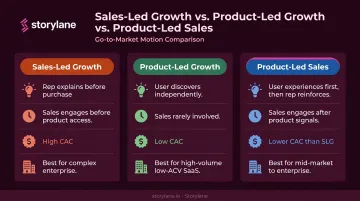
PLS combines the distribution advantages of PLG with the revenue ceiling-breaking capability of a sales team — the table below shows how the three models compare.
| Sales-Led Growth | Product-Led Growth | Product-Led Sales | |
|---|---|---|---|
| How value is demonstrated | Rep explains before purchase | User discovers independently | User experiences first, rep reinforces |
| When sales engages | Before product access | Rarely or never | After product engagement signals |
| CAC profile | High | Low | Lower than SLG; higher than pure PLG |
| Best fit | Complex, high-touch enterprise | High-volume, low-ACV SaaS | Mid-market to enterprise with expansion potential |
McKinsey reports that 65% of SaaS buyers prefer a combination of sales-led and product-led experiences — which is precisely what PLS delivers.
What Is a Product-Qualified Lead (PQL)?
A PQL is a user who meets three conditions simultaneously:
- Fits the ICP: right job title, company size, and industry
- Has hit an activation milestone: they've experienced real product value, not just created an account
- Shows behavioral buying intent: their in-product actions signal readiness for a sales conversation
This is fundamentally different from an MQL (based on content consumption) or an SQL (based on rep judgment). According to OpenView, PQLs often convert at 15–30%, and hand-raisers — users who actively signal interest — can convert at 2–4x the rate of traditional MQLs.
The Three Signal Types
Firmographic/demographic signals:
- Job title and seniority level
- Company size and industry
- Business email domain (vs. personal email)
- Team size and expansion potential
Product usage signals:
- Key feature activation milestones
- Frequency and depth of engagement
- Actions like inviting teammates, exporting work, or sharing content
- Return visit patterns
Buying intent signals:
- Visits to pricing pages
- Questions about plan limits or enterprise features
- Demo requests submitted from within the product
- Hitting usage or feature limits
Building a PQL Scoring Model
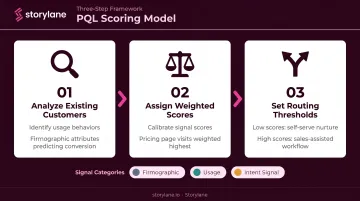
The process works in three steps:
- Analyze existing customers: identify which usage behaviors and firmographic attributes actually predict paid conversion
- Assign weighted scores: a pricing page visit outweighs a single login — calibrate accordingly
- Set routing thresholds: low scores stay in self-serve nurture; high scores trigger a sales-assisted workflow
One thing PQL scoring is not: treating everyone who signs up as a PQL. Product activation must be a prerequisite. Sales time spent on users who haven't reached a value milestone is wasted, no matter how strong the firmographic fit.
Tooling Requirements
PQL scoring only works with the right infrastructure in place. You need:
- Product analytics to track usage behavior (Mixpanel, Amplitude)
- CRM integration to surface signals where sales teams work
- Intent data to layer buying signals on top of usage signals
Platforms like Storylane feed demo engagement data — completion rates, step-level interactions, CTA clicks, and account-reveal signals — directly into Salesforce and HubSpot, giving sales teams PQL-quality context on prospects who've engaged with interactive demos before any rep makes contact.
How to Build a Product-Led Sales Motion: Step-by-Step
Step 1 — Define the Hybrid Model and Set Clear Goals
Before building anything, define what PLS is meant to accomplish: free-to-paid conversion, enterprise expansion, churn reduction, or all three. Without a clear goal, PLS becomes an uncoordinated sales layer that steps on the self-serve motion.
Draw a hard line between PLG users (low ACV, self-serve appropriate) and PLS targets (high ACV, sales-assisted). This boundary prevents reps from interrupting users who would have converted on their own — which is both a poor buyer experience and a waste of sales capacity.
Step 2 — Build the Self-Serve Experience That Feeds PLS
PLS only works when users reach genuine product value before sales engages. The self-serve experience is the engine that creates PQLs. Common entry points include:
- Free trials with a defined activation milestone
- Freemium tiers gating higher-value features
- Interactive demos embedded across the buyer journey
Storylane lets teams deploy interactive demos on the website, in outbound email sequences, and in pre-call nurture workflows. Prospects engage with the actual product before a rep ever reaches out, and that engagement generates behavioral data that surfaces high-intent accounts.
Frictionless onboarding is non-negotiable. If users can't reach an activation milestone independently, PQL scoring has nothing meaningful to measure.
Step 3 — Score PQLs and Route Them to the Right Track
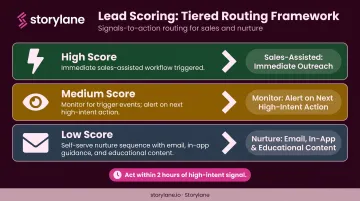
Implement your PQL scoring model inside the CRM or marketing automation platform. Tag users by score tier and set up automatic routing:
- Low score → self-serve nurture sequence (email, in-app guidance, educational content)
- Medium score → monitor for trigger events; alert set for next high-intent action
- High score → immediate sales-assisted workflow triggered
Manual routing introduces lag, and timing matters — a high-intent signal that goes unactioned for 72 hours loses most of its value. Automation isn't optional; it's what makes the timing work.
Step 4 — Equip Sales with Product Context and Execute Outreach
PLS outreach is not cold outreach with a product spin. The rep knows what the prospect explored, which features held their attention, and how far they got. That context shapes every element of the message.
Best practices for PLS outreach:
- Keep messages short and reference specific product actions the prospect took
- Frame the call as a "personalized onboarding" rather than a sales demo
- Follow up 3–5 times within a tight window (signals decay fast)
- Act within 2 hours of a high-intent engagement — not days later
Storylane customers like Wiley and Altrata receive instant Slack notifications the moment a prospect engages with a demo, giving reps a precise conversation starter before the intent signal cools.
Step 5 — Align Teams and Establish Rules of Engagement
PLS fails without coordination across product, sales, and marketing. Three rules need to be explicit before launch:
- Which users sales can contact — and which belong to the self-serve track
- What role sales plays at each funnel stage: qualifier, closer, or expansion driver
- How insights from sales calls feed back into product and onboarding improvements
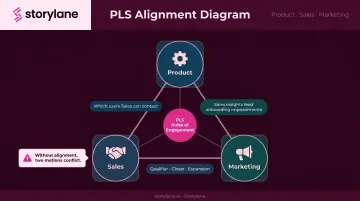
Without these rules, the two motions conflict. Buyers get mixed signals, self-serve gets disrupted, and you end up with two underperforming motions instead of one that compounds on the other.
Key Metrics to Measure PLS Success
Tracking the right numbers tells you whether your product is actually qualifying and converting users — or just generating noise. These metrics break down across three areas.
Product Usage and Conversion Metrics
| Metric | What It Reveals |
|---|---|
| Feature adoption rate | Whether users are reaching activation milestones |
| Time-to-value (TTV) | How quickly users experience the core value proposition |
| Free-to-paid conversion rate | Health of the self-serve to paid motion (benchmark: 5% freemium, 17% free trial) |
| PQL-to-customer conversion rate | Effectiveness of PQL scoring and sales outreach |
TTV deserves particular attention: if users aren't reaching value quickly, PQL scoring will flag the wrong people — and the entire motion breaks down upstream.
Revenue Efficiency Metrics
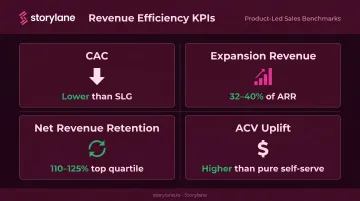
- Customer Acquisition Cost (CAC) — PLS-assisted CAC should trend lower than pure SLG as product does more qualifying work
- Expansion revenue — track separately for PLS-converted accounts vs. self-serve conversions
- Net Revenue Retention (NRR) — high-ARPA B2B SaaS benchmarks range from 110–125% at top quartile
- ACV uplift — PLS-converted accounts typically carry higher ACV than pure self-serve conversions, though the exact delta varies by model
Expansion represented 32.3% of ARR gained in 2023 across SaaS broadly, reaching 40% in high-ARPA B2B segments. PLS is the primary mechanism for capturing that expansion opportunity systematically.
Sales Cycle Efficiency Metrics
- Lead-to-close time — shortening over time confirms the product is qualifying leads effectively
- Touchpoints-to-conversion — fewer touches needed signals higher-quality PQL identification
Together, these two metrics show whether the product is doing its qualifying work. Stalled close times usually point to one of two root causes: a weak PQL scoring model or an activation milestone that isn't reflecting real value.
Frequently Asked Questions
What does product-led sales mean?
PLS is a GTM strategy where product usage data guides when and how sales teams engage. Users experience the product first — via free trial or interactive demo — and sales reaches out to high-engagement accounts based on behavioral signals rather than cold outreach.
What is the difference between product-led and sales-led companies?
Sales-led companies gate the product behind a rep and rely on persuasion before purchase. Product-led companies let users experience value first and use that engagement to drive conversion, which results in lower CAC and shorter sales cycles.
What is a product-qualified lead (PQL)?
A PQL is a user who fits the ICP, has reached a product value milestone, and shows buying intent through behavior. That makes them far more likely to convert than a traditional MQL, which is based on content consumption alone.
How is product-led sales different from product-led growth (PLG)?
PLG is the self-serve growth motion where the product acquires and converts users without sales involvement. PLS layers a targeted sales team on top of PLG to capture larger deals, drive enterprise expansion, and reduce churn.
When should a company add a sales team to a PLG motion?
Watch for three signals: hand-raisers asking about enterprise pricing, bottom-up user adoption that isn't translating into team-wide deals, or an LTV high enough to justify the cost of a human sales touchpoint.
What metrics matter most in a product-led sales model?
Track metrics across three categories:
- Product engagement: TTV, feature adoption rate, DAU/MAU ratio
- Conversion: free-to-paid rate, PQL-to-customer rate
- Revenue efficiency: CAC, NRR, and ACV uplift for PLS-converted accounts vs. self-serve