Gong's analysis of over 300 million cold calls found that the top five objection types account for 74% of all objections, split across dismissive (49.5%), situational (42.6%), and existing-solution (7.9%) categories. In other words, the objections prospects raise are predictable — and that means they're preparing for.
This guide covers the six most common objection types, a repeatable four-step handling framework, specific response scripts for each scenario, and how to reduce objection volume before the call even begins.
Key Takeaways
- Objections signal engagement, not rejection — closed-won deals contain more objections than closed-lost ones
- Most price objections mask a value perception gap, not a genuine budget constraint
- The 4-step framework — Listen, Acknowledge, Clarify, Respond — works across every objection type
- Proactive pre-call education cuts surface-level objections before the first rep conversation
- Top reps talk less: won deals average 57% seller talk time versus 62% in lost deals
What Is a Sales Objection (and Why It's Not a Dead End)?
A sales objection is any concern, hesitation, or reason a prospect expresses for not moving forward at a given stage. The critical thing to understand: an objection signals engagement. A prospect who raises concerns is still in the conversation.
Gong's research backs this up — closed-won deals actually contained more concerns and objections across the sales cycle than closed-lost deals. The prospect who pushes back is often more invested than the one who quietly disappears.
Objection vs. Brush-Off
Not every resistance is a real objection. There's an important distinction:
- Genuine objection: Has a specific, addressable concern underneath ("Your price is too high" → likely a ROI question)
- Brush-off: A vague deflection from a poorly qualified prospect ("Just send me some info")
A brush-off usually means the lead was never properly qualified. Recognizing this early saves reps real time — pursuing a brush-off as though it's a real objection is one of the fastest ways to waste a sales cycle.
Real objections are also valuable intelligence. They reveal gaps in the prospect's understanding, unspoken concerns about risk, or internal dynamics — a budget freeze, a competing initiative, a skeptical stakeholder — that the rep wasn't aware of. That context is often what separates a rep who closes from one who loses on price.
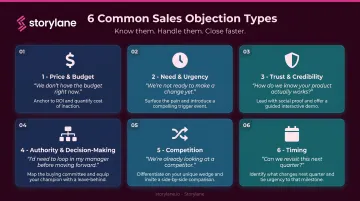
The 6 Most Common Types of Sales Objections
Price and Budget
"It's too expensive." / "We don't have budget right now."
Price objections are the most frequently cited in B2B sales. A Corporate Visions survey of 300+ B2B salespeople found 28% cited inability to articulate value as the top margin-impacting problem, with 21% admitting to negotiating against themselves and 14% discounting too quickly. In most cases, the real problem is unclear ROI, not actual affordability.
Need and Urgency
"We're happy with what we have." / "This isn't a priority right now."
These signal the prospect hasn't connected the solution to an active pain point. The rep's job is to surface the cost of inaction, not push the product harder.
Trust and Credibility
"We've never heard of your company." / "How do I know this will work?"
Common in risk-averse buying environments. Social proof, named case studies, and honest scoping are the primary tools to deploy.
Authority and Decision-Making
"I need to run this by my boss." / "I'm not the decision-maker."
This often isn't a stall. Gartner reports the typical complex B2B buying group involves six to ten decision-makers — and Gong's 2025 data shows strategic enterprise deals average 17 contacts, with multi-threading increasing win rates by 130% on deals over $50K. Identify the true decision-maker while preserving the current contact as an internal champion.
Competition
"We're already using a competitor." / "Your competitor is cheaper."
The goal here is differentiation, not a price race. Ask discovery questions designed to surface dissatisfaction gaps — what the competitor doesn't cover, where the current setup falls short — rather than directly criticizing them. Prospects respond better to uncovering their own frustrations than to being told a competitor is inferior.
Timing
"Let's revisit next quarter." / "Now isn't a good time."
Timing objections usually disguise something else: an upcoming budget cycle, competing internal priorities, or a genuine lack of urgency. Diagnosing which one is driving the delay determines your next move. A budget cycle issue calls for pipeline timing; a priority issue calls for re-establishing impact.
A Proven 4-Step Framework for Handling Any Sales Objection
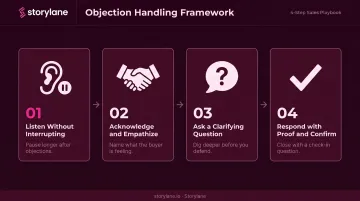
Step 1 — Listen Without Interrupting
The most common mistake is cutting the prospect off mid-objection. Let them finish completely. Pay attention to tone and emotion, not just the words.
Gong's analysis of 67,149 sales meetings found that successful reps pause longer after objections. Unsuccessful reps, when flustered, speed up from an average of 173 words per minute to 188 words per minute. Slowing down signals confidence.
Step 2 — Acknowledge and Empathize
Validate before you respond. Empathy disarms defensiveness before any logic lands.
Useful phrases:
- "That's a completely fair concern."
- "I hear that from a lot of buyers at this stage."
- "That makes sense given where you are."
Step 3 — Ask a Clarifying Question
Most surface objections have a deeper root. A stated price objection might really be about budget approval processes. A timing objection might really be about stakeholder alignment.
Clarifying questions by type:
| Objection | Clarifying Question |
|---|---|
| Price | "Is the concern the absolute cost, or is it more about how you'd justify the investment internally?" |
| Timing | "When you say next quarter — is that tied to a budget cycle, or is there an internal initiative taking priority right now?" |
| Trust | "What would give you enough confidence to move forward — is it references from similar companies, or would a trial period help?" |
Gong data shows winning reps ask 15–16 questions per call, while losing reps ask closer to 20. Asking too many questions can feel like an interrogation — what matters is asking the right one at the right moment.
Step 4 — Respond with Specific Proof, Then Confirm
Once the clarifying question surfaces the real concern, use that answer to shape your response — not a generic rebuttal. Use a relevant case study, ROI example, or feature walkthrough as proof.
Then explicitly check for resolution: "Does that address your concern, or is there another piece we should talk through?"
Skipping that confirmation step is how deals quietly stall — the prospect walks away unresolved, and the rep assumes it was handled.
How to Respond to the Most Common Sales Objections
"Your price is too high."
Resist the reflex to discount. Discounting before establishing value teaches the prospect that the initial price was inflated — and it weakens every future negotiation.
Instead, reframe around ROI: "Let's look at what this problem is costing your team per quarter before we decide if the investment makes sense."
If budget is genuinely constrained, explore phased rollouts or pilot programs — but only after ROI is clearly framed. Offering flexible terms before establishing value reinforces the objection rather than resolving it.
Gong's call data shows star reps introduce pricing in the 38–46 minute window of a 60-minute call. Reps who lead with pricing in the first 12–15 minutes close at lower rates.
"We don't have an urgent need right now."
Help the prospect calculate the cost of inaction rather than pushing urgency artificially. A useful prompt: "If this stays as-is for another quarter, what does that mean for [the specific pain point they mentioned]?"
If no genuine pain point exists that your solution addresses, that's a qualification problem, not an objection. The right move is to gracefully disengage and set a future follow-up — not manufacture urgency.
"We're already working with a competitor."
Respond with curiosity. Ask what they like most about their current solution, then ask what they wish were different. This surfaces dissatisfaction gaps without attacking the competitor.
Gong's 2024 data shows competitive mentions increased 57% from 2022 to 2024, and discussing competitors early in enterprise deals increased win rates by 32% compared to deals where competitors weren't acknowledged. Avoiding the topic doesn't help.
Once you've surfaced those gaps, your solution's differentiation lands with context — not as a pitch, but as the logical answer.
"I need to get my manager's approval."
Never respond with "okay, let me know" — that cedes all deal control. Instead, equip the internal champion:
- A one-page business case
- Key ROI figures specific to their situation
- Pre-answered objections their manager will likely raise
Offer to join a follow-up call with the decision-maker directly, framed as a "quick 20-minute overview" — not a sales pitch.
"I'm not sure I trust your company yet."
The 3 F's framework addresses this directly: Feel, Felt, Found.
- "I completely understand how you feel."
- "Many of our customers felt the same way before getting started."
- "What they found was [specific result]."
From there, back it up with substance:
- Share named case studies from companies of similar size or industry
- Offer a proof-of-concept or trial period to reduce perceived risk
- Be upfront about what the product doesn't do — honest scope-setting builds more credibility than overselling
Best Practices to Sharpen Objection-Handling Skills
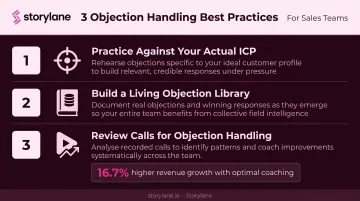
Three practices separate reps who handle objections reliably from those who wing it every call:
Practice against your actual ICP. Generic role-play produces generic results. Simulate objections from specific buyer profiles — a budget-conscious VP at a 500-person SaaS company pushes back very differently than an enterprise IT director. Record sessions and debrief on what landed versus what didn't.
Build a living objection library. Document every objection by deal stage, prospect role, and industry — along with the responses that worked and those that didn't. This becomes more actionable than any off-the-shelf methodology framework, because it's built from your real deals.
Review calls for objection-handling, not just outcomes. The Sales Management Association found that organizations providing optimal coaching realized revenue growth 16.7% higher than those providing none. Reviewing specifically how objections were handled — not just whether deals closed — accelerates skill development faster than formal training alone.
The call data reinforces this: Gong's 2025 analysis of 326,000 sales calls found that won deals averaged 57% seller talk time, while lost deals averaged 62%. Reps talking more than 65% of the call consistently underperformed.
How to Reduce Sales Objections Before the Call Even Starts
Most sales calls are reactive because prospects arrive knowing almost nothing about the product. They've done their research elsewhere, formed partial impressions, and walk into the call ready to push back on things they don't yet understand.
Gartner's 2026 survey found 67% of B2B buyers prefer a rep-free experience, and 6sense's research on nearly 4,000 B2B buyers shows prospects complete roughly two-thirds of the buying journey before first seller contact. The prospect arriving at your demo call has already formed opinions — the question is whether those opinions were shaped by your content or a competitor's.
This is where proactive objection prevention changes the dynamic. When prospects can self-explore a product before the call via an interactive demo, they arrive pre-qualified, with informed questions rather than surface-level skepticism. The "I don't understand how it works" and "I need more time to evaluate" objections disappear entirely.
Storylane's interactive demo platform is built specifically for this. Prospects experience the product on their own terms before speaking to a rep, and Storylane's analytics surface which features they engaged with most and where they dropped off. A rep who knows a prospect spent significant time on a particular workflow has a very different opening than one going in cold.
Three capabilities make this work in practice:
- Pre-call engagement analytics — demo signals show exactly which features a prospect explored, giving reps data-backed context before the first sentence
- RepX AI sales rep — handles buyer questions, runs full product demos autonomously, qualifies leads by buying sentiment, and routes sales-ready prospects to CRM, 24/7 in multiple languages
- Personalized demo delivery — demos tailored to a prospect's company name, industry, or use case neutralize the "this doesn't apply to us" objection before a rep says a word
By the time a human rep enters the conversation, the buyer is already warm and informed.
Frequently Asked Questions
What are the most common sales objections?
The six most common categories are price/budget, need/urgency, trust/credibility, authority, competition, and timing. Each requires a meaningfully different response approach — a price objection needs ROI reframing, while a trust objection needs social proof and transparency.
What are the 3 F's in sales?
Feel, Felt, Found. A rep acknowledges the prospect's feeling, normalizes it by noting others felt the same, then pivots to outcome ("but they found that..."). It works best for trust and price objections, where emotion is driving the resistance.
What is the 10-3-1 rule in sales?
A prospecting heuristic: for every 10 outreach attempts, roughly 3 will respond and 1 will convert. Most objections soften with consistent, value-driven follow-up, which is why persistence matters more than any single response.
What is the difference between a sales objection and a brush-off?
An objection has a specific addressable concern ("your price is too high"). A brush-off is a vague deflection from a poorly qualified prospect ("just send me info"). Proper lead qualification upfront minimizes brush-offs and ensures reps spend time on conversations worth having.
How can you prevent sales objections before a sales call starts?
Share an interactive demo before the call. Prospects who self-educate arrive pre-qualified, with informed questions rather than surface-level skepticism, sharply reducing "I don't understand" and "I need more time" objections before the conversation even starts.