Meanwhile, companies like Slack, Notion, and Calendly scaled to billions in valuation with minimal outbound sales investment. Their secret wasn't better reps or bigger ad budgets. It was the product itself.
That shift has a name: product-led growth (PLG). This article covers what PLG actually is, how it differs from sales-led and marketing-led models, the mechanics that power it, real-world examples, and the metrics every team should track.
Key Takeaways
- PLG is a go-to-market strategy where the product drives acquisition, activation, retention, and expansion via freemium or free trial models.
- Unlike sales-led growth, PLG lets users experience value before any commercial conversation begins.
- Core PLG mechanics: self-service access, a fast "aha moment," value before monetization, and network effects.
- Essential PLG metrics: time-to-value (TTV), activation rate, free-to-paid conversion rate, and product-qualified leads (PQLs).
- PLG makes sales teams more effective by grounding outreach in real product usage signals, not replacing them.
What Is Product-Led Growth (PLG)?
PLG is a business and go-to-market strategy where the product itself is the primary driver of customer acquisition, conversion, retention, and expansion. The defining characteristic: users experience meaningful value before any commercial conversation happens. Upgrading becomes the natural consequence of getting value, not the prerequisite for accessing it.
The term was coined in 2016 by Blake Bartlett at OpenView Partners — specifically, OpenView traces the phrase to an internal email sent on May 6, 2016. But the underlying mechanics (freemium access, self-serve adoption, viral product spread) predate the label. Dropbox, for instance, reported generating over 90% of revenue from self-serve channels before the term existed, with 6.5 million paying users by year-end 2015.
PLG isn't defined by a feature or a pricing decision. It's an organizational orientation: every team — product, marketing, sales, customer success, engineering — aligns around user success and product usage as the engine of growth, rather than headcount or ad spend.
Freemium vs. Free Trial
That orientation shows up most concretely in how users first access the product. PLG typically enters through one of two models:
- Freemium — a permanent free tier with feature limits (Slack, Notion). Users build habits and dependency before monetization pressure appears.
- Free trial — time-limited access to full or core features (common across SaaS). Creates urgency while still removing the salesperson as a prerequisite for experiencing value.
The right model depends on product complexity, target market, and how quickly users can reach their first measurable result. Either way, the user self-qualifies and self-educates — no sales call required to understand whether the product fits.
PLG vs. Sales-Led vs. Marketing-Led Growth
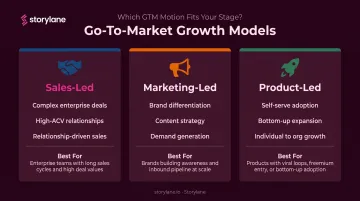
Most companies don't choose one model exclusively — they blend them. But understanding the structural differences matters for deciding where to invest.
| Model | Primary Driver | Trust Built... | Scales With... |
|---|---|---|---|
| Sales-Led | Relationship and persuasion | During the sale | Headcount |
| Marketing-Led | Brand and demand generation | Before the sale | Spend |
| Product-Led | The product itself | Through use | Product adoption |
The key structural difference: in sales-led and marketing-led models, the prospect must be told the product's value. In PLG, they discover it themselves. That shift means conversion happens without proportional cost — and that's where the model's efficiency advantage originates.
Sales-led growth scales linearly — more reps mean more revenue, but costs grow proportionally. Marketing-led scales with budget. Product-led can scale non-linearly because the product handles qualification and conversion without equivalent cost growth.
The market data reflects this. Bain's 2023 research found that PLG companies grew revenue approximately 2x faster than non-PLG companies in 2022. OpenView has also reported that PLG companies trade at a 50% revenue multiple premium to SaaS peers — a structural advantage rooted in lower CAC and stronger retention.
When each model makes sense:
- Sales-led — complex, high-ACV, highly customized enterprise deals where relationship and configuration matter
- Marketing-led — categories where product differentiation is low and brand or content can create competitive separation
- Product-led — products that deliver clear individual-user value quickly, where a bottom-up adoption motion (individual → team → organization) is viable
The Core Mechanics of a PLG Strategy
PLG isn't a single tactic. It's a set of interconnected design choices that, when executed together, compound on each other — each mechanic making the next more effective. Four mechanics underpin every successful PLG motion.
Self-Service Access
PLG requires removing friction from the path to first use. No mandatory demo calls. No lengthy procurement. No complex setup requiring IT involvement. Users should be able to sign up, access the product, and extract value independently.
This is increasingly what buyers expect. In addition to the 61% rep-free preference cited earlier, Gartner separately reports that 75% of B2B buyers prefer a rep-free sales experience — especially technology buyers already familiar with a product category.
Tools like Storylane's interactive demos serve this mechanic earlier in the funnel. By embedding self-guided product tours on websites or in outreach sequences, teams give prospects a genuine product experience before sign-up — so that when someone does create an account, they arrive already knowing what they're getting into.
Campminder found that embedding Storylane demos in email campaigns prompted responses like: "I love this, no one else is doing this. I want to schedule something."
The "Aha Moment" (Activation)
The activation moment is the specific in-product action or outcome at which a user first experiences the product's core value. Identifying and accelerating this moment is the central design challenge of PLG.
Slack's activation milestone is the clearest example in the industry. According to founder Stewart Butterfield, after a team exchanged 2,000 messages in Slack, 93% of those teams were still using the product. That threshold became a north star — something Slack could design onboarding around and track as a leading indicator of retention.
Every PLG product needs this clarity. Without knowing what activation looks like, teams optimize for the wrong signals (signups, logins) instead of the right ones (first meaningful outcome).
Value Before Monetization
The PLG principle of "value before monetization" means letting users solve a real problem with the product before asking for payment. Freemium and free trials operationalize this in the product itself. Interactive demos serve a similar function earlier in the funnel.
Whispli's COO described a 15-minute Storylane HTML demo giving prospects "a full idea of what Whispli is about" — something longer unstructured trials failed to deliver. The demo built conviction before any monetization conversation began.
The practical design question isn't whether to offer value first — it's how much value to give before the paywall, and which value signals you track as the precursor to upgrade intent.
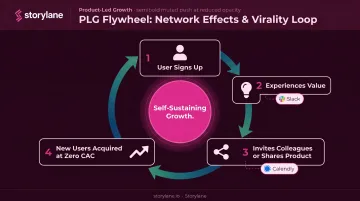
Network Effects and Virality
The strongest PLG products are designed so that using them creates a natural reason to invite others. Two patterns drive this:
- Slack and Notion become more useful as teammates join, so individual users naturally pull in colleagues
- Calendly turns every scheduling link into an implicit demo — recipients experience the product before they ever sign up
Network effects lower CAC over time and accelerate top-of-funnel growth without paid spend. When the product itself generates awareness and acquisition, the economics of growth improve with scale rather than degrading.
Real-World PLG Examples That Work
Slack
Slack's PLG motion rests on three pillars: a freemium entry point, a team-based network effect, and a concrete activation milestone. Free teams build daily communication workflows in Slack, creating dependency. The 2,000-message threshold provides a natural trigger for upgrade conversations — by that point, 93% of teams are still active. Slack now has 200,000+ paid customers, with 77 of the Fortune 100 using the platform daily.
Notion
Notion spreads team by team, not top-down. Its generous free tier lets individuals build deep personal and team workflows before monetization enters the picture. With 100 million users across 50+ countries and 62% of the Fortune 100 as customers, Notion's growth has been almost entirely bottom-up — individuals adopt, build habits, then organizations formalize.
Calendly
Every scheduling link Calendly users send to a contact is, implicitly, a product demo. Recipients experience the interface, understand the value, and often become users themselves. Calendly has reached 20 million users across 230+ countries, with 86% of the Fortune 500 using the platform. Its $3B valuation was built on a product that markets itself through every interaction.
The consistent pattern across all three:
- Fast time-to-value for the individual user
- Natural expansion from individual through teams and into the broader organization
- Usage signals that create upgrade moments without a sales call
That pattern holds even outside consumer-adjacent tools. Atlassian built its entire company on a bottom-up PLG model for technical teams — what its own annual report calls a "self-service, high-velocity, low-friction distribution model" — with minimal early-stage sales investment.
Key PLG Metrics Every Team Should Track
One hallmark of PLG organizations is that all teams align around shared metrics focused on user value, rather than siloed KPIs. The core set:
| Metric | What It Measures | Benchmark Reference |
|---|---|---|
| Time-to-Value (TTV) | How quickly new users reach activation | Lower is always better |
| Activation Rate | % of signed-up users who reach the "aha moment" | ~20% freemium, ~40% free trial (OpenView) |
| Free-to-Paid Conversion | % of free users who upgrade | ~7% freemium, ~14% free trial (OpenView) |
| Product-Qualified Leads (PQLs) | Users showing buying intent through product usage | PQLs convert at 15–30% (OpenView) |
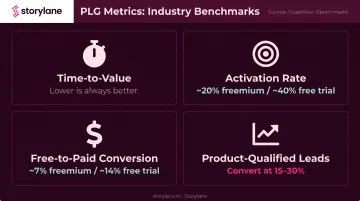
PQLs deserve particular attention. Unlike MQLs based on content downloads, PQLs reflect actual product usage — OpenView reports that tracking PQLs increased the likelihood of fast growth by 61% in its 2023 Product Benchmarks. A user who has explored three core workflows and returned five times in two weeks is an entirely different signal than someone who downloaded a whitepaper.
That's the logic behind tools like Storylane's Account Reveal feature, which surfaces PQL-equivalent signals from demo engagement — identifying which companies are exploring specific product areas and routing those insights to sales via Slack alerts and CRM integration before the first call happens.
Beyond acquisition, two expansion metrics separate PLG businesses that sustain growth from those that merely accumulate users:
- Net Revenue Retention (NRR) — NRR above 100% means the customer base compounds in value even without new acquisition. Top SaaS companies consistently maintain NRR between 115–125%.
- Expansion Revenue — upsells, seat growth, cross-sells — the revenue layer that makes PLG defensible over time.
How to Start Building a PLG Strategy
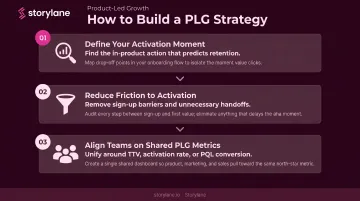
Transitioning to PLG requires an organization-wide culture shift. Three foundational steps can start that process without a complete overhaul.
Step 1: Define Your Activation Moment
Before optimizing anything else, identify the specific in-product action that predicts long-term retention. Analyze behavioral data to find which early actions correlate with paid conversion and low churn. This is an empirical question — it requires real usage data, not intuition.
Step 2: Reduce Friction on the Path to That Moment
Audit the onboarding flow from sign-up to activation. The goal is to get every new user to the activation moment as fast as possible, without a human intermediary. Remove anything slowing that down:
- Unnecessary sign-up fields or verification steps
- Required human handoffs before users reach core value
- Onboarding steps that don't directly drive activation
For teams not yet at full PLG, interactive demos can compress time-to-value before sign-up itself, so users arrive at the product already oriented.
Step 3: Align Teams Around Shared PLG Metrics
PLG breaks down when marketing optimizes for MQLs, sales chases demos booked, and product ships features in isolation. Establish one shared metric — TTV, activation rate, or PQL conversion — that forces cross-functional alignment around user success as the leading indicator of revenue.
Frequently Asked Questions
What is product-led and marketing-led growth strategy?
Product-led growth makes the product the acquisition and conversion engine — users sign up, experience value, and upgrade through product use rather than sales conversations. Marketing-led growth centers demand generation and content to attract and nurture leads before any product engagement. Many companies combine both: PLG handles self-serve segments while marketing-led tactics support brand awareness and top-of-funnel reach.
What is an example of product-led growth?
Slack is the canonical example — a free tier built team dependency through daily use until upgrading became the obvious next step, with no sales involvement required. Calendly follows the same logic: every scheduling link shared with a non-user is an organic product demo that turns recipients into prospects.
Is PLG just a trend?
PLG is a structural response to shifts in buyer behavior and software economics, not a passing trend — rising acquisition costs and expectations for frictionless experiences are only intensifying. That said, it works best for specific product types and is commonly paired with sales-led motions rather than replacing them entirely.
What is a product-qualified lead (PQL)?
A PQL is a user or account that has demonstrated buying intent through specific product actions — not just signups, but behaviors indicating genuine reliance. They give sales teams a more reliable outreach signal than marketing-qualified leads and convert at 15–30%, according to OpenView research.
Does product-led growth work for B2B enterprise companies?
Yes, though it typically follows a bottom-up model where individual users or small teams adopt first, then usage expands to the broader organization, eventually triggering an enterprise conversation. Atlassian and Notion are two well-known B2B examples of PLG working at enterprise scale — both built their enterprise presence through individual and team adoption rather than top-down sales.