
.svg)

For RevOps, Sales Ops, and Marketing Ops professionals at B2B SaaS companies, lead routing is often the invisible bottleneck. This guide covers what lead routing is, the main strategies teams use, best practices for building a system that holds up, and the failure points that quietly drain pipeline.
Key Takeaways
- Lead routing assigns incoming leads to the right sales rep based on defined criteria, directly reducing time-to-response and improving conversion rates
- Most B2B teams layer 2–3 routing strategies rather than relying on a single approach
- CRM data quality is the foundation — even well-designed routing logic breaks on stale or missing fields
- Common failure points: over-engineering logic, skipping fallback rules, routing leads before qualifying them, and ignoring round-robin fairness across reps
- Speed matters: InsideSales/XANT's 2021 research found leads contacted within the first five minutes convert at 8x higher rates
What Is Lead Routing?
Lead routing is the process of automatically or manually assigning incoming leads to the sales representative best suited to convert them, based on predefined rules or criteria. The goal is connecting the right lead to the right rep at the right time — minimizing the gap between lead capture and first contact.
Lead scoring and lead routing are not interchangeable. Scoring determines whether a lead is qualified enough to send to sales. Routing determines which rep receives that qualified lead. They work in sequence — scoring first, routing second.
Conflating the two is a common setup mistake. The result is predictable: unqualified leads flood the sales queue, or qualified leads sit unassigned with no clear owner.
Why Lead Routing Is Critical for B2B Sales Teams
B2B sales creates specific pressures that make routing far more consequential than in shorter, lower-stakes sales:
- High-value, multi-stakeholder deals — Forrester's 2024 research found that the average B2B buying group involves 13 people across two or more departments, with 86% of B2B purchases stalling at some point
- Simultaneous vendor evaluation — 96% of buyers start with a candidate list, and 89% choose from that initial list — meaning speed and the right rep assignment both influence whether you even stay in the deal
- Longer sales cycles — misassigning a lead to the wrong specialist at the start can take weeks to correct, not days
What Breaks Without a Routing System
Without defined routing logic, the same problems surface repeatedly:
- Leads fall through cracks and receive no outreach (a 2021 InsideSales/XANT study found 77% of leads received no response)
- Multiple reps duplicate outreach on the same account
- High-value prospects land with the wrong specialist
- Rep workloads become unbalanced, with some overwhelmed and others underutilized
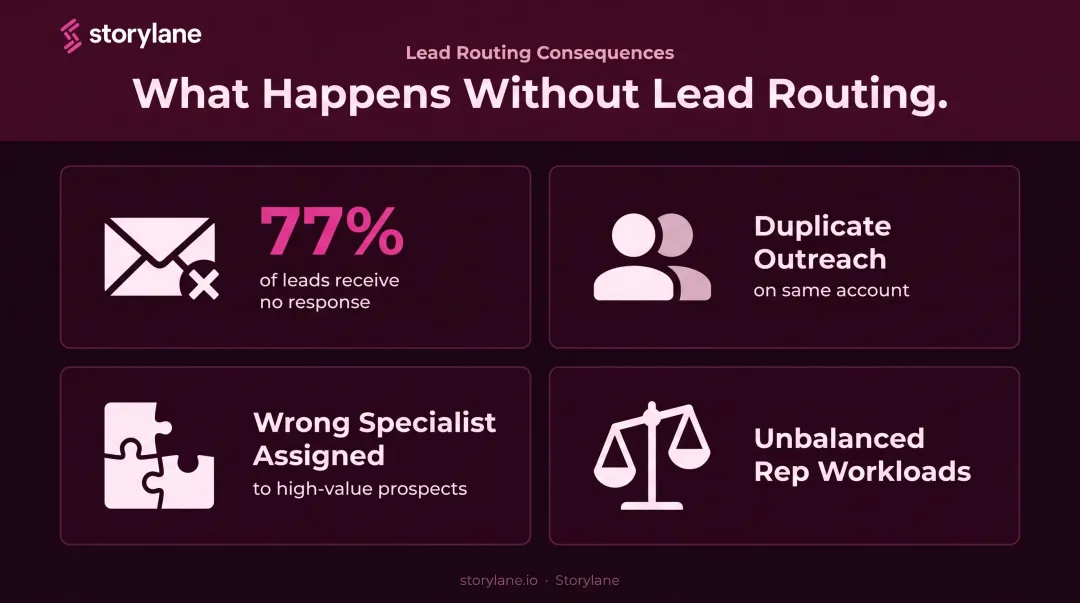
Each of these failures drains pipeline that marketing already paid to generate. Routing is the mechanism that keeps that investment from leaking out before a rep ever makes contact.
Lead Routing Strategies: The Main Approaches Explained
No single routing method fits every team. Most organizations layer two or three strategies to match their go-to-market motion — and simpler logic holds up better than complex rule stacks when team structures change.
One universal requirement: fallback routing. Regardless of which strategies you use, every system needs a catch-all rule that ensures no lead goes unassigned when primary criteria go unmet.
Round-Robin Routing
Round-robin distributes leads evenly and sequentially among a rep pool. It's the right fit when:
- Reps have equivalent skills and deal experience
- Inbound volume is moderate and relatively consistent
- Fairness in distribution is a priority
Where it breaks down: high variance in rep expertise, complex enterprise deals requiring specialist knowledge, or scenarios where matching a lead to an account owner matters more than even distribution. Round-robin works well as a fallback mechanism even when it's not the primary strategy.
Territory and Geography-Based Routing
Territory-based routing assigns leads based on geographic region or market segment. It works well for teams with regional specialization — for example, separate reps covering North America enterprise vs. EMEA mid-market.
The main risk: uneven lead volume across territories creates workload imbalances. A territory covering three major metros will generate more inbound than one covering a single secondary market, and round-robin can't compensate for that structural asymmetry.
Account-Based Routing
Account-based routing matches incoming leads to the rep who already owns the relevant account in the CRM. This prevents duplicate outreach, protects rep-to-buyer relationships on existing accounts, and ensures enterprise prospects land with someone who knows the deal context.
The catch: this strategy is only as reliable as your CRM data. Common failure points include:
- Account owners who left the company months ago
- Ownership fields never updated after a territory reorg
- Duplicate account records splitting ownership across two reps
When records are stale, leads get misrouted to reps with no context — or no reason to act.
Behavioral and Trigger-Based Routing
Trigger-based routing assigns leads based on real-time actions or behavioral signals: pricing page visits, demo requests, content downloads crossing a scoring threshold, or high-engagement product interactions.
This pairs naturally with intent data and behavioral analytics. Storylane's interactive demo platform, for example, captures granular engagement signals — which features a prospect explored, time spent per step, completion rate, and CTA clicks — alongside firmographic data surfaced through Account Reveal. When a prospect from a target account completes a demo and crosses a high-intent threshold, that signal triggers a Slack alert to the AE and auto-syncs to Salesforce or HubSpot, routing the lead within seconds of the prospect's last click.
For teams using interactive demos in their inbound motion, these engagement signals serve as high-intent routing triggers for leads who have already self-qualified through a product experience.
Hybrid Routing
Hybrid approaches combine automated routing for high-volume inbound with manual review for high-value or strategic accounts. This model works best when the team has clearly defined thresholds for when automation fires and when a human checkpoint is required — for example, automate everything below $50K ACV and manually review any enterprise inbound above that threshold.
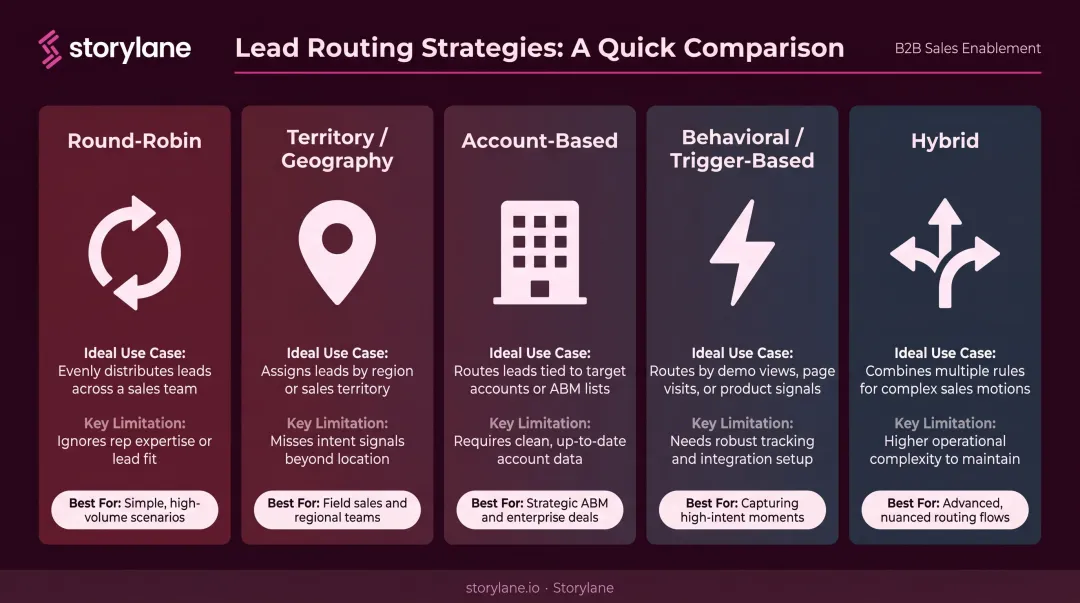
Without those thresholds defined in writing, hybrid systems tend to default to "everyone reviews everything," which defeats the purpose.
Lead Routing Best Practices
Document Logic Before You Build It
Specify lead sources, routing criteria, team structure (SDR vs. AE), expected response SLAs, and fallback rules in a shared document before touching any platform configuration. Routing that lives only in one person's head creates fragility. When that person leaves or the system breaks, there's no reference point for debugging.
Qualify Before You Route
Routing unqualified leads to sales reps erodes buy-in fast. Reps who repeatedly receive leads that don't meet basic qualification criteria stop trusting the queue — and start ignoring it.
Enrich and score leads upstream using firmographic data, behavioral signals, and intent data, so only leads meeting a defined MQL threshold get routed. Storylane's RepX acts as a qualification layer here — an AI sales agent that engages buyers, qualifies leads, answers objections, and runs demos 24/7, routing only sales-ready prospects into the CRM without requiring a human SDR to be online.
Balance Speed With Accuracy
The research on response time is clear: contact within five minutes produces 8x higher conversion rates than waiting longer. But speed and expertise aren't always compatible, especially for enterprise deals.
A practical framework:
| Deal Type | Priority | Why |
|---|---|---|
| High-volume inbound (SMB/mid-market) | Speed | First available qualified rep wins |
| Enterprise / strategic accounts | Accuracy | Right specialist > fastest responder |
| Demo requests / high-intent signals | Speed + context | Immediate alert, rep calls with context |
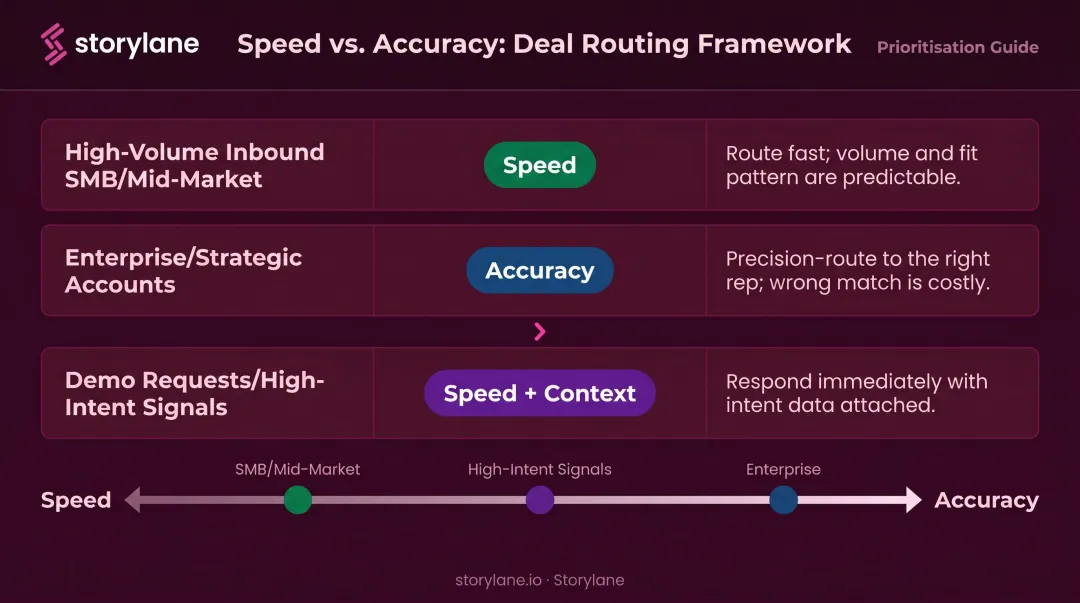
Automated routing — rather than manual assignment — is the only reliable way to achieve consistent speed at scale.
Audit Regularly
Routing logic drifts. Reps are added, territories shift, GTM strategy evolves — and the routing rules don't always keep up. A practical audit cadence:
- Daily: Flag unrouted leads and leads sitting in fallback queues
- Monthly: Review distribution fairness across reps
- Quarterly: Revisit logic and segmentation fields for accuracy
Always enable field history tracking in the CRM so you can trace every routing decision. Validity's 2024 CRM data report found that 24% of CRM admins said less than half their CRM data is accurate and complete — a number that makes regular audits non-negotiable.
Build Fallback Rules and Alerts
Every routing system needs:
- A designated fallback owner for leads that don't match any rule
- A catch-all queue with clear visibility
- An alert (Slack notification, email, or webhook) when a lead lands in that queue
Without this, missed-rule leads disappear silently. The fallback queue should be treated as a monitoring dashboard, not a dumping ground.
Common Lead Routing Mistakes
Over-Engineering the Logic
The pattern looks like this: a team hard-codes 15 field-level conditions into a routing rule, then six months later a new data source starts passing revenue as a range ("$1M–$5M") instead of a number. The router expects a number, the condition fails silently, and leads start landing in the fallback queue — or nowhere at all.
Simpler, centralized logic — where routing fields are normalized in the CRM and the router reads from those clean fields — outlasts complex conditional stacks every time.
Treating Routing as a One-Time Setup
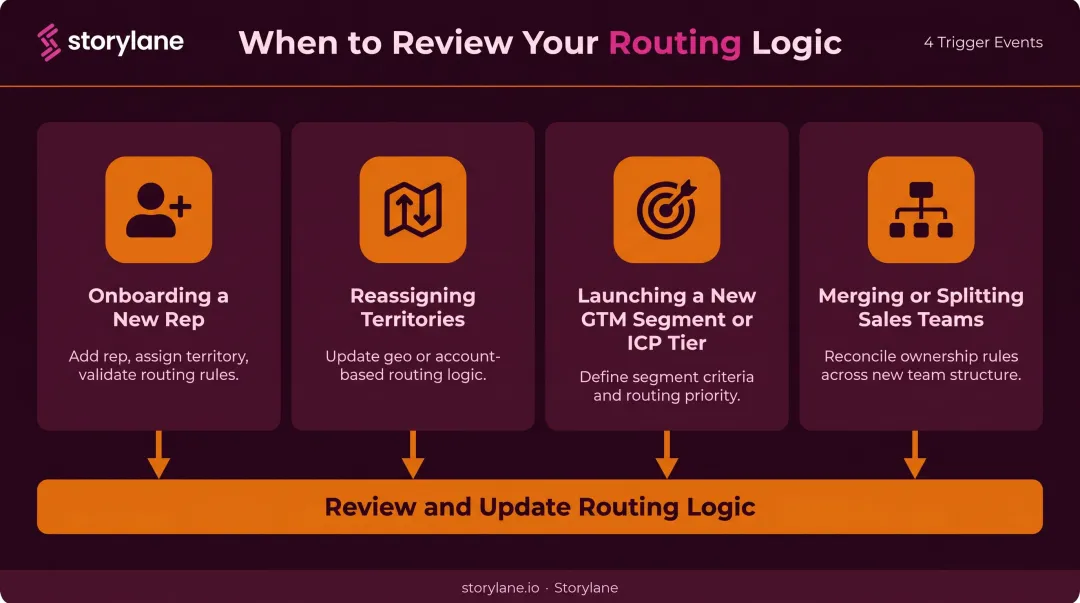
Routing logic must be updated whenever team structures change, territories are reassigned, new reps are onboarded, or GTM strategy evolves. Teams that configure routing once and move on see increasing misassignment rates over time, but the drift is gradual enough that no single incident triggers a review.
Tie routing reviews to standard team change processes. Common triggers include:
- Onboarding a new rep
- Reassigning territories
- Launching a new GTM segment or ICP tier
- Merging or splitting sales teams
Catching these at the point of change prevents the slow misassignment drift that only surfaces months later.
Confusing Routing Tools With Data Quality Fixes
Adding a better routing platform will not fix underlying data problems. Routing logic is only as accurate as the data it reads — stale account ownership, missing enrichment fields, or inconsistent CRM data will cause misroutes regardless of which tool is doing the routing.
Clean and enrich the data first, then configure the routing rules. Doing it in reverse is a common and expensive mistake.
Frequently Asked Questions
What does lead routing mean?
Lead routing is the process of assigning incoming leads — automatically or manually — to the most suitable sales rep based on criteria like territory, account ownership, expertise, or availability. The goal is minimizing time between lead capture and first contact while matching each lead to the rep best positioned to close them.
What are the three types of routing?
The most common types are rule-based routing (criteria like geography or company size), round-robin (even sequential distribution), and account-based (matching leads to existing account owners). Most teams layer these — using account-based as the primary method and round-robin as the fallback for unmatched leads.
What is a lead routing platform?
A lead routing platform is a tool that automates the assignment of leads to sales reps based on defined rules. It typically integrates with the CRM and marketing automation stack, and may include features like round-robin distribution, lead-to-account matching, and SLA monitoring.
What is the difference between lead routing and lead scoring?
Lead scoring determines whether a lead is qualified enough to send to sales. Lead routing determines which sales rep receives that qualified lead. They work sequentially — scoring happens first, routing follows.
How quickly should leads be routed after they come in?
Research from Harvard Business Review found that leads contacted within five minutes are 100x more likely to connect than those reached after 30 minutes. Automated routing is the only reliable way to hit that window consistently — manual assignment introduces delays that compound fast, especially outside business hours.
What is the most common reason lead routing fails?
Poor data quality in the CRM. When account ownership is stale, enrichment fields are missing, or routing criteria are inconsistently populated, even well-designed routing rules will misfire. Fixing the data upstream is a prerequisite for routing that works reliably.