
.svg)

Introduction
Most sales teams don't have a content problem — they have a content usage problem. According to Forrester, citing SiriusDecisions research, 60–70% of B2B marketing content goes unused, with some organizations reporting more than 80% sitting idle. Reps default to whatever they remember, prospects get generic decks, and deals stall.
The fix is the right content, organized well, with reps who know exactly when and why to use each piece.
This guide covers what sales enablement resources are, how they map to a five-pillar framework, which resources every team needs, and how to build a library reps will actually use.
Key Takeaways
- Sales enablement resources split into two categories: internal (for rep preparation) and external (shared with prospects)
- Five pillars shape a complete enablement program: Content, Training, Coaching, Technology, and Analytics
- Essential internal resources: playbooks, battle cards, email templates, buyer personas, win/loss stories
- Prospect-facing resources include case studies, one-pagers, white papers, interactive demos, and webinars
- Measurement matters: win rate, sales cycle length, quota attainment, and content adoption rate all indicate whether your library is working
What Are Sales Enablement Resources?
Sales enablement resources are the content, tools, and training materials that help reps engage buyers more effectively and move deals forward at every stage of the sales cycle. Gartner defines the broader practice as providing the sales organization with the information, content, and tools that help sellers sell more effectively.
Internal vs. External Resources
The most useful distinction is who the resource is for:
- Internal resources are built for reps — used in preparation, deal execution, and ongoing skill development. Think playbooks, battle cards, and call scripts.
- External resources are shared directly with prospects — designed to inform their buying decision and build confidence. Think case studies, demos, and white papers.
This distinction shapes how you plan and build content. Mixing them up leads to playbooks that read like brochures and case studies that only make sense to the rep who wrote them.
How Enablement Differs from Marketing Content
Marketing content builds awareness. Sales enablement resources are built specifically for defined stages of the sales cycle, tied directly to revenue outcomes rather than brand reach. A blog post pulls prospects into the funnel; a competitive battle card keeps them moving through it.
The 5 Pillars of Sales Enablement
Most enablement programs invest heavily in one or two areas and neglect the rest. CSO Insights data shows exactly where the gaps tend to fall: 62.9% of organizations use random or informal coaching, only 31.8% have a formal content strategy, and just 15.8% operate under a formal enablement charter.
The five pillars framework addresses this by covering what a complete enablement program actually requires:
| Pillar | What It Does | Common Gap |
|---|---|---|
| Content | Gives reps the right materials for each stage | Only 31.8% have a formal content strategy |
| Training | Builds product and process knowledge | Investment is often low or inconsistent |
| Coaching | Reinforces skills in real deals | 62.9% rely on informal or random coaching |
| Technology | Streamlines access and execution | Many teams lack centralized content tools |
| Analytics | Closes the loop on what's working | Outcomes rarely tied back to specific assets |
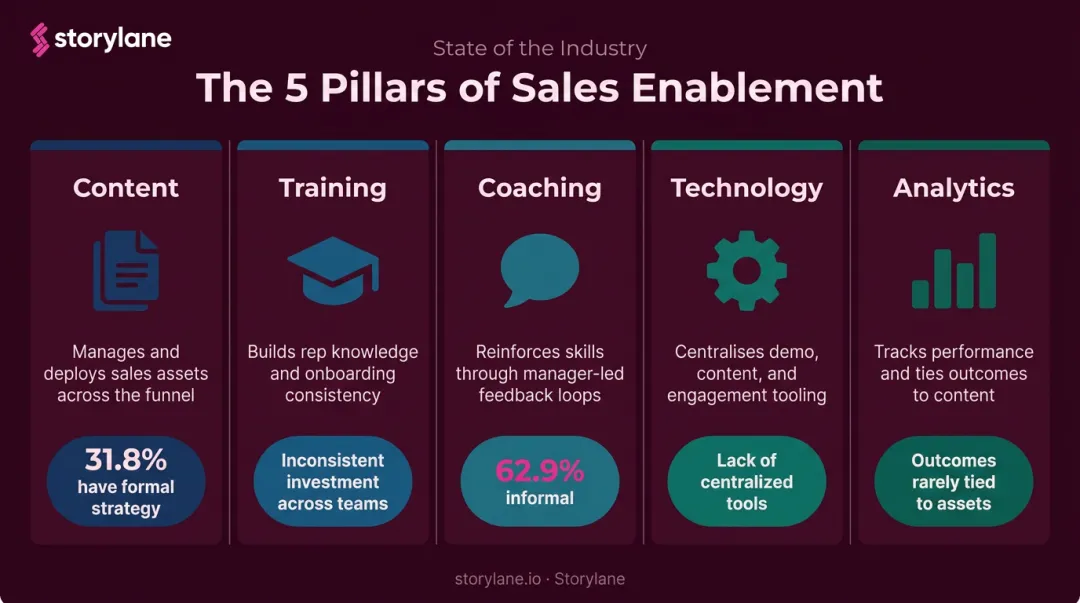
These pillars don't operate in isolation. Content without training leaves reps holding materials they don't know how to use — and coaching can't fix what training never built. Even solid analytics become dead weight if no one acts on what the data shows.
The resources in the next two sections are organized around all five pillars. Whether you're shoring up a weak spot or building from scratch, each one needs to be covered.
Essential Internal Sales Enablement Resources
Sales Playbooks and Call Scripts
A playbook gives reps a repeatable framework for each stage of the sales cycle: discovery question structures, objection handling sequences, stage-exit criteria. It answers "what should I do next?" without the rep needing to reinvent their approach every deal.
Call scripts complement playbooks by providing talk tracks for specific scenarios — the first cold call, the demo follow-up, a competitive displacement situation. They're not meant to be read verbatim; they're a scaffold for reps who are still building confidence in a new scenario.
What makes a playbook actually usable:
- Organized by deal stage, not by product feature
- Short enough to reference mid-deal, not just during onboarding
- Includes real objection responses, not aspirational ones
- Updated when win/loss patterns shift
Battle Cards
Battle cards are concise, rep-facing documents built for competitive deals. Sellers face competition in 68% of deals, yet the average sales team's self-rated readiness for competitive conversations sits at 3.8 out of 10.
A good battle card covers:
- The competitor's core strengths and how to acknowledge them honestly
- Your differentiated advantages in that specific matchup
- The objections that come up most often against that competitor — and the responses that work
- Landmines to avoid (things you shouldn't say that will backfire)
Each major competitor deserves its own card. Generic "us vs. them" comparisons don't help a rep who's mid-call with a prospect considering a specific alternative.
Email Templates, Buyer Personas, and Win/Loss Stories
Most teams underinvest in these three resources — yet each one fills a gap that formal training rarely covers:
- Email templates — Pre-built messages for outreach, post-demo follow-up, proposal stage, and re-engagement. Reps personalize from a strong starting point instead of writing from scratch.
- Buyer personas — Reference guides covering a prospect's likely role, pain points, decision authority, and relevant messaging angles. Especially useful when selling into an unfamiliar industry.
- Win/loss stories — Short recordings or write-ups from reps on what worked, what objections surfaced, and how deals closed. The peer-to-peer intelligence here is something no formal training can replicate.
Essential External Sales Enablement Resources
Case Studies and Social Proof
Case studies are consistently the highest-impact external resource in the middle of the buying cycle. According to Demand Gen Report's 2024 Content Preferences Benchmark Survey, 78% of mid-stage B2B buyers value case studies, while 63% of late-stage buyers value user reviews.
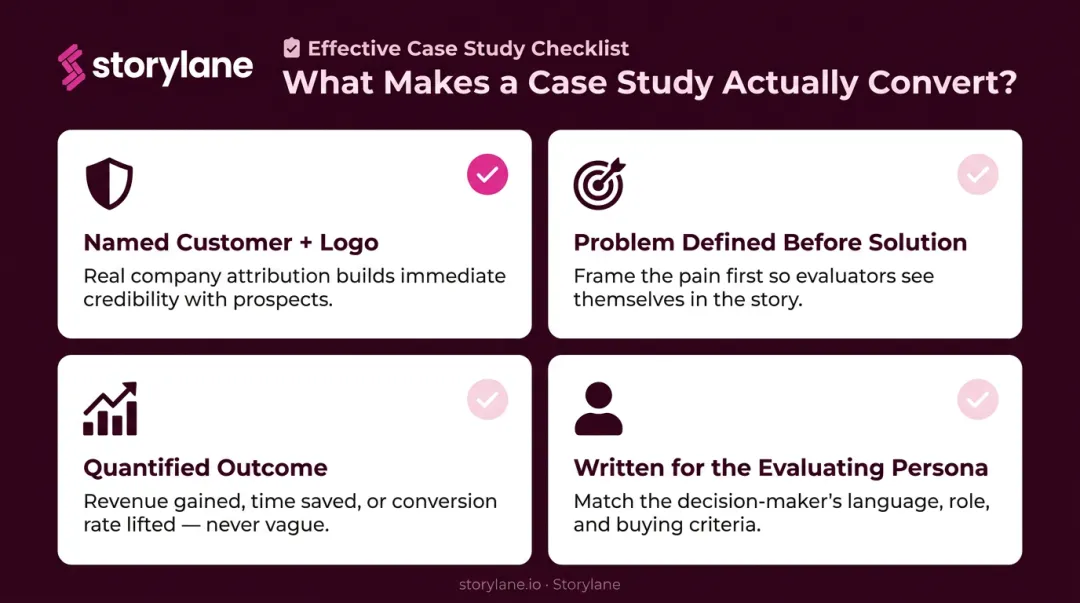
What makes a case study effective:
- Names the customer (when possible)
- Describes the specific problem before your solution
- Quantifies the outcome — revenue, time saved, conversion rate improvement
- Written for the persona evaluating you, not for internal pride
Customer testimonials and peer reviews serve a related but different function. More than a third of B2B buyers sought influencer or user-generated content in 2024, up from less than a quarter the year before. Reps who combine both — a written case study paired with a peer review link — give skeptical buyers two independent signals to trust.
One-Pagers, Solution Briefs, Data Sheets, and Long-Form Content
Different content formats serve different buyers at different stages:
| Format | Best For | Deal Stage |
|---|---|---|
| One-pager | Quick value proposition overview | Early conversations |
| Solution brief | Business problem + solution narrative | Mid-stage champions |
| Data sheet | Feature-level technical detail | Technical evaluators |
| White paper / eBook | Thought leadership, credibility building | Top of funnel |
White papers and eBooks work particularly well as value-add assets during early outreach — a rep sharing a relevant research report signals expertise before the product conversation even starts. 73% of buyers are willing to provide their contact information in exchange for long-form foundational content, making these formats useful lead generation tools as well.
Interactive Product Demos
Interactive demos are now a baseline expectation for most B2B software buyers. 77% of late-stage buyers value product demos, and 75% of B2B buyers now prefer at least some portion of the buying process to be rep-free.
Static screenshots and video walkthroughs don't meet that expectation. Interactive demos let prospects click through real product workflows, explore specific features relevant to their use case, and self-qualify — all without scheduling a call.
Storylane lets sales teams build personalized, trackable interactive demos with several capabilities specifically designed for external sales use:
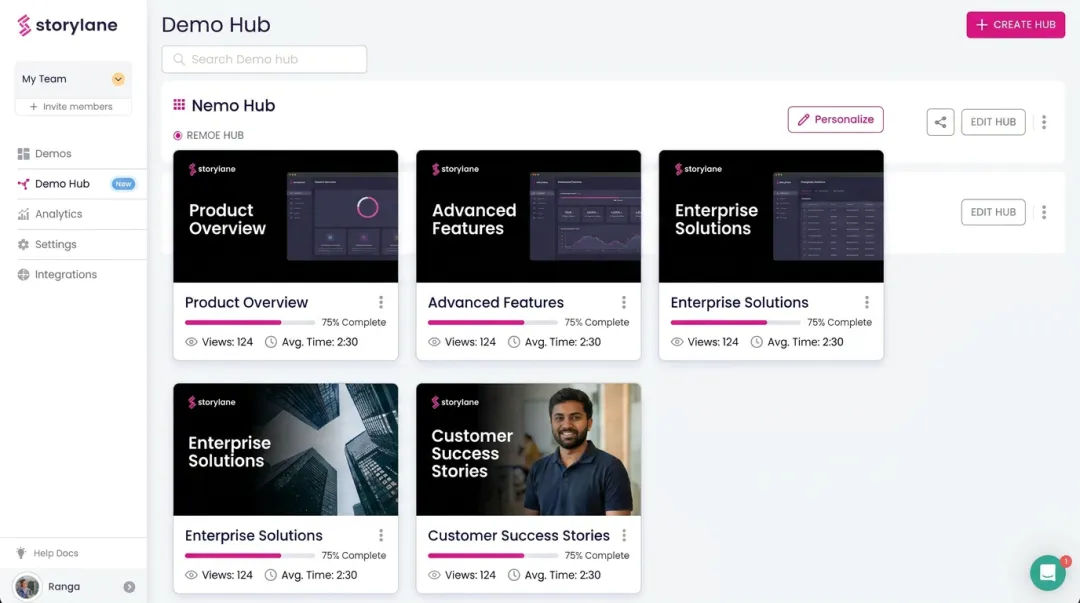
- Organize demos by use case, persona, or funnel stage in a branded Demo Hub — available in Gallery layout (multi-persona, SEO-friendly) or Playlist layout (sequential, guided journeys)
- Get real-time engagement alerts via Slack the moment a prospect opens a demo, so follow-up is timely and specific
- Personalize at scale using dynamic tokens that swap company name, logo, and brand colors without rebuilding each demo from scratch
- Surface anonymous traffic with Account Reveal, which maps demo visitors to company-level firmographic data
Teams like PDQ achieved a 92% conversion lift after implementing interactive demos through Storylane, with completion rates holding at 50–60%. ContactMonkey attributed $1.3M in influenced pipeline directly to their interactive demo, with 28% of demo leads becoming opportunities — roughly double their other inbound sources.
Webinars
Webinars let reps deliver deep-dive education to multiple prospects simultaneously — particularly useful for complex products with longer evaluation cycles. Live sessions create urgency and engagement; recorded versions let buying committees evaluate on their own schedule, without requiring another rep-led call.
For late-stage deals, a targeted technical webinar can move a committee forward faster than a one-on-one call with each stakeholder.
How to Build and Organize Your Sales Enablement Resource Library
Audit First, Create Second
Before adding anything new, take stock of what exists. For each stage of the buyer journey, ask:
- Is this asset current, or is it outdated?
- Does it match how we actually sell today?
- Are reps using it, or did it get created and forgotten?
Common gaps surface quickly: late-stage content (ROI calculators, competitive comparison guides) is almost always missing, and industry-specific case studies rarely keep pace with how a company's customer base evolves.
Map Content to Buyer Journey Stages
Tag every asset by funnel stage: awareness, consideration, decision. When reps can filter by stage, they find the right resource for where their prospect actually is — not just whatever they happen to remember from onboarding.
Tag every asset by funnel stage: awareness, consideration, decision. When reps can filter by stage, they find the right resource for where their prospect actually is — not just whatever they happened to memorize during onboarding.
A few tagging practices that pay off quickly:
- Funnel stage: awareness, consideration, decision
- Persona: economic buyer, end user, technical evaluator
- Asset type: case study, one-pager, demo, calculator
Centralize Everything
Content scattered across email threads, shared drives, and personal desktops will never get used consistently. GTM leaders without enablement technology spend an average of 10 hours per week searching for, comparing, or revising content — and 77% of them say that time could be better spent advancing team goals.
A centralized repository (whether a dedicated enablement platform or a well-structured shared library) needs to be:
- Searchable
- Version-controlled (so reps aren't sharing outdated decks)
- Organized by stage, persona, and asset type
For interactive demos, the same logic applies. Storylane's Demo Hub, for example, consolidates all demos in one branded destination organized by use case, persona, or product — so prospects and reps can navigate without digging through folders. Best results come from keeping it focused: under nine demos per hub, grouped into three clear sections.
Train Reps on When and Why to Use Each Asset
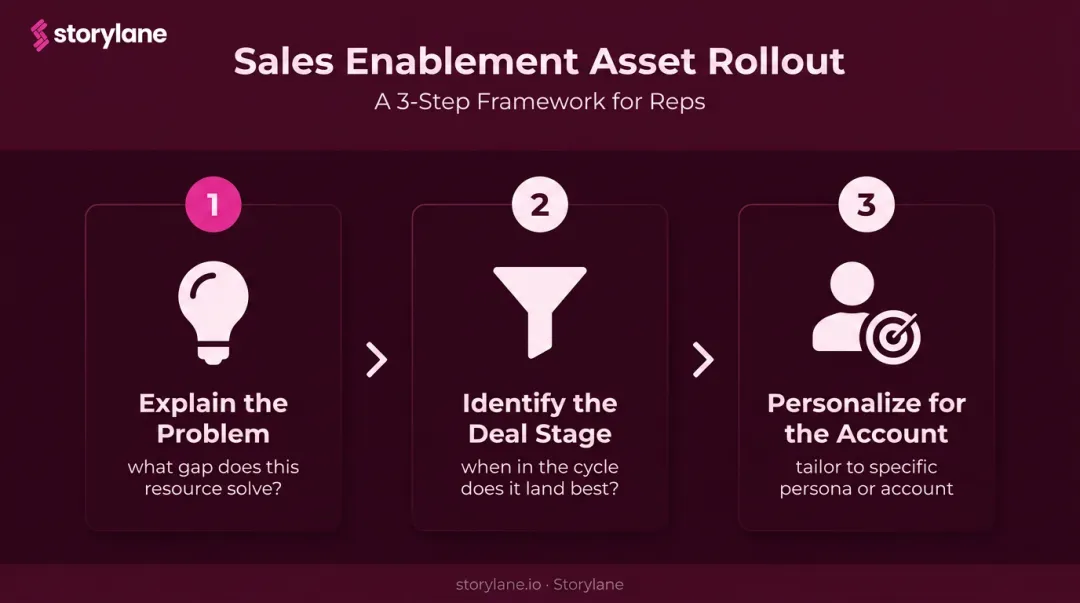
Publishing content isn't enough. A rollout for any new asset should cover:
- Explain the problem this resource solves
- Identify the deal stage where it lands best
- Show reps how to personalize it for a specific account or persona
Track content adoption — how often reps actually use each asset — as your leading indicator. Low adoption usually signals one of three things: reps don't know the asset exists, they don't know when to use it, or the asset doesn't actually help them in real deals.
Key Metrics to Measure Sales Enablement Effectiveness
Win Rate and Conversion Rate
Win rate is the clearest signal that enablement is working. CSO Insights found organizations with formal enablement programs achieved 49% win rates versus 42.5% for those without. Organizations running a formal content strategy saw win rates improve by 27.1%.
Track win rate changes in correlation with specific resource rollouts — not just as a lagging annual metric.
Sales Cycle Length and Quota Attainment
These two metrics reveal different failure points — one diagnostic, one definitional:
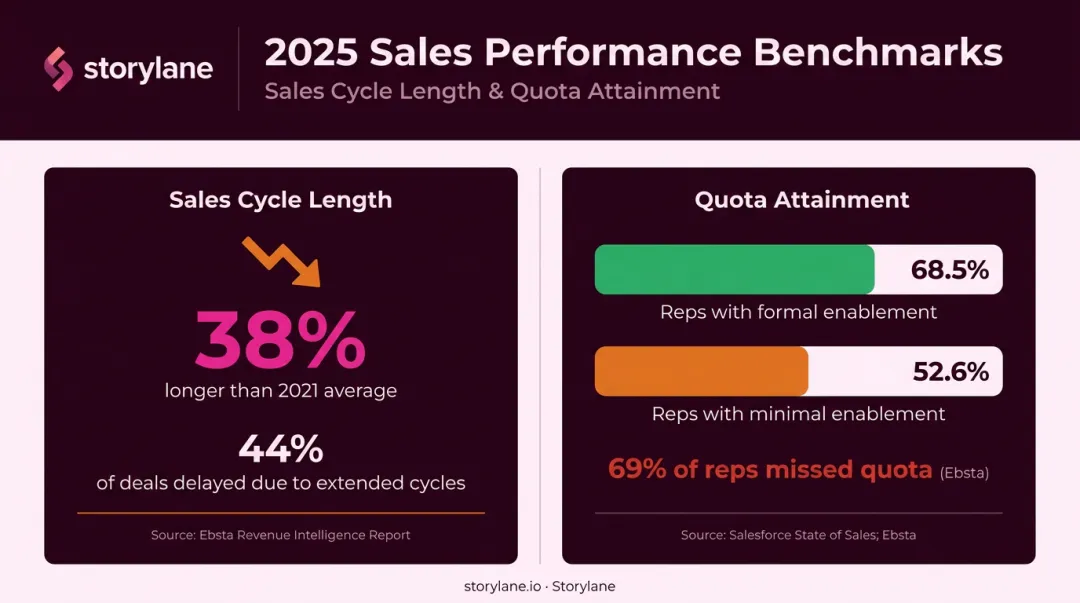
- Sales cycle length — Compare average deal duration before and after introducing resources like interactive demos or ROI calculators. Ebsta's 2024 benchmark report found sales cycles were 38% longer than 2021 levels, with 44% of deals pushed back or delayed.
- Quota attainment — The most direct measure of enablement at scale. CSO Insights found organizations meeting most stakeholder expectations hit 68.5% quota attainment versus 52.6% for those meeting few. Ebsta's data is a stark counterpoint: 69% of reps missed quota in the same period.
Pair quota attainment with content adoption rate to separate a training and access problem from a content quality problem. If reps aren't using your assets, no amount of content quality will move the numbers.
Frequently Asked Questions
What are sales enablement resources?
Sales enablement resources are the content, tools, and training materials that help reps engage buyers at every stage of the sales cycle. They fall into two categories: internal resources (playbooks, battle cards, personas) built for rep preparation, and external resources (case studies, demos, white papers) shared directly with prospects to support their buying decision.
What are the 5 pillars of sales enablement?
The five pillars are Content, Training, Coaching, Technology, and Analytics. A strong enablement program addresses all five. Neglecting any single pillar creates performance gaps that the others cannot compensate for.
What is the difference between internal and external sales enablement content?
Internal content is built for reps — designed to support preparation and execution in deals. External content is shared directly with prospects to help them evaluate your solution and build internal consensus. Conflating the two leads to reps sharing internal battle cards with buyers, or building customer-facing content that never actually reaches prospects.
How do you measure the effectiveness of sales enablement resources?
The core metrics are win rate, sales cycle length, content adoption rate, and quota attainment. The most useful approach ties metric changes to specific resource rollouts rather than measuring enablement performance in aggregate.
How often should sales enablement resources be updated?
Battle cards and competitive content warrant a quarterly review. Playbooks and buyer personas can follow an annual cycle. Any major product update, pricing change, or notable competitive shift should trigger an immediate review of affected materials — especially battle cards.
What tools do you need for sales enablement?
The core stack covers four categories: a CRM for pipeline and customer data, a content repository or enablement platform for organizing and distributing resources, a training or LMS solution for rep development, and an interactive demo tool for creating self-serve buyer experiences. Each layer addresses a distinct part of the enablement workflow.