Poor collateral costs more than just a few delayed deals. When reps improvise their own materials, messaging drifts. When prospects can't find answers independently, they disengage. When champions lack shareable proof, internal approvals drag on for weeks.
This guide covers what sales collateral actually is, why it matters more than most teams realize, the key formats organized by buyer journey stage, and the practices that separate teams whose collateral closes deals from those whose assets collect dust in shared drives.
Key Takeaways
- Sales collateral spans both external assets shared with prospects and internal tools used by reps
- Matching collateral format to buyer journey stage is the single highest-leverage practice
- Gartner research shows buyers who find supplier information helpful are 2.8x more likely to experience purchase ease
- Interactive demos, case studies, and personalized proposals drive the most impact at the decision stage
- Tracking engagement (not just distribution) is what turns collateral into actionable sales intelligence
What Is Sales Collateral?
Sales collateral is the collection of documents, media, and assets that sales and marketing teams use to inform, persuade, and move prospects toward a buying decision. The range is broad — from a one-page product summary to a full proposal deck.
The most useful distinction is between two types:
- External collateral — shared directly with prospects (presentations, case studies, proposals, interactive demos)
- Internal collateral — used by the sales team itself (battlecards, playbooks, objection-handling guides)
Both matter. External collateral gives buyers the information they need to decide. Internal collateral gives sellers the structure and confidence to guide that decision effectively. Teams that invest in one but ignore the other leave deals on the table.
Sales collateral is a practical sales tool — one that works hardest when marketing builds it with the seller's workflow in mind, not just the brand guidelines.
Why Does Sales Collateral Matter?
Buyers Self-Educate Before They Talk to Anyone
According to Demand Gen Report's content preferences research, 47% of B2B buyers viewed 3 to 5 pieces of content before engaging a sales rep. More recent data from Demand Gen Report's 2024 survey found 89% of B2B buyers downloaded and consumed assets they discovered independently. By the time a rep enters the picture, a buyer's opinion is already being formed — shaped by whatever collateral they found on their own.
If your collateral doesn't answer the questions buyers are asking before the first call, someone else's will.
Bad or Missing Collateral Creates Friction — and Kills Deals
Without effective materials, reps improvise. Messaging diverges from brand standards. Prospects who can't find answers go quiet. Many deal delays and drop-offs aren't really pipeline problems — they're collateral problems in disguise.
That behavior has a measurable cost. Forrester research found an estimated 65% of content marketing assets go unused because they're irrelevant to the buyer's actual situation. The volume of content isn't the issue. Relevance is.
Buying Committees Are Larger Than Most Teams Plan For
In B2B deals, the person you're selling to usually needs to convince multiple people internally. Challenger's 2024 research found that buying groups have grown from the historically cited 5.4 stakeholders to just under a dozen.
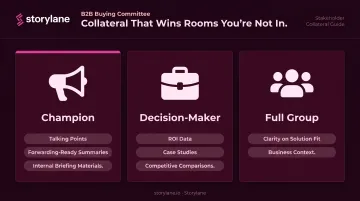
The rep you're talking to is often your champion — not your decision-maker. That distinction matters for how you build your collateral:
- Champions need talking points they can forward to finance, legal, or the executive sponsor
- Decision-makers need proof — ROI data, case studies, and competitive comparisons
- The whole group needs clarity on why your solution fits their specific situation
The right piece of collateral can advance the deal in rooms you'll never be invited into.
Types of Sales Collateral by Buyer Journey Stage
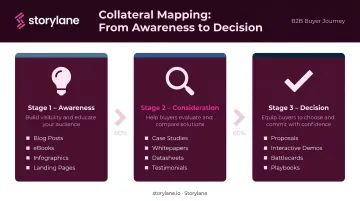
Sales collateral is not one-size-fits-all. The format that educates a first-time visitor will not convert a prospect who is ready to sign. Organizing collateral by buyer journey stage ensures reps always deploy the most relevant asset.
Awareness Stage: Build Trust Before You Sell
Awareness-stage collateral is built to educate, not to pitch. The goal is helping prospects understand their problem while positioning your brand as a credible resource.
Formats that work here:
- Blog posts, eBooks, and guides attract inbound leads, support SEO, and establish authority on topics your buyers are actively researching. The intent is to be useful, not promotional.
- Infographics, newsletters, and social content are lightweight, shareable touchpoints that keep your brand visible with prospects who aren't yet evaluating solutions.
- Landing pages serve double duty: capturing leads and routing prospects into the right funnel stage based on what they engaged with.
The test for awareness collateral is simple: would a prospect find this genuinely useful even if they never buy from you?
Consideration Stage: Reduce Doubt and Build Confidence
Once a prospect engages with your awareness content, the dynamic shifts. They know they have a problem — now they're deciding whether you're the right solution. Collateral here needs to provide proof, depth, and the kind of validation that moves someone from curious to seriously evaluating.
Formats that work here:
- Case studies and customer testimonials are the most credible proof format available. A well-structured case study (challenge, solution, measurable result) helps a prospect see themselves in the story. G2's 2024 research shows 31% of software buyers consult review sites more often than any other source — peer proof matters here.
- Whitepapers and research reports establish thought leadership and provide the data-backed justification that procurement teams and senior decision-makers typically require. Original research or industry benchmarks carry particular weight.
- Datasheets and product one-pagers are concise, shareable summaries designed for multi-stakeholder deals where a champion needs to quickly brief a colleague or manager. Brevity and clarity are the priority — not comprehensiveness.
Decision Stage: Close the Gap
Decision-stage collateral is where generic loses to specific. Buyers at this stage have already narrowed their options. What they need now is confidence — in your solution, your team, and the outcome they can expect.
Formats that work here:
- Sales proposals and presentations must be personalized to the specific prospect's context: their pain points, business goals, and the conversations that have already happened. Generic templates lose deals that tailored decks win.
- Interactive product demos let prospects explore on their own schedule and arrive at final conversations already informed. Gartner's data shows 75% of B2B buyers prefer a rep-free sales experience — self-guided demos meet that expectation directly.
- Internal enablement collateral — battlecards, sales playbooks, and objection-handling guides — ensures every rep is prepared, consistent, and confident. Buyers never see these assets, but they directly shape the quality of every conversation.
Platforms like Storylane let teams build personalized, shareable interactive demos using dynamic variables for company names, logos, role-specific flows, and currencies — without rebuilding assets from scratch for every account. Reps receive Slack alerts and CRM-synced engagement data showing exactly which features a prospect explored, how long they spent, and whether they returned.
Best Practices for Effective Sales Collateral
Align Collateral to a Specific Stage and Persona Before Creating It
Collateral built without a defined use case tends to sit unused. Before production begins, answer three questions:
- Who is this for? (Specific role, not "all buyers")
- When will they see it? (Journey stage, not "whenever")
- What decision does it support? (A specific next step, not "awareness")
This upfront clarity is the difference between assets that get deployed and assets that get ignored.
Personalize at Scale — Without Rebuilding for Every Account
Generic collateral underperforms. Even modest personalization signals — a prospect's industry, use case, or company name in the right place — meaningfully improve engagement. Demand Gen Report's 2024 research found 86% of B2B marketers are turning to personalized 1:1 marketing as a priority.
The challenge is scale. Rebuilding every asset for every prospect isn't sustainable. Storylane's dynamic variable system addresses this directly: reps build one strong demo asset, then populate it with prospect-specific tokens (name, company, logo, currency, role-specific flows) at the sharing stage. A single demo template serves dozens of accounts without manual duplication.
Track Engagement, Not Just Distribution
Knowing a prospect received a piece of collateral is not the same as knowing it influenced them. The metrics that matter:
- Time spent — did they read it or skim it?
- Sections viewed — which parts held their attention?
- Return visits — did they come back, and who else did they share it with?
- CTA clicks — did the asset drive a next action?
Storylane captures and routes this data automatically — completion rates, feature-level engagement, and intent scores — routing it to reps via Slack alerts and CRM integration. A rep who knows a prospect spent 20 minutes on a specific product area before a call walks in with a very different conversation than one going in blind.
Build a Centralized Collateral Library Reps Can Actually Use
Collateral only creates value if reps can find it quickly. A scattered shared drive defeats the purpose.
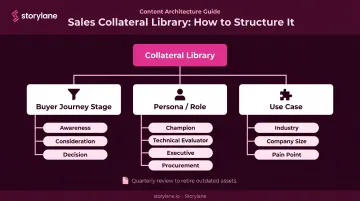
Organize by:
- Buyer journey stage (awareness, consideration, decision)
- Persona or role (champion, technical evaluator, executive, procurement)
- Use case — not just content type
Storylane's Buyer Hub functions as exactly this kind of organized library — grouping demos by persona and use case, supporting multi-chapter paths for different buyer roles, and giving reps (and prospects) a single destination to navigate. Build in a quarterly review to retire outdated materials before they create inconsistencies in the field.
Repurpose Strategically to Get More From Every Investment
Creating good collateral is expensive. Repurposing it extends the value of that original investment without starting from scratch.
Practical repurposing moves:
- A whitepaper becomes multiple blog posts
- Case study results anchor a personalized proposal
- A recorded demo walkthrough becomes a self-serve asset for early-stage prospects
- A live presentation becomes an async shareable link for follow-up
The key is planning for reuse before you build — not retrofitting it afterward.
Frequently Asked Questions
What is point of sale collateral?
"Point of sale collateral" refers to physical retail materials — shelf displays, signage, and branded inserts — placed where a consumer makes an in-store purchase. This is distinct from B2B sales collateral, which supports complex, multi-stage buying decisions involving multiple stakeholders rather than single in-store conversions.
What is an example of collateral in sales?
Collateral takes different forms at each stage: an eBook shared with an inbound lead at awareness, a case study sent to a champion during consideration, and a personalized proposal delivered at the decision stage. Each format serves a different buyer need at a different moment in the journey.
What is the difference between sales collateral and marketing collateral?
Marketing collateral is typically designed to build broad awareness across a wide audience. Sales collateral targets specific conversations and moves individual deals forward. In practice, the two often overlap — a case study can serve both purposes depending on whether it's used in a campaign or handed directly to a prospect mid-deal.
How should sales collateral be organized and managed?
Organize by buyer stage, persona, or use case rather than content type alone. A centralized repository — whether a dedicated platform or a well-structured shared drive — keeps materials current, accessible to all reps, and searchable. The right asset should be findable in seconds, not minutes.
How do you measure whether sales collateral is effective?
Three signals matter most: engagement metrics (views, time spent, sections consumed), deal influence (did deals that included this asset close faster or at higher rates?), and rep adoption (are reps actually using it, or ignoring it?). All three together give a complete picture.
What types of sales collateral work best for B2B SaaS companies?
Interactive demos, case studies, ROI documentation, and personalized proposals consistently drive the highest impact for B2B SaaS. Buying committees typically include technical, financial, and operational stakeholders — these formats give each group the proof and hands-on confidence they need to move forward.