Introduction
Most sales reps open with the same move: here's what we offer, here's what it costs, here's why it's great. The problem? Buyers tune out before the second slide. When the conversation is about your product instead of their problem, prospects don't feel understood — and buyers who don't feel understood rarely convert.
Solution selling flips this dynamic. It puts the buyer's problem at the center of every conversation, only introducing the product once the pain is clearly on the table.
It's the go-to methodology for complex B2B deals — the ones with multiple stakeholders, longer decision cycles, and buyers who won't commit until they feel genuinely understood.
This guide covers the full picture: a clear definition, how solution selling compares to other methodologies, when to use it, the step-by-step process, key techniques, and the honest trade-offs your team should weigh before adopting it.
Key Takeaways
- Solution selling is a problem-led methodology: diagnose the buyer's situation before pitching a solution
- It outperforms feature selling in complex, high-value B2B deals with multiple stakeholders
- The process has six core steps, from product knowledge through objection handling
- 87% of business buyers expect reps to act as trusted advisors
- It requires real process discipline: structured steps, consistent execution, and deliberate skill-building
What Is Solution Selling?
Solution selling is a problem-led sales methodology where reps first diagnose a prospect's specific pain points, then recommend the product or service best suited to resolve them. The sequence matters: problem before product, always.
The methodology traces back to Frank Watts in the mid-1970s. Mike Bosworth later formalized and commercialized it, founding his Sales Performance International business in 1983 — partly inspired by work at Xerox — and publishing Solution Selling: Creating Buyers in Difficult Selling Markets in 1994. Sales Performance International (SPI) has since been acquired by Richardson, which continues to evolve the framework under its current training offerings.
Problem First, Product Second
The "solution" in solution selling is not the product — it's the outcome the prospect gains. This distinction changes everything.
Instead of "here's what we offer," the conversation becomes "here's how we solve your specific problem." That shift positions the rep as a diagnostic partner rather than a vendor chasing a close — and buyers notice the difference.
Richardson's current version of the methodology uses a PPVVC diagnostic lens: Pain, Power, Vision, Value, Consensus. Each element is designed to ensure reps surface the right signals before advancing a deal, not after.
Solution Selling vs. Other Sales Methodologies
Vs. Product Selling (Feature Selling)
Product selling leads with specs, pricing, and capabilities — assuming the product's value is self-evident. Solution selling leads with questions, only introducing the product once the pain point is clearly established.
The distinction matters because buyers who don't feel understood rarely convert, regardless of how strong the product is. Feature selling asks buyers to connect the dots themselves. Solution selling connects them.
Vs. Transactional Sales
Transactional sales are high-volume, low-touch interactions where speed and price are the primary levers. They work well for commodity purchases with minimal complexity and clearly defined needs.
Solution selling invests in understanding each buyer's unique context. It's slower and more resource-intensive. That trade-off makes sense for complex, high-value deals — not for quick-close, low-risk transactions.
Vs. Gap Selling
Gap selling, popularized by Keenan (whose book was published in 2018), focuses on quantifying the distance between a prospect's current state and their desired future state — and using that gap to create urgency.
Both methodologies are problem-centric, but they differ in emphasis:
- Gap selling drives urgency by making the cost of inaction explicit
- Solution selling focuses on matching the right solution to a diagnosed need through a structured process
In practice, reps often layer them: use gap selling to surface urgency early, then shift into solution selling's structured diagnosis to guide the close.
Vs. Consultative Selling
Consultative selling and solution selling are often used interchangeably, but the distinction is worth drawing. Consultative selling leans heavily on advisory relationship-building and open-ended exploration. Solution selling is more structured — built around a defined process of diagnosis → recommendation → close.
Most high-performing reps blend both: the relational depth of consultative selling within the process discipline of solution selling.
Quick Reference Comparison
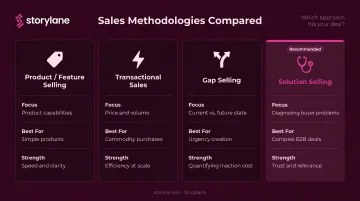
Here's how the four methodologies stack up at a glance:
| Methodology | Focus | Best For | Key Strength |
|---|---|---|---|
| Product/Feature Selling | Product capabilities | Simple, well-understood products | Speed and clarity |
| Transactional Sales | Price and volume | Commodity purchases, repeat orders | Efficiency at scale |
| Gap Selling | Current vs. future state gap | Deals needing urgency creation | Quantifying cost of inaction |
| Solution Selling | Diagnosing and solving buyer problems | Complex B2B deals, multi-stakeholder | Trust and relevance |
When Is Solution Selling the Right Approach?
Solution selling thrives in specific deal environments. Knowing when to use it — and when to skip it — is as important as the methodology itself.
Where It Works Best
According to Forrester's 2026 State of Business Buying, a typical B2B buying decision now involves 13 internal stakeholders and nine external influencers. That level of complexity demands a methodology built for consensus-building and nuanced problem diagnosis — exactly what solution selling delivers.
It's most effective when:
- The purchase is high-value with a longer sales cycle
- The product or service is complex and difficult to evaluate on specs alone
- Multiple decision-makers have varying priorities
- The solution requires customization or significant implementation
Industries where it's most impactful:
- Enterprise SaaS and cloud software
- IT consulting and managed services
- Healthcare technology
- Industrial and manufacturing equipment
- Financial services
- Any sector with significant regulatory complexity or customization requirements
When NOT to Use It
If the deal is transactional, the product is simple and low-cost, or the prospect's needs are already clearly defined and just need fulfillment — solution selling introduces process overhead that slows deals down without improving outcomes. The simpler the deal, the lighter the methodology should be.
The Solution Selling Process: A Step-by-Step Guide
Step 1: Know Your Product Inside Out
Reps cannot prescribe the right solution without deep knowledge of every product, package, and use case available. Build a centralized knowledge base with spec sheets, use cases, and competitive differentiators.
Without this foundation, the entire methodology breaks down. A rep who diagnoses accurately but prescribes the wrong solution loses credibility at the worst possible moment.
Step 2: Research and Qualify Prospects
Effective solution selling starts before the first call. Research the prospect's industry, org structure, and likely pain points using buyer personas and prior closed deals as reference.
Qualify early to confirm two things: the prospect has a genuine need, and they have the authority (or access to authority) to act on it. In B2B sales, decision-making is rarely unilateral — understanding the buying committee early prevents late-stage surprises.
Step 3: Uncover Pain Points Through Strategic Questions
Discovery is the heart of solution selling. The goal is to surface problems the prospect may not have fully articulated — moving from surface-level conversation to deeper operational or strategic pain.
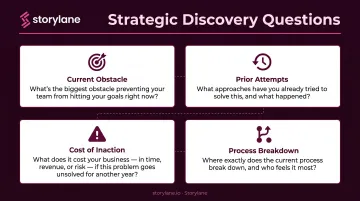
Example discovery questions:
- "What's the biggest obstacle preventing your team from hitting [specific goal] right now?"
- "What have you already tried to solve this? What worked and what didn't?"
- "What happens to the business if this problem isn't resolved in the next six months?"
- "Walk me through how your team currently handles [process] — where does it break down?"
These questions reflect the SPIN framework — developed by Neil Rackham from analysis of 35,000+ sales calls — which uses Situation, Problem, Implication, and Need-Payoff questions to structure discovery. It's the strongest evidence-backed questioning technique in B2B selling and maps directly to the solution selling discovery phase.
Step 4: Reframe the Problem and Create Urgency
After discovery, reflect the problem back to the prospect in a way that quantifies its impact. Connect the pain point to business outcomes: lost revenue, wasted time, competitive disadvantage, compliance risk.
The goal isn't to manufacture urgency — it's to help the buyer see the full cost of inaction. A prospect who can articulate what the problem is costing them in concrete terms is far closer to a decision than one who sees it as a background irritant.
Step 5: Present Your Solution (Not Your Product)
The pitch only comes after the problem is fully established. Position your offering as a direct response to the specific needs uncovered — using customer case studies, ROI examples, and outcome-focused language rather than feature lists.
Personalized, interactive product demos work particularly well here because the problem is already established in the buyer's mind. Instead of walking through a generic product tour, show prospects exactly how the solution addresses their defined pain point in context.
Storylane lets sales teams build persona-specific demo tracks and use dynamic variable tokens to personalize content per prospect — so each demo reflects the buyer's own terminology, use case, and pain points rather than a generic feature walkthrough.
Step 6: Handle Objections and Close
Anticipate objections rather than waiting for them. Review past deal transcripts and prepare responses to the most common pushbacks before they surface:
- Pricing: Frame against the cost of inaction established in Step 4
- Timing: Connect urgency to the business impact already quantified
- Competing priorities: Acknowledge the tradeoff, then revisit the stakes
In solution selling, a well-handled objection often reinforces trust rather than threatening the deal. When a rep addresses a concern before the prospect raises it, it signals preparation and genuine understanding of the buyer's situation.
Pros and Cons of Solution Selling
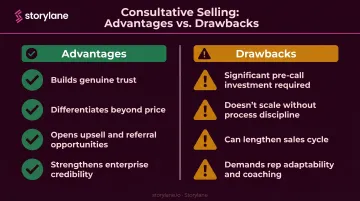
Advantages
- Builds genuine trust — prioritizing the buyer's problem over the sale creates credibility that features and pricing can't buy. 87% of business buyers now expect sales reps to act as trusted advisors.
- Differentiates beyond price — when a rep understands the problem deeply, the conversation shifts from cost to fit
- Opens the door for upselling, renewals, and referrals — reps positioned as partners rather than vendors earn repeat business naturally
- Strengthens credibility in complex enterprise deals where buyers are sophisticated and expect more than a generic pitch
Drawbacks
- Requires significant pre-call investment — research, discovery preparation, and ongoing qualification take real time
- Doesn't scale without process discipline — without defined frameworks and supporting tools, it drifts into over-nurturing with no clear path to close
- Can lengthen the sales cycle — especially if discovery phases run too long or lack direction
- Demands adaptability — reps must read the room and adjust in real time rather than follow a rigid script, which requires meaningful coaching investment
Richardson's solution selling certification runs 2.5 days of instructor-led training or five 4-hour virtual workshops — a concrete signal of how much skill-building this approach actually requires.
Key Techniques to Excel at Solution Selling
Build a Sales Needs Analysis
A structured pre-call or early-stage needs assessment — via a discovery call guide, questionnaire, or diagnostic tool — helps reps gather context, confirm fit, and prepare targeted talking points. The alternative is improvising in every meeting, which produces inconsistent results at scale.
Storylane's demo analytics support this directly: by reviewing which demo chapters a prospect explored, where they spent time, and where they dropped off, reps arrive at discovery calls with a behavioral profile already formed.
Lead with Problems, Not Products
Open every conversation with questions about the prospect's current challenges, goals, and what they've already tried. The product should not enter the conversation until the rep can name the exact pain it solves for this specific buyer.
This habit is harder to maintain than it sounds. The pull toward showcasing the product is strong. Resisting it is the discipline that separates solution sellers from feature sellers.
Use Case Studies and Social Proof Strategically
Referencing a past customer with a similar problem, along with the measurable outcome they achieved, is far more persuasive than any feature description.
Build a library of proof points organized by industry, use case, or pain point. When a healthcare tech prospect raises a specific concern, the ideal response is a story about a similar company that solved the same problem — not a feature list.
Maintain the Relationship Post-Sale
Solution selling doesn't end at the contract. Following up to confirm the solution delivered on its promise, checking in as the customer's needs evolve, and staying engaged makes the rep a long-term partner.
The commercial upside is real. McKinsey's research on cross-selling identifies deep decision-maker relationships as a key driver of expansion revenue. Reps who go quiet after close leave upsell and referral value behind:
- Confirm the solution delivered on its stated promise
- Check in quarterly as the customer's environment and goals shift
- Share relevant case studies or new capabilities as they emerge
- Treat every post-sale touchpoint as a referral opportunity
Frequently Asked Questions
What is solution selling?
Solution selling is a problem-led sales methodology where reps diagnose a prospect's specific challenges before recommending a product or service. It shifts the focus from product features to buyer outcomes, building trust and relevance from the first conversation.
What is the difference between solution selling and feature selling?
Feature selling leads with product capabilities and specs regardless of buyer context. Solution selling leads with discovery — the product only enters the conversation once the rep has identified the specific problem it solves for that particular buyer.
What is the difference between transactional sales and solution selling?
Transactional sales prioritize speed and volume with minimal buyer engagement, making them ideal for commodity or low-complexity purchases. Solution selling invests in understanding each buyer's unique situation and focuses on long-term value over quick conversions.
What is the difference between gap selling and solution selling?
Both methods are problem-centric, but gap selling focuses on measuring the gap between a buyer's current and desired state to create urgency. Solution selling emphasizes matching the right solution to a diagnosed need through a structured discovery process.
When should you use solution selling?
Solution selling is most effective in high-value, complex B2B deals with longer sales cycles, multiple stakeholders, or products requiring customization. It's less suited to simple, transactional, or commodity purchases where speed and price are the primary decision factors.
Is solution selling still relevant today?
Yes. With 87% of business buyers expecting reps to act as trusted advisors, solution selling's consultative approach is more relevant than ever. Pair it with insight-driven techniques and buyer enablement tools to maximize its impact.