That's not a lead quality problem. It's a process problem.
This guide covers what happens after a prospect fills out a form: enrichment, qualification, routing, scheduling, nurturing, and automation — the full inbound lead management cycle from first contact to sales-ready pipeline.
One distinction worth drawing before diving in: inbound lead generation is the work of attracting prospects to your website. Inbound lead management is everything that happens once they arrive. Most teams invest heavily in the former while leaving the latter to chance.
Key Takeaways
- Inbound lead management covers enrichment, scoring, routing, scheduling, and nurturing to turn a form fill into pipeline
- Effective lead scoring requires both fit signals (ICP alignment) and intent signals (behavioral activity)
- Responding within five minutes dramatically increases qualification odds — automation is the only way to hit that target consistently
- Sales-marketing alignment requires defined MQL-to-SQL criteria, response SLAs, and a feedback loop on lead quality
- Automation triggers the first response; reps take over once a lead is qualified and ready to engage
What Is Inbound Lead Management?
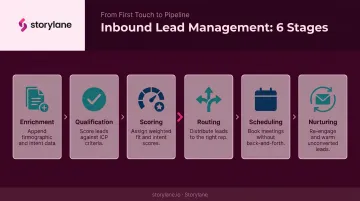
Inbound lead management is the end-to-end process that takes over the moment a prospect self-identifies — typically by filling out a form, requesting a demo, or downloading a piece of content. It covers six core activities:
- Append firmographic and behavioral context to the lead record (enrichment)
- Determine whether the lead matches your ICP (qualification)
- Prioritize leads based on fit and intent signals (scoring)
- Assign the lead to the right sales rep (routing)
- Convert interest into a booked meeting (scheduling)
- Stay relevant with leads who aren't ready to buy yet (nurturing)
Most revenue teams underestimate this stage because top-of-funnel volume is visible and measurable. A form fill registers as a conversion. What happens next — slow follow-up, wrong routing, leads dropped into generic sequences — is harder to track, and that's where pipeline quietly erodes.
The Inbound Lead Management Process: Step by Step
Step 1: Enrich the Lead
A standard inbound form captures three to five fields. That's rarely enough to qualify a lead, route it correctly, or personalize the first outreach.
Automated enrichment solves this by appending firmographic data (company size, industry, revenue, funding stage) and technographic data (tools in use, tech stack) to the contact record the moment they convert. Platforms like Clearbit demonstrated this clearly — Greenhouse increased demo form completion 20% after reducing a nine-field form to three fields, using enrichment to recover the data that longer forms were capturing manually.
Manual research is too slow and inconsistent. Enrichment should fire automatically — before a rep ever touches the record — and stay invisible to the prospect.
Step 2: Score the Lead
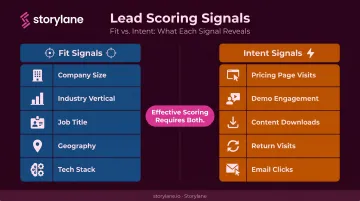
Lead scoring assigns point values to signals that indicate whether a lead is worth pursuing now. Two dimensions matter:
- Fit signals — job title, company size, industry, geography, estimated revenue. Does this company match your ICP?
- Intent signals — pages visited, content downloaded, demo engagement, email clicks, return visits. Is this person actively researching right now?
Rule-based scoring works for early-stage teams: define criteria, assign points, set thresholds. Predictive scoring (AI models trained on closed-won data) is more accurate at scale but requires sufficient historical training data.
The failure mode is scoring on fit alone — which produces a list of large accounts that aren't ready to buy — or on intent alone, which surfaces high-activity contacts at companies that will never become customers.
Step 3: Route the Lead
Routing assigns the lead to the right rep. Three main approaches:
- Round-robin — simple, fair distribution for early-stage teams without complex territory rules
- Rules-based routing — assignment by territory, company size, industry, or deal size
- Lead-to-account matching — automatically assigns a new contact to the existing account owner when the company is already in your CRM
Routing errors don't just slow things down. A qualified lead that lands in the wrong rep's queue — or in no queue at all — is effectively a lost deal, particularly when a competitor responds faster.
Step 4: Schedule the Meeting
Once routing fires, scheduling should trigger immediately — not after a rep checks their queue. The lead's attention peaks at the moment they submit the form, and every manual step in that gap is a conversion risk.
Scheduling methods that close the gap fastest:
- Embedded calendar links in routing confirmation emails
- Automated scheduling flows triggered by form submission
- Round-robin booking tools that assign and confirm in one step
Step 5: Nurture Unready Leads
Not every qualified inbound lead is ready for a sales conversation. Structured nurture sequences — segmented by buying stage and triggered by behavioral signals like a return visit to the pricing page — keep your brand present without pushing for a meeting the lead isn't ready for. The difference between effective nurture and noise is timing: send based on demonstrated interest, not a fixed drip schedule.
How to Score and Qualify Inbound Leads
The Two Dimensions of Effective Scoring
Scoring without both fit and intent produces predictable failures. Fit-only scoring chases large accounts that aren't actively buying. Intent-only scoring rewards high activity from contacts who will never convert.
Fit signals worth scoring include:
- Company size and revenue range
- Industry vertical
- Job title and seniority
- Geography
- Estimated budget or tech stack alignment
Intent signals to track alongside fit:
- Pricing page visits
- Demo engagement (time spent, completion rate, features explored)
- Content downloads, especially late-funnel assets like case studies
- Return visits within a short window
- Email click behavior
- Webinar attendance
Intent signals are time-sensitive. A prospect scoring high on intent today may not next week — which is why fast routing and follow-up are directly connected to scoring effectiveness.
Qualification Frameworks
BANT (Budget, Authority, Need, Timing) and MEDDIC give sales teams a structured lens for evaluating whether a lead can actually move forward. Use these frameworks as conversation guides during discovery, not rigid checklists. Each framework targets the same core questions:
- Does the lead have a clear, confirmed need?
- Who holds decision-making authority?
- Is there budget allocated or accessible?
- Is there real urgency to act now?
Where Interactive Demos Fit In
Qualification frameworks tell you what to ask — interactive demos help answer some of those questions before the first call. Storylane's interactive demos function as a pre-call qualification layer. When a prospect engages with a product demo before speaking to sales, they self-select into features relevant to their use case — effectively pre-qualifying themselves.
Storylane's Account Reveal feature identifies anonymous demo visitors and surfaces enriched firmographic data: company name, location, engagement depth, and intent classification (Low, Medium, or High).
Sales teams receive real-time Slack alerts the moment a prospect engages — including time spent, completion percentage, CTA clicks, and which demo steps they explored. That context turns a cold first call into an informed conversation.
Demo engagement signals — completion rate, features explored, CTA clicks, return visits — also flow directly into HubSpot, Salesforce, and Marketo, feeding the lead scoring model with behavioral data that's difficult to capture any other way.
Speed-to-Lead and Lead Routing Best Practices
Why Speed-to-Lead Is a Revenue Variable
The MIT/InsideSales.com 2007 Lead Response Management Study found that the odds of qualifying a lead at five minutes vs. 30 minutes drop 21 times. The odds of making contact at all drop 100x over the same window.
More recent data reinforces this. Harvard Business Review found that companies responding to online leads within one hour were nearly 7x more likely to qualify them than companies that waited longer — and more than 60x more likely than those waiting 24 hours.
This isn't about being courteous. It reflects the peak of a prospect's intent and attention. That window closes fast.

Routing Tiers
| Stage | Approach | Best For |
|---|---|---|
| Early-stage | Round-robin | Simple, no territory complexity |
| Growth-stage | Rules-based routing | Territory, size, industry, deal size |
| Mature/ABM | Lead-to-account matching | Existing accounts, named account lists |
Routing errors compound the speed-to-lead problem. A lead routed to the wrong rep — or not routed at all — doesn't just convert at a lower rate. It may convert with a competitor.
Setting and Enforcing SLAs
A healthy inbound SLA defines three things:
- Assignment speed: Lead routed to the correct rep within minutes of form submission
- First contact window: Rep attempts outreach immediately after assignment — not at end of day
- Breach alerts: CRM flags any lead that ages past the defined window without contact, triggering automatic escalation
For high-intent inbound leads (demo requests, pricing page conversions), five minutes is the target. One hour is the outer limit. Anything beyond that and you're responding to a prospect who has already moved on.
Scheduling automation reinforces the SLA: calendar links in routing confirmation emails reduce back-and-forth friction, while automatic reminders cut no-show rates. Every meeting should sync back to the CRM immediately — so rep activity is visible and no lead falls through the cracks.
Nurturing Leads and Aligning Sales and Marketing
Building a Nurture Track That Works
Research cited by HubSpot (sourced from Gleanster and Forrester) puts it clearly: 50% of qualified leads are not ready to buy immediately, and strong nurture programs generate 50% more sales-ready leads at 33% lower cost.
That means half your inbound pipeline needs a nurture track, not a closed-lost status.
Effective nurture sequences share a few characteristics:
- Segmented by persona, industry, or buying stage — not blasted to everyone
- Triggered by behavioral signals (a return visit to the pricing page should fire a different email than a cold lead aging in a sequence)
- Educational and relevant, not promotional — the goal is to be useful until the prospect is ready
The Marketing-to-Sales Handoff
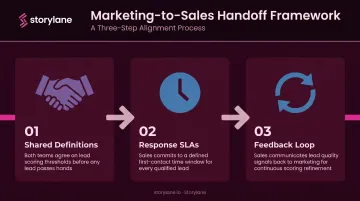
The MQL-to-SQL transition is where most alignment breakdowns happen. The fix requires three things:
- Shared definitions — both teams agree on what behaviors and scores trigger a handoff
- Response SLAs — sales commits to a first-contact time after accepting a lead
- A feedback loop — sales communicates lead quality back to marketing, so marketing can improve targeting and content
Without that feedback loop, marketing keeps sending the same lead profile into a conversion problem it can't see.
Three mechanics make alignment stick in practice:
- A shared CRM view so both teams see the same pipeline data
- Regular syncs to review conversion rates by source and identify weak spots
- Documented ownership at every stage, so no lead goes quiet because each team assumed the other was working it
How to Automate Inbound Lead Management at Scale
The Manual Process Breaks Under Volume
The critical actions that should happen in the first five minutes after a form fill — enrichment, scoring, routing, scheduling confirmation — can't be executed consistently by hand as inbound volume grows. At low volume, a delayed response is an inconvenience. At scale, it's a measurable revenue problem.
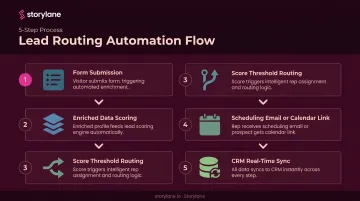
The automation sequence for an optimized inbound stack looks like this:
- Form submission triggers automated enrichment
- Enriched data triggers lead scoring
- Score threshold triggers routing to the correct rep
- Routing triggers a scheduling email or embedded calendar link
- All of this syncs to the CRM in real time
A unified platform reduces this risk. Every integration handoff between point solutions is a potential data loss point — fewer handoffs means fewer gaps.
That sequence assumes reps are available. The harder problem is what happens when they aren't.
Always-On Lead Engagement
Leads arrive outside business hours, across time zones, and during periods when no rep is available. Without a coverage layer, those leads go cold by the time anyone follows up.
Storylane's RepX handles this gap. It's an AI sales rep that qualifies inbound prospects, runs interactive demos autonomously, and routes pipeline-ready leads to the CRM — around the clock, without human intervention. For high-volume inbound motions, a lead that arrives at 11 PM on a Sunday gets the same response speed as one that arrives Monday morning.
The principle holds across any toolset: automate the first response so reps spend their time on conversations that actually move deals forward.
Frequently Asked Questions
How do you handle inbound leads?
Enrich the lead with firmographic data, score against your ICP criteria, route to the right rep, trigger immediate scheduling, and place unready leads into a segmented nurture sequence — all within the first five minutes of conversion. Automation makes that timeline achievable.
What is an example of an inbound lead?
A VP of Sales at a mid-market SaaS company finds a blog post via LinkedIn, returns two weeks later after a retargeting ad, downloads a buyer's guide, then requests a demo. Every action was self-directed, with no direct outreach from the sales team.
How quickly should you follow up with inbound leads?
The MIT/InsideSales.com 2007 study found that qualification odds drop 21x at five minutes vs. 30 minutes. Five minutes is the gold standard for high-intent leads; one hour is the outer limit. Without automation, hitting that five-minute window across every lead is nearly impossible at scale.
What is the difference between an MQL and an SQL?
An MQL has engaged with content and meets basic fit criteria but hasn't signaled explicit purchase intent. An SQL has been further evaluated — through scoring, enrichment, or a discovery call — and confirmed as ready for active sales pursuit.
What tools are used for inbound lead management?
The core stack typically includes:
- CRM (Salesforce, HubSpot) for centralizing lead data
- Enrichment software for firmographic context
- Lead routing tools for automated rep assignment
- Scheduling software to accelerate speed-to-meeting
- Marketing automation for nurture sequences
- Interactive demo platforms like Storylane for pre-call qualification and engagement scoring