Introduction
Most B2B teams don't have an activity problem — they have a quality problem. The pipeline is full of leads that never respond, demo requests from the wrong company size, or MQLs that sales won't touch. Meanwhile, budget keeps flowing into tactics that generate volume without generating revenue.
The teams consistently winning pipeline share a common trait: they combine outbound, inbound, and on-site conversion strategies with a disciplined qualification process. They pick fewer channels, run tighter targeting, and follow up with real context.
According to Demand Gen Report, B2B buyers are nearly 70% through their purchasing process before engaging a sales rep, and 80% initiate first contact themselves. That means your content, your website, and your demos are doing the selling long before a rep gets involved.
This guide covers outbound, inbound, demo-led conversion, lead qualification, and measurement — the specific areas where most B2B teams lose pipeline they should be winning.
Key Takeaways
- Define your ICP and buyer personas before running any tactic — targeting logic determines everything downstream
- Outbound requires persistence: RAIN Group research finds it takes 8 touchpoints to earn an initial meeting
- B2B buyers research independently; SEO and interactive demos capture high-intent prospects before they contact sales
- Lead scoring plus speed-to-lead moves the needle: companies responding within an hour are 7x more likely to have meaningful conversations
- Track four core metrics: CPL by channel, Lead-to-Opportunity rate, Opportunity-to-Close rate, and Pipeline Influenced
Build the Right Foundation Before Running Any Strategy
Every tactic in this guide depends on one thing: knowing exactly who you're targeting. Skip this step and you'll generate leads — just not the right ones.
Define Your ICP First
Your Ideal Customer Profile operates at the company level. A strong ICP includes:
- Target industry and sub-vertical (not just "SaaS" — get specific)
- Company size by headcount and revenue range
- Tech stack: tools they already use that your product integrates with or displaces
- Geography, regulatory context, and compliance requirements
- Pain points your solution directly resolves — not generic business challenges
Build this from real CRM data: analyze your top 20% of customers by revenue, run win/loss interviews, and look for patterns. Don't build it from assumptions.
Map Buyer Personas Separately
ICP tells you which companies to target. Personas tell you who to talk to inside those companies. Most B2B purchases involve three distinct roles, each requiring a different message:
- Economic Buyer: holds budget authority, cares about ROI and risk
- Technical Buyer: evaluates integration requirements and implementation fit
- End User — uses the product daily and cares about usability, not vendor strategy
A single message can't speak to all three. Your outbound sequences, landing pages, and demo content should each be mapped to one of these personas.
Why This Matters for Every Tactic
Getting your ICP and personas right multiplies the effectiveness of everything else. They directly shape:
- Targeting logic for paid ads
- Segmentation for email sequences
- Topics you build SEO content around
- Which accounts your ABM team prioritizes
Nail this once, and every downstream tactic performs better.
Outbound Strategies to Proactively Fill Your Pipeline
Personalized Cold Email and Multi-Touch Sequences
Generic cold email fails for a straightforward reason: it's written about the sender, not the recipient. What works is leading with the prospect's specific pain point, referencing company context you've actually researched, and making a single, low-friction ask.
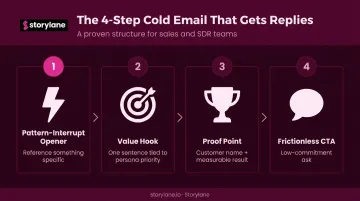
Structure a cold email sequence this way:
- Pattern-interrupt opener : reference something specific to their company or role
- Value hook — one sentence tied to the persona's top priority
- Proof point : a relevant customer outcome (company name + result)
- Frictionless CTA — "Worth a quick conversation?" beats "Book a 30-minute demo"
Single-touch outreach rarely works. RAIN Group found it takes an average of 8 touchpoints to earn an initial meeting with a new prospect. Build sequences that span email, LinkedIn, and phone over 2–3 weeks rather than sending one email and moving on.
Salesloft's 2023 Revenue Benchmark Report, based on 570 million interactions, found that SDRs average a 2.8% email reply rate in software — and at least 86% of emails sent have no personalization at all. That gap is your opportunity.
LinkedIn and Social Selling
LinkedIn operates in two modes for B2B lead gen, and the best teams use both:
- Organic thought leadership — publishing insights your ICP cares about, which attracts inbound attention and warms prospects before outreach
- Direct connection + DM outreach — proactively engaging target accounts with personalized messages
LinkedIn's own data indicates that 80% of B2B social media leads come through LinkedIn, and 92% of B2B marketers use the platform — making it the default social channel for professional outreach.
The key to LinkedIn DMs that get replies: don't pitch immediately. Engage with their content first, reference a specific post or company development, and treat the first message as starting a conversation rather than opening a sales cycle.
Account-Based Marketing (ABM)
ABM flips traditional lead gen: instead of broadcasting broadly and waiting for leads to raise their hand, you define a list of target accounts first, then concentrate your outreach, content, and ads on those specific companies.
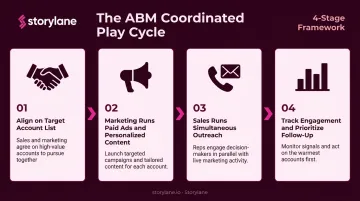
It works when sales and marketing align on the same accounts and run coordinated plays in the same window. The mechanics look like this:
- Sales and marketing agree on the target account list upfront
- Marketing runs paid ads and sends personalized content to those accounts
- Sales runs outreach simultaneously, reinforcing the same message
- Both teams track engagement across touchpoints to prioritize follow-up
The data supports the investment: according to a benchmark report from ABM Leadership Alliance and Momentum ITSMA, 77% of marketers running ABM programs reported revenue growth, with ABM receiving 28% of total marketing budget among respondents.
Intent data tools like Bombora and G2 Buyer Intent sharpen ABM further by showing which accounts on your list are actively researching solutions right now. ZoomInfo saw 17% higher conversion rates and 27% lower cost per lead after layering G2 Buyer Intent into their targeting — making timing-based outreach far more precise.
Inbound Strategies to Attract and Convert High-Intent Buyers
SEO and Long-Form Content
B2B buyers do significant independent research before contacting sales. Forrester's 2021 B2B Buying Survey found buyers engage in an average of 27 interactions across their buying journey. If you're not showing up in organic search during those interactions, a competitor is.
Prioritize content around:
- Solution-aware keywords — "[problem] software," "[category] platform"
- Comparison pages — your product vs. named alternatives
- Bottom-of-funnel guides — implementation guides, ROI calculators, use case breakdowns
For converting traffic into leads, gated content works when the asset earns the form fill. The highest-performing gated assets are either deeply original (proprietary research, benchmark data) or highly practical (templates, calculators, tools) — not generic eBooks rephrasing your homepage.
Webinars and Virtual Events
Webinars attract buyers who are actively seeking solutions and willing to invest 30–60 minutes of their time. That self-selection makes them one of the higher-quality lead gen formats available. ON24's 2025 Webinar Benchmarks Report puts the average registration-to-attendee conversion rate at 57% — a strong indicator of genuine intent.
Three practices that separate high-performing webinars from forgettable ones:
- Promote to a targeted prospect list, not just existing subscribers
- Include a live Q&A to increase engagement and surface objections
- Follow up within 24 hours with a replay link and a clear next step
Referrals and Customer Reviews
Referral leads convert faster because trust is already established. A simple referral program doesn't require complex software. Three steps cover most of it:
- Identify your 10–15 happiest customers
- Make a personalized ask (not a mass email)
- Remove the friction — provide a template, a name to mention, or a dedicated referral link
Beyond direct asks, public reviews on G2, Capterra, and Trustpilot function as always-on buyer research tools. G2's 2024 Buyer Behavior Report found that 31% of buyers consult review sites more often than other sources during vendor evaluation.
Making review collection a systematic post-sale step — not an afterthought — keeps that channel producing leads without ongoing effort.
Use Interactive Demos to Capture and Qualify Leads on Your Website
Static product pages create a fundamental lead gen problem: they don't give buyers enough context to self-qualify. You either gate too early and lose interest, or you never capture the lead at all.
Interactive demos solve this by letting prospects experience the product before talking to sales — and by capturing leads with embedded forms inside the demo flow itself.
How Interactive Demos Work as a Lead Gen Asset
The placement logic is straightforward: embed demos on your highest-traffic pages. Storylane's analysis of over 130,000 demo sessions shows that product pages account for 38.4% of demo deployments, followed by homepages and dedicated product tour pages. Critically, demos placed above the fold get 3.5x more engagement than below-fold placements.
Lead capture happens inside the demo, not before it. Two capabilities handle this:
- Embedded lead forms: Place forms mid-demo at strategic touchpoints; captured data flows directly into Salesforce, HubSpot, or Marketo with no middleware. Use Storylane's native form or embed a custom one to match your qualification fields.
- Account Reveal: For visitors who skip the form, this feature de-anonymizes demo visitors with enriched firmographic data, covering up to 10,000 visitors per month on the Premium plan.
The Qualification Advantage
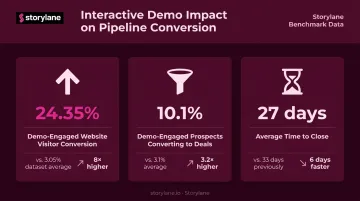
A prospect who completes an interactive demo signals meaningfully higher intent than one who downloaded a whitepaper. Storylane's research (based on 110,257 web sessions and 150 deals analyzed in partnership with Factors.ai) found that:
- Website visitors who engaged with an interactive demo converted at 24.35% — nearly 8x the dataset average of 3.05%
- Prospects who engaged with a demo during their journey converted to deals at 10.1% — 3.2x the average deal conversion rate of 3.1%
- Time to close shortened from 33 days to 27 days when demo touchpoints were involved
PDQ validated this with an A/B test: their interactive demo achieved a 92% conversion lift compared to a video in the same placement, with conversion rates moving from 3.19% to 6.14%.
Interactive Demos for Outbound
Sending a personalized demo link in a cold email sequence gives prospects something worth engaging with — far more compelling than a generic meeting request. Storylane supports per-prospect personalization at scale using dynamic variable tokens: company name, logo, contact name, and industry-specific content can all be swapped without rebuilding the demo.
When a prospect views the demo link, Storylane triggers a real-time Slack alert to the rep, so reps follow up while the prospect's attention is still on the product. Personalized content plus real-time intent signal means every outbound touchpoint arrives at the right moment with the right context.
Qualify, Score, and Nurture Leads More Effectively
Not every lead deserves the same follow-up. Lead scoring creates a systematic way to prioritize effort — and avoid letting high-intent prospects fall through the gaps.
Building a Scoring Model
Effective lead scoring combines two dimensions:
- Fit scoring — ICP match: industry, company size, job title, geography
- Behavioral scoring — email opens, page visits, content downloads, demo engagement, return visits
The BANT framework (Budget, Authority, Need, Timeline) provides a useful qualification lens on top of scoring. A prospect who matches your ICP and has completed an interactive demo scores differently than one who opened a single email.
Storylane feeds engagement analytics directly into lead scoring models via CRM integrations with HubSpot, Salesforce, and Marketo. Metrics like time spent per step, features explored, completion rate, and return visits flow in automatically — so demo engagement becomes part of your scoring logic without manual input.
Matching Nurture to Lead Tier
Segment scored leads into three tiers and route them accordingly:
| Tier | Criteria | Action |
|---|---|---|
| High | Strong ICP fit + high behavioral engagement | Immediate personal outreach from sales |
| Mid | Moderate fit or early-stage engagement | Targeted email drip with case studies or demo invites |
| Low | Weak fit or minimal engagement | Top-of-funnel educational content; re-score over time |
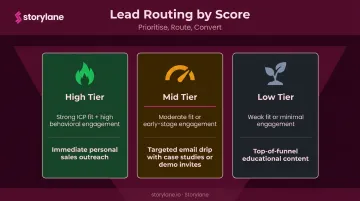
The tier structure only works if sales and marketing agree on the score threshold that triggers a handoff. Without that alignment, high-intent leads sit in nurture sequences while sales complains about lead quality.
Speed-to-Lead Matters More Than Most Teams Realize
Harvard Business Review found that companies contacting leads within an hour were nearly 7x more likely to have meaningful conversations than those waiting longer. InsideSales data shows conversion rates are 8x higher within the first 5 minutes versus 6+ minutes. Yet 77% of leads receive no response at all.
Real-time demo engagement alerts make this possible. When a prospect engages with your demo and a rep receives a Slack notification immediately, the follow-up happens while the product is fresh in the buyer's mind.
Metrics That Tell You If Your Lead Gen Is Actually Working
Tracking the wrong metrics creates the illusion of progress. These four tell you what's actually happening:
| Metric | What It Measures | Negative Trend Suggests |
|---|---|---|
| Cost Per Lead (CPL) by channel | Efficiency of each lead source | Budget allocation needs adjustment |
| Lead-to-Opportunity Rate | Lead quality | ICP targeting or qualification process is off |
| Opportunity-to-Close Rate | Sales process health | Messaging, nurture, or demo quality needs work |
| Pipeline Influenced | Total revenue pipeline attributable to lead gen | Attribution gaps or underinvestment in key channels |
The Optimization Loop
Raw data is only useful if it feeds decisions. Run monthly or quarterly reviews of these metrics by channel, test key variables (email subject lines, CTAs, landing page copy, demo placement), and document what you learn.
The most important feedback loop is between sales and marketing: sales needs to report back on lead quality, not just lead volume. If marketing is optimizing for CPL without knowing which leads actually closed, they'll keep optimizing for the wrong outcome.
That's where tools like Storylane's Deal Intelligence feature become useful. It tracks which demo interactions influenced pipeline and maps engagement to CRM deal stages, giving teams visibility into what's working beyond the form fill.
Frequently Asked Questions
What is B2B lead generation?
B2B lead generation is the process of identifying and attracting potential business customers — those with the authority, budget, and need to buy — so your sales team works a qualified pipeline rather than a list of random contacts.
What is the difference between MQL and SQL in B2B lead generation?
An MQL (Marketing Qualified Lead) has shown early interest — downloaded content, visited key pages — but isn't yet sales-ready. An SQL (Sales Qualified Lead) has demonstrated clear buying intent, such as requesting a demo or directly responding to outreach, and is ready for a direct sales conversation.
What are the most effective B2B lead generation channels?
Effectiveness varies by ICP, but consistently high-performing channels include LinkedIn outreach, SEO-driven content, targeted cold email, referrals from existing customers, and intent-triggered ABM. The best results come from combining multiple channels rather than relying on any single one.
How do you qualify B2B leads effectively?
Use the BANT framework — Budget, Authority, Need, Timeline — as your qualification structure, then layer in behavioral scoring based on how a lead has engaged with your content, demos, and outreach. Leads who match your ICP and show high engagement should move to the front of the queue.
How can B2B teams generate more leads without significantly increasing budget?
Three high-ROI, lower-cost tactics worth prioritizing:
- Systematize referral requests from happy customers
- Publish SEO content that compounds traffic over time
- Embed interactive demos on high-traffic pages to convert existing visitors into qualified leads
What role do interactive demos play in B2B lead generation?
Interactive demos let prospects self-qualify by experiencing the product before talking to sales. Embedded on key website pages with lead capture forms, they function as high-intent lead magnets. Engagement data — steps completed, time spent, features explored — then tells sales exactly what a prospect cares about before the first call, so reps can skip the intro pitch entirely.