

That gap — between how buyers want to buy and how sellers typically sell — is exactly what digital sales rooms address. According to Gartner, 67% of B2B buyers now prefer a rep-free buying experience, a figure that has only grown year over year.
This article covers what digital sales rooms are, why they matter for modern B2B selling, the core benefits they deliver, the features worth prioritizing, and practical advice for using them well.
Key Takeaways
- A digital sales room (DSR) is a secure, centralized workspace where buyers and sellers collaborate across the full deal cycle via a single shared link
- Buyers increasingly prefer self-serve, asynchronous evaluation — DSRs are built for exactly that
- DSR engagement analytics give revenue teams real buying signals, not subjective rep updates
- Embedding interactive product demos (like those built in Storylane) inside a DSR lets buyers explore the product on their own timeline
- Personalization, fresh content, and acting on engagement signals are what separate effective DSRs from neglected microsites
What Is a Digital Sales Room?
A digital sales room (DSR) is a secure, centralized online workspace where sellers and buyers collaborate across the entire sales cycle — from first meeting to closed deal. You may also see them called virtual deal rooms, sales microsites, or digital deal rooms. The names vary; the concept is the same.
Gartner defines them as "private, persistent microsites" that connect buying and selling teams. Forrester describes them as centralized locations where reps and buyers collaborate and co-create value.
How DSRs Differ from Traditional Selling
The contrast with conventional deal management is direct:
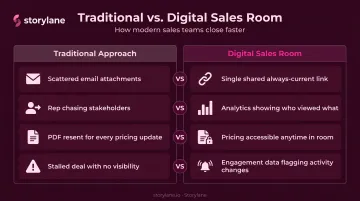
| Traditional Approach | Digital Sales Room |
|---|---|
| Email attachments, multiple versions floating around | Single shared link, always current |
| Rep tracks down stakeholders for feedback | Analytics show exactly who viewed what |
| Buyer asks for pricing — rep resends a PDF | Pricing lives in the room, accessible anytime |
| Stalled deal, no visibility into why | Engagement data flags zero activity or new stakeholder interest |
Instead of managing a scattered email chain with attachments nobody can find, a DSR gives every stakeholder — across every team involved in the purchase — one destination to access proposals, case studies, contracts, product demos, and communications.
Gartner-linked research published in 2022 predicted that 30% of B2B sales cycles will be managed through digital sales rooms by 2026. For sales teams still running deals over email threads and shared drives, that number signals where buyer expectations are heading.
Why Digital Sales Rooms Matter in Modern B2B Buying
Buyers Are Already Informed Before You Reach Them
Modern B2B buyers conduct extensive research before engaging a sales rep. A TrustRadius study found that **virtually 100% of buyers want to self-serve all or part of the buying journey**, and 97% said it would help to have all buying research and resources in one place. DSRs fulfill that expectation directly — they give buyers a structured, self-serve environment where they can evaluate on their own schedule.
The same research found that 69% of B2B buyers reported inconsistencies between information on a vendor's website and what sellers told them. A DSR reduces that friction by keeping everyone working from the same, seller-curated content set.
Buying Committees Have Grown More Complex
One-to-one selling is rarely how B2B decisions get made anymore. Gartner's research on the B2B buying journey indicates that complex purchases typically involve 6 to 10 decision-makers — each with their own priorities, concerns, and schedules.
TrustRadius data reinforces this: 27% of buyers reported an increase in the number of decision-makers involved in their purchasing process. A DSR doesn't just serve the champion you're talking to. It serves every stakeholder in the deal, on their own timeline:
- The CFO reviewing pricing at 10pm
- The IT lead checking security documentation
- The legal team reviewing contract terms
No new email thread required for each person.
Key Benefits of Digital Sales Rooms for Sales Teams
Shorter Sales Cycles
When every piece of deal content — proposals, case studies, pricing, contracts — lives in one place, buyers stop waiting for files to arrive in their inbox. Multiple stakeholders can evaluate content in parallel rather than sequentially.
Salesforce's State of Sales research notes that 57% of sales professionals say the sales cycle is getting longer. DSRs work against that trend by eliminating the back-and-forth of resending attachments and giving buyers instant, anytime access to what they need.
Buying Committee Visibility
DSR engagement analytics answer questions that champions often can't or won't: Who else is looking at this deal? What did they focus on? Did anyone share this internally?
Knowing that three new stakeholders viewed the security documentation over a weekend is actionable intelligence. It tells a rep which concerns to address, which personas to prepare for, and when to follow up — no longer relying on one contact to relay what's happening internally.
More Personalized Buyer Experiences
Personalization at scale is one of the harder problems in enterprise sales. A well-built DSR lets reps customize deal content — case studies from the buyer's industry, pricing relevant to their use case, messaging that speaks to their specific pain points — without rebuilding from scratch each time.
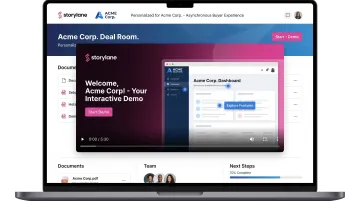
One effective approach: embedding interactive product demos directly into the DSR. Storylane's interactive demos let buyers explore the product asynchronously, clicking through a guided demo inside the room whenever they're ready. Smart variable tokens also personalize the demo itself — swapping in the buyer's company name and context so the experience feels built for them, not repurposed from a template.
Improved Forecast Accuracy
DSR engagement data replaces gut-feel pipeline reviews with objective signals: multiple stakeholders reviewing a proposal, a new executive entering the room, or two weeks of zero activity each tell revenue leaders something concrete about deal health.
This matters especially for enterprise deals with long timelines, where it's easy for a deal to appear active on paper while quietly stalling in practice.
Reduced Rep Administrative Burden
Salesforce reports that sales reps spend 60% of the workweek on non-selling tasks, with 18% of time going to manual data entry alone. DSRs consolidate communication, content sharing, and follow-up into one workspace — fewer emails to track down, fewer files to resend, fewer "can you send me that pricing doc again?" requests eating up afternoons.
GetAccept, a DSR vendor, reports that reps using their platform save 16 hours monthly (vendor-reported figure). When everything lives in one place, the admin work of maintaining it drops substantially.
Must-Have Features in a Digital Sales Room
Not all DSR platforms are built the same. When evaluating options, these are the features that actually move deals forward — not just the ones that make a polished first impression.
Buyer Engagement Analytics
Look for room-level tracking that shows:
- Which stakeholders visited, when, and how often
- Which sections they spent the most time on
- When activity spiked (signal: someone forwarded the room internally)
- When the room went quiet (signal: deal may be stalling)
This drives smarter follow-up timing. A rep who knows a stakeholder spent 12 minutes on the pricing page should follow up differently than one guessing at interest levels from email silence.
Content Management and Personalization
The room should support organized, easy-to-navigate content with the ability to update materials as the deal progresses — without sending buyers a new link every time something changes. Stale content erodes confidence.
Real-Time Collaboration Tools
In-room commenting, stakeholder tagging, and Q&A threads let buyers ask questions and get answers in context. This reduces the fragmented back-and-forth that happens when questions get buried in email chains.
CRM Integration
Strong CRM integration means room activity syncs bidirectionally to opportunity records automatically. One-way exports depend on rep discipline to happen consistently — bidirectional sync keeps forecast data current without the extra effort or the gaps that come from skipping it.
Security and Access Controls
For enterprise deals involving sensitive pricing, contract terms, or competitive positioning, security is non-negotiable. Look for:
- Role-based permissions
- Encrypted sharing
- Audit trails
- Compliance certifications (SOC 2, GDPR, ISO/IEC 27001)
Mutual Action Plans
Shared timelines with jointly owned milestones keep both sides accountable. A buyer who commits to a procurement review by a specific date inside the room has made a more visible commitment than one who agreed verbally on a call. Without that structure built in, complex deals stall — urgency fades when it isn't tied to something concrete.
Best Practices for Using Digital Sales Rooms Effectively
Having a DSR isn't enough. How you use it determines whether it accelerates deals or just adds another layer of digital clutter.
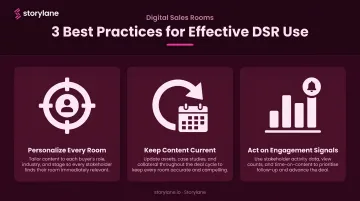
Three habits separate teams that close with DSRs from those that just check a box:
- Personalize every room to the deal. Skip the generic template. Include content tied to this buyer's pain points, industry, and evaluation stage — a financial services firm assessing a compliance tool needs different assets than a growth-stage HR tech startup.
- Keep content current throughout the deal cycle. Add meeting summaries, revised proposals, and new assets as conversations evolve. A room frozen at the original pitch deck from six weeks ago signals disorganization and gives buyers less reason to return.
- Act on engagement signals, not just email replies. When analytics show a stakeholder lingering on the pricing section, or three new visitors entering after your champion mentioned looping in IT, those are buying signals. Follow up with targeted outreach that reflects what the data is actually telling you.
Frequently Asked Questions
What's the difference between a digital sales room and a data room?
A virtual data room (VDR) is a secure document repository used during M&A transactions or due diligence processes. A digital sales room is a buyer-facing collaboration space designed for active sales deals. Same name pattern, entirely different purpose.
What content should you include in a digital sales room?
Common content includes proposals, pricing, case studies, product demos, contracts, and meeting summaries. The key is curation: include content relevant to the buyer's current stage and the specific stakeholders involved, not every asset your team has ever produced.
Who should use a digital sales room?
DSRs are primarily used by B2B sales reps and account executives, but also benefit sales engineers managing technical evaluations, customer success managers handling renewals, and revenue operations leaders who need accurate deal visibility across the pipeline.
How does a digital sales room shorten the sales cycle?
By giving buyers instant, anytime access to all deal materials in one place, DSRs eliminate delays caused by resending files and waiting for information to reach the right people. Multiple stakeholders can review content simultaneously, compressing the time it takes to reach consensus.
What's the difference between a digital sales room and a sales enablement platform?
Sales enablement platforms focus on internal content management and rep training — they're built for sellers. Digital sales rooms are buyer-facing workspaces where deals happen. The two categories complement rather than replace each other.
Do buyers need an account to access a digital sales room?
Most modern DSR platforms allow buyers to access rooms via a shared link without creating an account. Some platforms offer optional authentication for sensitive deals that require tighter access control.