Introduction
According to Gartner research, 67% of B2B buyers now prefer a rep-free buying experience. That means most prospects have already formed opinions about your product, your pricing, and your competitors before your sales team enters the picture.
This shift doesn't make sales reps irrelevant. It makes the content they carry more important than ever.
Without the right assets, deals stall, messaging gets inconsistent, and buyers lose confidence fast. But when the content strategy is tight, reps show up to every interaction prepared, on-message, and genuinely useful to the buyer.
Here's what this guide covers:
- What sales enablement content is (and what it isn't)
- The difference between internal and external content types
- A six-step framework for building a strategy from scratch
- How to map content to each stage of the buyer journey
- How to measure what's actually working
Key Takeaways
- 67% of B2B buyers prefer a rep-free experience — content must work without a rep present
- Up to 65% of marketing content goes unused because it's irrelevant or unfindable
- Internal and external content must align, or buyer trust erodes
- Mapping content to funnel stage prevents deals from stalling due to mismatched assets
- Engagement signals from analytics should drive rep follow-up and ongoing content optimization
What Is Sales Enablement Content?
Sales enablement content is any material — internal or external — designed to help reps engage buyers more effectively and help buyers make purchasing decisions with confidence. The key distinction from general marketing content: it's purpose-built for specific moments in the sales process, not broad awareness.
A blog post that drives traffic is marketing content. A battlecard that helps a rep handle a competitive objection on a Thursday afternoon call is sales enablement content. Same company, same product — completely different jobs.
The Business Case for Getting This Right
When sales and marketing create content together, three things happen:
- Rep guesswork drops — they know exactly which asset fits which situation
- Deal cycles shorten — buyers get the right information at the right time
- Message consistency improves across the entire buyer journey
The reverse is also true. Forrester research found that an estimated 65% of content marketing assets go unused because they're irrelevant — and separately, that sellers now have an average of 1,400 sales assets to choose from, most of which don't match what buyers actually need at a given moment.
Most teams don't have a content shortage. They have a strategy gap — nothing connecting the content they produce to the outcomes reps actually need.
Internal vs. External Sales Enablement Content
Sales enablement content splits into two distinct categories — and both have to work.
Internal content is what reps use to prepare themselves. Battlecards, playbooks, scripts, objection-handling guides, win/loss stories, training resources — all of it exists to make reps consistent, confident, and fast in any selling scenario. The audience is the sales team, not the buyer.
External content is shared directly with prospects and buying committees. Case studies, pitch decks, one-pagers, ROI calculators, interactive demos — these materials must hold up without a rep in the room, because much of the buying evaluation happens asynchronously. A prospect reviewing your security documentation at 10 PM isn't going to wait for a rep to explain it.
Why They Must Work Together
Treat them in isolation and the seams start showing. Gartner found that 69% of B2B buyers report inconsistencies between what's on a vendor's website and what sellers tell them. When internal training teaches reps one narrative and external collateral tells a different story, buyers catch it — and deals stall.
The standard to aim for: a prospect who reads your whitepaper, talks to your rep, then reviews your one-pager should encounter one coherent story — not three slightly different versions of it.
| Internal Content | External Content | |
|---|---|---|
| Audience | Sales reps | Prospects & buying committees |
| Purpose | Prepare, train, align | Educate, persuade, advance deals |
| Examples | Battlecards, playbooks, win/loss stories | Case studies, pitch decks, ROI calculators |
| Used when | Before and during the call | During and between touchpoints |
Types of Sales Enablement Content
Internal Content Types
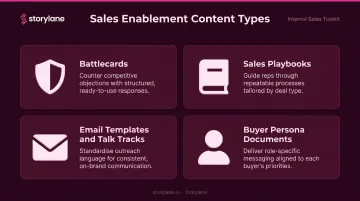
Four internal content types consistently deliver the most impact:
Battlecards — Used in competitive situations and live objection handling. Good battlecards are concise, scannable, and updated whenever a competitor makes a major product change or pricing move.
Sales playbooks — Document repeatable processes by deal type, vertical, or persona. A playbook for an enterprise security deal looks very different from one for a SMB HR software deal — they should be treated that way.
Email templates and talk tracks — Provide consistent language for outreach, follow-up, and key conversation moments. The goal isn't to robotize reps; it's to give them a proven starting point they can personalize.
Buyer persona documents — Help reps tailor messaging to specific roles and pain points. A VP of Engineering cares about different things than a CFO, even when evaluating the same product.
External Content Types
Six external content types consistently drive the most value:
Case studies and testimonial videos — Most effective mid-to-late funnel. 43% of B2B buyers rank case studies as a highly valuable content type when evaluating solutions, per Demand Gen Report's 2023 research.
Sales decks and one-pagers — Structure the narrative and enable your internal champion to sell on your behalf when you're not in the room. One-pagers do the heavy lifting in multi-stakeholder deals.
ROI calculators and diagnostic tools — Quantify the problem or solution before a budget conversation. 31% of buyers find ROI calculators valuable for purchase decisions.
Whitepapers and research reports — Educate executive sponsors on broader strategic risk. 46% of B2B buyers prefer research and survey reports when researching solutions.
Product demo videos and explainer videos — Help buyers visualize the product between conversations. 70% of buyers wanted a demo early in the process, making this format relevant well before the decision stage.
Interactive demos — This format goes beyond what a video can do. Rather than watching a walkthrough, prospects self-navigate the product on their own timeline, exploring the features most relevant to their situation.
That personalization gap is where tools like Storylane fit in. Storylane lets sales teams build interactive demos with dynamic variable tokens that automatically swap in prospect name, company, and use case, so each prospect navigates an experience shaped around their context. Its Demo Hub centralizes all demos in one location, supporting both self-serve discovery and guided sales journeys.
Sales teams at companies like SentinelOne, Sprout Social, and Gong use this approach so prospects arrive at live calls already familiar with the product. Reps can move past basic feature walkthroughs and spend the conversation on what actually moves deals forward.
How to Build a Sales Enablement Content Strategy
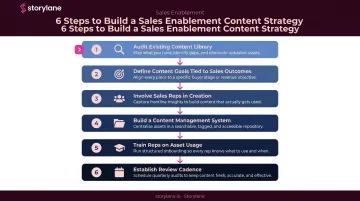
Step 1 – Audit Your Existing Content Library
Before creating anything new, catalog what exists. Map every internal and external asset, identify what's being used versus ignored, and surface marketing-created content that sales teams don't even know about. Most audits uncover two things simultaneously: critical gaps and significant duplication.
Retire outdated assets as part of this process. Stale content doesn't just go unused — it actively harms rep credibility when a prospect encounters a product description that no longer reflects reality.
Step 2 – Define Content Goals Tied to Sales Outcomes
Every piece of content should be created to solve a specific, defined problem:
- Reducing objections about pricing
- Increasing demo-to-close rates
- Shortening the security review process
- Helping champions build internal consensus
Focused content built for one job outperforms comprehensive content that tries to do everything. When a rep is on a call and needs to address a security concern, they need a precise asset — not a 40-page whitepaper.
Step 3 – Involve Sales Reps in the Creation Process
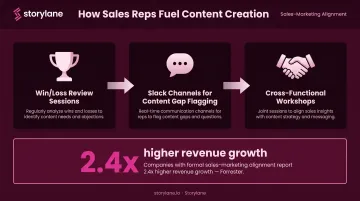
Content created without rep input rarely gets used. Gather feedback through:
- Regular win/loss review sessions
- Dedicated Slack channels where reps can flag content gaps
- Cross-functional workshops between sales, marketing, and product marketing
Rep-built content reflects actual buyer language and real objections — and reps use it because they shaped it. Companies with formal sales-marketing alignment report 2.4x higher revenue growth than those without it, per Forrester.
Step 4 – Build a Content Management System Reps Can Actually Use
Even excellent content fails if reps can't find it in 30 seconds during an active deal. A searchable, well-organized content management system should be organized by:
- Funnel stage (awareness, consideration, decision)
- Persona (economic buyer, technical evaluator, end user)
- Use case (competitive displacement, net-new, upsell)
Storylane's Demo Hub applies this same logic to interactive demos, letting reps organize and access demos by category, use case, and buyer role from one centralized location — no hunting through folders or email chains mid-deal.
Step 5 – Train Reps on When and How to Use Each Asset
Distributing content without context leads to misuse or non-use. Roll out new content with explicit guidance on:
- Which scenario it's designed for
- Where it fits in the funnel
- Which stakeholder it's meant to reach
A competitive battlecard used in an early discovery call creates problems. That same card used at the right moment in a deal — when a prospect mentions they're also evaluating a competitor — can be decisive.
Step 6 – Establish a Regular Review Cadence
Sales enablement content has a shelf life. Quarterly reviews are the minimum. Trigger immediate reviews when:
- Product updates ship that change features, positioning, or pricing
- Pricing changes take effect
- A competitor makes a significant move in the market
- Messaging strategy shifts following a rebrand or repositioning
Designate a named owner for each content category. Without ownership, review cadences slip, libraries go stale, and reps stop trusting what they find.
Mapping Content to Each Stage of the Buyer Journey
Sending the right content at the wrong time is nearly as damaging as sending no content at all. Forrester found that nearly 70% of decision-makers recalled receiving vendor content they didn't ask for, and 64% said vendors send too much material overall.
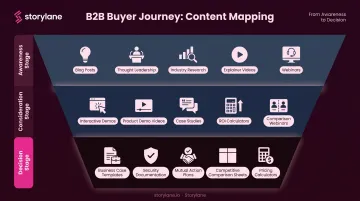
Awareness Stage (Top of Funnel)
Buyers are researching a problem, not a solution. Content should educate without selling.
Best formats:
- Blog posts and thought leadership
- Industry research reports
- Explainer videos
- Webinars on strategic challenges
Consideration Stage (Middle of Funnel)
Buyers are evaluating options and building internal awareness of the need. Content should help them understand how your solution fits their specific situation.
Best formats:
- Interactive demos (self-serve, so buyers can explore on their timeline)
- Product demo videos
- Case studies from similar industries
- ROI calculators that quantify the problem
- Webinars comparing approaches
Interactive demos are especially effective here. A prospect evaluating three vendors can self-navigate your product on a Sunday evening, experiencing it firsthand before they ever speak to a rep. When personalized with their company name and use case, that experience feels purpose-built for their situation.
Decision Stage (Bottom of Funnel)
Buyers are building internal consensus and managing procurement. Your champion needs to sell internally on your behalf.
Best formats:
- Business case templates
- Security and compliance documentation
- Mutual action plans
- Competitive comparison sheets
- Pricing calculators
The Cost of Stage Mismatches
Sending a pricing sheet to an awareness-stage prospect creates friction before the relationship has formed. Sending a blog post to a buyer who's ready to sign signals a lack of preparation.
A simple fix: tag all content by funnel stage in your CMS. This lets reps grab the right asset at the right moment and cuts the instinct to send everything and hope something sticks.
How to Measure the Impact of Your Sales Enablement Content
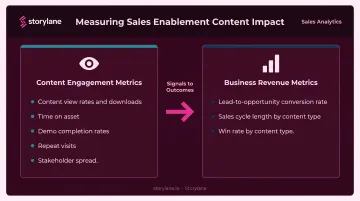
Content-Level Engagement Metrics
These signals reveal which formats resonate with buyers and which assets reps are actually using:
- Content view rates and asset downloads show basic adoption across your library
- Time on asset tells you how deeply a prospect engaged — not just that they clicked
- Demo completion rates are especially telling for interactive formats
- Repeat visits signal purchase intent; a prospect returning three times is worth a rep alert
- Stakeholder spread shows how many buying committee members touched the same asset
Business Metrics That Connect Content to Revenue
Engagement data only matters when tied to outcomes. Track:
- Lead-to-opportunity conversion rate for deals where specific assets were used
- Sales cycle length by content type — did deals with ROI calculators close faster?
- Win rate by content type — which assets correlate most with closed-won deals
That last metric is easier to act on when your analytics trigger action in real time. Storylane's Demo Signals feature scores prospects as low, medium, or high intent based on time spent, completion rates, and return visits. Rep alerts push to Slack automatically, with data synced to Salesforce and HubSpot.
The Optimization Loop
Build a simple, repeatable process to turn data into decisions:
- Review content performance on a set cadence (monthly for high-volume assets, quarterly for the full library)
- Update or retire assets that show low engagement and poor deal correlation
- Replicate the structure and format of high-performing assets
- Collect qualitative feedback from reps alongside quantitative data — numbers tell you what isn't working, reps tell you why
Frequently Asked Questions
What is the difference between sales enablement content and marketing content?
Marketing content is created to generate awareness and drive leads — its success is measured by traffic and top-of-funnel metrics. Sales enablement content is purpose-built to support specific moments in the sales process, helping reps have better conversations and helping buyers make decisions. The same topic can produce both types; the difference is the job each piece is designed to do.
What types of content are most effective at the bottom of the funnel?
Bottom-of-funnel assets are designed to help your internal champion build consensus with decision-makers: business case templates, ROI calculators, competitive comparison sheets, security and compliance documentation, and case studies from companies with similar profiles. These materials must work without a rep in the room.
What is the difference between internal and external sales enablement content?
Internal content equips reps to sell — battlecards, playbooks, talk tracks, and persona guides. External content is shared with prospects and buyers — demos, case studies, one-pagers, and ROI tools. Both must reinforce the same core narrative; when they diverge, buyers notice the inconsistency and lose confidence.
How often should sales enablement content be updated?
Quarterly reviews are the minimum standard. Immediate updates should be triggered by product launches, pricing changes, or major competitive shifts. Outdated content should be retired rather than left in the library — stale assets actively harm rep credibility when a prospect encounters information that no longer reflects reality.
How do interactive demos fit into a sales enablement content strategy?
Interactive demos are a self-serve format that lets prospects explore the product on their own timeline — particularly effective in the consideration stage, before buyers commit to a live call. They can be personalized at scale using dynamic variable tokens to reflect each prospect's company, use case, or industry, making the experience feel tailored rather than generic.
How do you get sales reps to actually use sales enablement content?
Adoption follows utility. Involve reps in the creation process so content reflects real buyer language and actual objections. Train them explicitly on when and why to use each asset. Then organize content in a system that's fast to search and current enough to trust.