That mismatch is expensive. According to G2's 2024 Buyer Behavior Report, 69% of B2B software buyers only engage a salesperson once they've already made their decision. By the time your sales team picks up the phone, the buyer has often moved on — or chosen someone else.
This guide breaks down the three core stages of the buyer's journey, explains how they differ from the customer journey, and gives sales and marketing teams practical ways to act on that knowledge.
Key Takeaways
- The buyer's journey covers three stages: awareness, consideration, and decision — and each one calls for a different content and sales approach.
- Modern B2B buyers do most of their research independently; reaching them early matters.
- The buyer's journey ends at purchase; the customer journey begins there.
- Journey mapping helps sales and marketing teams align, reduce friction, and improve conversions.
- Using the right tools at each stage, such as interactive demos during consideration, directly accelerates purchase decisions.
What Is the Buyer's Journey?
The buyer's journey maps the path a potential customer takes from first recognizing a need, through researching solutions, to making a final purchase decision. It views the entire process from the buyer's perspective — not the seller's.
That distinction matters. Here's how the two differ:
- Sales funnel: tracks internal pipeline metrics and seller progress — it tells you where a deal sits
- Buyer's journey: tracks buyer mindset, motivations, and actions — it tells you what the buyer is thinking
Both are useful, but they answer fundamentally different questions.
The buyer's journey framework exists for one practical reason: to help businesses deliver the right message at the right moment. Buyers who feel guided rather than sold to move faster and convert at higher rates.
The 3 Stages of the Buyer's Journey
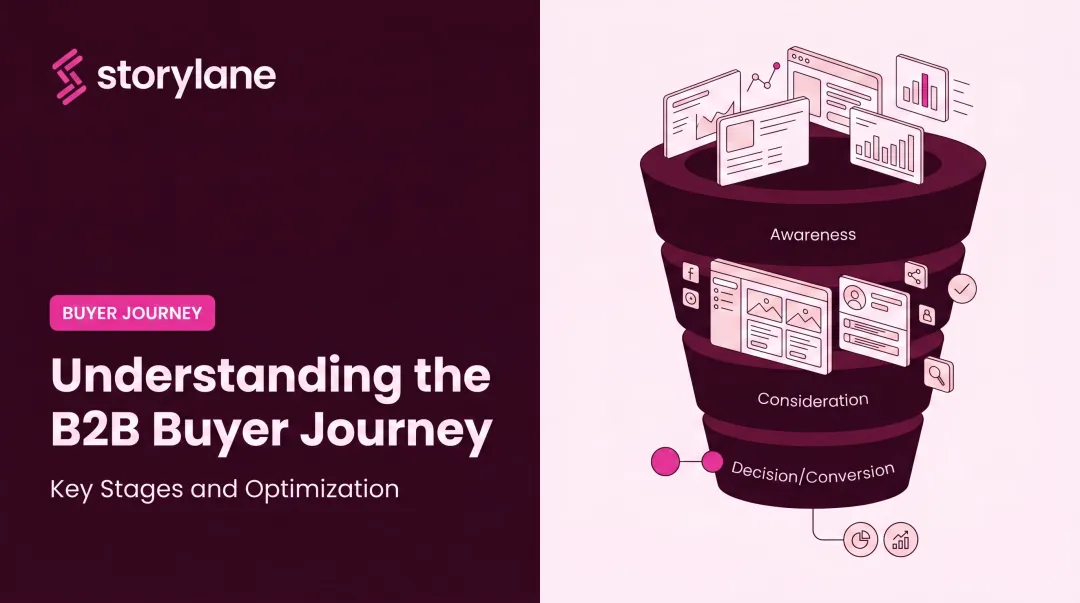
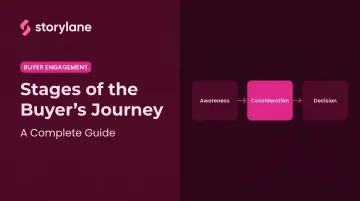
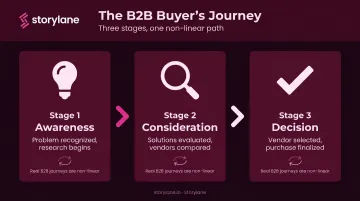
The classic model has three stages: awareness, consideration, and decision. While the model looks linear on paper, real B2B buying journeys rarely are. Prospects revisit stages, jump ahead based on a competitor demo, or stall when new stakeholders get involved. Understanding each stage is essential, but applying them rigidly is the mistake.
Awareness Stage
At this stage, the buyer recognizes a problem or challenge but hasn't identified a solution yet. They're in research mode, not vendor mode.
What buyers are doing:
- Searching general terms on Google (or, increasingly, asking AI chatbots)
- Reading industry content and asking peers
- Trying to frame and validate the problem they're experiencing
G2's 2026 AI Search Insight Report found that 51% of B2B software buyers now start research with an AI chatbot more often than Google — up from 29% just 11 months earlier. Awareness-stage content needs to appear wherever buyers are asking questions, not just where they used to search.
What works here: Educational, non-promotional content. Blogs, guides, explainer videos, and thought leadership that validates the problem and frames it clearly — without leading with product features.
Consideration Stage
In the consideration stage, buyers have clearly defined their problem and are now evaluating solution categories and specific vendors. They're comparing approaches, reading reviews, watching demos, and downloading comparison content.
This is where the self-serve preference becomes most pronounced. 83% of B2B software buyers want discovery to be self-service, according to G2's 2024 data. Buyers want to explore solutions on their own terms before committing to a sales conversation.
Interactive product experiences become critical here. Platforms like Storylane let buyers explore a product at their own pace — through guided HTML demos, branching demos, and AI video avatar walkthroughs organized in a centralized Buyer Hub.
A prospect can navigate directly to the use cases most relevant to their role, without waiting for a scheduled call. When they do connect with sales, they arrive already informed.
What works here: Case studies, comparison guides, webinars, product demo videos, and interactive demos that let buyers evaluate on their own terms.
Decision Stage
Buyers in the decision stage have selected a solution category and are narrowing down to a specific vendor. The evaluation now centers on pricing, contracts, onboarding, ROI, and security — the practical details that determine whether a deal closes.
A few data points that reveal what buyers care about at this stage:
- 64% of C-suite buyers are less likely to purchase if a vendor requires personal information before showing pricing
- 79% of buyers say the CFO always or frequently holds final decision-making power
- 80% of organizations required a security assessment in 2024
What works here: Remove friction. Offer free trials or live demos, share testimonials and ROI data, address security concerns proactively, and make pricing accessible. The sales process itself needs to be responsive — slow handoffs and opaque pricing pages kill deals that were otherwise won.
Personalization helps here too. Storylane's dynamic variable tokens let sales teams swap in each account's name, logo, and brand colors automatically — no manual prep per account. Private, tracked demo links give reps visibility into which stakeholders engaged and what they focused on, useful context heading into a final conversation.
Buyer's Journey vs. Customer Journey
These terms get used interchangeably, but they describe two different things.
| Buyer's Journey | Customer Journey | |
|---|---|---|
| Starts | Problem recognition | Purchase / signing |
| Ends | Contract signed | Advocacy (or churn) |
| Focus | Acquisition | Retention & expansion |
| Owned by | Sales & Marketing | Customer Success |
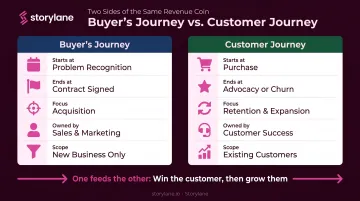
Both matter, and they're connected. A friction-filled buyer's journey creates skepticism that follows a customer into onboarding. On the flip side, strong post-purchase experiences generate the case studies, referrals, and word-of-mouth that feed back into the top of the funnel.
That feedback loop is why some modern frameworks merge the two into one continuous journey — it makes sense for SaaS businesses where the line between prospect and user is increasingly blurry. But for sales and marketing teams building content strategies, keeping the distinction clear prevents misalignment on what stage you're actually serving.
Why Understanding the Buyer's Journey Matters for B2B Sales and Marketing
Without journey mapping, teams default to treating all prospects the same. The same pitch goes to someone who just Googled the problem category and someone ready to request a contract. That creates three specific failure modes for B2B SaaS teams:
- High bounce rates on bottom-of-funnel content served too early
- Wasted sales rep time on unqualified, early-stage leads
- Traffic that doesn't convert because the content doesn't match where the buyer actually is
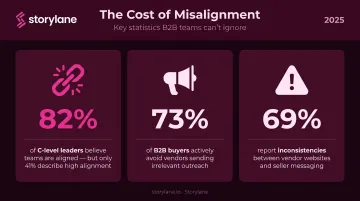
The misalignment problem runs deeper than most teams realize. Forrester research found that while 82% of C-level professionals believe their product, sales, and marketing teams are aligned, only 41% of C-suite respondents describe teams as highly aligned — and 65% of practitioners report outright misalignment between sales and marketing leaders.
The consequences of stage-agnostic outreach are measurable. Gartner's 2025 sales survey found 73% of B2B buyers actively avoid suppliers that send irrelevant outreach, and 69% report inconsistencies between what's on a vendor's website and what sellers tell them — both direct results of teams that haven't mapped the journey.
The flip side is just as clear: teams that align content and outreach to each stage close deals faster, waste fewer resources on bad-fit leads, and see higher conversion rates at every handoff.
How to Map and Apply the Buyer's Journey
Start With Buyer Personas
The buyer's journey only works when tied to a specific buyer archetype. Generic personas produce generic journey maps. Get specific: job role, pain points, information sources, decision criteria, and who else is involved in the purchase.
This last point matters more than most teams account for. Forrester's 2024 research found an average of 13 people involved in B2B buying decisions, with 89% of purchases involving two or more departments. Journey mapping for a single buyer persona misses most of the actual decision-making.
Research How Buyers Actually Buy
Don't guess. Interview existing customers about how they found and evaluated your product. Ask:
- Where did you first learn about us?
- What content or resources influenced your decision?
- Where did you almost walk away, and why?
- What finally convinced you?
Pair those interviews with keyword research (to identify stage-specific search intent) and CRM data (to see where leads drop off or convert). Patterns will emerge quickly.
Assign Content to Each Stage
| Stage | Content Types |
|---|---|
| Awareness | Blogs, thought leadership, explainer videos, guides |
| Consideration | Case studies, comparison guides, interactive demos, webinars |
| Decision | Free trials, pricing pages, testimonials, live demos, ROI data |
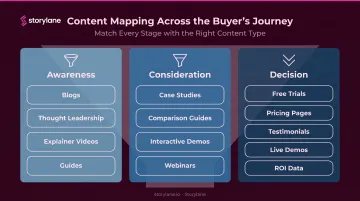
Every piece of content should serve a clear stage and move the buyer forward. An awareness blog that leads with product features defeats its own purpose. A decision-stage case study buried behind a form might never get read.
Use Engagement Signals to Identify Stage in Real Time
Behavioral data tells you more than demographic data about where a buyer sits in their journey. Demo views, page visits, content downloads, and email opens all signal intent.
Storylane's analytics dashboard surfaces this at the demo level: completion rates, time spent, CTA clicks, and specific features explored. Its Account Reveal feature, which de-anonymizes demo visitors at the company level and delivers real-time Slack alerts when prospects engage, lets sales teams prioritize outreach based on demonstrated intent rather than cold assumptions. That data syncs directly into Salesforce, HubSpot, and Marketo, so reps enter follow-up conversations with full context.
Align Sales and Marketing on Shared Definitions
That shared data foundation only pays off when both teams interpret it the same way. Sales and marketing must operate from the same journey map — agreed-upon definitions, not assumptions. That means agreeing on:
- What qualifies a lead as awareness vs. consideration vs. decision stage
- Which content is assigned to each stage
- What the handoff criteria look like between marketing-qualified and sales-qualified leads
Without shared definitions, content gets created for the wrong stage and leads get handed off at the wrong time.
Common Misconceptions About the Buyer's Journey
Three assumptions consistently cause teams to misread buyer behavior and miss pipeline opportunities.
The journey is always linear. B2B buyers — especially those navigating committee-based decisions with long sales cycles — routinely revisit the consideration stage after seeing a competitor demo or receiving internal pushback. Teams that apply a rigid three-step model miss re-engagement opportunities at exactly the moments they matter most.
Creating stage-labeled content is enough. Many teams produce content tagged by stage but fail to tailor the message, depth, or format to actual buyer needs. In fact, 51% of B2B buyers said content was too generic and irrelevant to their needs in 2024, up from 38% in 2023, according to Demand Gen Report's Content Preferences Benchmark Survey. Stage labels without stage-specific substance don't move buyers.
The buyer's journey ends at the decision stage. Post-purchase experience directly influences renewals, expansions, and referrals — all of which bring new prospects into your pipeline. Poor onboarding kills referrals; a customer who succeeds becomes your next case study. The decision stage is a handoff, not a finish line.
Frequently Asked Questions
What are the 5 stages of the buyer's journey?
The classic model has 3 stages: awareness, consideration, and decision. Some frameworks expand this to 5 or 6 by adding pre-awareness (learning/problem identification) and post-decision stages (preference/trial and loyalty). These additions are useful for mapping the full customer lifecycle, but the core pre-purchase model remains three stages.
What is the difference between the buyer's journey and the customer journey?
The buyer's journey covers the pre-purchase path from problem recognition to final decision. The customer journey begins at purchase and encompasses onboarding, usage, renewal, and advocacy. One is about acquisition; the other is about retention. Both directly shape the other.
How does the buyer's journey differ for B2B vs. B2C?
B2B journeys are typically longer, involve multiple decision-makers (Forrester found an average of 13), and are driven by ROI and business need. B2C journeys tend to be shorter, more emotionally driven, and made by individual buyers with far less consensus required.
What type of content should I create for each stage of the buyer's journey?
Awareness content educates: blogs, guides, and explainer videos. Consideration content differentiates: case studies, interactive demos, and comparisons. Decision content closes: free trials, testimonials, pricing pages, and live demos.
How do I know which stage a buyer is in?
Buyer stage shows up in behavioral signals — the pages they visit, the content they download, the search terms they use, and how deeply they engage with demos or trials. High demo completion rates and CTA clicks signal decision-stage intent; broad, surface-level browsing suggests awareness.
What is buyer journey mapping?
Buyer journey mapping is the process of documenting the steps, decisions, and touchpoints a specific buyer persona goes through from problem recognition to purchase. Teams use it to align content, sales tactics, and messaging to actual buyer needs at each stage, and to identify where prospects are dropping off.