The catch is that "having a cadence" isn't enough. Results vary enormously based on touchpoint sequencing, channel mix, timing, personalization depth, and how well the cadence maps to where the buyer actually is in their journey. There's no single right answer.
This article covers what a sales cadence is, how to build one step by step, three real examples with day-by-day breakdowns, and the best practices and mistakes that determine whether a cadence converts or stalls.
Key Takeaways
- A sales cadence is a structured, multi-step outreach sequence using email, phone, and LinkedIn to move prospects toward a meeting
- Cold outbound cadences typically run 21–27 days with 7–13 touchpoints across multiple channels
- Front-loading 3–4 touches in the first three days maximizes early engagement when prospect attention is highest
- Outbound, inbound, and AE mid-funnel cadences each require different sequencing and tone
- Track connection rate, reply rate, and meeting conversion to continuously improve cadence performance
What Is a Sales Cadence and Why Does It Matter
A sales cadence is a predetermined sequence of outreach activities — emails, calls, LinkedIn messages, video touches — spread across defined intervals. It gives reps a repeatable roadmap for moving a prospect from cold to conversation.
The key word is repeatable: a cadence removes the guesswork of when to follow up, what channel to use, and what to say at each stage.
Without a defined cadence, reps make those decisions in the moment. The result is inconsistency — some prospects get five touches, others get one, and there's no way to diagnose what's working. According to RAIN Group research on touchpoints to conversion, it takes an average of 8 touchpoints to get an initial meeting with a new prospect. Most reps stop well before that.
The Main Cadence Types
Cadences aren't one-size-fits-all. Identify which type fits your goal before building:
- Outbound (cold prospecting) — targeting net-new accounts with no prior relationship
- Inbound (warm response) — following up on prospects who've shown intent through a form, download, or trial
- Retention — nurturing existing customers through onboarding, check-ins, or renewal outreach
- AE / Hybrid (mid-funnel) — managing named accounts already in active pipeline
Each type calls for different touchpoint counts, channel mixes, and messaging — which is exactly what the next section breaks down.
How to Build a Sales Cadence: A Step-by-Step Process
Step 1: Define Your ICP and Segment Your Prospects
Before writing a single email, get clear on who you're reaching out to. Key ICP factors to nail down:
- Role and seniority level
- Company size and industry
- Core pain points and business triggers
- Where they are in the buying journey
Once your ICP is defined, segment prospects into tiers. Not every lead deserves the same level of effort:
- Tier 1 — High-value strategic accounts; deep research, high personalization, more touches
- Tier 2/3 — Standard ICP fits; moderate personalization, scalable sequences
- Signal-based — Intent-driven accounts showing active buying behavior; accelerated cadence
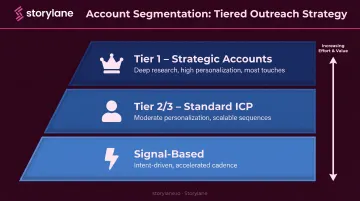
The tier determines how many touchpoints to include and how much personalization to build in. Conflating these tiers derails cadence performance before it starts.
Step 2: Choose Your Channels and Sequence Order
The core B2B outreach channels each serve a different purpose:
- Email — versatile, scalable, essential at every stage
- Phone/voicemail — highest conversion in B2B; best for personalized follow-up
- LinkedIn — less intrusive, effective for social selling and warm intros
- Video messages — differentiated mid-sequence touch that stands out
The "Power of Three" framework gives you early visibility across multiple surfaces: start with three different channel types in the first 1–3 days (LinkedIn connection + personalized email + cold call) before the prospect's attention has moved on.
Step 3: Set Your Timing and Number of Touchpoints
For cold outbound, plan for 21–27 days total. Salesloft's validated cadence data shows their Go-to Outbound Prospecting cadence runs 14 steps over 26 business days, with 6 touches in the first 3 days — consistent with the front-loading principle.
Front-loading logic: Concentrate 3–4 touchpoints in days 1–3, then space later touches by 3–5 days. Early days have the highest engagement probability before the prospect moves on.
Alongside your timing, define your exit criteria upfront so every rep knows exactly when to stop:
- Maximum attempts reached
- Unsubscribe request received
- Prospect converts or disqualifies
- Breakup email sent with no response
A breakup email as the final touchpoint serves two purposes: it gives the prospect one last chance to respond and it cleanly closes the loop for the rep.
Step 4: Script Messaging for Each Touchpoint
With your timing set, every touchpoint needs a distinct purpose — not just "following up." A progression that works:
- First touch — "Why you, why now": trigger-based relevance tied to a business event or pain point
- Middle touches — Value delivery: case study, industry insight, personalized demo link
- Late touches — Soft reframe or breakup framing
The difference between personalization that earns replies and personalization that reads as hollow comes down to connection. Compare these two openers:
Generic: "Hi Sarah, I came across your LinkedIn profile and thought you might be interested in our platform..."
Relevant: "Hi Sarah, saw that [Company] just expanded into EMEA — we've helped three similar SaaS teams reduce their sales cycle by 20% during regional expansions. Worth a 20-minute conversation?"
One mentions a channel. The other references a real business trigger — and gives the prospect a concrete reason to respond.
A strong mid-cadence touchpoint: around Day 10, send a personalized, self-guided interactive demo link. Storylane lets reps generate a unique trackable link in seconds, customized with the prospect's name and company, so they see a tailored experience rather than a generic product tour.
When the prospect engages, the rep receives a real-time alert. That makes the timing of the Day 12 follow-up call intentional rather than arbitrary.
Step 5: Test, Measure, and Refine
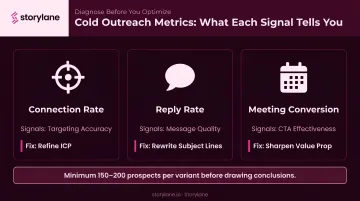
Once your cadence is live, three metrics matter most:
| Metric | What It Signals | Low Performance Fix |
|---|---|---|
| Connection rate | Targeting accuracy | Refine ICP, check list quality |
| Reply rate | Message quality | Rewrite subject lines and openers |
| Meeting conversion | CTA effectiveness | Sharpen value prop and ask |
One critical rule: don't make changes on small samples. Outreach recommends at least 150 prospects through a sequence step before drawing conclusions. SalesHive recommends 200–500 sends per variant for B2B email tests. Reactive changes based on a handful of replies lead to false conclusions and an endlessly unstable cadence.
Sales Cadence Examples for Different B2B Scenarios
The right structure varies by situation. Here's a quick orientation before the breakdowns:
| Cadence Type | Touchpoints | Duration |
|---|---|---|
| Outbound SDR (cold) | 10–13 | 21–24 days |
| Inbound / Warm Lead | 6–8 | 7–10 days |
| AE / Mid-Funnel | 8–10 | 21 days |
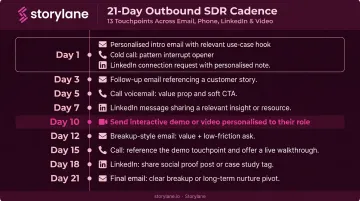
Outbound SDR Cadence: 13 Touchpoints Over 21 Days
Goal: Break into net-new accounts with no prior relationship.
| Day | Activity |
|---|---|
| Day 1 | LinkedIn connection request + personalized email + cold call/voicemail |
| Day 3 | Bump email (short reply to original thread) |
| Day 5 | LinkedIn message referencing a post or shared connection |
| Day 7 | Cold call — different time of day than Day 1 |
| Day 10 | Value email with personalized interactive demo link |
| Day 12 | Cold call — follow up on demo engagement if prospect viewed it |
| Day 15 | LinkedIn engagement on their content |
| Day 18 | Final personalized email with a soft reframe |
| Day 21 | Cold call + voicemail |
| Day 24 | Breakup email |
Day 10 is where a personalized demo touchpoint earns its place. Rather than attaching a PDF or linking to a generic product page, reps can send a Storylane demo link tailored to the prospect's company and role. If the prospect opens it on Day 11, the rep gets an immediate Slack or email alert with engagement context — which transforms the Day 12 call from a cold dial into a well-timed, relevant follow-up.
Inbound / Warm Lead Cadence: 6–8 Touchpoints Over 7–10 Days
Goal: Convert a prospect who's already shown intent.
Speed is the defining variable here. Foundational research from MIT and InsideSales found that contact and qualification rates drop 10x after the first five minutes of a form submission. The HBR study found companies responding within one hour were 7x more likely to have a meaningful conversation with a decision-maker than those waiting even 60 minutes longer.
| Day | Activity |
|---|---|
| Day 1 | Personalized email within minutes of form fill + immediate call attempt |
| Day 2 | Follow-up call + voicemail if no answer |
| Day 3 | LinkedIn connection with specific context |
| Day 5 | Value email referencing the specific asset they downloaded |
| Day 7 | Second call attempt |
| Day 9 | Final email with soft CTA or breakup line |
Every touchpoint references what the prospect already did: "I noticed you downloaded our guide on reducing sales cycle length — here's how teams similar to yours are solving that exact problem." You're not introducing yourself; you're continuing a conversation they started.
AE / Mid-Funnel Cadence: 8–10 Touchpoints Over 21 Days
Goal: Re-engage named or worked accounts without overwhelming active relationships.
| Day | Activity |
|---|---|
| Day 1 | Trigger-based email (funding, job change, industry event) + LinkedIn connection |
| Day 3 | Call if mobile number is available |
| Day 6 | Bump email |
| Day 9 | LinkedIn engagement on their content |
| Day 12 | Value email — share a relevant report, case study, or interactive demo hub |
| Day 15 | Second call attempt |
| Day 18 | LinkedIn DM — "would love your thoughts on this" |
| Day 21 | Soft breakup final email |
The AE cadence philosophy is fewer but higher-quality touches. AEs should spend more time per account — researching trigger events, personalizing messaging, and timing re-entry when context gives them a real reason to reach out.
Prioritization matters just as much as timing. Use engagement signals to decide where to focus:
- Demo opens and return visits indicate active consideration
- Content clicks reveal which problems the prospect is researching
- Job changes or funding rounds create natural re-entry points for dark accounts
Storylane's Deal Intelligence tracks demo engagement against pipeline stage, giving AEs a data-backed view of which accounts are warming up vs. which are genuinely stalled.
Best Practices for a High-Converting Sales Cadence
Multi-channel is non-negotiable. Salesloft's data science research shows multi-touch cadences are roughly 3x more effective than single-touch, and omni-channel cadences are 5x more effective than single-channel outreach. Email-only cadences leave significant pipeline on the table.
Personalization must be relevant, not decorative. There's a meaningful difference between:
- Decorative: "Hi [First Name], I noticed you work at [Company]..."
- Relevant: "Hi Marcus, saw that [Company] just made G2's top 10 for CRM — congrats. We've helped three other G2 leaders reduce their demo-to-close time by 30%."
The former uses personalization as cosmetic packaging. The latter connects a business context to a real reason to talk.
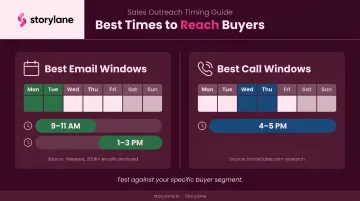
Front-load and time your outreach deliberately. Based on Yesware's analysis of 200,000+ sales emails, the strongest email response windows are 9–11 AM and 1–3 PM, with Monday and Tuesday showing the most reply activity. For calls, InsideSales research points to Wednesday and Thursday as the best days, with 4–5 PM as the highest-performing window. Use these as starting hypotheses, then test against your specific buyer segment.
Adapt mid-cadence based on engagement signals. If a prospect opens an email multiple times, clicks a demo link, or returns to a product tour, treat those actions as a trigger to accelerate your next touch — not stick to the schedule.
Tools like Storylane's Account Reveal de-anonymize companies interacting with demo touchpoints and surface enriched firmographic data. Slack alerts fire the moment high-intent engagement occurs, so reps can follow up while the prospect's attention is still live.
Common Mistakes to Avoid
Giving Up Too Early
RAIN Group's research shows it takes an average of 8 touchpoints to reach a new prospect. Velocify's analysis of converted leads found 93% were reached by the sixth call attempt. Reps who stop after 3–4 attempts — or abandon email after one non-reply without trying phone or LinkedIn — are walking away before most conversions occur.
Treating All Prospects the Same
One generic cadence for all leads ignores ICP tier, intent level, and buying stage. High-value strategic accounts need deep research and tailored outreach. Standard ICP fits can run on a more automated sequence. Blurring the two means over-investing in low-priority accounts and under-resourcing the deals that actually move.
Changing Too Soon
Reactive cadence changes — adjusting subject lines after five no-replies or overhauling messaging after a slow week — produce false conclusions. Wait until at least 150–200 prospects have moved through a cadence step before drawing any conclusions on what to tweak.
Frequently Asked Questions
What is a sales cadence?
A sales cadence is a structured, repeatable sequence of outreach activities — emails, calls, LinkedIn messages — spread across set intervals to move a prospect from cold to conversation. The goal is consistent, multi-channel contact at the right times, not just high contact volume.
What is an example of a sales cadence?
A typical outbound SDR cadence runs 13 touchpoints over 21 days. It starts on Day 1 with a LinkedIn request, personalized email, and cold call, then follows with spaced value touches — including a mid-cadence demo or content share — before ending with a breakup email around Day 21.
What are the main types of sales cadences?
The three primary types are outbound (cold prospecting into net-new accounts), inbound (responding to warm leads who've shown intent through forms, trials, or content downloads), and retention (nurturing existing customers through onboarding checkpoints and renewal outreach).
How long should a sales cadence be?
Cold outbound cadences should run 21–27 days; shorter cadences miss prospects who respond after the fifth or sixth touch. Inbound cadences can compress to 7–10 days given higher intent. Enterprise cadences can run longer — the right length depends on buyer type and deal complexity.
How many touchpoints should a sales cadence have?
Cold SDR cadences typically use 10–13 touchpoints, AE hybrid cadences 8–10, and inbound cadences 6–8. The right number depends on account tier, deal complexity, and prospect responsiveness, not a one-size-fits-all number.
What channels should a sales cadence include?
At minimum, B2B cadences should combine email, phone, and LinkedIn. Video messages or personalized interactive demo links added mid-sequence improve differentiation. SMS can work for later-stage or warm prospects but performs poorly as a cold opener.