Introduction
Most B2B sales reps know discovery matters. Few actually do it well.
The sales discovery process is the structured sequence of conversations where a rep uncovers a prospect's pain points, goals, budget, and decision-making criteria — before pitching anything. It sits between the cold call and the demo, doing the diagnostic work that makes everything else sharper.
The problem? Reps rush it. They treat discovery as a formality before getting to the demo they're excited to run. As the Sandler methodology puts it, prescription without diagnosis is malpractice. Skipping discovery is exactly that.
You end up proposing solutions to problems you haven't fully understood, and deals stall because the fit was never properly established.
This article walks through five concrete steps to run a discovery process that qualifies better, builds trust faster, and creates a foundation for deals that actually close.
Key Takeaways
- Discovery's only goal is to uncover pain, fit, and buying readiness — not to pitch
- Strong discovery requires pre-call research, a clear agenda, sharp questions, active listening, and purposeful follow-up — in that order
- Treat discovery as an ongoing process, not a single call — it runs across the entire sales cycle
- Rushing to the solution before understanding the problem is the most common and costly discovery mistake
- Discovery insights should shape every subsequent conversation, demo, and proposal
What Is the Sales Discovery Process?
Discovery is a structured, pre-demo conversation (sometimes a series of conversations) where the sales rep gathers the information needed to determine fit, understand specific challenges, and decide how to move forward.
It sits between two common touchpoints most reps already know:
- Cold calls are unsolicited and pitch-focused — discovery only happens after a prospect has expressed some level of interest
- Demos are solution-focused and assume fit is already established — discovery comes before that assumption gets made
Discovery validates intent and diagnoses need before any solution gets introduced.
What Good Discovery Produces
A rep who runs discovery well leaves with a clear picture of:
- The prospect's primary pain point and its business impact
- Gaps in their current solution or workflow
- Who else is involved in the decision
- Timeline and urgency
- Whether there's genuine fit worth pursuing
That last point matters. Discovery isn't just about building a pitch — it's equally about disqualifying deals early. The best reps walk away from bad fits before investing time in a tailored demo, keeping their pipeline focused on accounts that can actually close.
Why Sales Discovery Is Critical in B2B Sales
B2B buyers rarely arrive with a complete picture of what they need. They know something isn't working, but they haven't always diagnosed why. Discovery is how reps build that picture together with the prospect — and that collaboration is what makes the eventual pitch land.
According to Demand Gen Report, 81% of B2B buyers already have a preferred vendor at first contact, and 85% have purchase requirements established. That means by the time a prospect agrees to a discovery call, they have opinions. Discovery isn't starting from scratch. It's understanding the lens they're already using to evaluate you — and adjusting your approach accordingly.
What Gets Broken When Discovery Is Skipped
The downstream consequences compound fast:
- Wasted demo time — reps present features irrelevant to the actual challenge
- Misaligned proposals — commercial terms don't reflect the prospect's budget reality or decision timeline
- Late-stage deal collapse — procurement surfaces objections that discovery would have caught in week one
- Post-sale churn — customers who bought on a misread of their needs disengage quickly
In the moment, these look like pricing objections, procurement delays, or product gaps. Trace them back, though, and they share a common origin: the rep proposed a solution before fully understanding the problem. Discovery is what prevents that gap from opening in the first place.
5 Steps to Master the Sales Discovery Process
Step 1: Do Your Pre-Call Research
Walking into a discovery call blind signals immediately that you haven't earned the prospect's time. Pre-call research is how you arrive with a point of view rather than a blank slate.
Practically, this means:
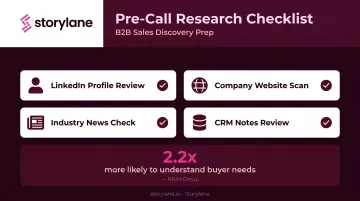
- Reviewing the prospect's LinkedIn profile and role history
- Scanning the company website for strategic priorities or recent announcements
- Checking industry news for trends affecting their sector
- Reviewing prior CRM notes, emails, or interactions
If the prospect has already engaged with an interactive demo sent as part of your outbound sequence or via a pre-call Storylane link, you have an advantage most reps never use. Storylane's analytics dashboard surfaces which specific features a prospect clicked, how long they spent on each step, where they dropped off, and their overall completion rate. That data tells you what they care about before the call starts.
RAIN Group's research across 700 B2B purchases found that sales winners were 2.2x more likely to understand buyer needs and 2.2x more likely to listen effectively than second-place finishers. Pre-call research is how that understanding starts.
Step 2: Set a Clear Agenda and Align Before the Call
The space between booking the call and running it is underused. Most reps send a calendar invite and leave it at that. Strong reps use this window to set expectations and reduce friction.
A well-structured pre-call setup looks like:
- Send a calendar invite with 2–3 discussion topics listed (not a detailed agenda, just enough to frame the conversation)
- Share relevant materials (a short product overview or relevant use case) so the prospect arrives informed
- Confirm attendance with a brief reminder, ideally the morning of the call
This frames the discovery call as a professional, time-respecting conversation — one that signals preparation and cuts no-shows.
More practically: when a prospect arrives knowing what the conversation will cover, they come prepared to share relevant context. That means better answers, faster.
Step 3: Ask the Right Discovery Questions
The goal isn't to run through a checklist. It's to understand the prospect's situation well enough to know whether and how you can help.
Gong's analysis of over 500,000 sales calls found the highest discovery success when reps asked 11–14 targeted questions (enough to surface meaningful context, without the call feeling like an interrogation). Their more recent data suggests winning sellers ask around 15–16 questions, while reps who lose deals tend to ask closer to 20.
Three question types drive great discovery:
- Open-ended — invites the prospect to share context in their own words
- Probing — digs into root causes and business impact of a stated challenge
- Clarifying — verifies your understanding before moving on
Topics every discovery conversation should cover:
- Current situation and existing tech stack
- Specific pain point and what triggered the search for a solution
- Business impact of the problem (time, money, risk, headcount)
- Who else is involved in the decision
- What a successful outcome looks like
- What has prevented them from solving this before now
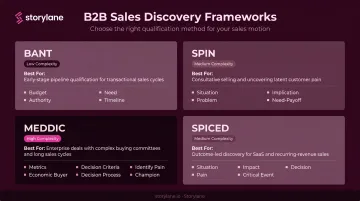
On frameworks: SPIN, MEDDIC, BANT, and SPICED are all useful guides — not scripts. BANT works for straightforward qualification. SPIN suits consultative selling. MEDDIC is built for complex enterprise deals with long cycles. Most experienced reps blend elements from more than one, adjusting as the conversation evolves.
Step 4: Listen Actively and Probe Deeper
Most reps underestimate how much listening matters and overestimate how much they're actually doing it.
Gong's talk-to-listen data is clear: closed-won deals show 57% seller talk time, lost deals show 62%. That five-point difference compounds. When reps talk too much, they fill space that should belong to the prospect , missing the context that would make their pitch relevant.
Active listening in discovery means:
- Paying full attention without mentally preparing your next question
- Summarizing what the prospect said before moving on ("So if I'm understanding correctly...")
- Following their lead when something important surfaces, even if it's off your planned agenda
- Embracing silence : pausing after a prospect answers often prompts them to add detail they wouldn't otherwise share
The best discovery questions are usually not the ones you planned. They're the follow-up to something the prospect just said. Treat your pre-call list as anchors. When something unexpected surfaces — a stakeholder conflict, a failed implementation, a budget constraint — that thread is worth pulling.
Step 5: Confirm Next Steps and Follow Up With Purpose
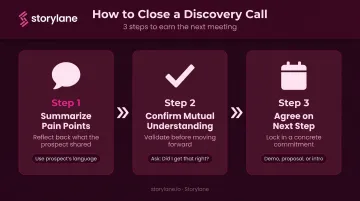
A discovery call that ends without a clear next step hasn't actually advanced the deal. Strong close-of-call alignment looks like:
- Summarize the pain points in the prospect's language (not your interpretation of them)
- Confirm mutual understanding : "Did I get that right?" matters more than most reps realize
- Agree on a concrete next step : a follow-up call, a tailored demo, a proposal review, or a stakeholder introduction
The follow-up email is not an admin task. It's the first step of the next stage. It should recap the key challenges discussed, restate any commitments, and introduce what comes next.
One approach that works well: sending a personalized interactive demo via Storylane after discovery, tailored to the pain points uncovered on the call. Using dynamic tokens like {{first_name}} and {{company_name}}, reps can build a demo that references the prospect's company, mirrors their use case, and spotlights the product areas most relevant to their challenge — without rebuilding from scratch each time.
Storylane then tracks how the prospect engages with that content, surfacing Slack alerts and CRM-logged signals that show exactly what resonated before the formal demo call begins.
Key Factors That Shape a Successful Discovery Process
Qualification Before Discovery
Discovery works best when it builds on qualification, not duplicates it. Reps who already know a prospect meets basic ICP criteria can spend the entire call going deep into pain. Reps still figuring out basic fit during discovery waste time they should spend understanding the actual problem.
If leads are pre-qualified — whether through intent data, inbound behavior, or tools like Storylane's RepX (which qualifies and routes leads automatically before a human rep enters the conversation) — discovery becomes a deeper, more productive conversation.
Discovery as an Ongoing Process
Complex B2B deals involve multiple stakeholders and evolving priorities. Discovery doesn't end when the first call does.
Every subsequent touchpoint — the demo, the technical review, the commercial discussion — is an opportunity to learn something new. When a new stakeholder enters the deal, that's another discovery moment. When the prospect's timeline changes, that's another one.
Storylane's Buyer Hubs support this approach: reps can organize demos by use case, persona, or pain point in a single shareable destination. When a procurement lead or technical evaluator enters the deal late, they self-navigate to the relevant content.
The rep then receives analytics showing exactly what that stakeholder explored, enabling a targeted follow-up without asking the prospect to repeat themselves.
Internal Alignment
Discovery insights only create value if they're shared. When what was learned in discovery is documented in the CRM and visible to SEs, AEs, and CSMs, the entire team can deliver a coherent, personalized experience. Storylane's direct Salesforce and HubSpot integrations support this: demo engagement signals flow automatically into the CRM, giving every downstream team member the context they need without requiring the prospect to re-explain their situation.
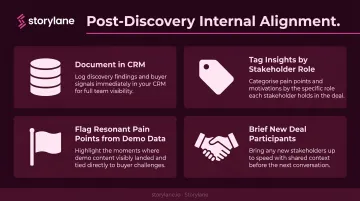
Key behaviors that reinforce internal alignment:
- Document discovery findings in the CRM immediately after each call
- Tag insights by stakeholder role so SEs and CSMs can act on them directly
- Use demo engagement data to flag which pain points resonated most
- Brief new deal participants before they enter the conversation
Common Discovery Mistakes to Avoid
Even well-prepared reps fall into patterns that undermine discovery. Here are three mistakes worth eliminating:
- Pitching too early: Jumping to the solution before fully understanding the problem anchors the conversation on the wrong pain points — and signals you're more interested in selling than listening.
- Running it like an interrogation: Moving mechanically through a checklist makes prospects feel processed, not heard. Rep talk time should sit around 30–40%, not 70%. Good discovery flows like a business conversation.
- Skipping the close: If a rep doesn't summarize and get explicit agreement on what was learned before moving to demo or proposal, they risk building the next stage on a misunderstanding. Reflect back what you heard and ask whether you got it right.
Frequently Asked Questions
What are the 5 P's of prospecting?
The 5 P's of prospecting are Purpose, Preparation, Personalization, Perseverance, and Practice. Each maps to the pre-discovery stage: having a clear reason for outreach, researching the prospect, tailoring your message, following up consistently, and refining your approach based on results.
What are the 5 methods of discovery?
The five core discovery methods are research-based pre-call prep, open-ended questioning, active listening, stakeholder mapping, and post-call validation. Together, they build a complete picture of the prospect's needs, buying context, and decision-making process.
What is the difference between a discovery call and a sales demo?
A discovery call focuses on understanding the prospect's pain, goals, and fit. A demo is solution-focused and assumes fit has already been established. Discovery should always come first — running a demo before discovery means presenting a solution to a problem you haven't fully understood.
How long should a sales discovery call be?
Most effective discovery calls run 20–45 minutes, depending on deal complexity. Research from Gong suggests 31-minute calls have a 60% higher success rate than shorter ones. The goal is enough time to uncover meaningful context without overstaying the prospect's interest.
What are the best questions to ask in a sales discovery call?
The strongest discovery questions are open-ended and target four areas:
- Current situation and how it compares to their goal state
- Root cause and business impact of the challenge
- Who else is involved in the decision
- What a successful outcome looks like
"What's prevented you from solving this before?" often surfaces the most useful context.
Which discovery framework is best for B2B sales — SPIN, BANT, or MEDDIC?
It depends on deal complexity. BANT works for straightforward qualification. SPIN suits consultative, mid-market selling. MEDDIC is built for complex enterprise deals with multiple stakeholders and long cycles. Most experienced teams borrow from multiple frameworks — the right mix depends on your deal size, cycle length, and buyer complexity.