Introduction
B2B sales has gotten harder. Buying committees now average 10+ people, 86% of B2B purchases stall during the buying process, and reps are expected to hit quota with fewer resources than ever. Meanwhile, buyers are doing the bulk of their research before they'll take a call — Gartner found that 61% of B2B buyers now prefer a rep-free buying experience.
Sales accelerator tools exist to bridge that gap. They surface buyer intent earlier, cut the manual work that eats up rep time, and help teams engage prospects who are already mid-research. This guide covers the key categories, what to look for, and which tools are worth your attention.
Quick note on terminology: "sales accelerator" covers two distinct concepts. It can refer to a category of sales software that speeds up pipeline stages, or to a commission structure that rewards reps for exceeding quota. This guide focuses entirely on the tools side.
Key Takeaways
- Sales acceleration tools remove friction at every pipeline stage — prospecting, outreach, demos, and close
- 61% of B2B buyers prefer rep-free experiences, making digital buying tools non-negotiable
- Top-performing stacks combine prospecting intelligence, engagement automation, and buyer enablement tools
- Interactive demos (like those built in Storylane) convert prospects at 3.2x the average deal rate (per Storylane internal data)
- Over-tooling and poor CRM data hygiene are the two most common reasons stacks underperform
What Are Sales Accelerator Tools?
Sales accelerator tools are software platforms that automate manual work, centralize deal data, and help reps reach the right prospects at the right moment — across every stage of the pipeline, not just one.
The case for building that ecosystem is straightforward. Salesforce research found that reps spend only 28% of their week actually selling — the rest goes to administrative tasks, data entry, and deal management. Sales accelerator tools exist to reclaim that lost time and redirect it toward revenue-generating activity.
What a Complete Stack Addresses
The best acceleration stacks don't patch one bottleneck. They work across the full pipeline:
- Top of funnel: Finding and qualifying the right accounts
- Mid-funnel: Engaging prospects consistently across channels
- Mid-to-late stage: Enabling buyers to evaluate and champion the product
- Ongoing: Coaching reps and improving forecast accuracy
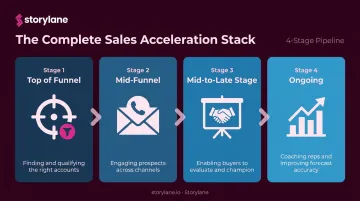
Each stage compounds the next — which is why the tools you choose at the top of the funnel directly affect close rates at the bottom.
Types of Sales Accelerator Tools
These categories overlap — good stacks combine several layers rather than treating each as a standalone solution.
Prospecting and Lead Intelligence Tools
These tools automate the work of finding and qualifying prospects that match your ideal customer profile. Key players include LinkedIn Sales Navigator, Apollo.io, and ZoomInfo Sales.
Core capabilities to look for:
- Contact and company databases with firmographic filters
- Buying intent signals that surface in-market accounts
- Automatic CRM enrichment to keep records current
- AI-powered lead scoring and prioritization
Apollo, for example, runs a database of 230M+ contacts and supports multi-channel outreach campaigns from the same platform, eliminating the need for a separate outreach tool.
CRM and Pipeline Management Tools
CRMs are the backbone of any acceleration stack. They centralize customer data, automate task logging, and give managers real-time pipeline visibility. Salesforce Sales Cloud and HubSpot Sales Hub are the dominant platforms here.
The real value isn't just storage — it's prevention. A properly configured CRM with automated follow-up reminders stops deals from going cold because a rep forgot to circle back after a promising call.
Sales Engagement and Outreach Tools
Sales engagement platforms like Outreach and Salesloft automate multi-channel sequences across email, calls, LinkedIn, and SMS. They surface buyer engagement signals in real time, so reps know exactly which prospects are active and which need a nudge.
Consistency at scale is the core win here. Without these platforms, follow-up quality varies rep to rep. With them, every prospect gets a structured, personalized sequence, and reps focus attention on the accounts that are actually engaging.
Interactive Demo and Buyer Enablement Tools
This category accelerates mid-to-late stage deals by letting prospects experience your product before — or instead of — a live sales call.
Storylane shows what this category looks like at full build-out. Reps create personalized, shareable demos across multiple formats (screenshot, HTML, guided, sandbox) without any engineering involvement. Dynamic token-based personalization swaps names, logos, currencies, and company data in seconds: one template, tailored to thousands of prospects.
Two features worth highlighting:
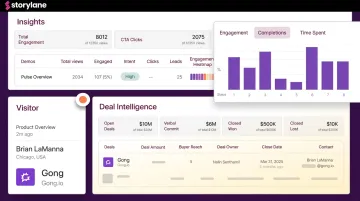
- Account Reveal de-anonymizes demo visitors, surfaces enriched firmographic data, and fires Slack alerts when high-intent accounts engage (up to 10,000 de-anonymizations/month on Premium).
- RepX is an AI sales rep that qualifies leads, answers objections, runs demos, and routes prospects to CRM — 24/7, across multiple languages — surfacing relevant case studies based on the conversation.
Storylane's own data (from 110,257 web sessions and 150 deals) shows prospects who engage with interactive demos convert at 10.1% — 3.2x the baseline rate of 3.1%. Campminder reported cutting their deal cycle from 6 weeks to 2 weeks after implementing Storylane demos as pre-call material.
Conversation Intelligence Tools
These tools record, transcribe, and analyze sales calls to surface coaching opportunities, flag recurring objections, and measure rep performance. Gong leads this category with revenue-team analytics that go well beyond transcription. Fathom is a lighter-weight option focused on meeting notes and follow-up with direct HubSpot and Salesforce integrations.
In practice, managers stop coaching on gut instinct and start coaching on what's actually happening on calls.
Key Benefits of Adopting Sales Acceleration Tools
More Selling Time Per Rep
When tools handle data entry, follow-up sequencing, and meeting scheduling, reps get that time back for actual conversations. Reps currently spend just 28% of their week actually selling — recovering even a fraction of the remaining 72% compounds fast across a team. Salesforce found that sales teams using AI are 1.3x more likely to see revenue growth than those that aren't.
Shorter, More Predictable Sales Cycles
Buyer intent data and real-time engagement signals help reps prioritize the accounts most likely to close so they can act before momentum fades. Storylane's internal analysis found that interactive demo touchpoints reduced average time-to-close by nearly a week per deal.
Better Coaching and Forecasting
Analytics embedded across these tools let managers tie specific behaviors to wins and losses. Gartner found that 84% of sales leaders say analytics has less influence than expected — most often because the underlying data is fragmented or buried in exports no one runs. Tools that surface engagement signals automatically, like demo interaction heatmaps or CRM-synced activity logs, close that gap without requiring manual data wrangling.
Key indicators these tools make actionable:
- Which prospects engaged with demos and for how long
- Which talk tracks or content pieces correlate with closed deals
- Where pipeline stalls by deal stage or rep
How to Build Your Sales Acceleration Stack
Start With Your Biggest Bottleneck
Audit your pipeline before purchasing anything. Where do deals stall most consistently — prospecting quality, demo no-shows, slow follow-up? The answer determines which tool category to prioritize first. Buying across all categories simultaneously without clear pain points is how teams end up with bloated stacks that no one uses.
Prioritize Integration Depth Over Feature Breadth
A sales accelerator is only as good as its data. Evaluate every tool by how well it syncs with your CRM. Native integrations with Salesforce or HubSpot are the standard — not Zapier workarounds that break when field names change. Storylane, for example, has native integrations with Salesforce, HubSpot, and Marketo that automatically populate demo engagement data into existing CRM records, including retroactive attribution for ungated demo visitors.
Map Tools to Pipeline Stages
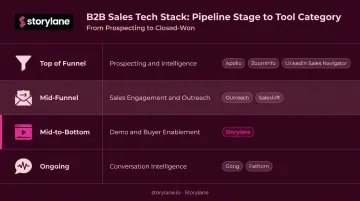
A simple framework for structuring your stack:
| Stage | Tool Category | Example |
|---|---|---|
| Top of funnel | Prospecting & intelligence | Apollo, ZoomInfo, LinkedIn Sales Navigator |
| Mid-funnel | Sales engagement & outreach | Outreach, Salesloft |
| Mid-to-bottom | Demo & buyer enablement | Storylane |
| Ongoing | Conversation intelligence | Gong, Fathom |
Storylane's Demo Hubs are worth a specific mention here — the Gallery layout serves top-of-funnel marketing (multiple buyer personas, SEO-friendly, ungated), while the Playlist layout supports sales and customer success use cases with sequential, curated flows. One tool, multiple stages.
Plan for Adoption From Day One
Tool adoption — not software quality — is what determines whether a stack delivers ROI. Build for it from the start:
- Involve reps in selection so they're bought in before rollout
- Connect tool usage to commission outcomes they already care about
- Track adoption as a KPI alongside pipeline metrics, not as an afterthought
Prioritize tools with self-serve onboarding so reps can get hands-on without waiting for IT or a scheduled training session.
Common Mistakes When Implementing Sales Accelerator Tools
Over-Tooling
Salesforce found that sales teams use an average of 10 tools to close deals, and 66% of reps feel overwhelmed by that number. More tools mean more context-switching, more data silos, and more time managing software instead of selling. The same research showed 94% of sales organizations planned to consolidate their stacks. Fewer, better-integrated tools outperform a sprawling collection of point solutions.
Skipping the Data Hygiene Step
AI-powered features (lead scoring, intent signals, forecasting) are only as reliable as the data underneath them. B2B contact data decays at roughly 22% per year. Gartner found that 44% of sales leaders cite poor data quality as a top barrier to analytics success.
Running sophisticated AI tools on a CRM full of stale, incomplete records produces confident-sounding wrong answers. Audit and clean your data before rolling out any AI-driven tooling.
Treating Tools as a Substitute for Strategy
Tools automate and accelerate a sales motion. They can't build one from scratch. An undefined ICP, weak messaging, or misaligned sales and marketing teams will be amplified by a powerful stack, not corrected by it.
Outreach sequences built around messaging that doesn't resonate will reach more wrong people, faster. Nail the strategy first — then layer in the tools to scale what's already working.
Frequently Asked Questions
What are sales accelerators?
Sales accelerators refer to two distinct things:
- Sales acceleration software — platforms that speed up pipeline stages through automation, intent data, and buyer engagement tools
- Sales compensation accelerators — commission structures that increase payout rates once reps exceed quota
Most revenue teams use the term to mean the software category.
What is the 3-3-3 rule in sales?
The 3-3-3 rule is a practitioner-defined prospecting framework. Definitions vary, but a common version involves three minutes of research, three relevant talking points, and three touchpoints per outreach sequence. Intelligence tools like ZoomInfo or Apollo cut the research time significantly, making it practical at scale.
What is the 2-2-2 rule in sales?
The 2-2-2 follow-up rule suggests contacting a prospect two days, two weeks, and two months after initial outreach. It's a practitioner guideline, not a formally studied framework. Sales engagement platforms like Outreach or Salesloft can automate this cadence so reps don't have to track it manually.
What are the 5 P's of sales?
Versions vary, but a common sales-specific list includes Preparation, Prospecting, Presentation, Persistence, and Performance. Sales accelerator tools support each stage: intelligence tools aid preparation and prospecting, demo platforms sharpen presentation, engagement tools drive persistence, and analytics track performance.
How do sales acceleration tools differ from a CRM?
A CRM is one component of a broader acceleration stack — it serves as the data and pipeline record. Sales acceleration tools extend beyond the CRM to include prospecting intelligence, outreach automation, interactive demo platforms, and conversation analytics. Most of these tools integrate with the CRM rather than replace it.