Introduction
Most B2B sales pipelines aren't stalling because reps aren't working hard enough. They're stalling because teams are still using playbooks built for a buying environment that no longer exists.
According to RepVue's Q2 2025 Cloud Sales Index, only 42.69% of reps across 246 companies hit quota — meaning the majority missed. Meanwhile, Gartner found that 73% of B2B buyers actively avoid suppliers that send irrelevant outreach. The gap isn't effort — it's precision in who you target and how you engage them.
This article breaks down the mechanics of modern B2B prospecting — how to identify the right accounts, which outreach approaches actually advance pipeline, how to act on buying signals before competitors do, and which metrics separate productive activity from motion without momentum.
Key Takeaways
- A precise Ideal Customer Profile — built on firmographic, technographic, and behavioral data — anchors every prospecting decision.
- Multi-channel sequences consistently outperform single-channel outreach — often by 2x or more.
- Buying signals (funding rounds, executive hires, demo engagement) identify accounts that are ready now, not just accounts that fit.
- Track three KPIs above all else: positive reply rate, meetings booked per channel, and lead-to-opportunity conversion.
- Interactive demos embedded in outreach sequences surface buyer intent before the first call ever happens.
Why Traditional B2B Prospecting Is Failing
B2B prospecting is the proactive, sales-driven process of identifying, researching, and initiating contact with potential buyers who fit your target profile. Unlike lead generation — which is marketing-led and inbound — prospecting is what your sales team does when they're not waiting for the phone to ring.
That distinction matters now more than ever, because the old playbook — buy a list, blast emails, hope for callbacks — has a structural problem: buyers have changed.
Gartner's 2025 survey of 632 B2B buyers found 61% prefer a rep-free buying experience. By 2026, that number climbed to 67%.
Buyers are researching, evaluating options, and forming opinions long before they talk to anyone in sales. When a generic cold email arrives with no relevance to what they're actually considering, they ignore it — or flag it as spam.
Inbound vs. Outbound: You Need Both
The inbound/outbound distinction matters for pipeline health:
- Inbound (marketing-generated): Captures buyers who raise their hands through content, ads, or search
- Outbound (sales-driven): Finds buyers who fit your profile but haven't raised their hands yet
Inbound scales with content investment. Outbound scales with targeting precision. Teams that over-index on inbound miss buyers who'll never stumble onto their content. Teams that over-index on outbound burn goodwill with irrelevant outreach. The highest-performing pipelines run both in coordination — same ICP, shared signal, unified follow-up.
How to Build Your Ideal Customer Profile (ICP)
Without a precise ICP, every downstream effort — targeting, messaging, sequencing — is pointed at the wrong accounts. Think of it as a detailed blueprint of your best-fit company, not a demographic checklist with two fields.
The Core Data Layers
A strong ICP stacks three types of data:
- Firmographics: Company size, industry, geography, and annual revenue — the basic shape of a target account
- Technographics: Their current tech stack, what integrations they run, which tools they've already bought — this reveals compatibility and buying patterns
- Structural signals: Team composition, headcount in specific departments (sales, marketing, engineering), presence of roles like SDRs or sales enablement managers
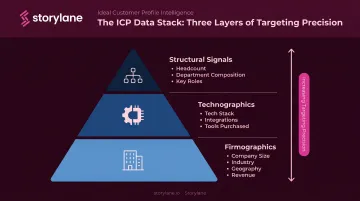
Each layer narrows your targeting accuracy. A company that looks right by size and industry but runs the wrong tech stack or lacks the team structure your product serves is a wasted sequence.
Mine Your Closed-Won Data First
The fastest path to a better ICP isn't market research — it's your own CRM. Pull your top 10 happiest, fastest-to-close, highest-retention customers and look for common threads:
- What industry and sub-vertical do they cluster in?
- What was their headcount and revenue range at time of purchase?
- What tech were they already running?
- What triggered the purchase? (new hire, funding, competitive pressure, expansion)
Patterns in closed-won data are worth more than any persona template. They tell you who actually buys, not who you think should.
Once you know who buys, the next step is identifying who's ready to buy right now.
Make It Dynamic with Buying Signals
A static ICP tells you who fits. A dynamic ICP layers in real-world triggers to surface accounts that fit and are primed:
- Recent funding announcements
- New executive hires in relevant departments
- Job postings signaling growth or new initiatives
- Product launches or market expansions
An account that matches your firmographic profile and just hired a VP of Sales is a fundamentally different prospect than one that matches on paper but hasn't moved in a year. Signals turn your ICP into a targeting engine, not just a description.
Set a quarterly review cadence to update your ICP as your product evolves, your market shifts, and your best-customer patterns change.
7 B2B Sales Prospecting Strategies to Fill Your Pipeline
No single method wins in isolation. The best teams combine several of these into coordinated sequences, choosing channels based on where their buyers actually pay attention.
Personalized Cold Email Outreach
Cold email is still one of the most scalable prospecting channels — but only when sent with precision, not volume. Belkins' analysis of 16.5 million B2B cold emails found average reply rates declined from 6.8% in 2023 to 5.8% in 2024. Outreach puts the average even lower at 2.9%. Sequences hitting 12-15% reply rates are genuinely performing well.
What separates high-performing cold email:
- Opening lines tied to the prospect's specific company context (a recent hire, a product launch, a funding round)
- Subject lines tested and iterated — A/B testing is not optional
- Body copy under 150 words
- A low-friction CTA: ask a question, not for a 30-minute meeting
LinkedIn Social Selling
LinkedIn lets reps warm up cold prospects before direct outreach. A profile view, a thoughtful comment on a relevant post, and a personalized connection request create familiarity — so when the email arrives, it doesn't feel cold.
LinkedIn Sales Navigator, trusted by 1.5M+ sellers, allows filtering by role, seniority, company size, and recent activity. This maps directly to ICP criteria, making list-building more intentional than pulling names from a spreadsheet.
Strategic Cold Calling
Cold calling works best as a touchpoint in a sequenced flow, not a standalone tactic. ZoomInfo's 2026 benchmark data shows only 3-10% of calls result in speaking to a live person — which is why calls burn through time when used indiscriminately.
The XANT research found that starting a cadence with a phone call produced a 21.1% contact rate versus 17.6% when starting with email. Calls land better after prior email or LinkedIn interaction — the prospect isn't completely cold, and the rep has context.
Referral Programs
Referrals produce the highest-quality leads in B2B sales because trust transfers from the referrer before the first conversation. The mechanics determine whether referrals happen consistently or just occasionally:
- Ask post-success or post-renewal — not randomly mid-engagement
- Build CRM workflows that prompt reps at the right stage
- Track referral sources to identify which customers refer most often
- Close the loop with the referrer so they stay engaged in the process
Account-Based Prospecting (ABM)
ABM-style prospecting means pursuing a defined set of target accounts with deliberate focus rather than broadcasting to broad lists. This involves mapping the buying committee, identifying each stakeholder's specific pain points, and tailoring messaging per persona.
72% of respondents in the ABM Leadership Alliance benchmark reported ABM delivers higher ROI than other marketing approaches. It's best suited for high-ACV deals where the investment in personalization yields outsized return.
Content-Driven Inbound Prospecting
Prospects who engage with blog posts, webinars, or case studies arrive with context — they've already spent time with your ideas. Speed is the differentiator here. Intent signal strength drops fast — follow-up within hours outperforms follow-up within days.
Sales teams that build a tight loop with marketing on content-engaged leads see the highest conversion rates from this channel:
- Identify which assets triggered engagement (webinar, case study, pricing page)
- Route high-intent signals directly to the owning rep via Slack or CRM alert
- Lead with the content topic in outreach — not a generic pitch
Interactive Demo Outreach
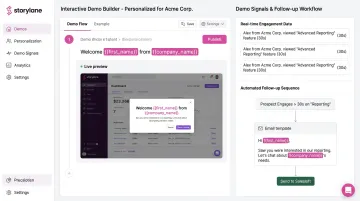
Instead of sending a pitch deck or a generic brochure, reps can embed a personalized, self-guided product demo directly in their outreach. The prospect experiences the product before the first call — arriving already familiar with the product and ready to discuss specifics rather than starting from scratch.
Storylane enables reps to personalize demos at scale using dynamic tokens (prospect name, company name) so each demo greets the recipient with their own context. More importantly, Storylane's Demo Signals workflow lets SDRs and BDRs identify which accounts engaged with a demo, auto-enrich them via Clay, and launch personalized follow-up sequences based on what specific features the prospect explored. Teams running this workflow report 3x higher response rates compared to cold outreach with no demo engagement signal.
Using Intent and Engagement Signals to Prioritize Outreach
Signal-based prospecting is now a competitive baseline, not a differentiator. When a rep reaches out immediately after a trigger event, relevance is built into the message — cold outreach that relies purely on copy quality can't replicate that timing advantage.
Gartner reports that 99% of B2B purchases are driven by organizational changes. XANT research found that zero email engagements corresponded to a 16.2% contact rate, while three engagements jumped that to 67.1% — a signal that engagement history predicts reachability.
Signal Categories to Monitor
| Signal Type | Examples |
|---|---|
| Company-level triggers | Funding rounds, new executive hires, job postings in target departments |
| Market signals | Regulatory changes, competitor moves, industry news |
| Behavioral signals | Pricing page visits, content downloads, LinkedIn engagement |
| Demo engagement | Feature exploration, completion rate, return visits |
A Practical Tiering Framework
Not every signal warrants the same response speed:
- High urgency (demo engagement, pricing page visit): same-day follow-up
- Medium urgency (content download, LinkedIn interaction): 24-48 hour cadence entry
- Low urgency (single blog visit): nurture sequence
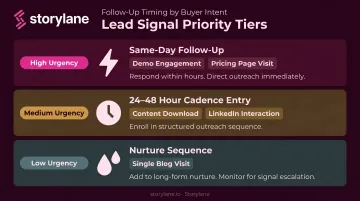
This tiering prevents reps from wasting time on low-intent accounts so no high-intent signal gets buried.
Storylane's Account Reveal feature addresses the specific problem of anonymous demo traffic. It de-anonymizes visitors engaging with interactive demos and surfaces enriched firmographic data (company, contact details, time spent, completion rate) with real-time Slack alerts.
A rep who knows someone from a target account spent 12 minutes on a demo that afternoon has a concrete starting point — one working a cold list does not.
How to Measure and Optimize Prospecting Performance
Measurement is where most teams have a gap. They track send volume or open rates, declare them insufficient, and work harder. Working harder on the wrong inputs isn't optimization.
The Three KPIs That Matter
- Positive reply rate — measures message relevance, not volume. A low rate is a messaging problem; sending more emails won't fix it.
- Meetings booked per channel — shows which tactics generate actual pipeline. If LinkedIn books 3x more meetings per touch than cold email, that's a resource allocation signal.
- Lead-to-opportunity conversion rate — reveals ICP accuracy. High meetings but low conversions usually indicates ICP drift: the net is too wide or has shifted from who actually buys.
A Funnel Diagnostic Framework
Each weak metric points to a specific problem:
- Low open rates: Subject line quality or deliverability issue
- High opens, low replies: Messaging relevance problem — the content isn't landing
- High replies, low meetings booked: Qualification or follow-up friction
- High meetings, low conversions: ICP is too broad or the wrong accounts are getting through
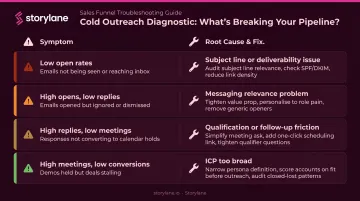
This framework prevents the "work harder" trap. Each symptom points to a specific fix.
Building an Optimization Cadence
- Weekly: Review active sequence performance (open rates, reply rates, booking rates)
- Monthly: Audit channel mix and ICP accuracy against new closed-won data
The key is that reps and managers review data together, not just RevOps pulling reports in isolation. Make frontline feedback a standing agenda item — what reps hear in conversations is signal that no dashboard captures, and it belongs in the same cadence as your quantitative review.
Frequently Asked Questions
What is prospecting in B2B sales?
B2B prospecting is the proactive, sales-driven process of identifying and engaging potential buyers who fit your ICP, with the goal of converting them into qualified opportunities. It's distinct from passive lead generation — prospecting is initiated by sales, not marketing.
What are the 5 P's of prospecting?
The 5 P's of prospecting are:
- Preparation: Research accounts before reaching out
- Personalization: Tailor messages to each specific prospect
- Persistence: Follow up consistently across multiple touches
- Prioritization: Focus on highest-fit accounts first
- Performance: Track KPIs to refine what's working
What are the 7 steps of B2B selling?
The 7 steps are: Prospecting, Research and preparation, Initial outreach, Qualifying, Presenting/demonstrating value, Handling objections, and Closing. Weak prospecting in step one creates misaligned pipeline that stalls at qualification and beyond.
What is the difference between B2B prospecting and lead generation?
Prospecting is a proactive, sales-led outbound activity targeting specific accounts by name. Lead generation is a marketing-led inbound effort attracting potential buyers through content and ads. Both feed the funnel, but from opposite ends.
How many touchpoints does it take to convert a B2B prospect?
RAIN Group's research found it takes an average of 8 touchpoints to get an initial meeting. Multi-channel sequences combining email, LinkedIn, and phone reach that threshold faster than single-channel attempts.