

The difference between high-performing sales teams and struggling ones often traces back to how they onboard. Not just whether they have a program, but how structured, role-specific, and reinforcement-focused it is.
This guide covers everything you need to build a sales onboarding program that actually moves the needle: the five core stages, a step-by-step build process, proven best practices, the 30-60-90 day framework, and how to measure whether it's working.
Key Takeaways
- Effective sales onboarding is a structured, multi-stage process spanning pre-onboarding through ongoing reinforcement.
- The 30-60-90 day framework gives reps clear milestones and managers a measurable coaching roadmap.
- Role-specific, active-learning approaches outperform generic training and shorten ramp time.
- Measure onboarding success with KPIs like time-to-first-deal and quota attainment, not just training completion.
What Is Sales Onboarding and Why It Matters
Sales onboarding is the structured process of equipping new reps with the product knowledge, messaging, sales methodology, and tool proficiency they need before they ever engage a live deal. It's not HR paperwork and a company overview. It's a performance program directly tied to revenue.
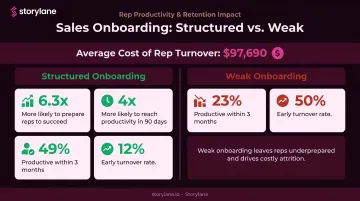
The business case is clear. RAIN Group research shows organizations with effective onboarding are 6.3x more likely to prepare new sales hires to succeed, and sellers are 4x more likely to reach productivity within 90 days — with 49% productive in under three months versus just 23% in companies with weak onboarding.
The impact extends well beyond the new hire:
- Managers spend less time correcting basics and more time coaching complex deals
- Enablement teams can advance skills instead of patching fundamentals
- Revenue operations gets more predictable pipeline contribution from day one
Without structured onboarding:
- Reps default to guesswork on positioning and messaging
- Customer-facing conversations are inconsistent across the team
- Managers absorb the coaching burden that onboarding should have handled
- Early attrition climbs, with RAIN Group data showing turnover drop from 50% to 12% as onboarding effectiveness improves
The Stages of a Sales Onboarding Process
Effective onboarding follows a logical progression. Programs that treat each stage as connected — not isolated — tend to produce reps who ramp faster and retain what they've learned.
Stage 1: Pre-Onboarding
Before day one, preparation signals professionalism and removes first-week friction. This includes:
- Setting up CRM, email, and tool access in advance
- Preparing a welcome pack: company overview, product primer, org chart, and team bios
- Defining measurable onboarding goals for the first 90 days
- Briefing the assigned manager and mentor so they're ready to engage on day one
A rep who arrives to a configured laptop, a clear schedule, and a mentor who already knows their background starts with momentum — not two days of chasing IT tickets.
Stage 2: Orientation
The first week should build belonging and context — not overwhelm. Key elements:
- Company mission, values, and culture walkthrough
- Team introductions and org chart orientation
- A structured mentor one-on-one to establish the relationship early
- Guided walkthrough of the tech stack (CRM, communication tools, demo software)
The goal isn't comprehensive knowledge. It's enough context to feel grounded and connected before training begins.
Stage 3: Sales Training and Product Mastery
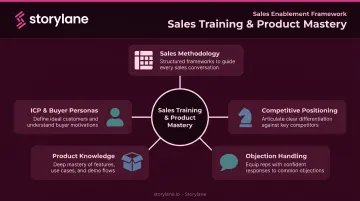
This is the core of onboarding and the stage most programs either rush or dilute. Structured sales training should cover:
- Sales methodology — whether your team runs MEDDIC, Challenger, or SPIN, reps need to internalize it from day one, not pick it up on the fly
- ICP and buyer persona deep-dives — who they're selling to, the pain points that trigger buying, and the language prospects actually use
- Competitive positioning — how to differentiate, not just describe
- Objection handling — practiced responses, not improvised ones
- Product knowledge — experienced as a buyer would, not read from a spec sheet
On product training specifically: interactive demo platforms give new reps a structured way to self-explore the product at their own pace. Storylane, for example, supports both a free-navigation sandbox mode (for organic product exploration) and structured guided tour flows that mirror the exact demo experience reps will deliver to prospects. New reps can explore the product environment freely, then follow guided paths that replicate live sales scenarios — building product fluency before any real call.
Stage 4: Shadowing, Role-Play, and Practice
Passive training alone doesn't build confidence. Reps need:
- Call shadowing — observing experienced sellers in real conversations
- Reverse shadowing — the rep leads, the mentor observes and debriefs
- Structured role-plays — realistic objections, buyer personas, time pressure
Deliberate practice with specific feedback accelerates skill development faster than any amount of slide-deck review.
Stage 5: Transition to Independent Selling
Reps gradually take ownership of live pipeline activity, but the support structure doesn't disappear. Reinforcement continues through:
- Regular manager check-ins tied to specific deals and calls
- Recorded call reviews with structured feedback
- Milestone checkpoints at 30, 60, and 90 days
- Ongoing coaching as reps encounter new objections and buyer types
What changes is the ratio of guidance to autonomy — not the presence of support altogether.
How to Build a Sales Onboarding Program: Step-by-Step
Build your program around these five steps — each one closes a gap that generic onboarding leaves open.
Step 1: Define Clear Goals, Milestones, and Timelines
Generic onboarding goals like "complete training by week three" don't drive performance. Set objectives tied to actual selling behaviors:
- Time-to-first-qualified-meeting
- Pitch score benchmarks from role-play evaluations
- Certification completion by specific dates
- Pipeline generated by day 60
A 60-90 day structured framework with weekly milestones keeps both reps and managers accountable to measurable outcomes, not just activity.
Step 2: Build a Role-Specific Curriculum
An SDR, a mid-market AE, and an enterprise seller don't face the same buyer interactions, deal types, or KPIs. A one-size-fits-all program leaves skill gaps that surface as lost deals.
Role-specific modules should address:
- The buyer personas each role engages
- The deal complexity and typical sales cycle
- The metrics each role is evaluated against
- The objections most common at their stage of the funnel
Step 3: Align Training to Your Sales Methodology
Onboarding must embed the company's sales methodology from the start — not reference it as background reading. Build methodology into:
- Training modules with worked examples
- Talk-track templates aligned to the framework
- Certification checkpoints that test application, not recall
When reps internalize methodology early, their first customer conversations reflect coached execution rather than improvised pitching.
Step 4: Create a Centralized Resource Library
A strong onboarding resource hub should include:
- Sales playbooks and talk tracks
- Competitor battle cards
- Call recordings (wins and losses, both)
- Product demo walkthroughs organized by persona and use case
- CRM workflow guides
- Customer persona profiles
Storylane's Demo Hub centralizes interactive demo assets organized by persona, use case, and competitive scenario, so new reps can self-navigate a structured demo library on demand. Customers like Goformz build hubs with dedicated sections for product overviews, competitive comparisons, and role-specific walkthroughs — giving new hires a well-organized sales enablement library from day one.
Resources need to stay current. An outdated battle card is worse than no battle card.
Step 5: Build in Feedback Loops from Day One
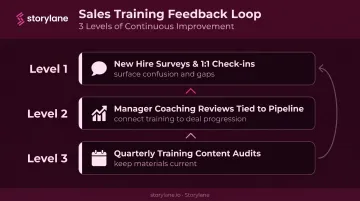
Without feedback, onboarding stagnates and gaps go undetected until they surface as lost deals. Three feedback levels matter:
- New hire surveys and 1:1 check-ins — what's confusing, what's missing, what's overwhelming
- **Manager coaching reviews tied to pipeline data** — connecting training activity to actual deal progression
- Quarterly training content audits — ensuring materials reflect current products, messaging, and market conditions
Sales Onboarding Best Practices to Accelerate Ramp Time
Prioritize Active Learning Over Passive Consumption
Research from Freeman et al. published in PNAS found students in traditional lecture courses were 1.5x more likely to fail than those in active-learning environments, with active learning producing a 0.47 standard deviation performance improvement. The mechanism translates directly to sales training.
Reps retain far more from:
- Role-plays with specific feedback
- Teach-backs (explaining a concept to a colleague)
- Live call reviews with structured debrief
- Scenario-based exercises with realistic buyer objections
Reading documents and watching recorded walkthroughs alone doesn't build selling capability. It builds familiarity, which isn't the same thing.
Avoid Information Overload with a Staggered Approach
Front-loading too much content in week one is one of the most common onboarding mistakes. When reps are overwhelmed, nothing consolidates.
Sequence topics logically:
- Company and culture before product
- Product before competitors
- Core methodology before advanced scenarios
- Tools before tasks that require them
Cognitive science research on distributed practice shows that spaced repetition — revisiting material over time — produces stronger retention than massed learning. Build in review touchpoints across weeks, not just at the beginning.
Make Sales Technology Fluency a Non-Negotiable
Reps can't sell efficiently without mastering the tools they'll use daily. CRM proficiency, sales engagement platforms, demo software — these aren't secondary skills.
Best approach:
- Give reps early, guided access before advancing to full permissions
- Build real tasks into training exercises (log a contact, build a sequence, create a demo)
- Set a tool-proficiency checkpoint before reps engage live prospects
For demo tools like Storylane, the sandbox mode lets new reps explore the product environment freely before they're responsible for delivering it to a buyer — a natural phased access approach built into the platform's design.
Build a Culture of Continuous Learning
Onboarding certifications are a starting line, not a finish line. "Everboarding" — ongoing skill reinforcement — is what keeps teams at quota rather than spiking and plateauing.
In practice, everboarding looks like:
- Regular coaching sessions tied to specific deals
- Microlearning refreshers when new features ship
- Peer deal reviews to surface what's working
- Updated playbooks that evolve alongside the market
Storylane supports this directly: when the product changes, demo content can be updated in minutes without rebuilding entire modules. Hubs surface new content to reps as targeted microlearning additions — no full re-onboarding required.
The 30-60-90 Day Sales Onboarding Plan
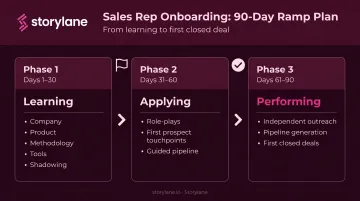
The 30-60-90 day framework gives both reps and managers a shared roadmap for what "good" looks like at each stage of ramp.
How Each Phase Works
| Phase | Focus | Key Activities |
|---|---|---|
| Day 1–30 | Learning | Company, product, methodology, tools, shadowing |
| Day 31–60 | Applying | Role-plays, first prospect touchpoints, guided pipeline activity |
| Day 61–90 | Performing | Independent outreach, pipeline generation, first closed deals |
Setting Meaningful Milestones
Milestones should be specific, role-appropriate, and tied to deal activity — not just training completion:
- Complete all certifications by day 21
- Book first qualified meeting by day 30
- Generate $X in pipeline by day 60
- Close first deal by day 90 (for AEs; SDRs would target qualified opportunities sourced)
According to RAIN Group research, organizations with effective onboarding make sellers 4x more likely to reach productivity in under three months. Tying each phase to concrete milestones is what turns that stat from aspiration into a repeatable outcome.
These milestones also give managers a consistent baseline — so coaching conversations start from data, not impressions.
Using It as a Coaching Tool
Managers should treat the 30-60-90 framework as a structured coaching cadence — not a performance review trigger. At each milestone:
- Review progress against metrics, not gut feel
- Recalibrate support based on where each rep's numbers are trending
- Surface skill gaps before they show up as missed quota — not after
Done well, the framework shifts managers from firefighting to coaching — catching issues at week four instead of month four.
Measuring and Improving Sales Onboarding Effectiveness
The KPIs That Matter
Move beyond "completed training" as a success metric. The KPIs that actually reflect onboarding quality are:
- Time to first meeting booked — how quickly reps generate real buyer engagement
- Time to first closed-won deal — the clearest indicator of full ramp
- Ramp-to-quota timeline — how long before a rep reaches consistent quota attainment
- Certification completion rate — a process metric, but useful for tracking program adherence
- 90-day retention rate — a signal of whether onboarding set reps up for sustainable success
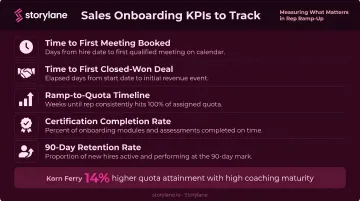
Korn Ferry research found that high coaching maturity correlates with 14% higher quota attainment, 15% higher win rates, and 18% lower voluntary turnover — reinforcing that onboarding and ongoing coaching are inseparable.
Connecting Training Activity to Pipeline Data
Training completion metrics capture activity. Pipeline data reveals whether any of it translated into performance. Connect the two by tracking:
- Whether reps who scored well in role-play evaluations convert first meetings at higher rates
- How call review participation correlates with early-stage deal progression
- Whether certification timing predicts time-to-first-deal
Tools like Storylane make this connection more concrete. Its demo analytics surface engagement signals on reps' demos — time spent, completion rate, return visits, intent scores — that managers can map directly to pipeline contribution. When a rep's demo starts pulling consistent engagement, that's a measurable indicator of readiness, not just a gut call.
Building a Review Cadence
Every onboarding cohort should make the next one better:
- Post-onboarding rep survey — what worked, what was missing, what was overwhelming
- Cohort performance analysis — comparing ramp metrics across cohorts to identify program improvements
- Quarterly content audit — ensuring training materials reflect current products, messaging, and competitive positioning
Frequently Asked Questions
What are the stages of the sales onboarding process?
The five core stages are: pre-onboarding preparation, orientation, training and product mastery, shadowing and practice, and transition to independent selling. The best programs treat these as a connected progression — each stage builds directly on the last, not a checklist to rush through.
What are the 5 C's of sales onboarding?
The 5 C's are Compliance (legal and policy basics), Clarification (role expectations and goals), Culture (company values and team norms), Connection (relationships with colleagues and managers), and Check-back (ongoing feedback and reinforcement). Together, they cover both the procedural and relational sides of joining a new team.
What is the 30-60-90 day rule in sales onboarding?
The 30-60-90 day plan is a phased milestone framework: the first 30 days focus on learning, days 31-60 on applying knowledge through guided practice, and days 61-90 on performing independently. It gives both reps and managers a shared roadmap with clear, measurable expectations at each phase.
How long should a sales onboarding program last?
Most programs run 60-90 days for structured onboarding, with reinforcement continuing well beyond. Ramp time varies by role — enterprise AEs typically need longer than SDRs — and onboarding works best when it blends into continuous development rather than ending on a fixed date.
How do you measure the success of a sales onboarding program?
Key metrics include time-to-first-deal, ramp-to-quota timeline, 90-day retention rate, certification completion rate, and early-stage pipeline generation. Revenue contribution speed matters more than module completion rates — that's the true measure of a program's impact.