Introduction
Most sales reps have experienced it: a deal sitting in the pipeline for three weeks with no clear sense of what should happen next or why it hasn't moved. The culprit is rarely a bad product or a disinterested prospect. Poorly defined deal stages are usually to blame — stages that exist in name only, with no real criteria governing movement.
According to CSO Insights, nearly 48% of organizations had random or informal alignment between their internal selling process and the customer's actual buying journey. Organizations with a formal, chartered approach achieved a 55.1% win rate versus just 43.3% for informal approaches. That 12-point gap traces directly back to process discipline.
This guide covers what deal stages are, how to structure them with clear entry and exit criteria, why they matter beyond simple pipeline visualization, and the mistakes that cause even well-intentioned teams to stall out.
Key Takeaways
- Deal stages track buyer progress, not seller activity — each stage should represent a verified buyer action
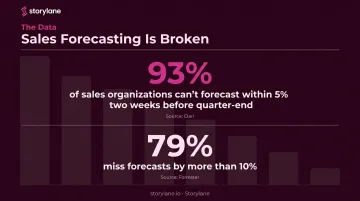
- Weak stage definitions corrupt forecasts — 93% of sales teams can't predict revenue within 5% even two weeks before quarter-end
- Entry and exit criteria separate a working pipeline from a vanity dashboard
- 6–8 stages is the practical target for most B2B teams; more creates admin burden without adding visibility
- Lost-reason tracking is the most underused data source in most sales organizations
What Are Deal Stages in a Sales Pipeline?
Deal stages are the discrete milestones that mark a prospect's progress from first contact to a final decision. The key distinction: each stage should represent a buyer action or a seller-verified milestone — not just the passage of time.
This is where many teams go wrong. They treat stages as timestamps ("we talked to them two weeks ago") rather than evidence checkpoints ("they've confirmed a business problem and identified a budget owner").
Pipeline vs. Deal Stages
These two terms get conflated constantly — here's why the difference matters.
- Sales pipeline — the overall visual structure showing where all active deals currently sit
- Deal stages — the individual steps within that pipeline that define how a deal progresses
Confusing the two leads to messy forecasting because reps start treating the pipeline as a general status board rather than a structured progression with defined criteria.
The Forecasting Connection
Deal stages are tied to probability percentages in most CRMs. Multiply those probabilities by deal values across all open opportunities and you get a weighted revenue forecast. A typical setup looks like this:
| Stage | Probability |
|---|---|
| Discovery | 25% |
| Demo Completed | 40% |
| Proposal Sent | 60% |
| Negotiation | 80% |
That math only works if stages mean the same thing across every rep on the team. If one rep marks "Proposal Sent" the moment they draft a quote internally, and another only marks it after the prospect has reviewed the document, those 60% probabilities represent entirely different situations. Your forecast is fiction.
The Core Deal Stages (and What Happens at Each One)
Stage names vary by company and CRM. What doesn't vary is the underlying logic. Every B2B pipeline follows a consistent arc from initial contact to final decision — the purpose of each phase is what actually matters.
Prospecting and Qualification
Prospecting is the top of the funnel — leads identified through outbound outreach, inbound channels, or referrals. The rep's job here isn't to sell. It's to determine whether there's a reason to engage further.
Qualification is where a lead gets assessed against a structured framework. The two most widely used:
| Framework | What It Covers |
|---|---|
| BANT | Budget, Authority, Need, Timeline |
| MEDDIC | Metrics, Economic Buyer, Decision Criteria, Decision Process, Identify Pain, Champion |
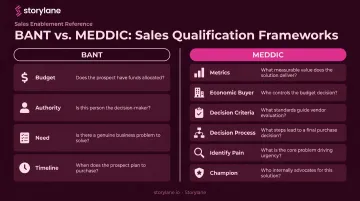
The goal is straightforward: does this prospect have the budget, decision authority, genuine need, and timeline to justify serious sales investment? Better to find out now than three meetings in.
Discovery and Demo
Discovery is a structured conversation — not a casual call — where the rep uncovers specific pain points, how the prospect measures success, and how their internal buying process works. Deals that skip this stage frequently stall later because the proposal doesn't map to what the buyer actually cares about. You end up with a technically impressive pitch that answers questions no one asked.
Demo/Presentation is where the product is shown in the context of the prospect's specific use case, not as a generic walkthrough.
One persistent challenge: keeping buyers engaged between the live demo and the next touch. That gap — often days or even weeks — is where momentum stalls and deals go cold.
Storylane's interactive demo formats address this directly. Reps can send a self-guided demo that prospects explore at their own pace, with personalized walkthroughs that include the prospect's company name, logo, and relevant use case data already embedded. Engagement analytics then show exactly which features the prospect spent time on, giving the next conversation a precise starting point rather than a cold restart.
Proposal, Negotiation, and Close
Proposal Sent and Negotiation are best understood together. The proposal formalizes the commercial offer (scope, pricing, terms). Negotiation is the back-and-forth on adjustments.
Deals that stall at this stage almost always have the same root cause: stakeholder buy-in that should have been secured during Discovery wasn't. You're negotiating with someone who can't actually say yes.
Closed Won and Closed Lost are non-negotiable terminal stages. Every pipeline needs them, and they should never be optional. Logging lost reasons is just as important as celebrating wins because that data reveals whether the problem is product fit, pricing, timing, or a competitor, and drives improvements across sales, product, and positioning.
Why Deal Stages Matter Beyond the Pipeline
Forecasting Accuracy
Each deal stage carries a probability weight. Multiply that weight by deal value across all open deals and you get a weighted forecast. The problem is how rarely that forecast is reliable.
Clari reported that 93% of sales organizations couldn't forecast revenue within 5%, even two weeks before quarter-end. Forrester cited research showing 79% miss forecasts by more than 10%. The common thread in both cases: stages that don't reflect actual buyer progress give probability weights that are essentially guesses.
Rep Prioritization
Left without visible stages, reps default to working on deals they like — the friendly prospect, the familiar industry, the account with the good vibes. Deal stages surface which opportunities are most advanced and which have gone dormant longest, making prioritization explicit rather than intuitive.
Stage visibility helps reps act on what the data shows, not what feels comfortable:
- Identifies deals stalled longest without next steps
- Flags advanced-stage opportunities at risk of going cold
- Surfaces which accounts need immediate follow-up to hit quarter targets
Coaching and Accountability
Managers can use stage data to distinguish systemic bottlenecks from individual rep issues. If every deal on the team stalls at "Proposal Sent," that's a positioning or process problem. If only one rep's deals stall there, that's a coaching conversation. Without stage data, both situations look identical — and managers end up applying the wrong fix to both.
How to Define Entry and Exit Criteria for Each Stage
What Entry and Exit Criteria Are
- Entry criteria: what what must be true before a deal can enter a stage
- Exit criteria: what what must happen before a deal can advance to the next one
Most teams skip this entirely. The result: deals get moved forward prematurely because a rep feels optimistic, or left to stagnate because no one defined what "done" looks like for that stage.
What Criteria Look Like in Practice
| Stage | Entry Criteria | Exit Criteria |
|---|---|---|
| Proposal Sent | Formal quote prepared; decision-maker identified | Prospect confirms receipt and review |
| Negotiation | Decision-maker responds with specific feedback on proposal | Revised terms agreed or timeline confirmed |
| Closed Won | Contract signed by authorized signatory | Payment or implementation initiated |
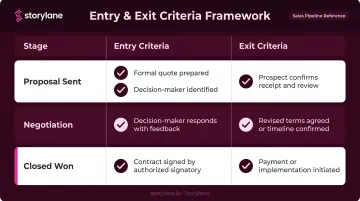
The difference between a functional pipeline and a decoration is specificity. "They seem interested" is not an exit criterion.
Buyer-Verified vs. Seller-Assumed Criteria
This distinction separates strong pipelines from weak ones.
- Seller-assumed: "I think the demo went well" / "They haven't said no"
- Buyer-verified: "They replied requesting a proposal" / "The economic buyer attended the last call" / "They've shared their decision timeline"
The strongest pipelines only advance deals when the buyer has taken a concrete action — replied to an email, attended a meeting, requested a document, or engaged meaningfully with shared content.
Storylane's engagement analytics feed directly into this framework. When a prospect spends significant time on specific demo steps or revisits particular features, that's an objective buyer signal — not a seller assumption. Reps can point to specific engagement data rather than gut feel when advancing a deal.
Making Criteria Operational
Stage definitions should live inside the CRM as helper text or required fields — not in a slide deck that no one reads after onboarding. When criteria are embedded in the tool reps use every day, adoption improves without extra coaching.
Consistent application across the team is non-negotiable for data integrity. If one rep advances deals loosely and another applies criteria strictly, the same stage label ends up representing different realities.
The result: pipeline reports lose their meaning, and forecasting becomes unreliable — not because the data is missing, but because it's inconsistent.
Best Practices for Managing Deal Stages Effectively
Keep the Pipeline Lean
Most B2B sales teams function well with 6–8 stages. More than that creates administrative burden without improving visibility. The test for any stage: does it represent a meaningful shift in the buyer's commitment, or is it just tracking an internal seller activity? If it's the latter, cut it.
Define Clear, Action-Oriented Stage Names
Stage names should describe a completed action, not a vague status.
- ❌ "In Progress" / "Considering" / "Active"
- ✅ "Discovery Call Completed" / "Proposal Sent" / "Contract Under Review"
Action-oriented names eliminate ambiguity. Either the action happened or it didn't.
Use CRM Automation to Trigger the Right Actions
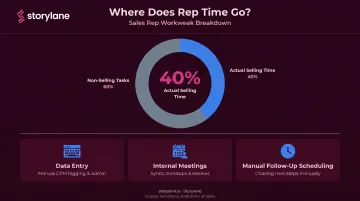
CRM automation can be configured to create follow-up tasks, notify managers, or trigger outreach sequences when a deal enters a new stage. Salesforce's 2026 State of Sales report found reps spend 60% of their average workweek on non-selling tasks. Stage-triggered reminders remove the cognitive load of tracking next steps and ensure no deal sits idle between touches.
Tools like Storylane take this further by pushing demo engagement data directly into Salesforce and HubSpot records, so workflows fire based on actual prospect behavior, not just rep-logged activity.
Conduct Regular Pipeline Reviews
Deal stages only reflect reality if someone is checking. A weekly pipeline review cadence — where deals that haven't advanced in a defined number of days are flagged, reassigned, or closed — keeps the data clean. Stale deals distort forecasts and consume manager attention that should go to active opportunities.
Align Deal Stages with Marketing Content
Every stage corresponds to a different buyer mindset:
- Early stages — educational content that builds awareness and frames the problem
- Mid-stages — competitive comparisons, ROI calculators, use case examples
- Late stages — case studies, implementation guides, security documentation
Sales and marketing should agree on what content supports each stage before deals start moving through the pipeline, not after reps start improvising.
Common Deal Stage Mistakes (and How to Fix Them)
The "Too Many Stages" Trap
Teams add stages for every internal activity — "Internal Review," "Manager Approval," "Legal Check" — until the pipeline looks more like a project management board than a sales tool. Audit stages quarterly and remove any that don't represent a verified buyer commitment. Internal activities belong in tasks, not stages.
No Lost-Reason Tracking
Closing deals as "lost" without logging why is the most expensive data gap in most sales organizations. A useful lost-reason taxonomy includes:
- No compelling pain or confirmed business outcome
- No economic buyer or unfunded interest
- Decision criteria mismatch (product fit issue)
- Decision process or timing blockage
- Weak champion with insufficient internal influence
- Competitor selected
- No decision / status quo maintained
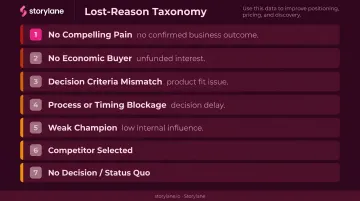
This data drives improvements in product positioning, pricing strategy, and discovery process. Without it, the team keeps losing the same way for the same reasons.
The "Set It and Forget It" Pipeline
That pattern of repeated losses points to a deeper structural issue: pipelines built for one stage of growth rarely survive the next. Deal stages that worked at five reps and 50 deals per month won't hold at 50 reps and 500. Sales cycles evolve, buyer behavior shifts, and products change. Review pipeline definitions at least annually — especially after a significant team or product change — to confirm they still reflect how deals actually progress.
Frequently Asked Questions
What are the stages of a deal?
The core stages in sequence are: Prospecting, Qualification, Discovery, Demo/Presentation, Proposal Sent, Negotiation, and Closed Won/Lost. Exact names vary by company and CRM, but the underlying buyer journey logic — moving from initial contact through evaluation to a final decision — remains consistent.
How many deal stages should a sales pipeline have?
Six to eight stages is the practical target for most B2B sales teams. Too few stages reduce visibility into where deals are in the buying process; too many create administrative overhead that slows reps down and clutters the pipeline with noise.
What is the difference between a deal stage and a sales funnel stage?
A sales funnel is a marketing concept describing awareness-to-purchase behavior at a population level — how many prospects enter, how many convert. Deal stages are CRM milestones for tracking individual active opportunities through a defined sales process, used by reps and managers to move specific deals forward.
How do you move a deal from one stage to the next?
Deal advancement should be triggered by a defined buyer action or verified milestone — a proposal explicitly requested, a decision-maker confirmed, a meeting attended. Elapsed time and rep optimism are not valid triggers — the buyer needs to take a concrete, observable action to justify the move.
How do deal stages help with sales forecasting?
Each stage carries an assigned probability percentage. Multiplying that probability by deal value across all open opportunities produces a weighted revenue forecast. This gives sales leaders a data-based view of expected revenue for a given period, provided the stages themselves reflect actual buyer progress rather than rep assumptions.
What should you do when a deal gets stuck in a pipeline stage?
First, diagnose whether the stall is on the buyer side (budget freeze, internal approvals, competing priorities) or the seller side (unclear next step, wrong contact, weak champion). Then re-engage with something specific — a tailored demo addressing their specific use case, a case study from a comparable company, or a direct question that requires a yes or no. If there's no movement after a defined follow-up window, mark the deal inactive and clean the pipeline.