A sales enablement framework fixes this. Not by adding more tools or training sessions, but by creating a repeatable operating blueprint that connects content, training, technology, and measurement around a single goal: helping reps have better conversations and close more deals.
This guide covers what a sales enablement framework actually is, the five pillars that form its backbone, a four-step build process, and how to measure whether it's working.
Key Takeaways
- Organizations with formal enablement programs see up to 9 percentage points higher win rates than those without
- Five pillars form the core: strategy, content, learning, technology, and measurement
- 60% of rep time goes to non-selling tasks — a framework directly reclaims that capacity
- Interactive, self-serve buyer content is now a requirement, not a nice-to-have
- Measurement must cover both leading indicators (content usage, ramp time) and lagging ones (win rates, quota attainment)
What Is a Sales Enablement Framework?
A sales enablement framework is a structured operating model that aligns content, training, technology, and measurement to systematically equip sales teams to engage buyers and close deals. That structure is the point. It's what separates a repeatable system from the scattered, reactive approach most teams default to.
Gartner defines sales enablement as "the process of providing the sales organization with the information, content and tools that help sellers sell more effectively." A framework is how you operationalize that definition at scale.
Why It Actually Matters
The performance gap between structured and ad hoc enablement is measurable. According to Sales Enablement PRO's 2023 State of Sales Enablement Report:
- Organizations with dedicated enablement efforts had a 9 percentage point higher average win rate
- Those with a formal enablement charter saw 5 percentage point higher win rates
- Organizations using a dedicated methodology were 2x more likely to increase both win rates and quota attainment
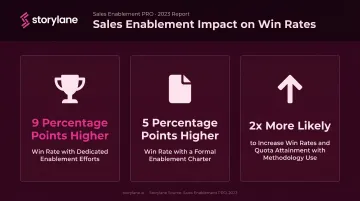
These aren't marginal differences. Over a full sales year, a 9-point win rate improvement compounds significantly across pipeline.
What a Framework Is Not
A common mistake: treating enablement as a tool purchase or a one-time training event. A sales enablement framework is neither.
- Technology is an input, not the framework itself — platforms support execution, but can't substitute for strategy
- It's ongoing, not a launch — the system should evolve as your buyers' expectations and market conditions shift
- Ownership is shared — sales, marketing, and RevOps each have a role; siloed execution undermines the whole model
When these functions operate from a shared playbook, enablement stops being a support function and starts driving measurable pipeline outcomes.
The Five Pillars of a Sales Enablement Framework
Every effective sales enablement framework rests on five pillars. Together, they ensure reps have what they need at every stage of the buyer journey, from onboarding through every deal stage.
Pillar 1: Strategy and Planning
A framework without a defined strategy is just activity. This pillar covers:
- Choosing a sales methodology (MEDDIC, Challenger, SPIN, etc.) that fits your sales motion and customer complexity
- Setting measurable KPIs tied to business objectives — not vague goals like "improve rep performance," but specific targets like "reduce ramp time by 6 weeks" or "increase win rate from 22% to 28%"
- Establishing cross-functional buy-in between sales, marketing, and RevOps — without this, even a well-designed framework stalls at execution
Teams that skip this step build reactive enablement, responding to symptoms like low win rates and long ramp times instead of addressing root causes. Proactive planning is what separates a framework from a fire drill.
Pillar 2: Sales Content and Buyer-Facing Assets
Content is what reps use in front of buyers every day. This pillar covers two categories:
Internal-facing content:
- Playbooks and call scripts
- Battlecards and competitive intel
- Objection-handling guides
- Talk tracks by persona and deal stage
Buyer-facing content:
- Case studies and ROI calculators
- Product one-pagers and comparison guides
- Interactive demos mapped to specific use cases
The critical principle: content must be mapped to specific buyer stages and personas. Content created in bulk and dumped into a shared drive creates noise, not momentum.
This is where tools like Storylane become directly relevant. Rather than relying on static PDFs or recorded videos, sales teams can build personalized interactive demos that buyers explore before a sales call, arriving already informed about the product.
Storylane customers like PDQ use this approach to ensure prospects aren't starting from scratch during live demos. It compresses discovery time and shifts conversations toward higher-value discussion.
Pillar 3: Learning and Development
One-size-fits-all training fails. ATD research cites the Ebbinghaus Forgetting Curve: 72% of learning is forgotten within two days without reinforcement.
Effective L&D in a sales enablement framework includes:
- Structured onboarding with milestone-based progression (not just a 2-week product dump)
- Continuous skills training tied to what reps actually struggle with in the field
- Personalized coaching cadences from managers — Sales Enablement PRO found effective coaching correlates with 14 percentage point higher win rates
- Role-plays and live practice before reps encounter real buying situations
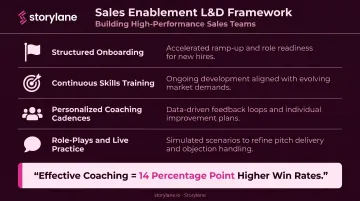
Initial capability building only matters if skills hold up six months later. Preventing skill decay is the real objective.
Pillar 4: Technology and Tools
The tech stack exists to reduce the time reps spend on non-selling activities. Salesforce's 2026 State of Sales report found reps spend 60% of their time on non-selling tasks, and sellers who feel overwhelmed by tool volume are 45% less likely to attain quota.
Core technology categories in a sales enablement stack:
| Category | Purpose |
|---|---|
| CRM | Single source of truth for pipeline and buyer data |
| Sales enablement / content platform | Centralized hub for all sales resources |
| Conversation intelligence | Visibility into rep performance in real deals |
| Learning management system (LMS) | Structured training delivery and tracking |
| Interactive demo tools | Buyer-facing product experiences at every deal stage |
The goal isn't more tools. It's fewer, better-integrated ones that actually work together.
Pillar 5: Measurement and Optimization
This is the feedback loop that keeps the framework relevant. Without measurement, you can't distinguish what's working from what's just familiar.
Track two categories:
- Leading indicators: content usage rates, training completion, rep readiness scores, time to first deal
- Lagging indicators: win rates, quota attainment, sales cycle length, average contract value
Leading indicators tell you what's likely to happen. Lagging indicators confirm whether it did. Most teams measure only lagging metrics. By the time those numbers surface, months of pipeline have already been affected.
How to Build a Sales Enablement Framework in 4 Steps
Step 1: Research, Align, and Set Goals
Before building anything, understand what you're working with. This means:
- Audit rep skills and existing resources — identify gaps, and check whether current content is actually being used.
- Define ideal customer profiles and buyer personas — your framework is only as good as your understanding of who it serves.
- Get explicit commitment from sales leadership, marketing, and RevOps before any resources are built.
- Set specific, measurable goals tied to revenue outcomes — for example, reducing ramp time from 5.3 months to 3.5 months, or lifting win rate from 24% to 30%.
Goals disconnected from revenue outcomes won't hold executive attention past the first quarter review.
Step 2: Build the Framework Components
With goals defined, build the actual components — prioritizing depth over volume:
- Choose a sales methodology that fits your deal complexity and buyer profile.
- Develop or audit content mapped to specific buyer stages — not a generic catch-all library.
- Design a structured onboarding program with clear milestones and skill checkpoints.
- Build training paths tailored to different rep roles and tenure levels.
- Establish regular coaching cadences between managers and individual reps.
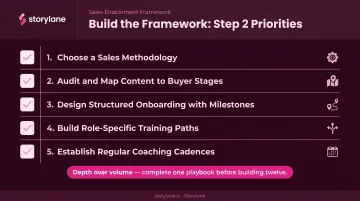
Resist the temptation to build everything at once. A focused, complete playbook for one deal stage is more valuable than 12 half-finished ones.
Step 3: Deploy and Enable Teams
Deployment is where frameworks succeed or fail. Common mistakes: emailing reps a folder of resources and calling it "rollout."
Effective deployment includes:
- Give reps one centralized hub to find everything — not five scattered folders.
- Connect learning to live selling — coaching lands better in the context of real deals than classroom settings.
- Use conversation intelligence to observe actual rep behavior and surface what's working.
- Help reps make decisions based on buyer signals and pipeline data, not gut feel.
Step 4: Measure, Collect Feedback, and Iterate
A framework is never "done." Build continuous improvement into the operating model from day one:
- Track KPIs on a regular cadence (monthly for leading indicators, quarterly for lagging)
- Run structured win/loss reviews to understand what's actually influencing deal outcomes
- Collect rep feedback through surveys and deal debriefs — ground-level insights often surface problems before the metrics do
- Identify which programs moved metrics and which didn't — and reallocate investment accordingly
Sales Enablement Content: The Fuel That Powers the Framework
Content is the most visible output of any sales enablement framework. It's what reps use in front of buyers every day, which means poor or misaligned content directly kills deals — regardless of how well the other pillars are built.
Internal vs. Buyer-Facing Content
Internal-facing (rep-use):
- Playbooks and objection-handling guides
- Battlecards with competitive positioning
- Discovery call frameworks
- Deal stage-specific talk tracks
Buyer-facing (prospect-use):
- Case studies with specific customer outcomes
- ROI calculators and business case templates
- Product one-pagers and comparison guides
- Interactive demos tailored to persona and use case
The rule: every content asset should be mapped to a specific buyer stage and persona. If you can't answer "who uses this and when in the deal?" the asset probably won't be used at all.
The Shift Toward Interactive Content
According to Gartner research, 67% of B2B buyers prefer a rep-free buying experience. Static PDFs and recorded videos don't serve this preference.
Modern B2B buyers want to explore products on their own terms before engaging a rep. Storylane lets sales teams build personalized interactive demos that buyers explore self-serve, arriving at live calls already familiar with the product. This shifts conversations from basic orientation to high-value discovery.
Customers like Campminder and Whispli send pre-call demos via calendar invites. Their sales teams report skipping basic discovery entirely and going straight into high-intent conversations.
The Content Governance Problem
Content only creates value if it's current, findable, and actually used. Forrester's research noted that as much as 60–70% of B2B marketing content goes unused — sitting in portals and shared drives where reps can't find it or don't trust it.
The fix is governance infrastructure:
- A centralized hub or content management system where all assets live
- Clear version control so reps always access current materials
- Content tagging by deal stage, persona, and product area
Storylane's Buyer Hub feature addresses part of this — consolidating all interactive demos into a single, organized location that prospects and reps can navigate by use case, persona, or deal stage.
How to Measure the Success of Your Sales Enablement Framework
Leading vs. Lagging Indicators
Measurement only works when you track both types:
Leading indicators (predict future performance):
- Content usage rates and search time
- Training completion and certification coverage
- Onboarding ramp time to first deal
- Rep readiness scores
Lagging indicators (confirm past performance):
- Quota attainment and win rates
- Deal velocity and average contract value
- Rep retention rates
The connection between these two sets matters. Sales Enablement PRO found organizations tracking time to quota were 60% more likely to report decreased ramp time — and saw 6 percentage point higher quota attainment. In other words, the act of tracking leading indicators creates accountability that pulls outcomes in the right direction.
A Practical Measurement Framework
Organize KPIs into three buckets when presenting to leadership:
| Category | Example Metrics |
|---|---|
| Readiness | Ramp time, certification completion, coaching frequency |
| Engagement | Content usage, demo sends, training completion |
| Revenue Impact | Win rate, quota attainment, deal velocity |
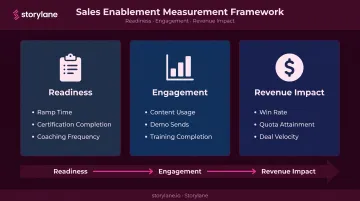
This structure makes it easy to connect enablement investment to business outcomes — which is what earns and sustains executive buy-in.
Build In Qualitative Feedback Loops
The table above tells you what's happening across the funnel. Rep feedback tells you why — and that distinction is where most teams find their highest-leverage improvements. Build regular channels for capturing ground-level insight:
- Quarterly rep surveys on content quality and usefulness
- Deal debrief conversations after wins and losses
- Manager interviews to surface coaching friction
- Win/loss reviews with buyers when possible
When reps flag that a specific piece of content isn't landing, or managers identify a recurring objection slipping through, you have actionable direction for your next framework iteration — not just a dashboard that confirms something went wrong.
Frequently Asked Questions
What is a sales enablement framework?
A sales enablement framework is a structured operating model that aligns content, training, technology, and measurement to systematically improve rep effectiveness and revenue outcomes. Unlike ad hoc enablement — where resources are built reactively and inconsistently — a framework creates a repeatable system that scales with the sales organization.
What are the pillars of sales enablement?
The five core pillars are: strategy and planning, sales content and buyer-facing assets, learning and development, technology and tools, and measurement and optimization. These pillars function as an integrated system — weaknesses in one directly undermine the performance of the others.
What is the difference between sales enablement and revenue enablement?
Sales enablement traditionally focuses on equipping sales reps with the resources they need to sell. Revenue enablement expands that scope to include marketing, customer success, and all customer-facing roles — a model many organizations are adopting as go-to-market teams become more cross-functional.
Who owns the sales enablement framework in an organization?
Ownership typically sits with a dedicated sales enablement leader or RevOps function, though this varies by company size. What matters more than formal ownership is cross-functional sponsorship. Without genuine buy-in from sales, marketing, and executive leadership, even a well-designed framework won't be consistently executed.
How do you measure the effectiveness of a sales enablement framework?
Track both leading indicators (training completion, content usage, ramp time) and lagging indicators (win rates, quota attainment, deal velocity). Linking these two categories is how you demonstrate ROI and show leadership that enablement inputs are driving real business outcomes.
How often should a sales enablement framework be updated?
Review it at minimum quarterly, and update it whenever there are significant changes in product, market conditions, sales methodology, or buyer behavior. A framework that goes stale becomes an obstacle. Reps stop trusting resources that feel outdated, and adoption erodes quickly from there.