Introduction
Marketing generates leads. Sales is supposed to work them. But somewhere between "marketing-qualified" and "sales-qualified," leads vanish — either abandoned because reps don't consider them worth pursuing, or left to go cold while no one takes ownership.
This gap costs B2B organizations more than they realize. Sales-marketing misalignment costs businesses over $1 trillion annually, according to HBR, and only 30% of sales professionals say their teams are closely aligned with marketing.
The Sales Accepted Lead (SAL) stage exists to close that gap. Here's what that means in practice — what an SAL is, how it differs from MQLs and SQLs, the criteria sales teams use to accept or reject leads, and how to generate more of them.
Key Takeaways
- An SAL is an MQL that sales has formally reviewed and accepted as meeting agreed-upon criteria, distinct from a lead that simply landed in a rep's queue
- The SAL stage requires a documented SLA between marketing and sales defining acceptance criteria and follow-up obligations
- Target a 90%+ SAL acceptance rate; lower rates signal a definitional misalignment between teams
- Best practice is to follow up within 24 hours of acceptance — maximum 72 business hours
- Demo engagement data (completion rates, features explored, time spent) is one of the strongest pre-conversation signals of SAL-level readiness
What Is a Sales Accepted Lead (SAL)?
The Formal Definition
A Sales Accepted Lead is a marketing-qualified lead that has been reviewed and officially accepted by the sales team as meeting agreed-upon criteria for sales-readiness. Acceptance means a rep has looked at the lead record, confirmed it meets the terms of a shared SLA, and committed to following up. It is eligible for direct sales engagement from that point forward.
SiriusDecisions/Forrester defines the SAL as "a formal process for acceptance of leads by inside, field or channel sales," with sales verifying the lead meets "target market, activity or lead level thresholds."
Where SAL Fits in the Lead Lifecycle
The full progression looks like this:
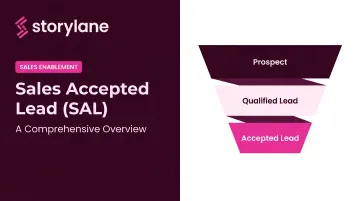
MQL → SAL → SQL → Opportunity → Customer
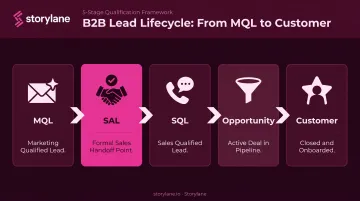
Skipping the SAL stage is common, and the cost is real. Without it, there's no formal moment where sales commits to working a lead. Leads get passed informally, ignored quietly, or worked inconsistently — and neither team can be held accountable because no one ever explicitly accepted responsibility.
Rejection vs. Disqualification — A Critical Distinction
That accountability gap is exactly why rejection and disqualification need to stay separate. Conflating them distorts your pipeline data:
- Rejection happens before contact — the rep reviews the record and determines it fails on procedural, clerical, or definitional grounds (wrong territory, incomplete data, outside ICP)
- Disqualification happens after contact — the rep reaches the prospect and learns there is no budget, need, or timeline fit
Treating disqualification as rejection masks real lead quality problems. If reps are rejecting leads post-conversation, something is wrong with how reps are logging those rejections.
Calculating Your SAL Rate
SAL Rate = (Number of SALs ÷ Total Leads) × 100
What it tells you is how efficiently your marketing-to-sales pipeline converts leads into sales-accepted prospects. According to Forrester, organizations should target SAL acceptance rates of 90% or higher. Rates below that threshold point to a misalignment between what marketing considers qualified and what sales will actually work.
MQL vs. SAL vs. SQL: Understanding the Lead Lifecycle
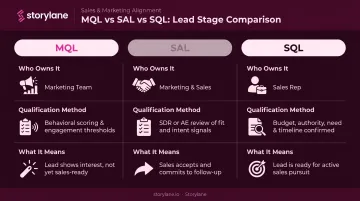
MQL, SAL, and SQL aren't just labels — they define ownership, accountability, and readiness at each step of the funnel. Knowing where a lead sits tells you who's responsible, what's been verified, and what needs to happen next.
| Stage | Who Owns It | Qualification Method | What It Means |
|---|---|---|---|
| MQL | Marketing | Behavioral scoring (emails, page visits, downloads) | Lead shows enough engagement to be worth passing to sales |
| SAL | Shared handoff | ICP + criteria review against SLA | Sales has formally accepted the lead as worth pursuing |
| SQL | Sales | Direct outreach (BANT, MEDDIC, MEDDPICC) | Confirmed budget, authority, need, and timeline through conversation |
Why Each Transition Matters
MQL → SAL forces a fit check before rep time is spent. Behavioral signals show engagement, but they don't confirm whether the person is in the right company, role, or buying stage. The SAL gate closes that gap.
SAL → SQL confirms intent through direct conversation. Acceptance means the lead is worth contacting — qualification determines whether there's an actual deal to pursue.
The Two Failure Modes SAL Prevents
Without a formal SAL stage, two problems emerge consistently:
- Sales wastes time on unfit leads. Reps chase MQLs inconsistently, burning time on leads that fail even a basic ICP check.
- High-intent leads go cold. Without a committed follow-up obligation, warm prospects sit in queues while reps prioritize their own pipeline over marketing-sourced leads.
The SAL stage addresses both by creating a formal acceptance moment and an SLA-backed follow-up requirement.
How to Qualify a Sales Accepted Lead: Key Criteria
Not every MQL earns SAL status. Acceptance criteria should be defined and documented — agreed between marketing and sales before any lead changes hands.
ICP and Firmographic Fit
The lead's company size, industry, geography, and job title must align with your ideal customer profile. Forrester notes that a well-defined ICP aligns teams, sharpens focus, and drives targeted growth across the B2B customer lifecycle. Leads outside the ICP should be rejected cleanly — not nurtured into sales conversations where they'll waste rep time.
Lead Data Completeness
An SAL requires a complete, verifiable record: name, email, company, and role at minimum. Missing or inaccurate data is a legitimate procedural reason to reject the lead and route it back to marketing for correction before any outreach occurs.
Lead Scoring Threshold
Behavioral signals accumulate into a lead score, and only leads exceeding a predefined threshold should advance to SAL. Common signals include:
- Pricing page visits
- Case study or whitepaper downloads
- Webinar attendance
- Demo engagement or interactive demo completion
Many teams now use AI-powered predictive scoring to weight these signals automatically, prioritizing leads most likely to convert rather than relying on manually assigned point values.
Buying Signals and Decision-Maker Authority
Strong SAL candidates show specific intent indicators: explicit questions about integrations, pricing, or timelines. They also hold some level of decision-making authority or influence within the buying group. Forrester notes that B2B buying groups typically include three or more people, often five or more — so evaluate the lead in the context of a buying group, not in isolation.
Product Engagement as a High-Intent Qualifier
Prospects who have explored an interactive product demo have self-selected into a deeper level of interest. Time spent inside the actual product is one of the clearest pre-conversation signals available.
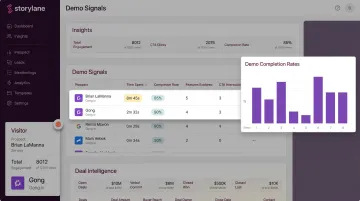
Storylane's Demo Signals feature tracks exactly this: time spent, completion rates, features explored, and whether a CTA was clicked. That data flows directly to sales via Slack alerts and CRM sync (HubSpot, Salesforce), so reps arrive at the first conversation already knowing what the prospect engaged with.
A prospect who completed 80% of a demo and clicked a pricing CTA is a fundamentally stronger SAL candidate than one who opened an email — and that distinction is visible before the first call.
The SAL Process: Acceptance, Rejection, and Follow-Up
The Formal Acceptance Step
When an MQL meets SAL criteria, it routes to the sales team — typically an SDR or BDR — for review. The rep checks the lead record against the SLA criteria and formally accepts or rejects it. This review should take a few minutes and must happen before any outreach attempt.
Acceptance is a commitment. It means the rep is agreeing to follow up within the defined SLA window.
Valid Rejection Reasons
Three categories of pre-contact rejection are appropriate:
- Procedural — Wrong territory, duplicate record, assigned to the wrong rep
- Clerical — Incomplete or inaccurate contact data
- Definitional — Does not meet ICP, lead level, or scoring thresholds
Rejected leads should route automatically back to marketing for nurturing, data correction, or reassignment. Abandoned rejections are pipeline leakage.
Follow-Up SLA Timing
Once accepted, the rep is obligated to make first contact within a defined window. Forrester's guidance: 24 hours is best practice, 72 business hours is the maximum. Beyond that, warm leads cool rapidly.
The MIT Lead Response Management Study found the odds of contacting a lead drop 100x when response time extends from 5 minutes to 30 minutes. At the SAL stage, the urgency is lower than an inbound demo request, but the principle holds.
Delayed follow-up is one of the primary ways accepted leads die.
Best Practices to Generate More High-Quality SALs
Align on a Written SLA First
Document exactly what criteria an MQL must meet to become an SAL, the follow-up obligations once accepted, and the routing process for rejections. This single step has more impact on SAL acceptance rates than any tactical change. Without a written SLA, "qualified" means something different to every rep — and rejection rates reflect that inconsistency.
Build a Behavioral Lead Scoring Model
Combine firmographic fit with engagement signals. Weight high-intent actions (demo engagement, pricing page visits, direct sales inquiries) more heavily than passive content consumption like blog visits. Review the model regularly against which SALs actually convert to SQLs and customers. A scoring model that never gets recalibrated drifts out of alignment with reality.
Key signals to weight heavily:
- Interactive demo completion (high-confidence intent signal)
- Pricing or ROI page visits
- Case study downloads
- Webinar attendance with Q&A participation
- Direct requests for demos or calls
Use Interactive Demos to Warm Leads Before Handoff
Deploying a self-serve interactive demo in nurture sequences or on high-intent pages means prospects arrive at sales conversations already familiar with the product. This shortens discovery calls, improves show rates, and gives reps a concrete starting point.
That context carries into the handoff. Storylane's engagement analytics show marketing teams exactly which features prospects explored, enabling more precise lead scoring and giving SDRs a richer starting point for the first conversation. Campminder's Sales Manager describes the practical result: "Prospects see the product. We skip over the discovery, and jump straight into a high-intent demo. Time saved for buyers and sellers."
The difference shows up in conversion rates: leads who've already explored the product self-selectively arrive better qualified, reducing the discovery overhead that stalls early-stage deals.
Frequently Asked Questions
What is a sales accepted lead?
An SAL is a marketing-qualified lead that has been formally reviewed and accepted by the sales team as meeting agreed-upon criteria for sales-readiness. It commits the rep to follow up within a defined timeframe.
What is MQL vs. SQL vs. SAL?
An MQL is marketing-qualified based on engagement signals. An SAL is an MQL formally accepted by sales as meeting ICP and readiness criteria. An SQL is an SAL further qualified through direct outreach — confirmed as having budget, authority, need, and timeline.
What is a good SAL acceptance rate?
Organizations should target 90% or higher. Rates below that threshold typically signal a misalignment between marketing and sales on what constitutes a qualified lead — usually a sign the SLA definition needs revision.
How long should sales take to follow up on an SAL?
Best practice is within 24 hours of acceptance. A maximum of 72 business hours is generally acceptable. Delayed follow-up significantly reduces conversion likelihood — prospect interest drops fast once the moment of engagement passes.
How do you calculate an SAL rate?
(Number of SALs ÷ Total Number of Leads) × 100. This shows how efficiently the marketing-to-sales pipeline converts leads into sales-ready prospects — and highlights where ICP or scoring definitions may need adjustment.
What happens to a rejected SAL?
Rejected SALs should route automatically back to marketing for nurturing, data correction, or reassignment. Abandoning them outright is a mistake — many will qualify after further nurturing or a data correction.