This guide is for sales reps, sales managers, and B2B sales leaders who want a structured, repeatable process — one that produces predictable results rather than outcomes that vary rep to rep.
Key Takeaways
- The 7 steps are: Prospecting, Preparation and Qualification, Approach and Outreach, Presentation and Demo, Handling Objections, Closing, and Follow-Up
- Each step feeds the next; skipping any one of them — especially qualification — directly damages close rates
- Personalization matters at every stage, not just the demo
- A defined process creates consistency, accelerates rep onboarding, and makes performance measurable
- The process must evolve — treat it as a living document, not a static checklist
What Is the Sales Process?
A sales process is a structured, repeatable sequence of steps that guides reps from identifying a potential customer through to closing the deal and retaining them afterward. Its purpose is predictability: giving every rep — experienced or new — a clear model to follow so that outcomes aren't driven by individual intuition alone.
These two terms are often conflated:
- Sales process = the what (the steps to follow)
- Sales methodology = the how (the philosophy used to execute those steps — SPIN Selling, Challenger, MEDDIC, etc.)
A methodology like Challenger Sale can be layered on top of the 7-step process. Think of the process as the fixed framework — methodology determines how you move through it.
Why a Defined Sales Process Matters
Without a formal process, reps default to their own instincts. Some are good at prospecting but weak on objections. Others pitch brilliantly but skip qualification entirely. The result: inconsistent pipeline, unpredictable revenue, and no clear answer to why deals are won or lost.
A defined process changes that in three ways:
- Follows the same model across every rep, making performance gaps identifiable and fixable
- Produces reliable pipeline data when stages have clear exit criteria
- Gives new reps a documented framework from day one — instead of absorbing habits from whoever trained them
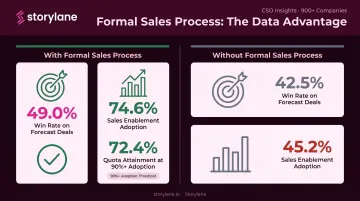
CSO Insights' research across 900+ companies backs this up: organizations with formal or dynamic sales processes achieved 49.0% win rates on forecast deals versus 42.5% for those without, and were nearly twice as likely to have sales enablement in place (74.6% vs. 45.2%). When process adoption exceeded 90%, quota attainment reached 72.4% — but only when reps actually followed it.
The 7 Steps of the Sales Process
The seven steps follow the natural arc of a buyer's journey — from being identified as a potential fit through to becoming a retained customer. Each step has a specific goal that sets up the next.
Step 1: Prospecting
Prospecting is the process of identifying potential customers who match your ideal customer profile (ICP). Without a well-defined ICP, prospecting becomes guesswork — reps fill the pipeline with contacts who lack the budget, authority, or real need to buy.
Practical approaches that work:
- Use CRM and sales intelligence tools to filter by company size, industry, and seniority
- Leverage LinkedIn for multi-threading — identifying multiple stakeholders within a target account before first outreach
- Qualify inbound marketing leads before passing them to sales; not every lead that fills out a form is sales-ready
- In teams with SDRs, initial outreach runs parallel to this research phase
Step 2: Preparation and Qualification
Preparation means researching each prospect individually — understanding their business challenges, existing tools, and decision-making structure — before any outreach happens. This is what separates an informed conversation from a generic pitch.
Qualification adds a filter: does this prospect have the need, budget, authority, and timeline to actually buy? Frameworks like BANT, MEDDIC, or CHAMP each approach this differently, but the goal is the same — turn a broad prospect list into a focused set of sales-qualified leads worth pursuing.
Reps who skip this step pitch unqualified prospects, waste cycles on deals that won't close, and inflate pipeline numbers that mislead forecasts. The cost compounds fast.
Step 3: Approach and Outreach
This is the first direct contact with a prospect. Generic outreach — the same email sent to 500 contacts — is both ineffective and actively harmful. Gartner's 2025 survey of 632 B2B buyers found 73% of B2B buyers actively avoid suppliers that send irrelevant outreach.
Effective outreach channels include email, LinkedIn, phone, and warm referrals. What differentiates high-performing outreach isn't the channel — it's the specificity:
- Reference a recent trigger event (funding round, product launch, leadership change)
- Connect to a known pain point specific to their industry or role
- Personalize to the individual, not just the company
One practical approach: Storylane allows reps to embed personalized, trackable interactive demo links directly in outreach emails. When a prospect engages, the rep receives a real-time alert — turning a cold sequence into a warm, behavior-triggered follow-up.
Step 4: Presentation and Demo
The presentation stage is not a feature walkthrough. It's a tailored value conversation built around the specific pain points surfaced during qualification. If the prep work was done properly, this stage should feel like a natural continuation of the discovery conversation — not a product tour the rep delivers to every buyer.
Modern B2B buyers complicate this further. Gartner reports that 61% of B2B buyers now prefer a rep-free buying experience, doing extensive self-directed research before engaging with sales. And 94% of technology buyers say tailored demos are important when evaluating products. Generic demos don't clear that bar.
This is where interactive demo platforms change the equation. Storylane lets reps build personalized, interactive product experiences — with the prospect's company name, logo, and relevant use cases embedded through smart variable tokens — that prospects can explore before or during a sales call.
Teams like PDQ and Entrust report that prospects who engage with a Storylane demo ahead of a live call arrive already primed, making the conversation sharper and shorter.
This stage also requires stakeholder awareness. Map who else needs to be involved and tailor the narrative to each person's priorities:
- Champions — focused on internal buy-in and ease of adoption
- Economic buyers — need clear ROI and total cost of ownership
- Technical evaluators — concerned with security, integration, and implementation
Step 5: Handling Objections
Objection handling is where most deals are lost without the rep understanding why. The conventional mistake is treating an objection as a rejection and disengaging. The data argues against this approach.
RAIN Group's research shows it takes an average of 8 touches to generate an initial meeting, and top-performing sellers use cadences averaging 15.5 touches per prospect. Most reps stop far short of that.
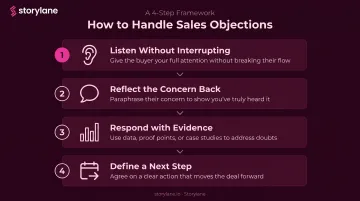
The consultative approach to objections follows a clear sequence:
- Listen without interrupting — let the prospect finish before formulating a response
- Reflect the concern back — paraphrase it to confirm you understood, not to stall
- Respond with evidence — case studies, ROI data, and testimonials land better than defensive positioning
- Define a next step — every objection conversation should end with a concrete path forward, not a vague "I'll follow up"
Storylane's engagement analytics add a tactical edge here. If a prospect dropped off during a specific chapter of a demo — say, the security or pricing section — that's a behavioral signal. Reps can prepare targeted responses to those exact concerns before the follow-up call, turning reactive objection handling into a proactive conversation.
Step 6: Closing
In B2B, closing is rarely a single moment. It's the alignment of stakeholders, the resolution of last-mile concerns, and the maintenance of momentum across what can be weeks or months of final deliberation.
Common closing approaches:
- Alternative choice close — "Would you prefer to start with the Growth plan or go straight to Enterprise?"
- Urgency-based close — tied to a genuine deadline or pricing window, not manufactured pressure
- Champion-led close — equipping the internal advocate to move the deal forward within their organization
Common closing mistakes to avoid:
- Failing to involve the right decision-makers early enough
- Not quantifying ROI clearly for economic buyers
- Delaying follow-up after the final presentation — prospect interest fades fast
The champion-led close is worth expanding on. This is the person within the prospect's organization with the most incentive to push the deal forward — and they're often selling your product internally without you in the room. Equip them: shareable assets, clear ROI data, and a demo they can present independently.
Storylane's Buyer Hub and offline demo features are purpose-built for this scenario. Champions can share a hub link or present a downloaded demo at an executive meeting — without needing a sales rep present — while the sales team tracks engagement in real time through CRM-synced analytics.
Step 7: Follow-Up and Relationship Nurturing
The sales process doesn't end at signature. What happens in the weeks after close determines whether that customer renews, expands, and refers others — or quietly churns.
The economics make this obvious. According to HBR, acquiring a new customer costs 5x to 25x more than retaining an existing one. And SaaS companies with net revenue retention above 100% grow 43.6% annually on average, according to ChartMogul's analysis of 2,100+ SaaS businesses.
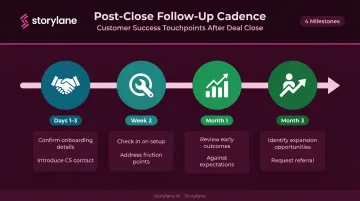
A simple post-close follow-up cadence:
| Timing | Action |
|---|---|
| Day 1-3 | Confirm onboarding details; introduce CS contact |
| Week 2 | Check in on initial setup; address early friction |
| Month 1 | Review early outcomes against expectations |
| Month 3 | Identify expansion opportunities; request referral if satisfied |
Satisfied customers become the most efficient source of new revenue: upsells, cross-sells, and warm referrals that convert at significantly higher rates than cold outbound.
Common Sales Process Mistakes to Avoid
Even well-documented sales processes break down at predictable points. Here are three mistakes that cost teams the most:
Pitching before qualifying. Reps who skip discovery waste time on prospects who lack budget, authority, or real need — and damage the relationship by appearing uninformed. No demo recovers from a qualification failure.
Feature-focused presentations. Showing everything the product does, rather than what it does for this specific buyer, is the fastest way to lose attention. Needs analysis must come before the presentation — not after.
Treating the close as the finish line. Reps who disengage after the contract is signed miss the retention and referral value that post-sale relationships generate. Expansion revenue and referrals come from customers who feel supported after the deal — not just before it.
Frequently Asked Questions
What is the 5-step sales process?
A condensed 5-step version merges certain stages — combining preparation with approach, or folding objection handling into closing — and covers: prospecting, qualifying, presenting, closing, and follow-up. The 7-step version adds operational clarity for complex B2B cycles involving multiple stakeholders.
What is the difference between a sales process and a sales methodology?
A sales process defines the sequence of steps a team follows. A sales methodology defines the philosophy for executing those steps — SPIN Selling and Challenger, for example, are methodologies that can be applied within any process structure.
What is the most important step in the sales process?
Qualification and discovery deliver the highest leverage. Getting these right eliminates wasted effort downstream and ensures your presentation and closing stages focus on buyers who are both interested and able to purchase.
How do you know when to move a prospect to the next stage?
Each stage should have defined exit criteria — specific signals or actions confirming readiness to advance (confirmed budget before a demo, or agreement on next steps before closing). CRM tools help track these milestones systematically, removing ambiguity from the process.
How long does a B2B sales cycle typically take?
According to Ebsta and Pavilion's 2024 B2B Sales Benchmark Report — analyzing $54B in revenue across 530 companies — the average B2B sales cycle is 117 days, with cycles lengthening 16% year over year. Strong qualification upfront reduces cycle time by cutting dead-end pursuits early.