Introduction
You send a great pitch. Crickets. Now what?
Most sales reps either fire off a generic "just checking in" email or give up entirely. Neither works. According to Gong's analysis of B2B sales deals, winning deals involve an average of 8 email touchpoints, while losing deals involve just 3 — a 243% difference. Most reps stop at 3. That's where deals die.
This guide gives you what you actually need:
- Ready-to-use templates for six common follow-up scenarios
- Subject line formulas that get opened
- Timing frameworks, including the 2-2-2 rule
- The practices that separate follow-ups that convert from ones that get deleted
Key Takeaways
- Closing deals typically takes ~8 follow-up touchpoints — most reps stop at 4
- Subject lines under 5 words consistently outperform longer ones
- Every follow-up must offer something new — a resource, insight, or question
- Trigger-based timing beats fixed-schedule cadences — send when prospects re-engage
- One CTA per email dramatically outperforms multiple asks
What Makes a Sales Follow-Up Email Work
A sales follow-up is any purposeful message sent after a prior interaction — cold outreach, discovery call, demo, or proposal — with the goal of maintaining momentum and moving the prospect toward a decision.
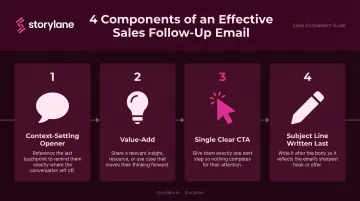
Four components separate effective follow-ups from forgettable ones:
- Context-setting opener — reference the prior interaction specifically, not vaguely
- Value-add — an insight, case study, stat, or resource the prospect didn't have before
- Single clear CTA — one ask, not three
- Subject line written last — after the email body, so it accurately reflects the content
Why Email Over Other Channels?
Each channel has tradeoffs:
- Calls interrupt — buyers rarely answer unknown numbers during focused work
- LinkedIn DMs pile up and lack urgency once the connection request fades
- Email gives B2B buyers the flexibility to respond on their schedule and creates a searchable record of your conversation
That's why email remains the default format for B2B follow-up, particularly in multi-stakeholder deals where your message gets forwarded internally to champions and decision-makers you haven't met yet.
Sales Follow-Up Email Subject Lines That Get Opened
Your follow-up email can't convert if it never gets opened — and the subject line is the only thing standing between the inbox and the trash folder. HubSpot reports that 43% of recipients decide whether to open an email based on the subject line alone, and Yesware's analysis of over 262,000 sales templates found that open rates peak with 1–5 word subject lines.
The best-performing subject lines have four things in common:
- Keep it under 50 characters
- Reference the prospect's company, challenge, or goal
- Hint at what's in it for them
- Write the subject line after the email body — so it matches what's inside
Subject Line Formulas by Category
Prompt/Context-Driven
- "Following up on [topic]"
- "Re: [Company] + [Your Company]"
- "Your question about [pain point]"
- "Next steps from our call"
Value-Driven
- "How [similar company] reduced [pain point] by X%"
- "One idea for [prospect's goal]"
- "Resource for [specific challenge]"
- "Quick thought on [topic from call]"
Question-Based
- "Still evaluating options for [goal]?"
- "Did [product] solve [problem] for you?"
- "Is [challenge] still a priority at [Company]?"
Urgency/Clarity-Based
- "Should I close your file?"
- "Last email on [topic]"
- "Worth a 15-minute conversation?"
Knowing which formulas work is only half the equation. Equally important: recognizing the patterns that quietly kill open rates before the email is ever read.
What to Avoid
Subject line patterns that consistently hurt open rates:
- Fake thread replies — using "RE:" when there's no prior reply destroys trust permanently
- Vague check-ins — "Following up" with no hook gives the reader zero reason to open
- Overly salesy phrases — "Act now!" or "Limited time" signals spam before the email is read
Sales Follow-Up Email Templates for Every Scenario
The best follow-up adapts to the stage of the relationship. Each template below includes:
- A labeled use case and recommended subject line
- The full template body
- A brief note on why it works
Keep your own versions in the 75–125 word range.
After Initial Contact or Cold Outreach
Use case: 3–5 days after a cold email receives no reply
Subject line: "One idea for [Company]'s [challenge]"
Hi [First Name],
Wanted to resurface this in case it got buried.
[Company] teams in [industry] often tell us they're struggling with [specific pain point]. We helped [similar company] address this by [brief outcome] — and I think there's a similar opportunity at [Company].
Worth a 15-minute call this week to see if it applies?
[Your name]
P.S. — Here's a quick case study showing how [similar company] approached it: [link]
Why it works: The P.S. does heavy lifting. It delivers proof without adding to the email's length, giving a hesitant prospect something concrete to review before committing to a call.
After a Demo or Sales Call
Use case: Within 24 hours of a discovery call or demo
Subject line: "Next steps from our call + [resource]"
Hi [First Name],
Great talking today. A quick recap:
- Your key challenge: [pain point #1]
- What matters most: [pain point #2]
- Agreed next step: [specific action, e.g., loop in [stakeholder] by [date]]
I've put together a personalized interactive demo so you can revisit the specific features we discussed at your own pace: [Storylane demo link]
When you explore it, I'll get a heads-up and can follow up with answers to any questions that come up.
Does [date/time] still work for our next conversation?
[Your name]
Why it works: Recapping pain points in bullets shows you listened. The interactive demo link lets the prospect re-engage on their schedule. When they do, the rep gets a real-time Slack or email alert with engagement data, creating a natural, well-timed trigger for the next outreach.
After Sending a Proposal or Quote
Use case: 2–3 days after sending pricing with no response
Subject line: "Questions on the proposal?"
Hi [First Name],
I wanted to make sure the proposal landed and check whether you have questions on the pricing or terms.
The goal we're working toward together: [specific result, e.g., reducing onboarding time by 40%]. Everything in the proposal is built around making that happen.
If anything needs adjusting — timeline, scope, structure — I'm flexible. Happy to jump on a quick call or answer by email, whichever is easier.
[Your name]
Why it works: The tone is confident and helpful, not desperate. Naming the specific outcome reminds the prospect why they requested the proposal in the first place.
After No Response (Mid-Sequence)
Use case: 3rd or 4th touchpoint when a prospect has gone quiet
Subject line: "Still relevant for [Company]?"
Hi [First Name],
I know your plate is full — I'll keep this brief.
[Industry stat or short insight relevant to their challenge, e.g., "Teams like yours are seeing X% improvement by addressing [pain point] earlier in the process."]
If this is still a priority for [Company], here's one resource that might be useful: [link to case study or guide]
No pressure — happy to connect whenever the timing works. Does [specific date] suit?
[Your name]
Why it works: This email earns its spot in the sequence by offering something new. Repeating the same ask five times is the fastest way to get marked as spam — this breaks the pattern.
After a Trigger Event (Prospect Engages with Content)
Use case: Prospect re-opens a demo link, downloads a resource, or re-engages with shared content
Subject line: "Saw you revisited the demo — quick thought"
Hi [First Name],
Noticed you had a chance to look at the [product/feature] demo again — hope it was useful.
Based on what you explored, I thought this might be relevant: [specific follow-up resource tied to the section they viewed].
I'd love to walk through [specific feature or use case] live if that would be helpful. Are you free for 20 minutes [date/time option]?
[Your name]
Why it works: This one lives or dies on timing. Storylane's Account Reveal and real-time Slack alerts show exactly when a prospect re-engages with a shared demo and which sections they revisited. Sending within 2 hours of that alert means the email arrives while interest is still active, not after it's cooled.
The Break-Up Email (Final Attempt)
Use case: After 7–10 touches with no response
Subject line: "Should I close your file?"
Hi [First Name],
I've reached out a few times and haven't heard back, so I'm going to assume the timing isn't right — and I'll stop following up.
If [challenge] becomes a priority again, I'm happy to reconnect. I'll leave the door open.
Wishing you and the team at [Company] well.
[Your name]
Why it works: Break-up emails consistently generate the highest response rates in the sequence. Framing it as a closure decision puts the prospect in a position to act or lose the option, which moves more replies than any polite check-in. The professional tone also matters: deals that go cold often come back, and this is the email they'll remember when they do.
Follow-Up Timing: The 2-2-2 Rule and Sequence Frameworks
The 2-2-2 Rule
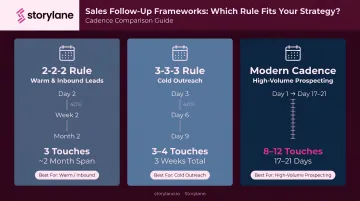
Follow up at 2 days, 2 weeks, and 2 months. This works best for warm or inbound leads who expressed initial interest but went quiet. The longer gaps give busy buyers breathing room without losing the thread entirely. Outreach notes this framework is considered a lighter-touch approach compared to modern high-velocity cadences.
The 3-3-3 Rule
Send 3 follow-up emails, spaced 3 days apart, over 3 weeks. This pacing suits cold outreach sequences where you want consistent presence without overwhelming the prospect. It's more aggressive than 2-2-2 in the early stages but still respects the reader's inbox.
Quick comparison:
| Framework | Best for | Total touches | Span |
|---|---|---|---|
| 2-2-2 | Warm/inbound leads | 3 | ~2 months |
| 3-3-3 | Cold outreach | 3–4 | ~3 weeks |
| Modern cadence | High-volume prospecting | 8–12 | 17–21 days |
How Many Follow-Ups Is Too Many?
Most reps quit after 4 or 5 touches, yet research consistently shows meetings typically require 8. The practical rule: keep going until the prospect explicitly asks you to stop. Silence usually means busyness, not disinterest.
When to Override the Schedule
Rigid timing frameworks break down the moment a prospect signals intent. When any of these happen, follow up within hours — not on your next scheduled send:
- Re-opens a demo or revisits a proposal
- Clicks a resource link you shared
- Re-engages with content after going quiet
Behavioral triggers outperform fixed-interval cadences because they reach the prospect at the moment of interest, not the moment of convenience.
Best Practices to Boost Follow-Up Conversions
Personalize Beyond the Name
Gong's analysis of 30,000 sales emails found that industry-specific social proof increases reply rates by 88%, and company-level research triples reply rates from executive buyers. Real personalization means referencing:
- A specific challenge the prospect mentioned on a call
- A recent company event (hiring surge, product launch, funding)
- An industry stat directly relevant to their role
Keep It Short
Salesforce data shows that emails of 1–25 words boost reply rates by 45.1%; Salesloft puts the sweet spot at 25–50 words. Either way, the message is the same: keep follow-ups short enough to read in 15 seconds. Post-demo recaps are the exception — detail is expected there, and brevity works against you.
Short emails also force you to lead with one clear ask — which brings us to the next rule.
One CTA Per Email
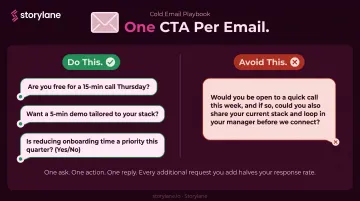
Multiple asks split attention and reduce replies. Each follow-up should direct the prospect toward exactly one action:
- ✅ "Are you free Thursday at 2pm?"
- ✅ "Would it help to see a 5-minute demo of this feature?"
- ✅ "Yes or no: is [challenge] still a priority this quarter?"
- ❌ "Let me know if you'd like to set up a call, or review the proposal, or connect on LinkedIn"
Optimize Send Timing
HubSpot's 2024 B2B data points to Tuesday as the highest-engagement send day, with 9 AM–12 PM generating the most opens. These are averages across industries, though — A/B test within your own audience before over-indexing on any benchmark.
Common Follow-Up Email Mistakes to Avoid
Sending the same email twice — Each touchpoint must bring a new angle, resource, or question. Identical follow-ups signal you're not paying attention to the prospect's situation.
Opening with "Just checking in": This phrase is entirely self-serving. It tells the reader nothing about why they should respond. Replace it with a specific reference to their challenge, a relevant insight, or a direct question.
Mismatching subject line and body: A subject line that promises value and delivers a generic pitch destroys credibility. Using "RE:" to fake a reply thread is worse — prospects notice, and it permanently damages trust.
Sending too many emails too fast: Three emails in four days with no new information looks like desperation. Space your sequence, and make sure each message earns its place.
Frequently Asked Questions
What are common follow-up rules like the 2-2-2 and 3-3-3?
The 2-2-2 rule follows up at 2 days, 2 weeks, and 2 months, making it well-suited for warm leads who've gone quiet. The 3-3-3 rule sends 3 emails, 3 days apart, over 3 weeks, which works better for cold outreach where faster pacing is appropriate.
How many follow-up emails should you send before giving up?
Most sales require around 8 touches to generate a meeting, but many reps quit after 4 or 5. Stop only when a prospect explicitly asks — not after silence alone.
What is the best time to send a sales follow-up email?
HubSpot's 2024 data points to Tuesday mornings (9 AM–12 PM) as the highest-engagement window for B2B email. A/B test within your audience to confirm what works for your segment.
How do you write a follow-up email after no response?
Acknowledge their busy schedule briefly, lead with a single relevant value point they haven't seen before, and close with one frictionless CTA: a yes/no question or a specific calendar slot.
What should a sales follow-up email subject line include?
The strongest subject lines hit three marks:
- Specific: reference a company name, challenge, or goal
- Brief: under 50 characters
- Benefit-led: hint at what's in it for the reader
What's the difference between a follow-up email and a cold email?
A cold email is your first contact with no shared history. A follow-up references a prior interaction, which puts personalization front and center. Because the prospect already knows who you are, the bar for a response is lower.