The gap between reps who build healthy pipelines and those who struggle usually comes down to how they prospect — not how hard they work.
This guide covers a practical framework for sales prospecting: how to build an ideal customer profile, master multi-channel outreach, use interactive demos as a prospecting asset, and qualify prospects faster so your pipeline stays clean and your close rate climbs.
Key Takeaways
- A clear Ideal Customer Profile (ICP) is the foundation of all effective prospecting — without it, you waste time on leads that will never convert
- Top prospectors generate 2.7x more conversions than average reps (RAIN Group)
- It takes an average of 8 touches to generate a B2B meeting — single-channel outreach rarely works alone
- Multi-threading across departments can increase win rates by up to 56%
- Interactive demos in cold outreach give prospects something tangible to engage with — before a call is even booked
What Is Sales Prospecting and Why It Matters
Sales prospecting is the process of identifying, researching, and initiating contact with potential customers to generate new business. It sits at the very top of the sales funnel — and pipeline health, conversion rates, and closed revenue all depend on how well it's executed.
Prospects vs. Leads: Key Differences
These two terms get used interchangeably, but they're not the same thing:
- Leads — anyone who has shown vague interest, such as visiting your website or downloading a resource. Broad, unqualified.
- Prospects — leads who have been evaluated against your ideal buyer profile and determined to be worth pursuing. Targeted and qualified.
Most prospecting problems start with reps treating leads as if they're already prospects. They're not. Qualification is what separates them.
Why Strategic Prospecting Drives Revenue
The performance gap between top prospectors and average reps is significant. RAIN Group research shows that top-performing sellers achieve a 72% average win rate on proposed sales, compared to 47% for other sellers. Top prospectors also generate 2.7x more conversions than their peers.
The quality problem cuts the other way too: 82% of buyers accept meetings from sellers who reach out, but 58% report those meetings provide no value. That gap is where revenue leaks. Stronger qualification and outreach prep translate directly into meetings that move deals forward — which is exactly what the strategies below address.
Know Your Buyer: Building an ICP and Researching Prospects
An Ideal Customer Profile (ICP) defines the type of company most likely to buy, stay, and expand. Without one, reps prospect in every direction and close in none.
Core ICP attributes to define:
- Company size (headcount and revenue range)
- Industry and sub-vertical
- Geography and language requirements
- Key pain points and business challenges
- Tech stack (especially for integration fit)
- Typical budget range and deal size
Build your ICP from existing customer data. Analyze your best accounts — largest deals, shortest sales cycles, lowest churn — and look for patterns. Revisit it quarterly, because your product evolves and so does your market.
Once you have an ICP, research individual prospects before outreach. Useful sources include:
- LinkedIn profiles for role history and recent activity
- Company websites and press releases for strategic priorities
- Job postings, which reveal current initiatives and pain points
- Earnings calls for enterprise targets
That research matters even more because B2B deals rarely hinge on one person's decision.
Understanding the Buying Committee
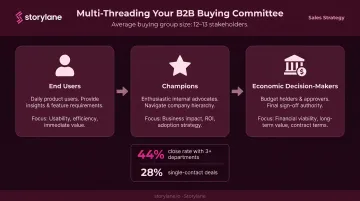
Forrester research puts the typical buying decision at 13 internal stakeholders and 9 external influencers. Challenger data puts the average buying group at nearly 12 people. Your outreach strategy needs to reflect that reality.
Multi-threading — reaching across end users, champions, and economic decision-makers — is the practical response. Deals engaging three or more departments close 44% of the time, versus 28% when outreach stays confined to a single contact.
Using Sales Triggers to Time Your Outreach
Sales triggers are events that signal a prospect may be primed to buy:
- New funding round announced
- Prospect promoted to a new role
- Competitor acquired or disrupted
- Company announcing expansion or headcount growth
- Leadership change at the executive level
Reaching out right after a trigger works because your message is relevant in the moment. A funding announcement creates immediate context for your outreach — wait three months and that relevance is gone.
Effective Sales Prospecting Strategies and Tips
Tip 1 — Prioritize Quality Over Quantity
Prospecting 300 well-qualified accounts will outperform blasting 1,000 loosely matched contacts. Personalized outreach to tightly aligned prospects converts at a higher rate, and your time is finite.
The math works in your favor when you're selective: fewer prospects, more research, better results.
Tip 2 — Personalize Every Touchpoint
Generic outreach gets ignored. Personalization doesn't require an hour per prospect — 3 to 5 minutes of focused research before each outreach is enough to reference:
- A recent company announcement
- A post the prospect published on LinkedIn
- A challenge specific to their industry
- A mutual connection
The goal is to make the prospect feel like you reached out to them specifically, not to whoever was next on a list.
Tip 3 — Use Referrals to Create Warm Introductions
Referrals transform cold prospects into warm ones. Proactively ask satisfied customers for introductions to peers in similar roles at other companies. A brief email or call asking "Is there anyone in your network who might benefit from what we've built together?" often yields results, particularly when the customer has seen real results.
Referral-driven outreach converts at a higher rate than cold outreach because you're starting with borrowed credibility instead of building it from scratch.
Tip 4 — Use Social Selling Strategically
LinkedIn is the primary platform for B2B prospecting. Practical tactics:
- Use LinkedIn Sales Navigator to filter prospects by ICP attributes (company size, title, industry, tech stack)
- Engage with a prospect's posts — like, comment thoughtfully — before sending a connection request
- Join industry groups where decision-makers are active
- Build a personal brand by sharing relevant insights consistently; it increases inbound response rates over time
Warm up before you reach out. A cold InMail from someone the prospect recognizes converts differently than one from a stranger.
RAIN Group research notes that 82% of buyers research providers on LinkedIn before responding to outreach. Your profile is part of your pitch.
Tip 5 — Use Interactive Demos as a Prospecting Asset
Sending a self-serve interactive demo in cold outreach, rather than a text-heavy email, gives prospects something tangible to engage with before any sales conversation happens.
Storylane lets reps build personalized interactive demos using dynamic token variables — inserting the prospect's company name, logo, or role-specific data — so each demo feels tailored without requiring a rebuild for every contact. Reps can generate uniquely tracked private links, set expiry windows to create urgency, and share them across email, LinkedIn, or direct mail.
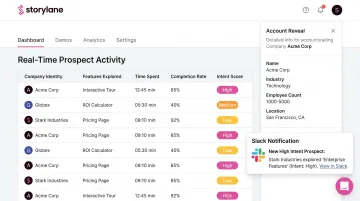
The follow-up intelligence is where it gets powerful. Storylane's Account Reveal feature automatically identifies companies viewing the demo and enriches them with firmographic and contact-level data, no form required.
When a prospect engages, the rep receives a real-time Slack notification surfacing company identity, features explored, time spent, completion rate, and an intent score (Low / Medium / High). Teams using demo engagement signals for follow-up timing report 3x higher response rates compared to standard cold outreach.
Tip 6 — Build a Structured Cadence and Follow Up Persistently
Those engagement signals matter because most prospects don't respond to the first touchpoint. According to RAIN Group, it takes an average of 8 touches to generate a B2B meeting. That means a single email is not a prospecting effort; it's just an introduction.
A solid prospecting cadence over 10 to 14 days typically includes:
- Day 1 — Cold email
- Day 3 — LinkedIn connection request with a brief note
- Day 5 — Phone call
- Day 7 — Follow-up email with a relevant resource (article, stat, or insight)
- Day 10 — LinkedIn message referencing your earlier email
- Day 14 — Final email with a clear close
Each follow-up should add value — share something relevant, not just "just checking in." InsideSales research found that after seven attempts, contact rates drop by 63.2%, so concentrate your effort in the first week.
Mastering Prospecting Outreach Across Channels
Cold Email Best Practices
An effective cold email has four components:
- Subject line — 4 words or fewer. Yesware analysis of 262,518 email templates found open rates peak for subject lines between 1 and 5 words.
- Opening line — personalized and specific, not "Hope this finds you well"
- Value proposition — tied directly to a pain point the prospect likely has (WIIFM: What's In It For Me)
- CTA — single, low-friction: "Are you open to a 15-minute call this week?"
Keep the email under 150 words. If you need 400 words to explain your value, the value proposition isn't sharp enough.
Cold Calling That Gets Responses
A cold call that works follows a simple arc:
- Ask if it's a good time — shows respect and increases engagement
- Lead with a pain point or trigger — not a product feature
- Listen more than you talk — ask open questions and let the prospect direct the conversation
- End with a clear next step — book a demo, schedule a follow-up call
Gong's analysis of 300 million B2B cold calls found that openers framing a conversational question (rather than launching into a pitch) significantly outperform standard approaches. Prepare a talk track, not a script — it keeps you focused without sounding robotic.
Social and LinkedIn Outreach
The sequence that works on LinkedIn:
- Engage with the prospect's content (comment on a post or article)
- Send a personalized connection request referencing something specific
- After connecting, send a value-first message — a relevant insight, resource, or stat
- Then, and only then, introduce your product
Personalized video messages in LinkedIn DMs cut through in a way text rarely does. In practice, a 60-second video that names the prospect and references their specific context tends to outperform a text InMail — the effort signals genuine interest, which most cold messages lack.
Multi-Channel Coordination
LinkedIn, email, and phone each work alone — but used together in sequence, they compound. The highest-performing prospectors treat channels as a coordinated system, not isolated tactics. One practical flow:
- Email → opens the conversation
- LinkedIn → references the email, adds a social touch
- Phone → creates human contact after digital warm-up
Each channel reinforces the others. The goal is to be consistently present — not overwhelming. Space touchpoints appropriately and vary the medium so each one feels like a natural continuation rather than a follow-up flood.
How to Qualify Prospects and Keep Your Pipeline Moving
BANT (Budget, Authority, Need, Timing) remains the most practical qualification framework. Use it to quickly assess whether a prospect deserves active pipeline attention:
| Criteria | Key Question |
|---|---|
| Budget | Do they have funds allocated for this type of solution? |
| Authority | Are you talking to someone who can say yes — or who influences yes? |
| Need | Is there a genuine, pressing problem your product solves? |
| Timing | Is there urgency, or is this a "maybe next year" conversation? |
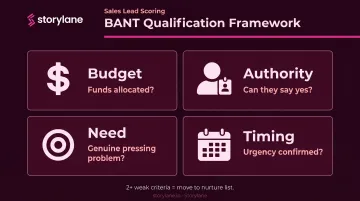
Not all four criteria need to be fully confirmed immediately. But if two or more are weak, the prospect belongs further down your nurture list — not in active pipeline.
Two habits separate reps who close from those who stall:
- Always end every interaction with a confirmed next step (time, date, action). Deals stall when reps assume the prospect will reach back out.
- Disqualify clearly and quickly. Consistent non-response after a full cadence, confirmed budget mismatch, or no access to decision-makers are all green lights to move on. Disqualification is a productivity decision, not a failure.
Frequently Asked Questions
What does sales prospecting mean?
Sales prospecting is the process of identifying potential customers and reaching out to start a sales conversation. It involves researching leads, qualifying them against your ideal buyer profile, and initiating direct contact — typically through email, phone, or LinkedIn.
What are examples of sales prospecting?
Common examples include cold calling, cold emailing, LinkedIn outreach, referral requests, social selling, warm calls to inbound leads, and attending industry events to initiate conversations with potential buyers.
What are the 5 P's of sales prospecting?
The 5 P's are:
- Preparation — know your ICP before outreach
- Personalization — tailor each message to the individual
- Persistence — follow up consistently across touches
- Problem-solving — lead with the prospect's pain points
- Performance — track results and refine your approach
The framework comes from sales training practice, not a formal methodology.
What is the 3-3-3 rule in sales prospecting?
The 3-3-3 rule is a research shortcut: spend 3 minutes researching a prospect, identify 3 relevant insights to reference in your outreach, and make contact across 3 different channels before moving on. It's designed to balance personalization with volume.
What is the difference between sales prospecting and lead generation?
Lead generation is marketing-owned — it attracts inbound interest at scale through content, ads, and events. Sales prospecting is sales-owned — it's a targeted, one-to-one process of qualifying specific individuals and directly initiating a sales conversation.