This cycle plays out in B2B revenue teams constantly — and it almost always traces back to the same root cause: no shared definition of what makes a lead ready for marketing versus ready for sales.
MQLs (Marketing Qualified Leads) and SQLs (Sales Qualified Leads) represent two distinct stages of buyer intent. Conflating them wastes sales cycles, burns out reps, and lets deals go cold. According to Forrester's 2024 Sales and Marketing Alignment Survey, 65% of sales and marketing professionals still report a lack of alignment between their leaders — a gap that compounds directly into lost revenue.
This article clarifies both terms, breaks down the key differences, and outlines practical strategies to move leads efficiently from one stage to the next.
Key Takeaways
- An MQL has shown interest but is not yet ready to buy; an SQL has demonstrated clear buying intent and is ready for direct sales engagement
- The core distinction is buyer intent and sales readiness — not just engagement volume
- MQLs live in the top/middle of the funnel; SQLs occupy the bottom
- Advancing leads from MQL to SQL requires lead scoring, behavioral signals, and BANT qualification
- Shared MQL/SQL definitions between sales and marketing directly determine conversion rates
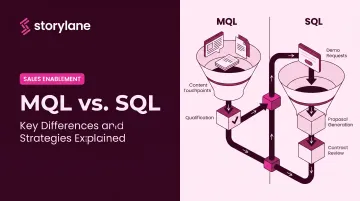
MQL vs. SQL: Quick Comparison
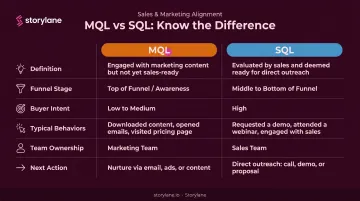
| Attribute | MQL | SQL |
|---|---|---|
| Definition | Engaged with marketing content; shows potential | Vetted and ready for a direct sales conversation |
| Funnel Stage | Awareness / Interest (top and middle) | Decision / Action (bottom) |
| Buyer Intent | Exploratory — researching a problem | Decisive — evaluating vendors, asking about pricing |
| Typical Behaviors | Blog reads, eBook downloads, webinar sign-ups, newsletter opens | Demo requests, pricing page visits, product comparisons |
| Team Ownership | Marketing | Sales |
| Next Action | Continue nurturing with relevant content | Initiate direct sales outreach |
Buyer Intent: The Real Dividing Line
Both lead types have interacted with your brand — but where they are in their decision process is what separates them. An MQL is still researching the problem. An SQL is already evaluating solutions.
That distinction drives every downstream decision: which team owns the lead, what content to send, and how fast to follow up. Get it wrong in either direction — rushing an MQL or sitting on an SQL — and you either burn the relationship or lose the deal.
What Is an MQL?
An MQL (Marketing Qualified Lead) is a prospect who has engaged with your marketing content and shown enough interest to suggest potential — but has not yet demonstrated the intent or readiness to buy. Marketing teams typically identify MQLs through a combination of behavioral signals and lead scoring thresholds.
Behaviors That Generate MQL Status
Common triggers include:
- Downloading an eBook, guide, or whitepaper
- Registering for or attending a webinar
- Signing up for a newsletter
- Revisiting blog content across multiple sessions
- Repeatedly clicking on paid ads
High engagement volume alone does not equal purchase intent. Context matters enormously.
A VP of Operations at a 500-person SaaS company who downloads your pricing guide and opens three nurture emails in a week probably crosses your MQL threshold. A university student downloading the same guide for a class project does not, even if the behavioral data looks identical.
When Is a Lead Classified as an MQL?
MQL thresholds vary by company, but most are defined through a lead scoring model that weighs both firmographic fit and behavioral signals.
The key mistake to avoid: pushing MQLs to sales too early. An MQL needs continued nurturing through progressively relevant content, not a sales pitch. Premature handoffs cause:
- Sales reps chasing leads who aren't ready to buy
- Prospects feeling pressured before they've built trust
- Friction between marketing and sales over lead quality
What Is an SQL?
An SQL (Sales Qualified Lead) is a prospect who has been vetted — by marketing, sales, or both — and confirmed ready for a direct conversation with a sales rep. SQLs have moved past research mode. They're comparing vendors, building internal business cases, and moving toward a decision.
What Makes a Lead SQL-Ready?
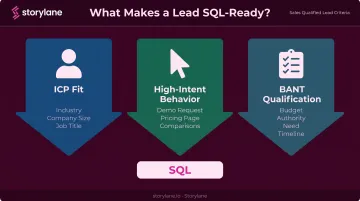
Three criteria typically converge:
- ICP fit — Industry, company size, and job title align with your Ideal Customer Profile
- High-intent behavior — They've requested a demo, hit your pricing page multiple times, or engaged with head-to-head comparison content
- BANT qualification — Budget is allocated, the right stakeholder is involved, the need is confirmed, and there's a purchase timeline in place
A Concrete SQL Scenario
A marketing director at a 200-person SaaS company who has read three comparison articles, visited your pricing page twice, and submitted a "Book a Demo" form is a clear SQL. Intent is explicit, persona fits, and they have initiated sales engagement themselves.
Some organizations add a middle step between MQL and SQL: the SAL (Sales Accepted Lead). When marketing passes a lead, sales formally "accepts" it before deeper qualification begins. That single checkpoint adds accountability and prevents leads from stalling after handoff.
MQL vs. SQL: Key Differences and Why They Matter
Intent Is Everything
Both MQLs and SQLs have interacted with your brand. But treating them the same is a reliable way to lose deals.
- Hard pitching an MQL (treating them like an SQL) pushes them toward a competitor before they're ready
- Over-nurturing an SQL (treating them like an MQL) lets high-intent prospects go cold while you send them another blog post
The funnel placement matters practically: MQLs consume educational content (how-to guides, explainers, webinars). SQLs consume evaluation content (pricing pages, case studies, product comparisons, demo requests). Align your content delivery and outreach cadence to match where each lead actually sits.
The Business Cost of Misalignment
When sales and marketing don't share clear MQL/SQL definitions, the result is a predictable blame cycle: sales says marketing sends bad leads, marketing says sales doesn't follow through. Both complaints have merit, and revenue takes the hit regardless of who's right.
Forrester's research found that highly aligned companies grow 19% faster and are 15% more profitable than their misaligned counterparts. That gap is largely a definitions problem.
Measuring MQL-to-SQL Conversion Rate
Your MQL-to-SQL conversion rate is one of the clearest health metrics in your pipeline. The formula:
MQL-to-SQL Conversion Rate = (Number of SQLs ÷ Number of MQLs) × 100
What different rates signal:
- Below 10% — MQL criteria are too loose, or lead quality is poor
- 10–20% — Typical healthy range for most B2B companies
- Above 25% — MQL bar may be too strict, leaving pipeline thin
You'll often see a 13% average cited for B2B — but that figure traces back to a single proprietary dataset with no independent verification. Use it as a directional reference, not a hard target.
How to Move a Lead from MQL to SQL
Step 1: Build a Point-Based Lead Scoring Model
Assign numerical values to both firmographic traits and behavioral signals, then set a threshold that automatically advances a lead to SQL.
Example scoring framework:
- +15 points — Matches ICP company size
- +10 points — Job title matches buyer persona
- +25 points — Downloads a pricing sheet
- +30 points — Visits the pricing page twice in one week
- +40 points — Requests a demo
- +5 points — Opens a nurture email
- −10 points — Student or non-ICP domain
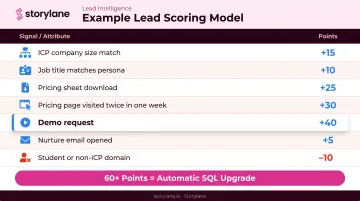
A lead hitting 60+ points triggers an automatic SQL upgrade and CRM workflow. The exact thresholds should be calibrated to your own close rate data — not borrowed from industry averages.
Step 2: Watch for High-Intent Behavioral Signals
Bottom-of-funnel behaviors outweigh volume of top-funnel engagement. Prioritize these signals:
- Demo or consultation request
- Multiple visits to the pricing page within a short window
- Engagement with product comparison content
- Specific feature questions via chat or email
- Returning to your site across multiple sessions in one week
Step 3: Apply BANT in Discovery
The BANT framework (Budget, Authority, Need, Timeline) gives sales reps a structured way to confirm SQL status. A prospect who fits ICP and shows high-intent behavior still needs to clear BANT before meaningful sales time is invested.
Reps can surface BANT answers through discovery calls, form data, or firmographic enrichment tools — without interrogating prospects. It should feel like a conversation, not a checklist.
Note: Gartner has flagged that BANT can be poorly suited to early-stage technology leads where budget and timeline are still undefined. Use it as a framework, not a rigid gate.
Step 4: Use Interactive Demos as a Behavioral Qualifier
A prospect who works through an interactive product demo, exploring specific features, clicking through workflows, and completing 80%+ of the experience, is showing a fundamentally different level of intent than someone who read a blog post.
Storylane captures exactly these signals for each session:
- Demo completion rate and time spent per session
- Features explored and drop-off points
- CTA clicks (such as "Book a Demo")
When a prospect from a target account spends 20+ minutes in a demo and clicks the CTA, that behavioral data pushes directly into Salesforce or HubSpot and can automatically trigger an MQL-to-SQL upgrade in your CRM workflow.
Storylane's Account Reveal feature extends this further: anonymous demo visitors get de-anonymized with enriched company data, so sales teams can identify and prioritize high-intent accounts who haven't filled out a form yet.
Step 5: Automate the Handoff
Once a lead hits the SQL threshold, the handoff should be automatic. Manual processes tied to spreadsheet reviews introduce delays that kill conversion.
CRM workflows in Salesforce or HubSpot can route the lead to the right rep immediately, with a notification and full engagement history attached. Speed is critical: according to InsideSales.com's 2021 study of 5.7 million inbound leads, conversion rates are 8x higher when reps respond within the first five minutes, yet only 0.1% of inbound leads are contacted that fast.
Real-time Slack alerts, triggered when a high-score lead completes a demo or hits a pricing page threshold, close that gap by surfacing the signal directly in front of the rep the moment it happens.
Strategies to Accelerate MQL-to-SQL Conversion
Align Sales and Marketing Through a Shared SLA
Both teams need to co-define MQL and SQL criteria, document the agreement in a Service Level Agreement (SLA), and hold regular syncs — weekly or biweekly — to review lead quality and conversion rates.
This isn't a one-time exercise. Buyer behavior shifts, ICP criteria evolve, and what counted as SQL-ready six months ago may not be accurate today. Revisiting thresholds quarterly keeps your pipeline honest.
Map Content to Funnel Stage
MQLs move faster when you give them the right content at the right moment. A simple progression:
- Awareness — Blog post or educational guide
- Interest — Comparison article or industry report
- Consideration — Case study or ROI calculator
- Intent — Demo invitation or pricing consultation
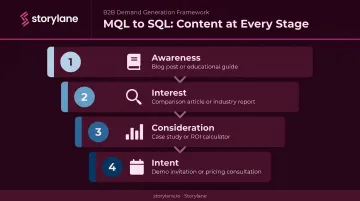
Each step builds intent. Skip the progression, and MQLs stall at whichever stage they're missing context for.
Deploy Interactive Demos as a Mid-Funnel Qualification Tool
Rather than waiting for a prospect to book a call to experience your product, embed interactive demos in:
- Email nurture sequences
- Landing pages
- Outbound SDR sequences
- Meeting confirmation emails
When prospects complete a self-guided demo before speaking to sales, they arrive already product-informed — shortening the sales cycle and arriving meaningfully closer to SQL status. Storylane customers embedding demos in outbound sequences have seen 3x higher response rates compared to cold outreach. Reps aren't following up blind — they're reaching out to prospects who already engaged with the product.
Automate Lead Scoring and CRM Alerts
Every hour between a high-intent signal and a rep's follow-up is a window for a competitor. CRM-native or integrated lead scoring tools close that gap by doing the following:
- Automatically advance leads based on cumulative score thresholds
- Trigger Slack or email alerts the moment a prospect hits a key signal (pricing page visit, demo completion)
- Route leads to the right rep immediately with full engagement context attached
When scoring and routing are automated, speed-to-lead becomes a structural advantage — not a matter of who checks Slack first.
Frequently Asked Questions
What's the difference between MQL and SQL?
An MQL has engaged with marketing content and shown interest but is not yet ready to buy — they're exploring, not deciding. An SQL has demonstrated clear buying intent and has been vetted as ready for a direct sales conversation. The core difference is intent and sales readiness.
What comes first, MQL or SQL?
MQL always comes first. A lead typically enters as an MQL through marketing engagement, then progresses to SQL once they meet behavioral and qualification criteria that signal readiness for sales outreach.
What is an SQL in sales?
A Sales Qualified Lead is a prospect confirmed to have the intent, budget, authority, and timeline to make a purchase, making them ready for active sales engagement. They're typically vetted through behavioral signals and qualification frameworks like BANT before being passed from marketing.
What is a good MQL-to-SQL conversion rate?
For most B2B companies, a healthy range falls between 10–20%. Rates below 10% often suggest loose MQL criteria or poor lead quality; rates above 25% may indicate the bar is set too high, resulting in a thin pipeline.
How do you qualify a lead as an SQL?
Leads are typically qualified through a combination of lead scoring thresholds, high-intent behavioral signals (demo requests, pricing page visits, repeated product engagement), and BANT confirmation that the prospect has the budget, authority, need, and timeline to buy.
How do sales and marketing teams agree on MQL and SQL definitions?
Both teams should define shared criteria in a shared SLA, align on lead scoring criteria and handoff thresholds, and hold regular syncs to review conversion data. Definitions should be treated as living agreements — revisited quarterly and adjusted based on what's actually closing.