Introduction
Enterprise B2B deals don't close in a single call. They involve procurement teams, legal reviews, executive sign-offs, and evaluation cycles that stretch across quarters — sometimes years. That's the reality of complex sales.
Many reps still treat these deals like transactional ones: pitch the product, share a deck, wait for a yes. That approach fails fast. It ignores buying committee dynamics, underestimates perceived risk, and misreads how modern organizations actually make large purchasing decisions.
According to Forrester's 2024 State of Business Buying report, **86% of B2B purchases stall during the buying process** — and the average decision involves 13 people across multiple departments. Managing that buying committee is where most deals are won or lost.
This guide breaks down what complex sales is, what makes a deal qualify as "complex," how the process works stage by stage, and what separates reps who consistently win large deals from those who don't.
Key Takeaways
- Complex sales involve multiple stakeholders, extended timelines, high deal values, and elevated business risk
- The buying process has four stages: Discovery, Qualification and Diagnosis, Proposal, and Closing
- 40–60% of lost B2B deals end in "no decision" — the status quo is your biggest competitor
- Multithreading deals over $50K boosts win rates by an average of 130%
- Winning requires stakeholder mapping, disciplined qualification, and persona-specific value communication
What Is Complex Sales?
Complex sales — also called enterprise sales — are B2B transactions where no single person can say yes. They're characterized by multiple decision-makers, extended evaluation cycles, high contract values, and significant business, financial, or technical risk. The purchase decision requires cross-functional consensus rather than one buyer's approval.
Why Complex Sales Exist
As organizations grew larger, purchases began touching multiple departments simultaneously. A new ERP system affects finance, IT, and operations. A cybersecurity platform requires sign-off from the CISO, IT, legal, and the CFO. This reality created the buying committee — a group assembled specifically to reduce the risk of a costly wrong decision.
Formal evaluation processes like RFPs, RFIs, and RFQs emerged for the same reason. According to Forrester, procurement professionals are now decision-makers in 53% of business buying cycles. The process exists to protect the organization, not to frustrate sellers.
What Complex Sales Is Not
Complex sales is not simply a "longer" version of transactional selling. The entire approach must change:
| Transactional Selling | Complex Selling | |
|---|---|---|
| Buyers | One decision-maker | Multiple stakeholders |
| Pricing | Standard | Customized |
| Cycle | Short | Months-long |
| Approach | Product pitch | Consultative diagnosis |
Reps who bring transactional tactics into complex deals — relying on product pitches or price-based persuasion — lose. The role in complex sales is closer to consultant than salesperson.
The Role of Risk
Risk is what drives complexity. The larger and more organization-wide a purchase is, the more stakeholders must sign off — each protecting their own department from the fallout of a bad decision:
- A technical evaluator risks choosing a platform that can't integrate
- A CFO risks approving a six-figure investment with unclear ROI
- An end user risks having their workflow upended
Complex sales appear across enterprise SaaS, commercial insurance, engineering services, government contracts, pharmaceutical procurement, and large fleet sales. The mechanics differ; the core characteristics don't — multiple stakeholders, long cycles, high-stakes decisions.
How Complex Sales Works: The 4-Stage Process
Complex deals are unpredictable, but they follow a recognizable sequence. Understanding each stage helps reps know where they are in a deal, what's needed next, and where most opportunities stall.
Discovery
Discovery is where the rep builds a baseline understanding of the buyer's business. The goal: identify pain points, map stakeholders, understand timelines, and surface objections before they become deal-killers.
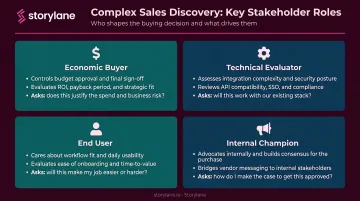
This stage goes beyond surface-level needs. In complex sales, discovery means understanding:
- Who holds budget authority (economic buyer)
- Who evaluates technical fit (technical evaluator)
- Who uses the product daily (end user)
- Who can advocate internally (champion)
It's research-heavy and relationship-initiation-focused. Reps who skip thorough discovery almost always regret it in the proposal stage, when a stakeholder they never identified suddenly derails the process.
Qualification and Diagnosis
Qualification is where the rep decides whether to pursue the opportunity — and equally important, whether to walk away. Assess fit against an Ideal Customer Profile, gauge urgency, and determine whether the prospect recognizes the full cost of their problem.
Diagnosis goes deeper. Using discovery findings, the rep articulates the prospect's problem back to them — often surfacing issues the buyer hadn't fully quantified. This reframing positions the rep as a business advisor, not just a vendor.
One critical insight from JOLT research: 40–60% of lost B2B deals end in "no decision", and fear of failure drove 56% of those no-decision outcomes. The status quo isn't neutral — it's the most common competitor. Strong qualification uncovers whether the prospect has enough urgency to actually move.
Proposal
The proposal stage presents a tailored solution — using case studies, implementation plans, and demonstrations to show how the offering solves the diagnosed problem. The challenge: not every decision-maker will attend every meeting.
Buying committee members, particularly executives, often review materials independently, on their own schedule. This is where asynchronous evaluation tools become critical. Platforms like Storylane let sales teams build interactive demos with role-specific content paths — a CFO follows the ROI flow, a technical evaluator digs into integrations, an end user walks through daily workflows — all from the same shared destination.
Storylane's Buyer Hubs consolidate demos, PDFs, case studies, and videos in one place, replacing the scattered email threads that lose stakeholders between meetings. The Account Reveal feature and Slack alerts notify reps when specific buying committee members engage, giving teams the timing and context needed for effective follow-up.
Closing
Closing in complex sales is rarely a single moment. It's the culmination of consistent trust-building across the entire cycle. After gaining stakeholder alignment, the rep finalizes contract terms, addresses remaining objections, and secures sign-off from everyone who needs to approve.
Post-close relationship management matters as much as the close itself. Complex deals are typically long-term contracts. Maintaining the relationship after signature signals the buyer made the right decision and significantly increases renewal and expansion probability.
Complex Sales vs. Transactional Sales
The core distinction is decision structure. Transactional sales have one buyer, a short decision timeline, standard pricing, and minimal customization. Complex sales have buying committees, months-long evaluation cycles, tailored contracts, and high perceived risk on both sides.
| Dimension | Transactional Sales | Complex Sales |
|---|---|---|
| Stakeholders | 1–2 | 6–13+ |
| Sales cycle | Days to weeks | 6–18+ months |
| Pricing | Standard | Customized |
| Decision process | Single approval | Cross-functional consensus |
| Rep's role | Order-taker | Trusted advisor |
| Customization | Minimal | Significant |
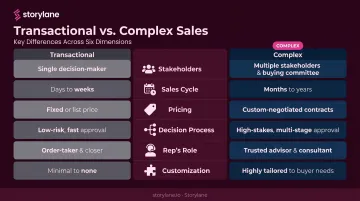
Those stakeholder counts reflect a real shift. Forrester's 2026 State of Business Buying found the typical buying decision now involves 13 internal stakeholders and 9 external influencers. In 2017, the average was 6.8. The buying committee has roughly doubled in a decade.
That growth is reshaping deals well below the enterprise tier. Mid-market B2B deals increasingly resemble enterprise deals in their stakeholder dynamics and evaluation rigor. More reps need complex sales skills than ever before, not just those carrying enterprise quotas.
How to Win at Complex Sales
Become a Product and Customer Expert Simultaneously
Surface-level product knowledge won't survive scrutiny from a technical evaluator or a skeptical CFO. Winning complex deals requires deep knowledge of both what you're selling and the buyer's specific business context — their industry, competitive pressures, operational constraints, and how decisions actually get made internally.
Reps who only know their own features lose to reps who walk in knowing the prospect's industry benchmarks, common pain points, and how competitors have tackled similar problems.
Map and Manage the Buying Committee
Every complex deal has a buying committee. Identify the key roles and develop a communication strategy for each:
- Economic buyer — cares about ROI, total cost, and strategic fit
- Technical evaluator — cares about integration, security, and implementation
- End user — cares about usability and workflow impact
- Internal champion — cares about advancing the project and their own credibility
Gong's 2025 research found that multithreading boosts win rates by an average of 130% in deals over $50K, and closed-won selling teams are 67% larger than teams on lost deals. Single-threaded selling — where the rep only has one contact inside the account — is one of the clearest predictors of a stalled or lost deal.
Qualify and Disqualify with Discipline
Elite complex sellers know when to exit deals that lack real potential. Chasing unqualified opportunities for months burns pipeline capacity that belongs on winnable deals.
Qualify against clear criteria before committing resources:
- Budget — does confirmed funding exist for this purchase?
- Authority — are you connected to someone who can approve the deal?
- Need — has the buyer acknowledged a problem worth solving?
- Timeline — is there a real deadline driving action?
- Decision process — do you understand how they'll make the call?
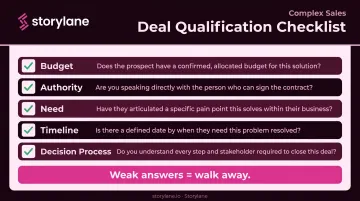
When the answers come back weak, walk away.
Guide the Decision, Don't Push the Sale
In complex sales, pressure closes almost nothing. Buyers who feel pushed toward a decision tend to stall or choose nothing. The rep's job is to help the buyer make a well-informed decision — asking the right questions, sharing relevant expertise, addressing risk proactively, and positioning as a long-term partner.
RAIN Group's research found high-performing sellers achieve a 72% win rate on proposed deals versus 47% for average sellers. That gap doesn't come from better closing tactics — it comes from how thoroughly top performers diagnose needs, reframe the buyer's thinking, and build a defensible ROI case before the close ever happens.
Frequently Asked Questions
What's the hardest type of sales?
Enterprise and complex sales are the most demanding. Long timelines, multiple stakeholders, high deal values, and the simultaneous need to manage risk, relationships, and customized solutions across cycles stretching 6 to 18 months make these deals fundamentally different from any other sales context.
What is an example of a complex sale?
A few concrete examples: an enterprise SaaS platform requiring sign-off from IT, procurement, legal, and the C-suite; a commercial insurance policy customized to a company's industry-specific risk profile; or a government infrastructure technology contract procured via formal RFP. All share the same core traits — multiple stakeholders, high value, extended evaluation.
What are the four types of sales?
The four common types are transactional, consultative, solution, and complex (enterprise) selling. Complex sales sits at the highest-stakes end. It's the most relationship-intensive form, requiring the rep to act as a consultant who diagnoses organizational problems and designs tailored solutions rather than selling a standard product.
How long is a typical complex sales cycle?
Complex sales cycles typically range from 6 to 18 months, with large enterprise deals sometimes extending to 24 months. Government technology purchases average 22 months according to Gartner research. Timeline depends on deal size, number of stakeholders, procurement processes, and the level of organizational change the purchase requires.
What is the difference between complex sales and transactional sales?
Transactional sales involve one buyer, standardized pricing, and a short cycle, often days or weeks. Complex sales require multiple approvals, customized solutions, and months of consultative engagement. In complex deals, the rep shifts from order-taker to trusted advisor, navigating a buying committee and managing organizational risk throughout.
What skills do you need for complex sales?
Key skills include: deep product and business knowledge, active listening and diagnostic questioning, stakeholder mapping and management, patience through long cycles, and the ability to communicate value differently to different buyer personas — what matters to a CFO is not what matters to a technical evaluator or end user.