This is the core problem sales signals solve. Rather than reaching out based on arbitrary cadences or demographic lists, signal-based selling tells you when a prospect is actually ready to hear from you.
According to LinkedIn's 95-5 Rule, up to 95% of your target accounts are out-of-market at any given time. That means most outreach — no matter how polished — hits people who simply aren't ready to buy. Signals change that equation.
This guide breaks down what sales signals are, how to categorize and prioritize them, the mistakes that kill conversions, and how to build a repeatable playbook around timing-driven selling.
Key Takeaways
- Sales signals are timely data points — funding rounds, pricing page visits, job postings — that show a prospect is entering a buying window
- Three signal types matter most: intent (what they're researching), trigger/event (what's changed), and engagement (how they interact with your content)
- Signal stacking — when multiple signal types converge on one account — creates the highest-confidence opportunities
- Signal value degrades fast — acting within hours consistently outperforms acting within days
- A signal playbook maps pre-defined responses to each signal type, so reps stop guessing and start closing on timing
What Are Sales Signals and Why Timing Is Everything
Sales signals are specific, timely data points tied to a particular account that indicate buying readiness, shifting priorities, or organizational change. The key word is specific — a general industry trend isn't a signal. A prospect company posting five new sales engineer roles this week is.
The timing problem is real and expensive. Salesforce's 2024 research found sales reps spend 70% of their time on non-selling tasks, and a significant portion of actual selling time goes toward outreach that lands outside any active buying cycle. A well-crafted message to a company that isn't evaluating solutions is simply noise.
Why Response Speed Changes Everything
Signal freshness matters more than most reps realize. A foundational HBR study found that companies responding to an online query within one hour were nearly 7x more likely to qualify that lead than those waiting even an hour longer — and more than 60x more likely than those waiting 24 hours.
The decay is steep. A signal from this morning is a live opportunity. The same signal from three days ago is probably stale.
From Volume-Based to Signal-Based Selling
Traditional selling asks: How many calls did we make today?
Signal-based selling asks: Which accounts are showing intent right now?
The difference is structural. Volume-based selling relies on demographic targeting and fixed cadences. Signal-based selling responds dynamically to what accounts are actually doing. The result is fewer, better-timed touches that arrive when they're relevant.
The challenge today isn't data scarcity. Between SEC filings, job postings, tech adoption tracking, review site behavior, and first-party engagement data, Forrester notes that most B2B organizations are investing in intent data — but many still struggle to translate it into pipeline impact. The reps who win aren't the ones with the most data; they're the ones who know which signals are worth acting on.
The Three Types of Sales Signals You Need to Know
Every signal answers a different question about buying readiness. Used together, they tell a complete story about an account.
Intent Signals: What They're Researching
Intent signals reveal what a company is actively researching outside your domain — keyword searches in your category, competitor comparisons on G2 or Capterra, or sustained engagement with problem-related content.
These are early-stage signals. The prospect is aware they have a problem; they're not yet ready for a pitch. The right response is to:
- Increase account visibility through targeted ads or content
- Begin nurturing sequences that educate rather than sell
- Watch for higher-value signals from the same account before initiating direct outreach
Trigger/Event Signals: The "Why Now"
Trigger signals are high-value public events that create sudden shifts in priority or budget. Common examples:
- Funding rounds — new capital means new tool evaluations
- Executive hires — a new VP of Sales brings their own process preferences
- Hiring sprees — five open SDR roles signals a team scaling aggressively
- Merger or acquisition — systems get consolidated, contracts get re-evaluated
- Competitive dissatisfaction — public reviews or community complaints about a competitor
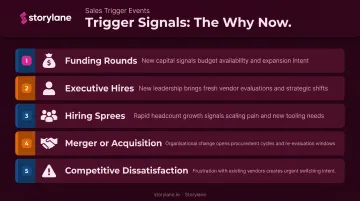
A new CRO joining a target account is one of the clearest trigger signals in B2B. That person typically has a 90-day window to establish their strategy, evaluate the current stack, and make changes. Outreach timed to that window — with a message tied to their new mandate — lands differently than a cold email in month seven.
Engagement Signals: How They Interact With You
Engagement signals are proprietary — generated from a prospect's direct interaction with your brand. They're stronger than intent signals because the prospect has moved from general research to actively evaluating your solution.
Key engagement signals include:
- Multiple pricing page visits from the same account
- Whitepaper downloads or case study reads
- Demo views, especially repeat visits or feature-specific engagement
- Webinar attendance from a buying persona
Most B2B teams overlook interactive demo engagement as a signal — which is exactly why it creates an edge. When a prospect revisits specific features, spends extended time on a particular demo step, or returns multiple times, they're revealing their exact priorities without saying a word.
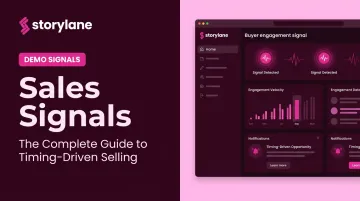
Storylane's Account Reveal feature surfaces this engagement in real time, de-anonymizing demo visitors with company and firmographic data and delivering Slack alerts directly to reps. No form fill required — reps see which accounts are actively evaluating their product and can follow up while interest is live.
The platform also tracks intent scoring, automatically classifying engagement as Low, Medium, or High based on time spent, completion rate, features explored, and return visits.
How to Identify High-Value Signals Worth Acting On
Not every signal deserves a same-day response. Chasing every data point creates signal fatigue and erodes trust with prospects who aren't ready. The real skill is building a prioritization hierarchy.
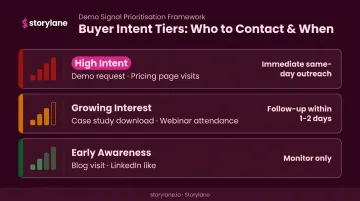
The Three-Tier Signal Framework
| Tier | Signal Type | Example | Action |
|---|---|---|---|
| Tier 1 | High intent | Demo request, multiple pricing page visits, direct competitive comparison | Immediate outreach — same day |
| Tier 2 | Growing interest | Case study download, webinar attendance, exec content engagement | Prompt follow-up within 1-2 days |
| Tier 3 | Early awareness | Single blog visit, LinkedIn like | Log and monitor; no direct outreach yet |
Signal Stacking: When Multiple Signals Converge
A single signal is a clue. When intent + engagement + trigger signals converge on the same account simultaneously, you've found a genuine high-priority opportunity.
Example: A target account (Tier 1 ICP fit) is comparing your product on G2 and just hired a new VP of Operations and one of their team members just completed your interactive demo. That's three signal types stacking on the same account within days of each other. That warrants urgent, personalized outreach, not a standard sequence.
Research on account scoring reinforces this point: equal signal weighting distorts prioritization. A junior employee opening 10 emails can technically "outscore" a VP requesting a single demo unless signals are weighted by persona and action type.
The ICP Filter Comes First
A Tier 1 signal from a company that doesn't fit your ICP is still noise. Before any signal triggers a sales play, run it through ICP qualification: firmographic fit, company size, industry, and technographic alignment. AI-powered tools can automate this scoring across hundreds of accounts simultaneously, ensuring reps only act on signals that actually matter.
Storylane's intent scoring filters engagement data by firmographics, so reps can segment audiences and build prioritized outreach lists instead of reacting to every demo view indiscriminately.
Timing Mistakes That Kill Conversions
Most signal failures aren't about missing the signal entirely. They're about mishandling it.
Acting on Everything
When reps treat a homepage visit the same as a pricing page visit, they flood prospects with irrelevant outreach. Gartner's 2025 survey of 632 B2B buyers found 73% actively avoid suppliers that send irrelevant outreach. Undifferentiated follow-up doesn't just fail — it damages the account relationship before a real conversation ever starts.
Tier 3 signals should stay in monitoring mode. They're not buying signals yet.
Waiting Too Long
Signal value decays rapidly. The HBR study mentioned earlier puts it starkly: responding within an hour versus waiting 24 hours produces a 60x drop in lead qualification rates.
Most teams aren't close to that threshold. InsideSales/XANT analysis of 5.7 million inbound leads found 57.1% of first call attempts happened more than a week after the initial signal.
A week after a prospect expressed interest, they've either moved deeper into a competitor's process or the urgency has evaporated entirely.
Mismatching Message to Signal Strength
The play must match the signal. Right timing with the wrong message is just as damaging as being late — and it happens more often than most reps realize.
Here's what correct signal-to-message matching looks like:
- Blog post read (Tier 3): Send a light, value-first touchpoint — a relevant resource or a single insight, not a pitch
- Demo completed + pricing page visited (Tier 1): Open a direct conversation about fit, timelines, and next steps
- LinkedIn engagement only: Acknowledge, don't sell — this prospect isn't in buying mode yet
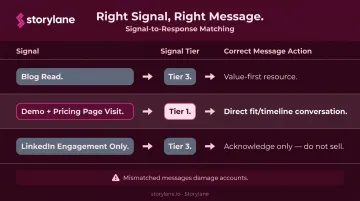
A hard pitch on a Tier 3 signal doesn't just go unanswered. It poisons the account for when the prospect does reach Tier 1.
What Happens When You Ignore or Mistime Sales Signals
The pipeline consequences are real and compound over time.
Deals that stall unexpectedly are often the result of missed signals — a competitive mention in a deal review, a budget freeze that wasn't flagged, a new stakeholder joining the evaluation whose questions went unanswered. These aren't mysterious; they're predictable when account intelligence is part of the process.
The late-stage cost is particularly damaging. 6sense's 2024 Buyer Experience Report found that 81% of B2B buyers have already selected a preferred vendor before speaking with a sales rep, and 69% of the purchase process is complete before they engage a seller.
Teams that wait for inbound signals, rather than actively identifying accounts already in a buying cycle, routinely enter conversations after a preferred vendor is already identified.
The organizational impact extends beyond individual deals:
- Reps running signal-blind outreach burn out faster; Salesforce found ~90% of sales reps experience burnout, driven by administrative load and unrealistic quota pressure
- Forecasting becomes unreliable when pipeline quality is unpredictable; Gartner reports only 7% of sales teams achieve 90%+ forecast accuracy
- SDR churn increases when teams aren't equipped with the intelligence to have relevant conversations
Building Your Timing-Driven Signal Playbook
A playbook turns signal-based selling from a concept into a repeatable process. Three components make it work.
Step 1: Lock Down Your ICP
Before defining which signals to monitor, get precise about who you're listening for. Document:
- Firmographic criteria (company size, industry, revenue range)
- Technographic criteria (current stack, tools they're replacing)
- Behavioral traits (how they typically evaluate software)
- Decision-making patterns (who influences the purchase)
A sharp ICP is what converts a flood of signal data into a prioritized list. Without it, you're optimizing the wrong accounts.
Step 2: Map Signals to Plays
For each Tier 1 and Tier 2 signal, define:
- The trigger — exactly what action or event qualifies
- The target persona — who you're reaching out to
- The channel — email, phone, LinkedIn, or a combination
- The message hook — what context from the signal makes this outreach relevant
Example play: A VP-level persona from an ICP-fit account completes your interactive demo and visits the pricing page within 48 hours.
- Trigger: Demo completion + pricing page visit (Tier 1)
- Persona: VP of Sales or VP of Revenue
- Channel: Direct email + LinkedIn connection request
- Hook: Reference specific features they explored; tie to their likely business objective
Storylane's demo analytics make this hook specific. Reps can see exactly which features a prospect spent time on, where they dropped off, and whether they returned for a second look — turning a generic follow-up into an informed, relevant conversation.
Step 3: Automate Signal Delivery into Existing Workflows
Signals only create value when they reach reps at the right moment. The best playbook breaks down if reps have to manually check a separate dashboard.
Connect your signal tools to where reps already work:
- CRM auto-sync — Storylane pushes demo engagement data directly to Salesforce and HubSpot, attributing engagement to the right account and contact
- Slack alerts — real-time notifications when high-intent accounts engage, so reps can follow up while the prospect is still actively evaluating
- Webhook integrations — trigger workflows in Clay, Zapier, or other tools based on specific engagement thresholds
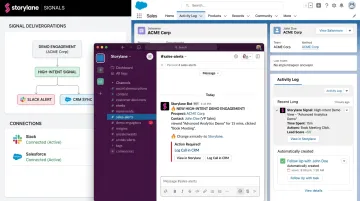
When a Tier 1 signal fires, the rep should have full context and a suggested play in front of them within minutes — no manual steps, no lag between signal and action.
Frequently Asked Questions
What are signals in sales?
Sales signals are specific, timely data points tied to a particular account — such as funding events, job postings, tech changes, or demo engagement — that indicate buying readiness or shifting priorities. They differ from generic market data by being account-specific and immediately actionable.
What is signal-based selling?
Signal-based selling replaces volume-based cold outreach with targeted engagement triggered by real-time buying events. Reps reach out when a prospect is actively in-market — not just when a calendar reminder fires.
What are the three types of sales signals?
Intent signals reveal what a company is researching (competitor comparisons, topic searches). Trigger/event signals are external changes — funding rounds, executive hires — that create urgency. Engagement signals are direct interactions with your brand, like demo views or pricing page visits.
How quickly should you respond to a sales signal?
Signal value degrades fast — leads contacted within an hour are up to 7x more likely to qualify than those followed up a day later. For Tier 1 signals like demo requests or multiple pricing page visits, same-hour outreach is the standard.
What is the difference between intent data and buying signals?
Intent data is a subset of buying signals, specifically tracking third-party research behavior — what topics an account is searching across the web. Buying signals is the broader category, including intent data, trigger events, and first-party engagement signals from your own properties.
Do I need dedicated software to track sales signals?
Standard CRM and marketing tools cover basic engagement signals like website visits and email opens. At scale, dedicated platforms automate detection, scoring, and routing. Storylane integrates with Salesforce, HubSpot, Marketo, and Slack to deliver real-time demo engagement signals directly into rep workflows.