Sales reps waste hours chasing contacts who downloaded a single blog post and never came back. Meanwhile, genuinely interested prospects — the ones who've visited your pricing page three times and registered for a webinar — sit untouched in a CRM queue. According to MarketingSherpa, only 27% of B2B inquiries are actually qualified and ready for sales, meaning roughly three-quarters of leads aren't worth a sales call yet.
Marketing Qualified Leads (MQLs) are how you fix that prioritization problem.
This article covers what an MQL is, how it differs from a Sales Qualified Lead (SQL), how to score and qualify MQLs effectively, and which tactics generate the most of them.
Key Takeaways
- An MQL is a prospect who has shown genuine interest through trackable behavior — but isn't ready for a sales pitch yet
- "Qualified" means agreed-upon criteria between marketing and sales — not gut feel
- Lead scoring combines fit data (who they are) and behavioral data (what they've done)
- Interactive demos are one of the strongest MQL signals available — they show hands-on intent
- MQL-to-SQL conversion rate and Cost Per MQL are the two metrics that matter most
What Is a Marketing Qualified Lead (MQL)?
An MQL is a prospect who has taken specific, trackable actions indicating genuine interest in your product or service, but who hasn't yet shown clear purchase intent.
The "qualified" part is what separates an MQL from any random website visitor. HubSpot defines an MQL as "a contact who's engaged with marketing content and shows potential interest but isn't ready for a sales pitch yet." That qualification is determined by pre-agreed criteria between marketing and sales — not gut feel, not volume metrics, and not assumptions.
Without a shared MQL definition, marketing and sales operate from completely different scorecards. Marketing celebrates lead volume; sales complains the leads are useless. An MQL definition creates a common language that forces both teams to agree on what "worth pursuing" actually looks like.
What an MQL Is NOT
- Every website visitor who lands on your site does not qualify
- Becoming an MQL carries no guarantee of future purchase
- Receiving a hard sales pitch immediately is the wrong next step
Think of it like someone browsing in a store. They've picked up a few products, spent time in the right aisle, and checked the price tags. They're interested — but they're not at the register yet.
Where MQLs Sit in the Funnel
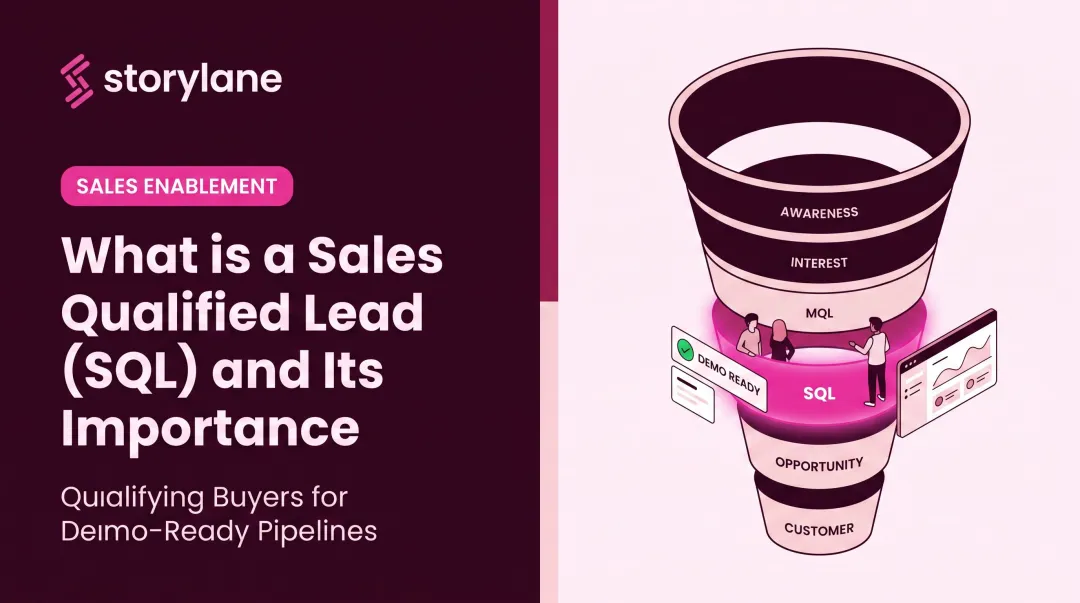
MQLs live in the awareness-to-consideration phase — top to middle of the funnel. They've raised their hand in some way, but they still need nurturing before they're ready for a sales conversation.
A concrete example: A VP of Operations at a 300-person software company downloads your pricing comparison guide, visits your features page three times over two weeks, and registers for an upcoming webinar. Scored against pre-set criteria, that behavioral pattern makes them an MQL — someone worth investing more marketing attention in, not someone to hand straight to a sales rep for a demo close.
MQL vs. SQL: Key Differences
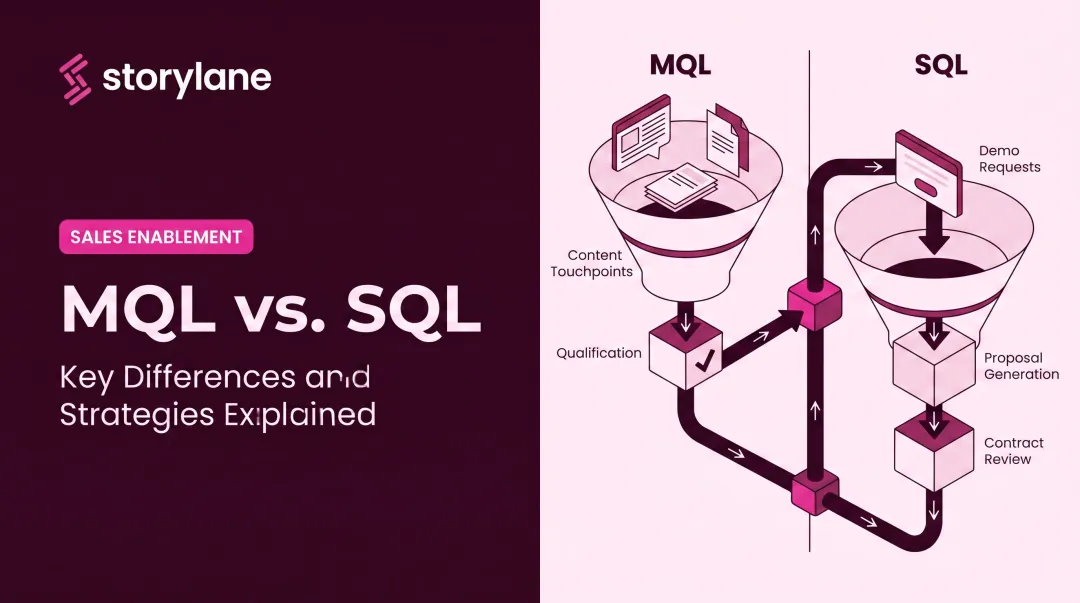
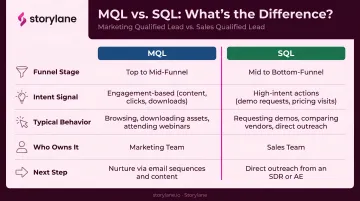
The distinction between an MQL and a Sales Qualified Lead (SQL) comes down to purchase intent, not just engagement level.
Adobe clarifies this well: an MQL is someone who expressed interest; an SQL is someone interested and intending to purchase. That distinction determines who owns the next step and what that step looks like.
Side-by-Side Comparison
| MQL | SQL | |
|---|---|---|
| Funnel stage | Awareness / consideration | Decision / action |
| Intent signal | Expressed interest | Clear purchase intent |
| Typical behavior | Downloads ebook, attends webinar, visits product page | Requests a live demo, asks about pricing, inquires about implementation |
| Who owns it | Marketing | Sales |
| Next step | Nurture sequence | Direct sales conversation |
Who Owns Each Stage
Marketing owns MQL generation and nurturing; sales takes over once a lead becomes an SQL. The handoff between the two is where deals most often fall through the cracks — usually because the criteria for that transition were never clearly defined upfront by both teams.
How to Score and Qualify MQLs
Lead scoring is how you operationalize MQL qualification. It assigns numerical point values to leads based on two dimensions: who they are (fit) and what they do (behavior). When a lead's combined score crosses a preset threshold, they become an MQL.
There's no universal scoring model. Each company must build one based on its own Ideal Customer Profile (ICP).
Fit Data (Explicit Scoring)
These signals tell you whether a lead is the right type of person — not whether they're ready to buy:
- Firmographics — company size, industry, annual revenue
- Demographics — job title, seniority, department
- Technographics — whether their existing tech stack is compatible with your product
A CMO at a 500-person SaaS company scores higher than an intern at a 10-person agency — not because one person is more engaged, but because one fits your ICP more closely.
Behavioral Data (Implicit Scoring)
These signals tell you whether a lead is warming up:
- Visited your pricing page (especially multiple times)
- Downloaded a gated asset (ebook, whitepaper, report)
- Registered for or attended a webinar
- Started a free trial
- Clicked through multiple emails in a nurture sequence
- Returned to your website repeatedly within a short window
Demand Gen Report's 2016 Lead Scoring Survey found that **74% of respondents cited lead prioritization** as the top benefit of scoring — meaning the primary value isn't prediction accuracy, it's helping sales focus on the right leads.
The BANT Framework
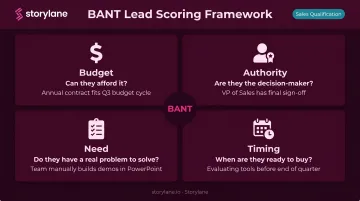
Many B2B teams layer BANT onto their scoring model to assign weight to certain signals:
- Budget — Does the prospect have funds allocated for this type of solution?
- Authority — Are they a decision-maker, or do they need to escalate?
- Need — Does their situation match the problems your product solves?
- Timing — Are they evaluating now, or in 12 months?
For a SaaS buyer, "timing" might surface when they request a demo during a fiscal quarter-end, or when they mention a contract renewal window in a form response.
Keep the Model Current
A scoring model built in isolation by marketing will miss what sales actually encounters in conversations. Build it together, then revisit it at least quarterly.
When you audit the model, check whether these still reflect reality:
- ICP definition — Have your best-fit customers shifted by size, industry, or role?
- Behavioral weights — Are the same actions still predicting pipeline, or has buyer behavior changed?
- Threshold calibration — Are too many MQLs being rejected by sales, or too few reaching them?
- Product positioning — Have new use cases or features changed what "good fit" looks like?
As the business evolves, so does what good looks like. The model needs to stay aligned with that reality.
Common MQL Behaviors and Signals
Not all actions carry equal weight. Here are the signals that most reliably indicate MQL-level intent in B2B SaaS:
High-intent signals:
- Filling out a "get more info" or contact form
- Downloading a gated asset (whitepaper, pricing guide, competitive comparison)
- Registering for a webinar
- Visiting a pricing page multiple times
- Starting a free trial
- Engaging with an interactive product demo
Lower-intent signals (not sufficient alone):
- A single blog post visit
- Following on social media
- Opening one email in a sequence
The key is the pattern, not the individual action. One blog visit means nothing. Three visits to your product page, combined with a guide download and a webinar registration, constitute a composite signal worth acting on.
Why Interactive Demos Are a Particularly Strong Signal
When a prospect actively explores your product through an interactive demo — clicking through feature flows, revisiting specific screens, completing the experience — they're showing hands-on curiosity that passive content consumption simply can't match. That level of engagement is a reliable indicator of genuine purchase intent.
Storylane's Demo Signals capability tracks time spent, completion rates, feature exploration depth, return visits, and CTA clicks — then automatically classifies prospects as Low, Medium, or High intent based on those engagement patterns.
For anonymous visitors, Storylane's Account Reveal feature de-anonymizes demo viewers with enriched firmographic data, converting unknown traffic into identified MQL candidates your team can actually act on.
Real-time Slack and email alerts notify sales teams the moment a high-intent prospect engages, so follow-up happens while the prospect is still actively evaluating — before the window closes.
How to Generate and Nurture MQLs
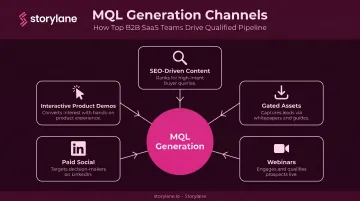
Generating MQLs means creating content and experiences that attract the right prospects and prompt them to take qualifying actions. The core inbound channels:
- SEO-driven content — blog posts, guides, and comparison pages that attract in-market buyers
- Gated assets — ebooks, templates, and research reports that require a form fill
- Webinars — high-intent registrations that combine fit data (job title) with behavioral signal (showing up)
- Paid social — LinkedIn lead gen forms targeting specific ICP job titles and company sizes
- Interactive product demos — embedded on landing pages or shared via email to let prospects self-qualify
Retargeting as an MQL Accelerator
Once a prospect has engaged with a piece of content or visited a landing page, retargeting campaigns can pull them back with more relevant content. Someone who read your "how to evaluate CRM options" guide, for example, is a strong candidate for a retargeting ad promoting a product comparison demo. That one step moves them from awareness toward active consideration.
Email Nurture Sequences
After a qualifying action (downloading a guide, attending a webinar), a structured email sequence can deliver progressively more product-specific content. The goal is to move prospects from awareness to consideration — not to send a sales pitch on day two. Sending too early is one of the most common MQL mistakes.
According to research cited by HubSpot, companies that excel at lead nurturing generate 50% more sales-ready leads at 33% lower cost — the compounding effect of not forcing leads through the funnel before they're ready.
How Interactive Demos Shorten the Path from Interest to Sales Conversation
Storylane demos can be embedded directly on landing pages, shared via personalized email links, or organized into Buyer Hubs — a centralized gallery where prospects self-navigate through multiple product experiences at their own pace.
Because the demo is interactive rather than passive, prospects arrive at sales conversations already familiar with the product — less time on basics, more time on fit. Storylane's custom lead capture forms, embedded directly inside the demo, collect contact information in context and push that data straight to connected CRMs like Salesforce, HubSpot, and Marketo.
Landing Page Optimization
Short, focused landing pages with a single CTA and minimal form fields convert more visitors into MQLs. HubSpot's analysis of 40,000+ landing pages found that adding phone, age, and geographic fields was associated with lower conversion rates. Fewer fields reduce friction — a principle ContactMonkey validated firsthand when reducing their Storylane demo form from six fields to three pushed their form conversion rate from 11% to 15%.
How to Measure MQL Success
Two metrics tell the complete story of your MQL program:
1. Cost Per MQL (CPMQL)
Formula:
CPMQL = Total Campaign Spend ÷ Number of MQLs Generated
If you spent $20,000 across paid social and content in a quarter and generated 200 MQLs, your CPMQL is $100. Tracking this per channel helps you identify which sources deliver the most efficient pipeline entry points.
2. MQL-to-SQL Conversion Rate
This is the percentage of MQLs that sales accepts and advances into active pipeline. It's the clearest indicator of lead quality — and the most common place where sales-marketing misalignment surfaces in your numbers.
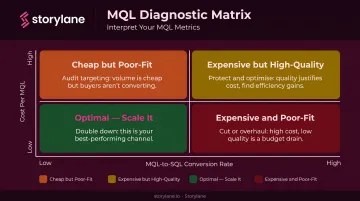
How to read the two metrics together:
| Scenario | Diagnosis |
|---|---|
| Low CPMQL + Low MQL-to-SQL | Cheap but poor-fit leads — scoring criteria too loose |
| High CPMQL + High MQL-to-SQL | Expensive but high-quality leads — evaluate channel efficiency |
| High CPMQL + Low MQL-to-SQL | Expensive and poor-fit — revisit ICP and channel targeting |
| Low CPMQL + High MQL-to-SQL | Optimal — scale what's working |
For reference: First Page Sage's 2025 B2B SaaS funnel data shows a 38% MQL-to-SQL conversion rate for cybersecurity SaaS — treat it as a category-specific data point, not a universal target. Your numbers will shift based on industry, deal size, and how tightly you've drawn your MQL definition.
Frequently Asked Questions
What is an example of a marketing qualified lead?
A VP of Sales at a 200-person software company downloads a competitive comparison guide and visits your pricing page twice within a week. If that combination of role, company size, and behavioral engagement meets your preset lead score threshold, that prospect qualifies as an MQL.
How do you get marketing qualified leads?
The core channels include:
- Gated content (ebooks, templates, webinars)
- SEO-driven blog content targeting in-market searches
- Paid social campaigns on LinkedIn targeting ICP personas
- Interactive product demos embedded on landing pages
- Retargeting campaigns
Each channel needs to feed into a lead scoring model so you can identify which leads actually qualify.
What is the difference between an MQL and a SQL?
An MQL is a lead marketing has identified as worth nurturing based on interest and engagement signals. An SQL is a lead sales has vetted as ready for a direct sales conversation. The difference is purchase intent — and which team is responsible for the next action.
What is a good MQL-to-SQL conversion rate?
Rates vary significantly by industry and deal size. First Page Sage's 2025 benchmark for cybersecurity SaaS puts it at 38%, but treat it as a directional benchmark, not a universal target. Improving your rate typically requires tightening lead scoring criteria and aligning marketing and sales on what "sales-ready" actually means.
What criteria should you use to qualify an MQL?
Use two dimensions: fit criteria (job title, company size, industry, decision-making authority) and behavioral criteria (content downloads, pricing page visits, demo engagement, webinar attendance). The exact criteria must be agreed upon jointly by marketing and sales — not defined unilaterally by either team.
How does lead scoring work for MQLs?
Lead scoring assigns point values to leads based on firmographic and demographic fit combined with behavioral actions. When a lead accumulates enough points to cross a preset threshold, they're classified as an MQL. From there, they either enter a nurture sequence or get passed directly to sales, depending on how high their score is.