
.svg)

Introduction
Most B2B buyers have already shortlisted vendors — sometimes even formed a preference — before a sales rep enters the picture. Gartner research finds that 67% of B2B buyers now prefer a rep-free buying experience, and 70% prefer a completely digital, self-service process. For sales and marketing teams, this is a real problem: the decisions that matter most happen before you're even in the room.
Understanding the B2B buyer journey directly determines what content you create, when sales reaches out, and how you structure every touchpoint from first impression to signed contract.
This guide walks through each stage of the journey, explains how modern buyer behavior has shifted, and shows how to optimize your approach at every touchpoint — from awareness through close.
Key Takeaways
- B2B buyers complete most of their research independently, well before any vendor enters the picture
- Purchases involve 6–13 stakeholders across departments, each needing different information
- The journey is non-linear: buyers loop back as new stakeholders join or priorities shift
- Consideration-stage optimization is where most deals are won or lost — before sales even enters the conversation
- Post-purchase experience directly drives revenue through retention, expansion, and referrals
What Is the B2B Buyer Journey?
The B2B buyer journey is the end-to-end process a business goes through — from first recognizing a problem to selecting a vendor and signing a contract. Crucially, it doesn't stop at contract signature. Implementation success, ongoing value realization, and advocacy all feed the next growth cycle.
How It Differs from B2C
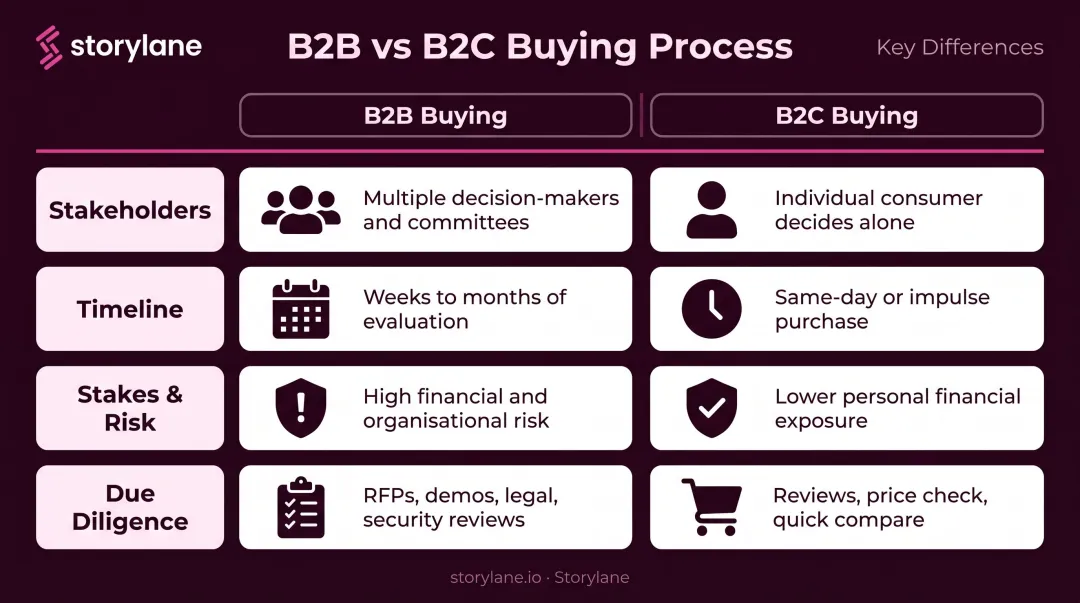
The surface-level answer is "more complex," but the specific differences matter:
- Multiple stakeholders — a B2C purchase is usually one person deciding; B2B involves committees with competing priorities
- Longer timelines — B2B buying cycles often span months, with enterprise deals frequently exceeding six months
- Higher stakes — Forrester reports that 86% of B2B purchases stall during the buying process, and 81% of buyers express dissatisfaction with chosen providers — a clear indicator of how much risk is involved
- Rigorous due diligence — B2B buyers conduct formal evaluations, security reviews, legal checks, and ROI analyses that simply don't exist in B2C
Why Non-Linearity Matters
The B2B buyer journey is rarely a clean funnel. Buyers loop back through stages when new stakeholders join the evaluation, budgets shift, or a competitive option surfaces late in the process. A prospect who seemed ready to decide may restart the consideration stage entirely after IT raises new security questions.
Mapping this non-linear path forces you to account for re-entry points — the moments where the wrong content, a missed follow-up, or an unanswered objection costs you a deal that was nearly closed.
The Key Stages of the B2B Buyer Journey
Most frameworks use three to five stages. The core structure covers Awareness, Consideration, Decision, and post-purchase — and understanding all four gives teams a meaningful advantage over competitors who only focus on top-of-funnel.
Awareness Stage
At awareness, a buyer recognizes symptoms of a problem but hasn't yet named it or identified a solution category. They're experiencing friction — workflows that are slower than they should be, a metric that's consistently off, a team complaint that keeps recurring — but they haven't framed it as a solvable business problem yet.
B2B awareness typically builds over weeks through accumulating friction, not a single moment of clarity.
At this stage, the people involved are typically end users, department managers, or a frustrated team lead — not yet procurement or IT. What they need is educational, problem-framing content: language to describe what they're experiencing and confirmation that it's a real, solvable problem. Product comparisons are premature.
Consideration Stage
Consideration is where buyers shift from understanding the problem to evaluating solution types and building shortlists. By the time they reach out to a vendor, many have already formed a strong preference. The outreach itself is often about validation, not genuine open-ended evaluation.
Buyers at this stage are actively seeking:
- Comparison guides between solution approaches
- Case studies with measurable outcomes
- ROI models and TCO calculations
- Peer reviews on G2, TrustRadius, or similar platforms
This is also where self-serve interactive demos have replaced the traditional "schedule a call" gate. Buyers want to explore on their own terms before talking to anyone. Tools like Storylane let prospects work through role-specific product tours at their own pace — and automatically notify sales teams when a prospect engages, so reps can follow up with real context rather than a cold intro.
Decision Stage
Decision-stage buying is fundamentally an internal coordination problem. Buyers aren't just evaluating vendors — they're navigating cross-functional alignment among finance, IT, legal, procurement, and executive sponsors, each with different concerns and different veto points.
What actually drives vendor selection at this stage goes beyond features:
- Implementation track record and onboarding methodology
- Support model and responsiveness
- Team credibility during the sales process
- Total cost of ownership, not just license price
- Cultural fit with the buying organization
Closing in B2B is really about helping the buying group build internal confidence to get approval — not about a final sales push.
Post-Purchase
The journey doesn't end at contract signature. Implementation success, ongoing value realization, and how well a vendor supports adoption directly determine whether a customer renews, expands, or becomes an active advocate.
This matters financially. SaaS Capital data shows that increasing net revenue retention from the 90–100% range to 100–110% improves growth rate by 5 percentage points. Post-sale experience isn't a service obligation — it's a revenue lever.
How the Modern B2B Buyer Has Changed
Self-Directed Research Is the Default
Today's B2B buyers don't wait for vendor outreach to start learning. TrustRadius found that 76% of buyers' first step after identifying a need was independent research — only 24% reached out to a salesperson first.
The research channels have also multiplied. Gartner reports that 45% of B2B buyers now use generative AI to gather information on vendors and products during a recent purchase, while 72% of B2B tech buyers encountered Google's AI Overviews during their research. Buyers are evaluating vendors across:
- Search engines and AI tools like ChatGPT and Perplexity
- Peer review platforms (G2, TrustRadius, Capterra)
- LinkedIn discussions and private Slack communities
Often, this happens well before any vendor knows they're in an evaluation.
Younger Buyers, Higher Self-Service Expectations
Forrester's Buyers' Journey Survey found that Millennials and Gen Z now represent 64% of B2B buyers. These buyers default to consumer-like self-service experiences and are more skeptical of vendor claims than previous generations. They expect to be able to evaluate a product on their own terms before engaging a sales team.
Trust Is Harder to Earn
Vendor credibility is increasingly fragile. Gartner found that 69% of B2B buyers report inconsistencies between information on a vendor's website and what sellers actually say — a gap that erodes trust at the worst possible moment. Meanwhile, Edelman reports that 73% of B2B decision-makers consider thought leadership more trustworthy than marketing materials or product sheets.
Authentic social proof — peer reviews, reference calls, case studies with real numbers — carries far more weight than branded marketing materials.
Who's Involved: The B2B Buying Committee
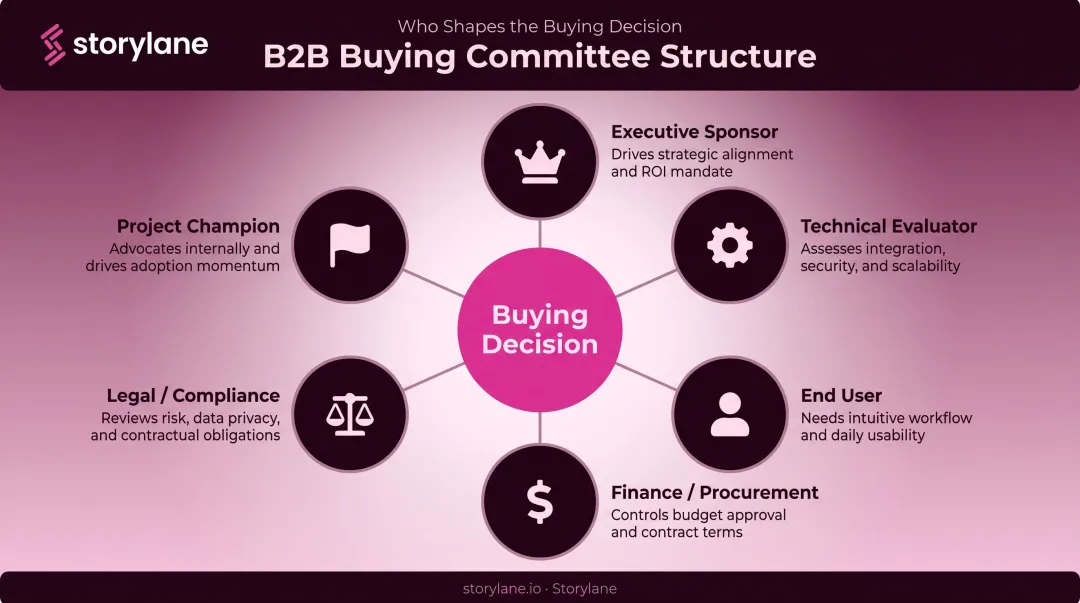
Modern B2B purchases are committee decisions. Gartner puts the typical buying group for a complex solution at 6 to 10 decision-makers; Forrester's 2026 research puts the figure even higher at 13 internal stakeholders.
Key Roles in a Typical Buying Committee
| Role | Primary Concern |
|---|---|
| Executive Sponsor | Strategic fit, business outcomes, budget authority |
| Technical Evaluator | Security, integrations, implementation complexity |
| End User | Day-to-day usability, workflow fit |
| Finance/Procurement | Total cost, contract terms, ROI |
| Legal/Compliance | Data handling, contractual risk |
| Project Champion | Internal coordination, building consensus |
Each role comes to the table with different priorities. Finance wants ROI models and payback timelines; IT needs security documentation and integration specs; end users want to see the product working for their actual tasks — not a polished demo built around someone else's workflow.
The Implication for Go-to-Market
Effective B2B go-to-market strategies must address the full buying committee — not just the champion who initiated the evaluation. Gartner reports that 74% of B2B buyer teams demonstrate unhealthy conflict during the decision process, which means internal alignment is often the primary obstacle to a closed deal — not competitive differentiation.
Role-appropriate content is what breaks that logjam: ROI models for finance, security docs for IT, and workflow-specific demos for end users — each delivered at the moment that stakeholder enters the evaluation.
How to Optimize Each Stage of the B2B Buyer Journey
Stage-appropriate optimization means removing friction at every decision point, building confidence before buyers ask for it, and delivering what they need to move forward — without waiting on a sales rep to prompt them.
Awareness Optimization
At awareness, the goal is to help buyers recognize and articulate their problem before they're ready to hear about solutions. Pushing product messaging here is counterproductive.
Effective awareness tactics:
- SEO-optimized educational content that frames common problems in the language buyers already use
- Thought leadership that addresses industry challenges without leading with product features
- "Signs you have this problem" guides that help buyers diagnose friction they've been tolerating
- AI search visibility — since buyers increasingly use generative AI tools for early research, content needs to be structured for AI Overviews and conversational queries, not just traditional search
At Storylane, we publish how-to content around the tools and workflows our audience already uses — so potential buyers find value well before they encounter a product pitch.
Consideration Optimization
This is where most competitive differentiation happens, and most companies underinvest.
High-impact consideration-stage assets:
- Comparison guides between solution approaches (not just "us vs. competitor")
- Case studies focused on methodology and measurable outcomes, not just brand names
- ROI calculators that let buyers model their own business case
- Transparent competitor comparisons that address objections head-on
Remove Demo Friction
Requiring buyers to schedule a call before experiencing the product creates exactly the kind of delay that causes prospects to disengage or default to a competitor they already know. Storylane lets buyers access self-serve interactive demos — complete with multi-chapter paths for different roles, AI-guided walkthroughs, and embedded lead capture — without requiring a sales call.
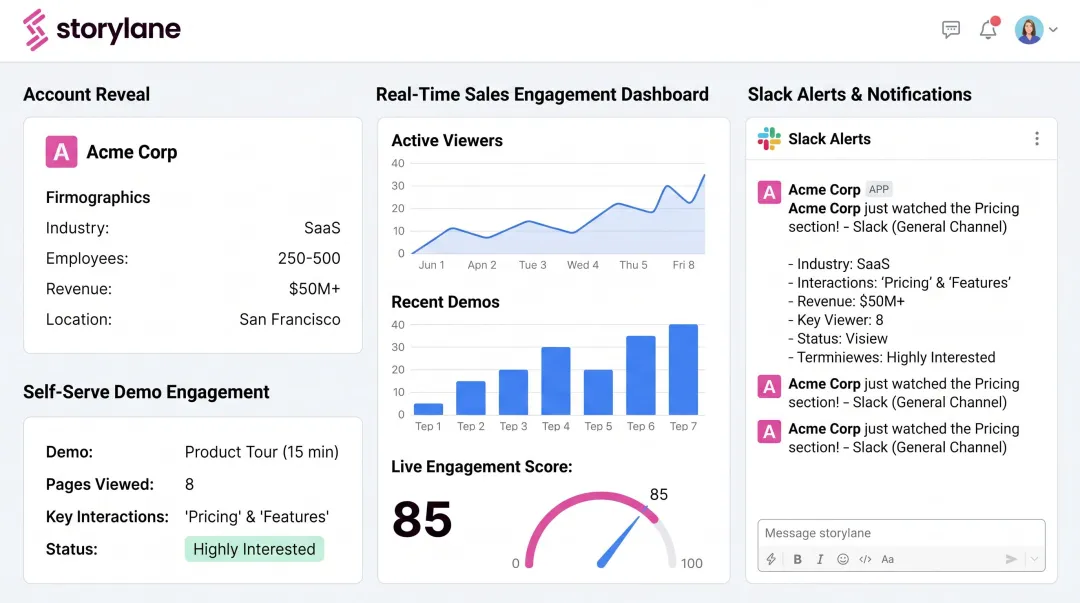
When a prospect engages, Storylane's Account Reveal feature de-anonymizes the visitor, surfaces enriched firmographic data, and fires real-time Slack alerts to the sales team. The result: sales reaches out at peak interest with full context on what the buyer actually explored, rather than cold-calling a form submission from three days ago.
Decision Optimization
Decision-stage optimization is primarily about reducing doubt and supporting internal buy-in.
What to provide:
- Implementation methodology documentation — buyers need to understand what happens after they sign
- Success stories with specific, measurable outcomes — not general testimonials
- Transparent pricing guidance — Forrester found that price transparency is a direct accelerator of B2B buying decisions
- Security and compliance documentation for IT and legal evaluators
Sales reps at this stage should shift from pitching to facilitating. The job is to help the buying group build the internal case for approval, not to convince the champion who's already sold.
Storylane's Buyer Hub gives buying committees a centralized space to review all relevant demos independently — organized by role or use case — so each stakeholder can evaluate on their own terms. Private demo links with unique tracking let sales teams see exactly which stakeholders have engaged and what they explored, enabling well-timed, targeted follow-up conversations.
How to Build a B2B Buyer Journey Map
A B2B buyer journey map is a visual representation of how your buyers actually move from problem recognition to purchase — including key touchpoints, stakeholder involvement, questions at each stage, and gaps in your current approach. It's a living document, not a one-time deliverable.
Steps to Build One
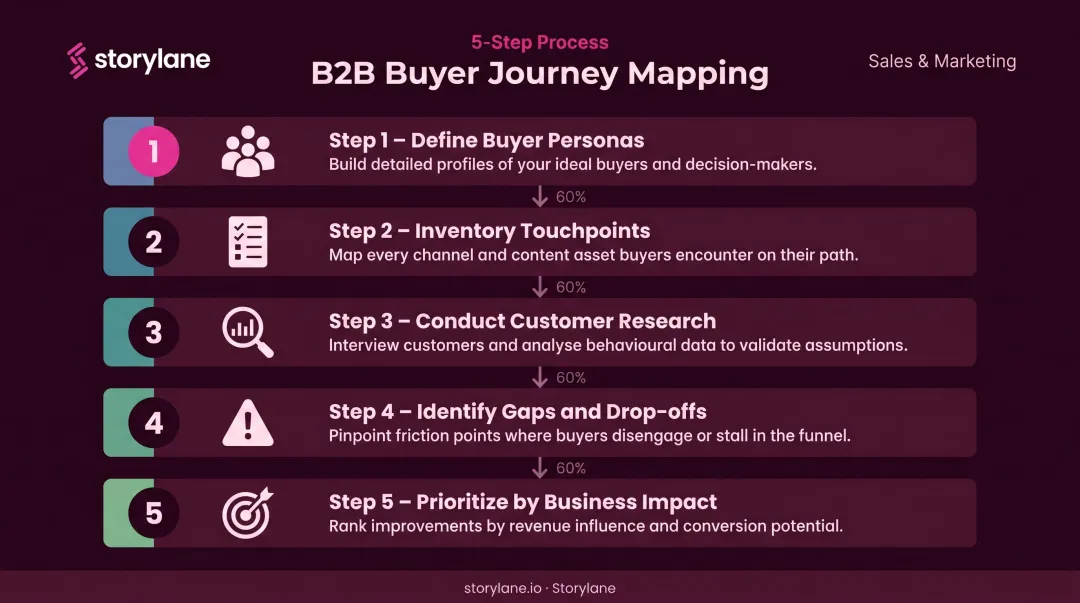
- Define buyer personas — include all relevant stakeholder roles, not just the primary contact
- Inventory existing touchpoints — categorize content, channels, and sales touchpoints by journey stage
- Conduct customer research — interviews, CRM win/loss data, and deal review sessions reveal what actually happens vs. what your team assumes
- Identify gaps and drop-off points — where do prospects stall, disengage, or go dark?
- Prioritize improvements by business impact — not everything needs fixing at once; focus on the gaps that affect the most deals
For steps 3 and 4, Storylane's demo analytics add a useful data layer. Drop-off points within interactive demos directly mirror where buyers lose confidence or hit friction in the broader journey. CRM-synced engagement data shows which demo content correlates with deals that progress versus stall.
Putting the Map to Work
The map is most valuable as a shared, cross-functional tool:
- Marketing identifies content gaps at each stage
- Sales enters calls knowing what buyers have already seen and what objections to expect
- Customer success designs onboarding that reflects how buyers actually made their decision
A buyer journey map that lives in a single slide deck adds no ongoing value. Treat it as a working document — review it quarterly against new win/loss data, and let each team update their section as the market shifts.
Frequently Asked Questions
What is the B2B buyer journey?
The B2B buyer journey is the end-to-end process a business follows from recognizing a problem to selecting a vendor. It spans multiple stakeholders, independent research phases, and formal evaluation steps — and typically extends beyond contract signature into implementation and ongoing value realization.
What are the steps in the B2B customer journey?
There are four core stages: Awareness (recognizing and defining a problem), Consideration (evaluating solution types and shortlisting vendors), and Decision (gaining cross-functional alignment and internal approval). Post-purchase extends the journey into implementation, adoption, and advocacy.
How long does the B2B buyer journey typically take?
B2B buying cycles span weeks to months depending on deal size and complexity. Enterprise purchases frequently take six months or longer due to the number of stakeholders, approval layers, and due diligence requirements involved.
How many stakeholders are involved in a B2B buying decision?
Research puts the number between 6 and 13: Gartner cites 6 to 10 decision-makers for complex B2B solutions, while Forrester's 2026 research puts the typical buying decision at 13 internal stakeholders. Buying committees span operations, IT, finance, legal, and executive leadership.
How is the B2B buyer journey different from B2C?
B2B involves committees rather than individuals, longer decision timelines, higher financial and operational stakes, and decisions driven by business ROI rather than personal preference. Due diligence in B2B includes formal security reviews, legal evaluation, and multi-department sign-off.
What content works best for each stage of the B2B buyer journey?
Educational blogs and thought leadership for awareness; comparison guides, case studies, ROI calculators, and interactive demos for consideration; implementation documentation, measurable success stories, and transparent pricing for the decision stage.