The core difference is simple: your pipeline tracks what your sales team does to close deals; your funnel measures how prospects move through their buying journey. One is internal and seller-driven; the other is external and buyer-driven.
This article covers both definitions, a side-by-side comparison, the key differences that matter for revenue, and how to use them together.
Key Takeaways
- A sales pipeline is seller-facing — it tracks the stages and actions your team takes from lead to close
- A sales funnel is buyer-facing — it visualizes the prospect's journey from awareness to purchase and measures conversion at each stage
- The pipeline tells you what your team is doing; the funnel tells you how buyers are responding
- You need both — pipeline for day-to-day deal management, funnel to diagnose where leads drop off
- Used together, they show you where deals stall, why leads go cold, and which reps need coaching
Sales Pipeline vs. Sales Funnel: Quick Comparison
| Sales Pipeline | Sales Funnel | |
|---|---|---|
| Focus | Deal activity and progression | Lead volume and conversion rates |
| Perspective | Seller-facing | Buyer-facing |
| Shape/Visualization | Horizontal stages (linear) | Wide-to-narrow (volume shrinks) |
| Stages Based On | Seller actions and handoffs | Buyer intent and mental state |
| Key Metrics | Deal size, velocity, win rate | Stage conversion rates, drop-off points |
| Primary User | Sales reps and managers | Marketing and sales ops teams |
| Customizable? | Yes — stages vary by company | Yes — model varies by business type |
Both tools map the same revenue process — the pipeline tracks what your sales team does, while the funnel tracks how buyers move through it. Used together, they give you a complete picture of where deals are won and where they're lost.
What Is a Sales Pipeline?
A sales pipeline is a structured, seller-centric model that tracks every active deal and the specific actions a rep must take to move it forward. It's primarily a management and forecasting tool — it answers "what is our team doing right now, and are we on track?"
Core Pipeline Stages
Most B2B pipelines follow a version of this sequence:
- Lead Generation — Identifying and sourcing potential buyers
- Prospect Qualification — Confirming fit, budget, authority, and need
- Meeting/Demo — Presenting the product and understanding requirements
- Proposal — Delivering a formal offer or solution recommendation
- Negotiation — Aligning on terms, pricing, and contract details
- Closed Won/Lost — Deal outcome recorded
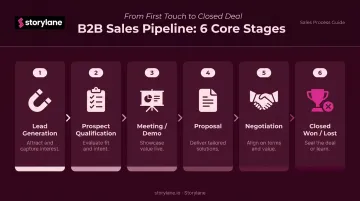
Stages vary by company, but they always reflect seller actions, not buyer emotions. A deal in "Proposal" tells you a document was sent — not whether the buyer is excited or ready to sign.
Pipeline Visualization
The pipeline is depicted as a horizontal bar or series of columns — not a funnel shape. Deals move linearly from left to right, with each stage representing a clear action or handoff. A deal sitting in "Proposal" means a proposal has been sent; it doesn't tell you how the buyer feels about it.
Key Pipeline Metrics
Sales managers track these to forecast revenue and coach reps:
- Number of deals per stage — identifies bottlenecks and rep workload
- Average deal size — informs revenue projections
- Sales cycle length — Richardson defines sales velocity using the formula: (opportunities × deal size × win rate) ÷ cycle length
- Pipeline velocity — how fast deals move through to close
- Win rate — the Bridge Group's 2024 SaaS benchmark puts median win rate at 19% across 172 B2B SaaS companies
Where Interactive Demos Fit In
Those metrics — especially sales cycle length and win rate — are directly affected by what happens at the Meeting/Demo stage. The quality of the demonstration often determines whether the deal advances.
Tools like Storylane let reps send interactive product demos before the sales call, so prospects arrive having already explored the product. Campminder reported that deals previously taking up to 6 weeks now close in as little as 2 weeks after adopting this approach — reps skip basic discovery and move straight into high-intent conversations.
Pipeline Use Cases
The pipeline is most valuable for:
- Sales managers tracking rep activity and deal health in real time — "which deals are at risk?" and "is my team on pace for quota?"
- Revenue forecasting — knowing the value and stage of every active deal lets leaders project revenue with much higher confidence than gut-feel estimates
What Is a Sales Funnel?
A sales funnel is a buyer-centric model that visualizes how a large pool of prospects narrows as they move through awareness, interest, consideration, and decision. Where the pipeline counts deals, the funnel measures conversion rates — and that's a meaningful difference.
The Funnel's Shape
The funnel is wide at the top because many prospects enter at the awareness stage. It narrows at every step because not all of them advance. This visual compression isn't a flaw — it's the whole point. The shape reveals where the biggest drop-off occurs, which tells you where to focus improvement efforts.
Core Funnel Stages
| Stage | What It Reflects |
|---|---|
| Awareness | Prospect discovers a problem or your solution |
| Interest | Actively researching options, consuming content |
| Consideration | Evaluating your product against alternatives |
| Decision | Ready to commit; reviewing proposals and pricing |
| Loyalty/Advocacy | Post-purchase retention and referrals (optional stage) |
These stages reflect the buyer's mental state, not the seller's actions. A prospect can sit in "Consideration" for weeks regardless of how many follow-up emails your rep sends.
Key Funnel Metrics
- Stage-to-stage conversion rates — the primary signal of funnel health
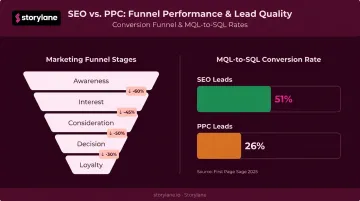
- MQL-to-SQL conversion — First Page Sage's 2025 B2B SaaS benchmark puts this at 51% for SEO-sourced leads and 26% for PPC leads, meaning nearly half to three-quarters of marketing-qualified leads don't reach sales qualification
- Drop-off points by stage — identifies where the funnel leaks most
- Lead-to-customer ratio — overall efficiency of the revenue process
The Marketing-Sales Handoff
Marketing owns the top of the funnel (awareness, interest). Sales takes over once a prospect is qualified. The MQL-to-SQL transition is where most B2B organizations lose the most leads — and Forrester research found that 65% of sales and marketing professionals report a lack of alignment between their leaders, even as 82% of C-suite executives believe the teams are aligned.
One way teams close that gap is by moving qualification earlier in the process. When prospects engage with an interactive demo and submit a form inside it, they arrive at the handoff already product-qualified — no rep follow-up required. CodeSignal, for instance, treats those form submissions as auto-MQL handraisers and routes them straight into Salesforce via Marketo integration.
Funnel Use Cases
- Pinpoint bottlenecks — a sharp drop between two stages signals poor lead quality, weak nurturing, or pricing friction
- Align marketing and sales — funnel reporting creates a shared language so both teams agree on what "qualified" means and where responsibility shifts
Key Differences Between Sales Pipeline and Sales Funnel
Perspective and Ownership
The pipeline is internal. Sales reps and managers control it directly by updating stages and logging activities. The funnel is external — you can only influence it indirectly, by improving outreach quality, nurturing sequences, and messaging at each stage.
Shape and Structure
The pipeline is linear: deals move forward through defined stages one action at a time. The funnel is volume-based: prospects can stall, re-enter, or exit at any stage, and the shape reflects the shrinking number of leads at each level. Unlike a funnel, where prospects drop out entirely, a deal in the pipeline stays active until it's explicitly won or lost.
What Each Measures
| Sales Pipeline | Sales Funnel | |
|---|---|---|
| Measures | Deal activity, velocity, rep performance | Conversion rates, buyer behavior over time |
| Data type | Current snapshot of active deals | Historical cohort view revealing patterns |
| Primary question | What are we doing? | How well is it working? |
What Each Helps You Improve
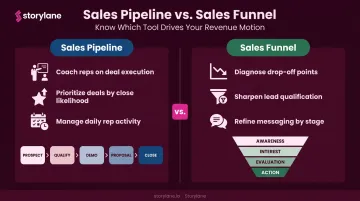
- Pipeline data → coach reps, prioritize deals, manage daily sales activity
- Funnel data → diagnose where prospects drop off, sharpen lead qualification, and refine messaging by stage
How to Use Both Together to Drive Revenue
The real value comes from connecting the two. Funnel data tells you where buyers drop off; pipeline data tells you what your team was doing at that moment.
Connect Funnel Signals to Pipeline Activity
Map funnel conversion rates back to pipeline stages. If your funnel shows low conversion from demo to proposal, check pipeline data to see whether reps are following up promptly after demos. The funnel identifies the symptom; the pipeline helps diagnose the cause.
Align Marketing and Sales in a Shared CRM
When both teams track their models in the same CRM, leads don't fall through the cracks at handoff. Set:
- Shared definitions for what constitutes a qualified lead
- Clear SLAs for follow-up timing at each pipeline stage
- Agreed handoff criteria between marketing-owned and sales-owned stages
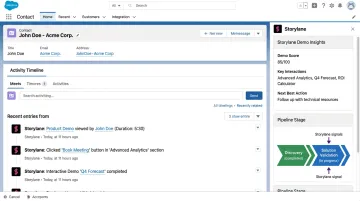
Storylane's integrations with Salesforce, HubSpot, and Marketo make this easier in practice: demo engagement data flows automatically into CRM records, so reps know exactly what a prospect explored before the first call. ContactMonkey used this approach to generate $1.3M in influenced pipeline, with 28% of demo leads converting to opportunities, roughly double the rate of other inbound sources.
A Practical Review Cadence
| Frequency | What to Review | Purpose |
|---|---|---|
| Weekly | Pipeline data | Deal management, rep coaching, forecast updates |
| Monthly/Quarterly | Funnel data | Spot systemic trends, adjust lead gen strategy, recalibrate forecasting |
Used together, they give you two views of the same revenue engine: the pipeline tells you what's happening deal by deal, while the funnel tells you whether your go-to-market motion is working at scale. Fix the funnel to fill the pipeline; manage the pipeline to close what the funnel delivers.
Frequently Asked Questions
Are sales funnel and pipeline the same thing?
They're related but distinct. The pipeline tracks seller actions and deal progression through defined stages. The funnel measures buyer behavior and conversion rates across the purchasing journey. One is about what your team does; the other is about how prospects respond.
What are the 5 stages of the sales funnel?
The typical stages are Awareness, Interest, Consideration, Decision, and (in some models) Loyalty or Advocacy post-purchase. Stage names vary by company and sales methodology, but they always reflect the buyer's mindset, not seller activity.
What is another word for sales pipeline?
Common alternatives include "deal pipeline," "opportunity pipeline," and "sales process." "Pipeline coverage" is a related metric — it measures total active deal value relative to quota. The Bridge Group benchmarks coverage at 5.3x for B2B SaaS.
Which is more important — the pipeline or the funnel?
Neither. They serve different purposes, and relying on only one leaves gaps in your visibility. The pipeline manages what your team does day to day; the funnel reveals how well that activity translates into buyer progression. You need both for accurate forecasting and continuous improvement.
How do the pipeline and funnel work together?
Funnel conversion data diagnoses where pipeline activity needs improvement. When both are tracked in a shared CRM, teams can connect buyer behavior to seller actions. For example, a drop in demo-to-proposal conversion often points directly to slow post-demo follow-up by reps.
What metrics should I track for each?
For the pipeline: deal velocity, average deal size, win rate, and pipeline coverage ratio. For the funnel: stage-to-stage conversion rates, MQL-to-SQL conversion, drop-off points by stage, and lead-to-customer ratio.