Introduction
Sales reps spend 70% of their time on non-selling activities, according to Salesforce's 2024 research — hunting for content, updating CRMs, prepping for calls, and everything except conversations that close deals.
Traditional enablement hasn't fixed this. Static content libraries go stale and periodic training sessions don't stick. Enablement teams supporting hundreds of reps can't manually deliver the right resource to the right rep at the right moment.
AI addresses this by shifting enablement from a "pull" model — where reps search for what they need — to a "push" model, where the right content, context, and coaching surface automatically.
This article covers what AI sales enablement actually is, the five use cases delivering real results, the top tools across each category, and how to evaluate which one fits your team.
Key Takeaways
- AI sales enablement uses machine learning, NLP, and generative AI to equip reps with content, coaching, and buyer intelligence at the right moment — automatically.
- Key use cases include conversation intelligence, just-in-time content delivery, onboarding acceleration, interactive demo automation, and pipeline forecasting.
- Top tools: Gong for call intelligence, Spekit for in-workflow enablement, Mindtickle for coaching, Salesforce Sales Cloud for CRM-native AI, and Storylane for interactive demos.
- Evaluate tools on workflow integration, use-case fit, and CRM compatibility — not feature breadth.
- The right AI stack cuts rep ramp time, surfaces deal risks earlier, and lets sellers spend more time in front of buyers.
What Is AI Sales Enablement?
AI sales enablement uses artificial intelligence — including machine learning, NLP, and generative AI — to improve how sales teams are prepared, coached, and supported throughout the sales cycle.
The core difference from traditional enablement is direction. With traditional enablement, reps hunt for the right battle card or case study when they happen to remember it exists. AI enablement flips that: the right resource surfaces automatically, triggered by deal stage, rep behavior, or buyer signals — without anyone going looking for it.
Why Adoption Is Accelerating
HubSpot's 2024 AI Trends for Sales report found that 43% of sales professionals used AI in their sales process — nearly double the 24% from a year earlier. Salesforce put the number even higher: 81% of sales teams were experimenting with or had fully implemented AI.
The pressure behind those numbers: longer sales cycles, buyers who arrive already informed, and enablement teams stretched thin across large revenue organizations.
Two Dimensions Where AI Adds Value
- Content creation and maintenance — AI generates, updates, and organizes enablement assets faster than any manual process
- Personalized delivery — AI reads CRM signals, deal context, and rep behavior to push the right resource to the right person, in real time
Teams that only automate content creation miss half the opportunity.
Top Use Cases for AI in Sales Enablement
The most effective AI enablement programs address two audiences simultaneously: the rep (internal enablement) and the buyer (external engagement). Here's where the highest-impact use cases live.
AI Coaching and Conversation Intelligence
Most sales managers can coach maybe two to three reps per week with any depth. AI removes that bottleneck.
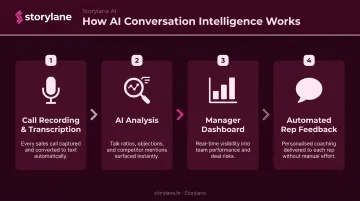
Conversation intelligence platforms record, transcribe, and analyze every sales call — surfacing talk-to-listen ratios, common objections, competitor mentions, and moments where deals stall. Managers get dashboards instead of guesswork. Reps get automated feedback after every call, not just after quarterly reviews.
According to Gong's analysis of more than one million sales opportunities, teams using Gong's AI-powered Smart Trackers for deal execution achieved 35% higher win rates.
AI role-play tools extend coaching beyond call review. Reps can practice objection handling, run through discovery questions, and get scored feedback on their own schedule — without requiring manager time.
Just-in-Time Content Delivery
Content sprawl is a real problem. The average sales team has content scattered across Google Drive, SharePoint, a CMS, and three different Slack channels. Reps either can't find the right asset or grab the last version they remember seeing — which may be outdated.
AI solves this by reading CRM signals and deal context, then surfacing relevant content directly inside the tools reps already use: Salesforce, Gmail, Slack, Outreach. No separate tab. No search required.
The goal is zero-search enablement. In practice, that looks like:
- A battle card surfaces automatically when a competitor comes up in a deal
- A case study loads when a prospect matches a specific persona
- Pricing context appears when a rep opens an opportunity at negotiation stage
Onboarding Acceleration and Continuous Training
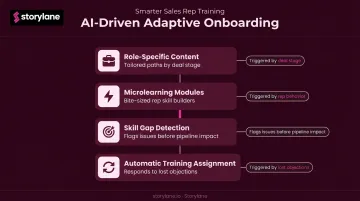
AI replaces static, one-and-done onboarding with adaptive learning paths that respond to what reps actually do in the field. Instead of front-loading everything into week one and hoping it sticks, the system delivers training when and where it's needed:
- Role-specific content served based on deal stage and rep activity
- Microlearning modules triggered by real behavior, not a fixed calendar
- Progress tracking that flags skill gaps before they become pipeline problems
- Automatic training assignments when a team is consistently losing on a specific objection
The impact on ramp time is significant. Mindtickle's 2024 State of Revenue Productivity report found that time required to complete onboarding programs decreased by 62% across their customer base.
Interactive Demo Automation and Buyer Engagement
Most enablement programs focus heavily on rep-side coaching and content delivery. Interactive demo automation addresses the buyer side — and it's where some of the clearest ROI data lives.
AI-powered interactive demo tools let prospects explore a product at their own pace, qualify themselves, and arrive at sales calls already informed. That changes the entire first conversation: instead of explaining what the product does, reps can focus on fit and next steps.
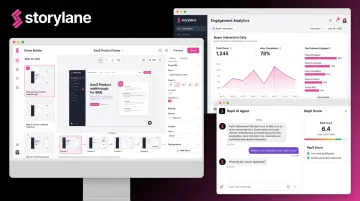
Storylane's RepX takes this further: it's an AI sales agent that engages buyers around the clock, qualifies leads, answers product questions, handles objections, runs product demos, and routes warm prospects directly to the CRM — without requiring a rep at all.
Storylane's Account Reveal feature adds another layer: it de-anonymizes demo visitors with firmographic data, giving sales reps real buyer intelligence before any call happens. When a prospect from a target account spends 12 minutes in a demo exploring a specific feature, the rep knows exactly what to lead with.
The numbers support the approach. Storylane's own research shows that deals involving interactive demo touchpoints closed in 27 days versus 33 days for deals without them — nearly a full week faster per deal.
Pipeline Forecasting and Deal Intelligence
Sales forecast accuracy remains a persistent problem. Clari's 2024 Revenue Leak Report found that 71% of revenue leaders reported incorrect or hidden forecast and pipeline details, and only 37% were fully confident they would meet their targets.
AI forecasting synthesizes deal activity, buyer engagement signals, email response patterns, and historical data to give revenue leaders a clearer picture of what will actually close. More practically, it flags at-risk deals before they slip — prompting a manager coaching touchpoint, suggesting a case study for a stalled opportunity, or recommending a next step based on what's worked in similar deals.
Best AI Sales Enablement Tools
No single tool solves every problem. The right platform depends on whether you're primarily solving for coaching, content management, training, buyer engagement, or forecasting — so here's how the leading options stack up.
Storylane
Storylane is an AI-powered interactive demo platform used by B2B sales and marketing teams — including Gong, Rippling, Nasdaq, SentinelOne, and 5,000+ others — to create, personalize, and deploy product demos that engage buyers before and during the sales cycle.
ContactMonkey generated $1.3M in influenced pipeline from their Storylane demo, with 28% of demo leads converting to opportunities — roughly double their other inbound sources.
Key capabilities that drive those results:
- RepX AI agent acts as a 24/7 sales rep: qualifying leads, answering product questions, running demos, and routing warm prospects to the CRM
- Account Reveal de-anonymizes demo visitors with firmographic data and sends Slack alerts so reps walk into calls with real context (up to 10,000 reveals/month on Premium)
- AI demo creation — video avatars, voiceovers, one-click annotations — builds personalized demos at scale without manual effort
- Demo Hubs serve as buyer deal rooms, organizing all demos in one self-serve or guided journey
| Details | |
|---|---|
| Best For | B2B SaaS teams wanting buyer-facing AI enablement: self-serve demos, 24/7 lead qualification, and pre-call buyer intelligence |
| Pricing | Free plan available; Starter at $50/month; Growth at $625/month; Premium at $1,500/month; Enterprise custom pricing |
Gong
Gong is a revenue intelligence platform that records, transcribes, and analyzes every customer interaction — calls, emails, and meetings — to surface deal risks, coaching opportunities, and winning behaviors across the sales team.
Gong's differentiator is depth of analysis: its AI goes beyond keyword tracking to understand conversational themes and buyer sentiment. Managers get data to coach at scale. Enablement teams get insights to build better playbooks. Revenue leaders get real-time deal health and forecasting signals.
| Details | |
|---|---|
| Key Features | Conversation intelligence, deal forecasting, coaching dashboards, competitive mention tracking, Smart Trackers, rep behavior analytics |
| Best For | Revenue and enablement leaders who want deep post-call analysis and data-driven coaching insights |
| Pricing | Custom, license-based pricing per user plus platform fee; contact Gong for a quote |
Spekit
Spekit is an AI-powered enablement platform that embeds training, process guidance, and content recommendations directly inside the tools reps use daily — Salesforce, Gmail, Slack, Outreach — without requiring them to switch context.
What sets it apart:
- AI Sidekick anticipates rep needs based on CRM signals, deal stage, and behavior — then surfaces the right content or playbook in context
- Intelligent content governance automatically flags outdated materials so reps never act on stale information
- Modular knowledge units (Speks) deliver bite-sized guidance without pulling reps out of their workflow
| Details | |
|---|---|
| Best For | Enablement teams who want just-in-time, embedded enablement with strong content management and governance |
| Pricing | Available on request; contact Spekit for custom pricing |
Mindtickle
Mindtickle is a sales readiness platform focused on structured training, AI-powered coaching, and rep skill development — particularly suited to organizations with formal onboarding requirements or compliance needs.
Agentforce Sales Coach acts as an autonomous coaching agent, using CRM data to deliver personalized rep feedback around the clock. Sales Programs surfaces relevant resources and coaching without switching tools. For teams already on Salesforce, it's the lowest-friction path to AI-powered enablement.
| Details | |
|---|---|
| Key Features | Einstein AI, Agentforce Sales Coach, conversation intelligence, personalized onboarding playlists, pipeline forecasting, Agentforce Engagement for lead nurturing |
| Best For | Teams already on Salesforce who want AI enablement embedded natively in their CRM workflow with minimal additional tooling |
| Pricing | Starter Suite: $25/user/month; Pro Suite: $100; Enterprise: $165; Unlimited: $330; Einstein 1 Sales: $500; Agentforce 1 Sales: $550 (all USD, billed annually) |
How to Choose the Right AI Sales Enablement Tool
The most common mistake teams make is selecting a tool based on feature breadth or demo impressiveness rather than fit with their specific problem. Start with a clear problem statement before evaluating any platform:
- Are reps struggling to find the right content at the right time?
- Is onboarding too slow, leaving new hires ramping for six-plus months?
- Are buyers disengaging before the first sales call?
- Are pipeline forecasts consistently off?
The right tool depends entirely on which of these is your primary bottleneck.
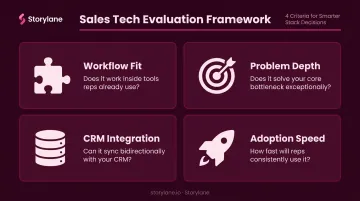
Four Practical Evaluation Criteria
- Fits into existing rep workflows — Does it work inside the tools reps already use, or does it add another tab to manage? Tools reps have to remember to open rarely get adopted.
- Solves your core problem deeply — Does it solve your primary bottleneck exceptionally well, or does it spread coverage across many problems adequately? Depth beats breadth.
- Reads and writes to your CRM — Can it sync bidirectionally to enable contextual AI? Without CRM data, personalization is guesswork.
- Gets adopted fast — How quickly can your team actually start using it? The best tool is the one reps use consistently, not the one with the most features.
Building a Stack vs. Going All-in on One Platform
The most effective AI enablement stacks combine tools by use case:
- A CRM-native platform (Salesforce Sales Cloud) for pipeline intelligence
- A conversation intelligence tool (Gong, Mindtickle) for coaching
- A buyer-facing demo platform (Storylane) for pre-call engagement and 24/7 qualification
Either way, run a structured pilot before full deployment — track new hire ramp time, content adoption rate, win rate, and deal velocity. The faster reps apply a tool in a real deal after using it, the easier it is to measure impact.
Conclusion
AI sales enablement works when it removes friction — giving reps the right information, coaching, and buyer context exactly when they need it, without requiring them to go hunting for it.
Start narrow. Identify the one workflow causing the most friction for your team today, evaluate tools built specifically for that problem, and measure impact before scaling.
One high-impact place to start: buyer enablement before the first conversation. Storylane's AI-powered interactive demos and RepX agent give prospects a hands-on product experience 24/7, while giving reps firmographic intelligence before every call. Try Storylane free or book a demo to see it in action.
Frequently Asked Questions
What is AI sales enablement?
AI sales enablement uses NLP, machine learning, and generative AI to equip reps with the right content, coaching, and buyer insights at the right moment in the sales cycle. It shifts enablement from a static, manually managed function to a dynamic, real-time system that responds to deal context and rep behavior automatically.
What is the best AI agent for sales enablement?
The right choice depends on use case. For coaching and conversation intelligence, Gong and Mindtickle lead the category. For buyer-facing engagement and 24/7 lead qualification without a rep, Storylane's RepX is purpose-built. For CRM-native guidance and coaching inside Salesforce, Agentforce is the natural fit.
What are the most impactful use cases of AI in sales enablement?
The top five: conversation intelligence and AI coaching, just-in-time content delivery inside rep workflows, onboarding acceleration through adaptive learning paths, interactive demo automation for self-qualifying buyers, and AI-powered pipeline forecasting that flags at-risk deals before they slip.
How does AI improve sales coaching?
AI analyzes call recordings at scale to surface coaching moments — objection handling gaps, talk-time imbalances, competitor mentions — and delivers personalized feedback without requiring constant manager involvement. Role-play tools also let reps practice pitches and receive scored feedback on their own schedule.
Will AI replace sales reps or sales enablement teams?
No — it will change these roles. Enablement professionals shift from formatting content to strategy; reps shift from searching to selling. AI handles repetitive tasks; humans handle relationship-building and judgment calls where trust matters.
How do I measure the ROI of AI sales enablement?
Tie activity to specific KPIs: new hire ramp time, content adoption rate, win rate, deal velocity, and forecast accuracy. Cleaner attribution comes from tighter links between tool usage and live deal application. Start with one metric per tool, measure consistently, and expand from there.