According to research cited by Salesforce, 79% of marketing leads never convert into sales. That's not a pipeline problem — it's a prioritization problem.
Predictive lead scoring is the fix. Unlike traditional point-based scoring, which relies on marketers manually assigning values to actions, predictive scoring uses machine learning to analyze historical conversion data and automatically rank leads by their likelihood to buy. The model learns over time, getting sharper with every deal closed or lost.
This article covers what predictive lead scoring is, how it differs from traditional scoring, how it works under the hood, and a practical five-step framework for implementing it.
Key Takeaways
- Predictive lead scoring uses machine learning — not human-defined rules — to rank leads by conversion likelihood
- The model trains on closed/lost deal history and updates automatically as new outcomes come in
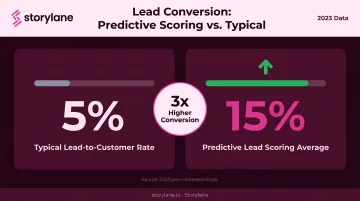
- Predictive scoring systems average 15% conversion vs. 5% for typical lead-to-customer rates, per a 2023 peer-reviewed study
- Product engagement signals — like interactive demo behavior — are among the strongest intent indicators available
- Successful implementation requires clean data, a clear conversion definition, and regular model retraining
What Is Predictive Lead Scoring?
Predictive lead scoring is an approach that uses machine learning to analyze historical customer data and identify patterns that preceded conversions. The model then assigns each open lead a score reflecting their likelihood to buy — no fixed, human-defined rules required.
Unlike traditional scoring, where a marketer decides upfront that "downloaded a whitepaper = 10 points," predictive models derive those weights from actual outcomes in your CRM.
What Inputs It Uses
The model draws on data from multiple sources simultaneously:
- Behavioral data — website visits, email opens and clicks, content downloads, webinar attendance
- Firmographic data — company size, industry, job title, revenue range
- CRM history — past deal cycles, sales activity, stage progression
- Third-party intent signals — research behavior across review sites, content consumption on external platforms
What the Score Represents
Scores typically appear as either a 0–100 numerical value or a tiered ranking (Very High / High / Medium / Low). The number isn't just a label — it maps directly to a recommended action: high scores trigger immediate sales outreach, mid-range scores enter nurture sequences, and low scores stay in awareness campaigns until engagement shifts.
Why the "Predictive" Part Matters
The defining characteristic of predictive scoring isn't just that it processes more data — it's that the model learns from outcomes. Every closed-won and closed-lost deal updates the model's understanding of what actually predicts conversion. A static point system can't do that — it stays frozen until someone manually revises the rules, meaning it's always optimizing for last year's buyer, not today's.
Predictive Lead Scoring vs. Traditional Lead Scoring
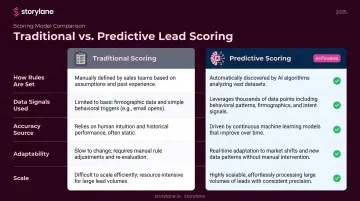
Traditional, point-based scoring works like this: marketers assign fixed values to actions (+5 for an email open, +20 for a pricing page visit), set a handoff threshold, and route leads to sales once they hit that number. It's simple and transparent, but it's also rigid and built entirely on assumptions.
When buyer behavior shifts, the model doesn't shift with it — which is where traditional scoring starts breaking down.
Side-by-Side Comparison
| Dimension | Traditional Scoring | Predictive Scoring |
|---|---|---|
| How rules are set | Manually, by marketers | Derived from actual conversion data |
| Data signals used | A handful of defined triggers | Hundreds of behavioral and firmographic signals |
| Accuracy source | Marketer assumptions | Historical deal outcomes |
| Adaptability | Static until manually updated | Self-updating as new data comes in |
| Scale | Manageable for small lead volumes | Built for high-volume, complex pipelines |
When Each Model Is Appropriate
Traditional scoring works fine for small teams with simple sales cycles and limited historical data — the manual overhead is manageable and the logic is easy to explain to sales.
Predictive scoring becomes necessary when:
- Lead volume grows beyond what manual review can handle
- Sales cycles involve multiple stakeholders and touchpoints
- Buyer behavior varies significantly across segments
- You have enough historical deal data to train a model — Step 3 covers the minimum thresholds
How Does Predictive Lead Scoring Work?
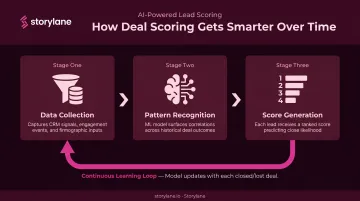
The process runs through three core stages, with a continuous feedback loop that makes each cycle more accurate than the last.
Stage 1: Data Collection
The model ingests data from all available sources — CRM records, marketing automation engagement, website behavior, firmographic enrichment, and any third-party intent feeds. More signals generally means better predictions, but data quality matters as much as volume. Duplicate records, missing fields, and unlogged deal outcomes all degrade prediction accuracy before the model even starts.
Stage 2: Pattern Recognition
Machine learning algorithms analyze closed-won and closed-lost deals to find which combinations of behaviors and attributes most reliably preceded a conversion.
A practical example: a lead who visited the pricing page twice in one week and attended a product webinar may show a statistically higher close rate than a lead who only downloaded a top-of-funnel guide. The model finds these patterns across thousands of historical records — patterns a human would never spot manually.
Stage 3: Score Generation
Each open lead receives a score based on how closely their profile and behavior match the identified conversion patterns. Those scores then drive automated actions:
- High scores → immediate routing to a sales rep with CRM alerts
- Mid-range scores → entry into multi-touch nurture sequences
- Low scores → educational content until engagement signals shift
The Continuous Learning Loop
As new deals close (or don't), the model updates its weightings. What predicted conversion six months ago may shift as market conditions, your ICP, or product positioning evolves. This is why predictive models outperform static rules over time — and why the quality of signals feeding the model matters more as it matures.
The Signal Most Teams Are Missing
As models grow more sophisticated, the limiting factor is often the signals going in — and product engagement data is one of the strongest intent indicators most teams still aren't capturing. How a prospect interacts with a product demo or trial — which features they explored, how long they spent, where they dropped off — tells you far more about readiness than a whitepaper download.
Platforms like Storylane capture this signal directly from interactive demos. When a prospect engages, the platform records:
- Feature-level engagement and time spent per section
- Completion rates and return visits
- Intent classification (Low / Medium / High)
That data pushes to Salesforce or HubSpot automatically, with real-time Slack alerts so reps enter follow-up calls knowing exactly what a prospect cared about. Fed into a predictive model, those signals produce richer, more accurate lead scores than web behavior alone.
Key Benefits of Predictive Lead Scoring
Higher Conversion Rates
A 2023 peer-reviewed literature review found that typical lead-to-customer conversion sits around 5%, while predictive lead scoring systems averaged 15% — a 3x difference. That gap is what reps feel when they stop chasing every lead and focus only on the ones data says are ready.
Stronger Sales and Marketing Alignment
The most persistent friction between sales and marketing comes down to one question: is this lead actually good? Predictive scoring replaces that subjective debate with a shared, data-backed definition of readiness. Both teams work from the same model, which means:
- Clearer accountability at the handoff stage
- Consistent lead quality standards across both functions
- A cleaner, more predictable handoff process
Scalability Without Headcount
As pipeline grows, a predictive model handles the qualification layer automatically. Teams don't need to add manual reviewers to keep up. For B2B SaaS companies experiencing rapid growth, this is the difference between a qualification process that scales and one that becomes a bottleneck.
How to Implement Predictive Lead Scoring: A 5-Step Framework
Step 1: Consolidate and Audit Your Data Sources
Before building anything, identify every data source available:
- CRM records (deal history, stage progressions, lost reasons)
- Marketing automation engagement (email opens, clicks, form fills)
- Website analytics
- Demo engagement signals — tools like Storylane capture which prospects explored specific features, how long they spent in a demo, and where they dropped off, all of which feed directly into scoring models
- Third-party intent data platforms
Then run a data quality audit:
- Remove duplicate records
- Standardize field naming conventions
- Backfill missing firmographic fields
- Verify that closed/lost deal outcomes are accurately logged — these are the training labels the model depends on
Siloed systems and incomplete records don't just reduce accuracy — they skew what the model learns to predict, often in ways that are hard to detect until scores start misleading reps.
Step 2: Define What Conversion Means for Your Business
Before training the model, your team must agree on what "converted" means in your context : a booked demo, a signed contract, an activated trial. This definition shapes the entire training dataset and what the model learns to predict.
If your conversion definition is fuzzy, your scores will be too.
Step 3: Choose the Right Tool and Build the Model
| Tool Type | Examples | Best For |
|---|---|---|
| CRM-native | Salesforce Einstein, HubSpot Predictive, Dynamics 365 | Lower implementation friction; works within existing CRM |
| Standalone AI platforms | 6sense, MadKudu | Broader signal coverage; deeper modeling; requires integration |
Minimum data requirements vary significantly by platform:
- Microsoft Dynamics 365: 40 qualified + 40 disqualified leads
- HubSpot: 50 contacts (25 converted, 25 non-converted)
- Salesforce Einstein: 1,000 leads created in the last 200 days, including 120 converted
A longer historical window generally produces more accurate predictions. If you're below these minimums, start collecting and cleaning data now — don't rush to build the model prematurely.
Step 4: Automate Workflows Around Score Thresholds
Score thresholds should trigger automated actions, not just display numbers:
- High-scoring leads → auto-route to a specific rep with a CRM task and Slack alert
- Mid-range leads → enroll in a multi-touch nurture sequence
- Low-scoring leads → receive educational content; re-evaluated as engagement shifts
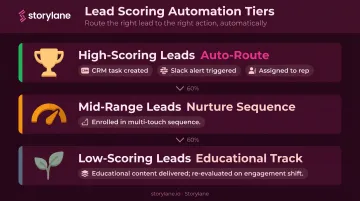
Define clear marketing-to-sales handoff rules at specific score thresholds. Without them, leads arrive prematurely at sales or stall indefinitely in nurture — both outcomes waste the signal the model just gave you.
Step 5: Monitor, Refine, and Retrain Regularly
Review model performance at least every 3–6 months, or whenever something material changes — a new ICP, a product relaunch, a pricing change.
Warning signs the model needs retraining:
- Conversion rates among top-scored leads are declining
- Sales reps are consistently overriding or ignoring scores
- Your ICP, product offering, or go-to-market motion has shifted significantly
Platform-native tools do retrain on their own schedules (Salesforce Einstein reanalyzes lead data every 10 days; Dynamics 365 can retrain every 15 days), but that's a baseline — not a governance process. Regular human review of score-to-outcome alignment is still essential to catch model drift before it erodes rep trust in the system.
Frequently Asked Questions
How does predictive lead scoring work?
Predictive lead scoring uses machine learning to analyze historical data from closed and lost deals, identify patterns linked to conversion, and assign each open lead a score reflecting their likelihood to buy. Scores update automatically as new deal outcomes come in, so the model improves over time without manual intervention.
Which tools provide predictive lead scoring?
Most teams start with native CRM options — Salesforce Einstein Lead Scoring, HubSpot's Likelihood to Close, and Microsoft Dynamics 365 Sales Insights. For larger data volumes or more complex signal requirements, standalone platforms like 6sense and MadKudu offer deeper modeling capabilities.
What's the difference between predictive and traditional lead scoring?
Traditional point-based scoring assigns fixed values to actions based on human assumptions and stays static until someone manually updates the rules. Predictive scoring learns from actual deal outcomes and adjusts scores dynamically, growing more accurate over time rather than drifting further from reality.
How much data do you need to start?
Most platforms recommend at least 40–100 historical qualified and disqualified leads to train an initial model, though requirements vary: HubSpot needs 50 contacts, while Salesforce Einstein requires 1,000 leads with 120 conversions. Data quality matters as much as quantity — clean, complete records outperform large, messy datasets.
How do you measure success?
Track three metrics against pre-implementation benchmarks: conversion rate of high-scored leads, sales cycle length for scored opportunities, and revenue attributed to pipeline sourced through the model. If none are improving within two to three quarters, audit your data inputs and model configuration before concluding the approach isn't working.