This guide covers what makes enterprise sales distinct, how the process works stage by stage, the best practices that separate teams who consistently win enterprise logos from those who stall, and the mistakes that quietly kill deals before they reach legal.
Key Takeaways
- Enterprise sales is a structured, high-touch process for closing complex deals with large organizations — expect months-long cycles, multiple stakeholders, and significant proof requirements
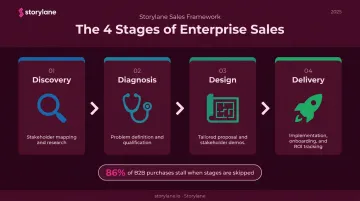
- The process follows four stages: Discovery, Diagnosis, Design, and Delivery — skipping any stage is the most common reason deals stall
- Multi-threading increases win rates by 130% in deals over $50K, per Gong; relying on a single champion is one of the most common ways enterprise deals collapse
- The deal isn't done at signing: post-sale engagement drives renewals, expansions, and referrals that turn one closed-won into a long-term revenue relationship
What Is the Enterprise Sales Process?
Enterprise sales (also called complex sales) is a structured, high-touch approach to selling solutions to large organizations. These are typically companies with 1,000+ employees, significant budgets, and layered decision-making structures.
The goal is a long-term, high-value partnership — one where the solution is customized to fit the buyer's infrastructure, compliance requirements, and business objectives. Salesforce describes enterprise deals as business-critical decisions with complicated implementations and often multiyear contracts.
How Enterprise Differs from SMB and Mid-Market
SMB, mid-market, and enterprise aren't just size labels — they describe fundamentally different buying dynamics. Tactics that close SMB deals routinely stall in enterprise.
| Dimension | SMB | Mid-Market | Enterprise |
|---|---|---|---|
| Decision-makers | 1–2 | 3–5 | 6–13+ |
| Sales cycle | Days to weeks | Weeks to months | 6–18+ months |
| Customization | Minimal | Moderate | Significant |
| Procurement rigor | Low | Medium | High (security, legal, IT review) |
| Implementation complexity | Low | Medium | High |
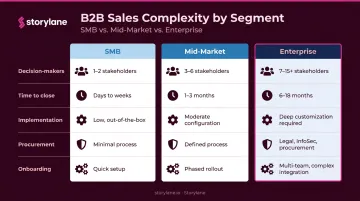
Forrester's 2024 State of Business Buying reports that the average business buying decision now involves 13 people, with 89% of purchases involving two or more departments. For technology purchases, LinkedIn data puts buying teams at 12–14 participants.
Why Enterprise Sales Is Worth the Complexity
The revenue math is the obvious starting point. According to the 2024 KeyBanc Capital Markets and Sapphire Ventures SaaS Survey, enterprise accounts contribute 61% of total ARR on average, compared to just 5% from SMB — meaning the enterprise segment delivered roughly 12x the ARR share.
The initial contract is only the beginning. Enterprise relationships stack value across multiple revenue streams:
- Renewals: Enterprise clients sign multi-year contracts, creating predictable revenue that SMB churn constantly erodes
- Expansion: ChartMogul's 2023 data shows expansion revenue accounts for 39.2% of new revenue for SaaS businesses at higher ARPA tiers — enterprise accounts drive this
- Credibility: Logos like SentinelOne, Gong, or Nasdaq signal that your product meets a high bar for security, scalability, and compliance. TrustRadius research shows 78% of buyers select products they've already heard of before evaluating — recognized logos reduce friction with every new prospect
- Referrals: Enterprise buyers move between large companies, carrying recommendations with them
That's the real case for enterprise sales: the complexity is a feature, not a bug. Every added stakeholder, security review, and procurement cycle exists because the contracts — and the compounding value that follows — are worth it.
The Enterprise Sales Process: Stages and Steps
Enterprise sales feels chaotic until you recognize the pattern underneath it. The process follows four stages — Discovery, Diagnosis, Design, and Delivery — and skipping or rushing any stage is the single most common reason deals stall. Forrester data confirms this: 86% of B2B purchases stall during the buying process.
Unlike transactional sales, each stage requires cross-functional coordination. AEs, solution architects, customer success, and leadership all have a role before the contract is signed.
Stage 1: Discovery
Discovery means deeply researching the prospect's business model, competitive landscape, internal org structure, and current pain points — before and during initial outreach.
Key activities at this stage:
- Map all likely stakeholders: economic buyer, champion, end users, IT, procurement, legal
- Research the company's recent news (funding rounds, leadership changes, product launches)
- Identify the real decision path, not the org chart version
- Qualify budget cycle timing and procurement process early
What goes wrong when this stage is rushed: reps pitch generic value props to the wrong people, miss the actual decision-makers, and spend months building relationships that have no path to a signed contract.
Stage 2: Diagnosis
Diagnosis translates raw pain points into a focused problem statement the buyer recognizes as their own. This is where internal collaboration begins — reps work with product and technical teams to confirm fit and identify gaps.
Enterprise buyers disengage the moment a pitch sounds generic. Specificity earns continued access: name their exact challenges, their current workarounds, and the cost of the status quo.
This stage is also where opportunity qualification happens. If the fit isn't real, exiting here costs weeks — staying in a bad-fit deal costs quarters you won't get back. The cleaner the qualification criteria, the faster the decision.
Strong qualification signals at this stage:
- A named economic buyer who is aware of the evaluation
- A defined problem with measurable business impact
- Budget allocated or actively being sought
- A realistic timeline tied to a business event
Stage 3: Design
Design means crafting a tailored proposal that addresses the prospect's specific technical, security, and operational requirements — and running demonstrations that speak to each stakeholder's distinct priorities.
The challenge: enterprise buying committees rarely convene in one room. Stakeholders review materials asynchronously, on their own schedules, often without the sales rep present. Each role has different priorities:
- CFO: ROI projections and risk reduction
- IT evaluator: Integration depth and security controls
- Department head: Day-to-day workflow fit
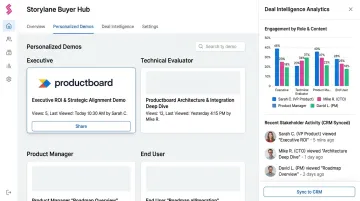
One way teams solve the asynchronous review problem is through interactive demo hubs — a single link that bundles personalized demos, case studies, and pricing, organized by stakeholder role. Storylane's Buyer Hubs let reps do exactly this, with demo tokens that personalize content (prospect name, company, logo, currency) and analytics that surface which sections each stakeholder revisited. Reps walk into the next meeting with actual engagement data rather than guesswork.
Stage 4: Delivery
Delivery covers structured implementation and onboarding: assigning a dedicated customer success manager, running training, tracking adoption metrics, and demonstrating early ROI to reinforce the purchase decision.
Most teams underinvest here. A strong post-sale phase drives renewal, surfaces expansion opportunities, and builds the satisfied relationships that become case studies and referrals. In enterprise sales, closing is the halfway mark — the account's long-term value is determined by what happens next.
Enterprise Sales Best Practices
Define Your ICP Before You Prospect
Qualify your Ideal Customer Profile before investing time in any account. Size, industry, existing tech stack, security requirements, and budget cycle all affect whether a prospect can realistically close. A deal outside your ICP may progress further than it should — and collapse at security review or procurement. Track win rates, sales cycle length, and expansion rates by ICP fit to tighten the definition over time.
Sell Consultatively, Not Transactionally
Enterprise buyers aren't looking for a pitch. They're looking for someone who understands their business better than most of their own internal stakeholders. Center every interaction on their goals. Lead with their problems before your product. That's what earns repeated access to a 13-person buying committee.
Multi-Thread Every Active Opportunity
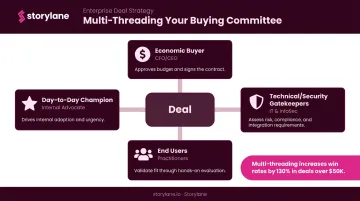
Gong Labs research found that multi-threading — building active relationships at multiple levels of the buying organization — increases win rates by 130% in deals over $50K.
Identify and cultivate:
- The economic buyer (CFO, CEO) who controls budget
- The day-to-day champion who drives internal momentum
- End users who will live with the product
- Technical and security gatekeepers who can veto the deal
Single-threaded deals don't just stall. They collapse entirely when one contact leaves or loses internal credibility.
Standardize with a Sales Playbook
Consistent processes outperform improvised ones. CSO Insights found that organizations using a formal sales enablement approach achieved 55.1% win rates versus 39.2% for ad-hoc approaches. Your playbook should include:
- Discovery question banks by industry and persona
- Common objection responses
- Stakeholder mapping templates
- Clear criteria for advancing or disqualifying an opportunity
Use Demo Engagement Data to Personalize Follow-Up
Sending a generic check-in email after sharing materials is a missed opportunity. Storylane's deal intelligence capabilities push demo engagement data directly into Salesforce and HubSpot: which stakeholder viewed the demo, which sections they spent the most time on, and what they revisited.
Use those signals to personalize follow-up by role and concern. A CFO who spent eight minutes on the ROI section needs a different next step than an IT evaluator who replayed the integration walkthrough twice.
Invest in Post-Sale as Deliberately as Pre-Sale
Closing the deal is the starting line, not the finish. Track adoption, check in proactively before renewals, and watch for expansion signals: new teams onboarding, increased usage volume, new use cases emerging. ChartMogul data shows that expansion revenue accounts for nearly 40% of new revenue at higher ARPA tiers. Enterprise clients that expand are significantly more profitable than net-new logos.
Common Mistakes in Enterprise Sales
Treating it like a volume outreach motion. LinkedIn's 2024 research shows 78% of B2B buyers strongly agree that outreach should be personalized. Enterprise buyers recognize spray-and-pray sequences immediately — and it permanently damages the relationship with that account. Enterprise sales demands fewer, deeper engagements.
Relying on a single champion. If that contact leaves, gets reassigned, or loses internal credibility, six months of deal-building collapses overnight. Multi-threading is the structural defense against that single point of failure. Build relationships across procurement, IT, legal, and the economic buyer from day one.
Pushing enterprise before you're ready. If your product lacks enterprise-grade security certifications (SOC 2, ISO 27001), scalable integrations, or dedicated support SLAs, enterprise procurement will surface objections you can't overcome. If your runway doesn't support 12–18 month sales cycles, targeting mid-market first is the more viable path.
Storylane, for example, is SOC 2 Type II certified and GDPR compliant, built specifically to clear enterprise security reviews rather than get held up by them. Enterprise readiness is a prerequisite, not a default destination.
Frequently Asked Questions
What are the 7 steps of the sales process?
The classic seven steps are: prospecting, preparation, approach, presentation, handling objections, closing, and follow-up. Enterprise sales expands and deepens each step significantly — a single "presentation" in transactional sales stretches into weeks of stakeholder-specific demos, proposal revisions, and security reviews.
What is the 30-60-90 rule in sales?
It refers to a structured ramp plan for new sales hires: the first 30 days focus on learning the product and process, days 31–60 on engaging prospects and building pipeline, and days 61–90 on closing initial deals. The same framework applies to new account planning when entering a strategic account.
How long does the enterprise sales process typically take?
Enterprise sales cycles commonly span multiple quarters. SaaStr suggests deals above $500K ACV can take 6 to 18+ months, particularly when tied to annual budgeting cycles and multi-department procurement processes.
How is enterprise sales different from SMB sales?
Enterprise deals involve buying committees of 6–13+ people, require customized solutions and security reviews, and take months to close. SMB deals often involve a single decision-maker, minimal customization, and close in days or weeks with far less procurement friction.
What tools do enterprise sales teams need?
The core stack includes:
- CRM (Salesforce, HubSpot) for pipeline management
- Sales engagement platform for multi-touch outreach
- Revenue intelligence tool for forecasting and call insights
- Interactive demo platform like Storylane, so buying committee members can explore personalized demos asynchronously, with engagement data flowing back to the rep in real time