Introduction
Most sales demos don't fail because the product is weak. They fail because reps treat the call as a feature tour rather than a targeted conversation built around the prospect's specific problems.
Gong's analysis of over 3 million product demos found that top-performing reps spend 39% less time talking about features, while buyers ask 28% more questions in those same calls. The pattern is clear: less pitch, more dialogue.
Gartner also reports that 67% of B2B buyers now prefer a rep-free buying experience. When a prospect does agree to a live call, the bar for that conversation is higher than ever.
This guide covers the sales demo best practices that top-performing reps use, from pre-call preparation to post-demo follow-up, to consistently move deals forward.
Key Takeaways
- Great demos are built on discovery: know the prospect's top 2-3 problems before you open a single slide
- Send a personalized interactive pre-demo before the live call — prospects who explore your product early engage more during the call
- Lead with the prospect's pain and use stories with real outcomes — uninterrupted pitching loses attention fast
- Close every demo with a specific next step agreed upon before hanging up
- Follow up with engagement intelligence — prioritize prospects based on what they actually viewed
What Makes a Great Sales Demo?
The difference between a product demo and a sales demo comes down to intent. A product demo shows what the software does. A sales demo answers a much narrower question: does this solve the problem this specific person is facing right now?
Three things separate demos that close from demos that end with "we'll be in touch":
- Thorough preparation — you've done the research before the call, not during it
- A clear purpose — you know exactly what action you want the prospect to take by the end
- Genuine two-way interaction — the prospect talks, not just you
What the Data Says About Demo Quality
Gong's analysis of 67,149 sales demo calls found that successful demos averaged 47 minutes versus 36 minutes for unsuccessful ones — and had 21% more speaker switches per minute. The single most striking finding: no closed-won demo in the entire dataset had more than 76 seconds of uninterrupted pitching.
Buyers tune out when demos become monologues. The reps who win treat demos as diagnostic conversations, not presentations.
The use-case data tells a similar story. Winning demos highlighted an average of 1.6 business use cases versus 1.2 in losing demos. The gap looks small, but the pattern is consistent: winning reps go deeper on fewer, more relevant scenarios rather than racing through every capability.
Show less. Go deeper. Get the prospect talking.
Before the Demo: How to Prepare and Personalize
Research the Prospect Before You Touch the Slides
Shallow prep produces generic demos. Before any call, go beyond the prospect's website:
- Review their LinkedIn activity and recent company news
- Check job postings (they reveal strategic priorities)
- Look at press releases for funding, expansion, or product announcements
- Understand what the specific person you're meeting cares about — a VP of Sales and a CTO have entirely different problems
The goal isn't to recite their company back to them. It's to show up already understanding their context so the conversation can go somewhere useful.
Run Discovery Before the Demo — Always
A demo should confirm a diagnosis, not start one. If you're opening the call still trying to understand the prospect's pain, you've already lost ground.
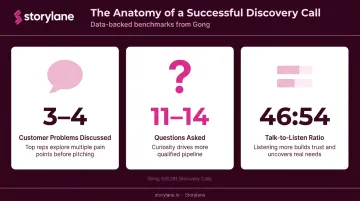
Gong's analysis of 519,291 discovery conversations found that successful discovery calls discuss 3 to 4 customer problems, ask 11 to 14 questions, and maintain a 46:54 talk-to-listen ratio. That balance matters. Reps who dominate discovery calls miss the inputs that make demos relevant.
After discovery, summarize the top 2-3 pain points and build the entire demo narrative around resolving those — nothing else.
Set a Clear Agenda in Advance
Send a structured agenda at least 24-48 hours before the demo. A simple time block works well:
- 5 min — intro and pain recap
- 15 min — focused demo (relevant features only)
- 10 min — Q&A
- 5 min — next steps
Sharing it in advance does two things: it lets prospects flag missing priorities before the call, and it signals that their time is being respected.
Warm Up Prospects With a Pre-Demo Experience
Respecting the prospect's time doesn't stop at the agenda. Sending a personalized, self-serve interactive demo before the live call means prospects arrive already familiar with the product — ready for a deeper conversation, not a first introduction.
Storylane handles this through demo tokens: variable elements that let reps insert the prospect's name, company, industry, logo, and relevant use cases directly into the demo in seconds. Reps typically use two formats for this:
- Screenshot demos: fast to build, ideal for product overviews before a discovery call
- HTML demos: pixel-perfect replicas of your product UI that let prospects explore hands-on without a sign-up
Once a prospect opens the pre-demo, Storylane sends Slack and email alerts so the rep knows who engaged, when, and with what — before the call even starts. Campminder used this approach to cut their sales cycle from 6 weeks to as little as 2 weeks.
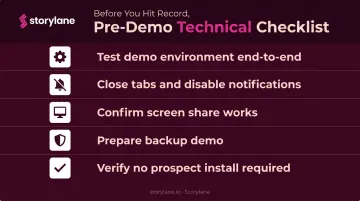
Technical Prep Checklist
- Test the demo environment end-to-end the day before
- Close all unnecessary tabs and disable notifications
- Confirm screen share works before the prospect joins
- Have a backup demo ready if the live environment fails
- Verify the prospect doesn't need to install anything
During the Demo: Best Practices to Engage and Convert
Lead With Their Pain, Not Your Product
Open by recapping the prospect's specific challenges — not a company history slide. Something as simple as: "Based on our last conversation, the three things you're most focused on are X, Y, and Z — does that still hold?" reengages the prospect immediately and confirms you built this call for them.
Starting with their problem frames your product as the answer to their specific situation — not a generic solution looking for a problem.
Sell With Stories, Not Feature Dumps
The most effective demo structure positions the prospect as the hero — their pain is the obstacle, your product is the tool that helps them overcome it.
Instead of: "Here's our workflow automation feature."
Try: "A [similar company in their industry] was spending 8 hours a week manually reconciling data. Here's exactly how they solved it — and what their workflow looks like now."
Specific outcomes make the value feel real. A recognizable customer name or industry-relevant story helps prospects immediately connect what they're seeing to their own situation.
Make It Interactive, Not a Monologue
Recall the 76-second rule. Pause frequently. Ask open-ended questions mid-demo:
- "Does this match how your team currently handles X?"
- "Is this the part that would affect your ops team, or more your finance team?"
Where possible, let the prospect interact with the product directly. Storylane's Presenter Mode is built for this — reps guide prospects through a live, click-through experience while presenter notes stay visible only to them. Hands-on interaction builds a sense of ownership that passive watching can't replicate.
Handle Objections During the Demo, Not After
Common objections — pricing sensitivity, implementation complexity, security requirements — shouldn't be saved for Q&A. Weave responses into the relevant section of the demo naturally:
- Showing the reporting module? Work in the ROI angle
- Walking through data handling? Address compliance proactively
- Covering onboarding or setup? Acknowledge implementation concerns before they're raised
A dedicated 10-15 minute Q&A block should still be in the agenda so prospects come prepared with questions. If you don't know the answer to something, say so directly. Guessing erodes trust faster than admitting uncertainty.
Close Every Demo With a Specific Next Step
"I'll follow up soon" is not a next step. Before the call ends, secure a concrete commitment:
"Can we schedule a 30-minute call with your IT lead on Thursday?"
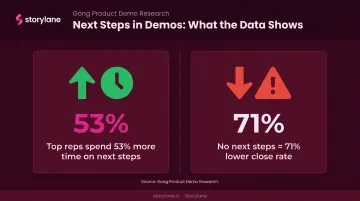
Gong's product demo research found that top reps spend 53% more time discussing next steps at the end of demos — and that failing to discuss next steps on the first call correlates with a 71% lower close rate.
Connect the next step to the prospect's stated urgency: "You mentioned needing this live by Q3 — if we start a pilot next week, that's achievable." That framing makes the urgency real without manufactured pressure.
After the Demo: How to Follow Up and Close
Send a Follow-Up That Recaps the Conversation
The follow-up email sent within 24 hours of the demo is not a formality. It's a critical touchpoint. It should include:
- The specific pain points discussed
- Which features were shown and why they're relevant to those pains
- The agreed-upon next step with a concrete date or action
A generic "great meeting!" email signals the rep wasn't paying attention. A specific, personalized recap tells the buyer their problem was actually heard — and that the rep is worth continuing the conversation with.
That specificity becomes sharper when it's backed by data on how the prospect actually engaged after the call.
Use Engagement Data to Prioritize Outreach
If you shared a Storylane interactive demo before or after the call, you already know which sections the prospect spent the most time on, where they dropped off, and what they revisited. Open the follow-up email with that context:
"I noticed you spent time on [specific module] — here's a related case study from a company with a similar setup."
Storylane surfaces this engagement data so reps act on real buyer signals, not hunches:
- Slack alerts notify reps the moment a prospect re-engages
- Email notifications flag drop-off points and revisited sections
- Direct CRM sync with Salesforce and HubSpot keeps pipeline data current
Build a Multi-Touch Follow-Up Sequence
A single follow-up email rarely moves a deal. Consider a sequence that includes:
- Recap email — personalized summary with confirmed next step
- Case study email — one relevant customer story tied to their specific use case
- Leave-behind demo — a short interactive demo focused on the 1-2 features that got the most attention
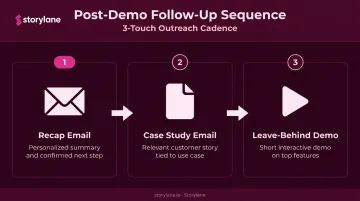
Storylane supports building these leave-behinds as standalone shareable demos with personalized tokens for company name and logo. When a prospect opens one, the rep gets a Slack notification in real time, turning follow-up timing into a deliberate decision rather than a calendar guess.
Common Sales Demo Mistakes to Avoid
The Feature Dump
Spending most of the demo walking through every capability overwhelms prospects and buries the key message. Gong's data is clear: top sellers spend 39% less time on features, and buyers ask 28% more questions in those demos. Show less. Go deeper on what matters.
Skipping Discovery
A demo without discovery is a generic pitch. For complex B2B deals, running the same demo for every prospect regardless of role, industry, or company stage signals to the buyer that the rep wasn't listening. Tailored demos close deals. Generic ones just fill calendar time.
Ignoring Live Buying Signals
If a prospect asks the same question twice, lingers on a specific feature, or leans in during a particular section, that's a signal to go deeper, not stay on script. Rigid adherence to a pre-planned flow at the expense of real-time signals is how reps miss closes they could have had.
Frequently Asked Questions
What is the 3-3-3 rule in sales?
The 3-3-3 rule is a multi-touch outreach framework focused on reaching prospects across multiple channels and touchpoints. Applied to post-demo follow-up, the principle holds: multi-touch sequences consistently outperform single emails at keeping deals moving.
What is the 2-2-2 rule in sales?
The 2-2-2 rule, originally outlined by Mark Hunter, suggests following up 2 days after a meeting, 2 weeks later, and 2 months later if no response. The timing should flex based on the prospect's stated decision timeline rather than followed rigidly.
How long should a sales demo be?
Gong's data puts successful B2B demos at an average of 47 minutes, with roughly 15-20 minutes for focused product demonstration, time for discovery recap, and a Q&A block. Length isn't what kills demos — covering irrelevant features is. Spend more time on what the prospect actually cares about.
What's the difference between a product demo and a sales demo?
A product demo is a general feature walkthrough used in marketing or onboarding. A sales demo is a targeted, prospect-specific conversation designed to connect product capabilities directly to a buyer's pain points and drive a purchasing decision.
How do you handle objections during a sales demo?
Anticipate common objections — pricing, implementation, security — and address them proactively within the relevant section of the demo. For unexpected objections, acknowledge them directly, offer to follow up with specifics, and never bluff an answer.
How do you measure if a sales demo was successful?
A successful demo ends with a specific next step agreed upon before the call closes. Beyond that, watch for engagement signals: questions asked, time spent on key features in a follow-up interactive demo, and whether the prospect pulls in additional stakeholders. These indicate real deal momentum.